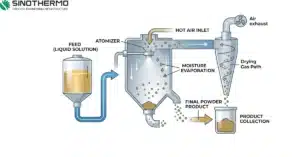
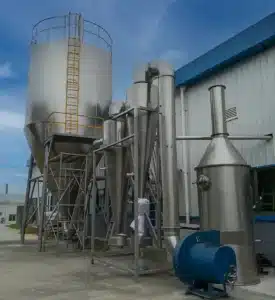
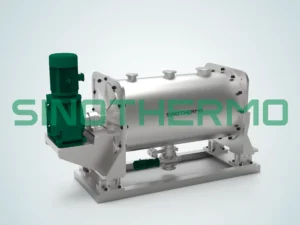
A spray dryer machine converts a liquid — a solution, suspension, or emulsion — into a dry, free-flowing powder in a single continuous step, by atomizing the feed into millions of fine droplets and drying them almost instantly in a stream of hot air. For process, procurement, and R&D engineers, the hard part is not understanding the principle — it is matching the right machine type, scale, and configuration to a specific feed so the powder meets spec and the quote is firm. This buyer’s guide walks through the four main machine types, the three scales, the real price drivers, and a six-step selection logic. For the underlying physics, see How Does Spray Drying Work; for how spray drying sits alongside other technologies, see How to Choose the Right Industrial Dryer.
The 4 types of spray dryer machine
The single most important design decision is how the feed is atomized and how the powder is finished. That choice defines particle size, bulk density, throughput, and how gently the product is treated. Four architectures cover the overwhelming majority of overseas process applications.
1. Centrifugal / rotary spray dryer. A high-speed spinning disc flings the feed outward into a fine, uniform droplet cloud. Because atomization is driven by disc speed rather than feed pressure, a rotary atomizer is remarkably robust to variation in feed viscosity and solids content — it keeps producing consistent fine powder even when the slurry drifts. This is the workhorse for fine, uniform powders such as milk powder, ceramics, and catalysts. In the SINOTHERMO range this maps to the LPG-series Sécheur par atomisation centrifuge.
2. Pressure-nozzle spray dryer. A high-pressure pump forces feed through a fine nozzle orifice, producing coarser, denser, more free-flowing granules. Pressure-nozzle towers tend to run tall and narrow, and they integrate cooling or fluid-bed sections cleanly, making them a strong fit where granule size and flowability matter more than ultra-fine particles. This is the YPG-series Sécheur par pulvérisation sous pression.
3. Two-stage / extract spray dryer. A nozzle atomizer is paired with an integrated fluid bed at the base of the tower. The first stage removes most of the moisture; the second stage completes drying at a lower temperature and agglomerates fines into a dust-free, instant-dissolving powder. The result is higher throughput, gentler treatment of heat-sensitive botanicals and extracts, and better powder handling. This is the ZLPG-series Sécheur par pulvérisation à extraction.
4. Closed-circulation spray dryer. When the feed is dissolved in an organic solvent — or is flammable, explosive, oxygen-sensitive, or toxic — an open-cycle tower that vents to atmosphere is unsafe and wasteful. A closed-circulation spray dryer runs on an inert gas (typically nitrogen) in a sealed loop: the drying gas is condensed to recover the solvent, then reheated and recirculated. This is the route for solvent-based pharmaceutical, catalyst, and specialty-chemical feeds that demand oxygen exclusion and full solvent recovery. This is the GXP-series Sécheur par pulvérisation à circulation fermée.
| Taper | Atomizer | Powder character | Best for |
|---|---|---|---|
| Centrifugal / rotary (LPG) | Spinning disc | Fine, uniform; tolerates feed variation | Milk, ceramics, catalysts |
| Pressure nozzle (YPG) | High-pressure nozzle | Coarser, dense, free-flowing granules | Coarse granules, dense powders |
| Two-stage / extract (ZLPG) | Nozzle + fluid bed | Agglomerated, dust-free, instant | Heat-sensitive extracts, high throughput |
| Closed circulation (GXP) | Nozzle / disc, inert loop | Powder dried under inert gas, solvent recovered | Organic-solvent, flammable or oxygen-sensitive feeds |
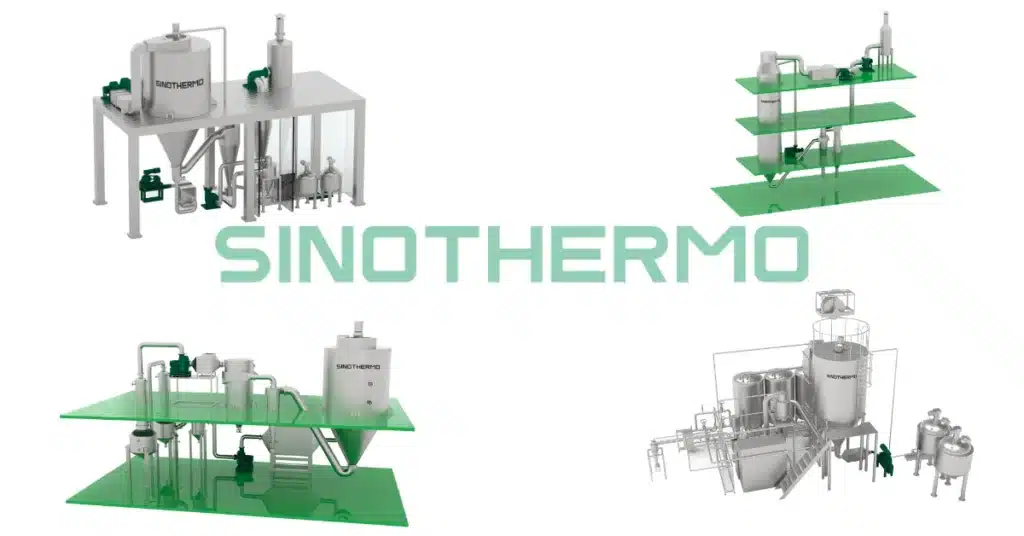
Choosing scale: lab, pilot, and industrial spray dryers
A spray dryer machine is bought at one of three scales, and confusing them is a common way to waste budget.
Lab spray dryer. Bench-top units process grams to a few kilograms per hour and exist to answer feasibility questions during R&D and formulation. They tell you whether a material can be spray dried at all and roughly what powder to expect — but their heat-transfer geometry does not scale linearly, so lab data alone is not a production spec.
Pilot spray dryer. Pilot-scale machines exist to confirm parameters and product quality under conditions that genuinely transfer to production: inlet/outlet temperature, atomizer speed or nozzle pressure, feed concentration, and residence time. A pilot run turns “it probably works” into a defensible process recipe and a firm capacity figure.
Industrial spray dryer. Continuous production machines sized to a required tonnage, with the collection train, heating source, and automation to run around the clock. Sizing is driven by evaporation capacity — kilograms of water removed per hour — not by tower dimensions.
SINOTHERMO supplies all three scales and, crucially, runs pilot trials in its own laboratory so that pilot-proven parameters carry straight into the industrial build. SINOTHERMO — Process Engineering Infrastructure. With 20+ years of experience, the pilot lab is where the promise “bring your material, trial it before you specify” becomes a signed configuration — we solve the process problem, not just sell a machine.
What drives spray dryer machine price?
There is no single “spray dryer price” because the machine is configured to the application. Understanding the drivers lets you read a quote and control cost.
- Evaporation capacity (kg water/hr) — by far the biggest lever. It sets tower size, air handling, and heater duty, and it scales the whole machine.
- Materials of construction — carbon steel is cheapest; 304 stainless is standard for food; 316L with sanitary polished finishes is required for pharma and pushes cost up substantially.
- Atomizer type — a high-speed rotary atomizer and a high-pressure nozzle system carry different capital and maintenance profiles.
- Heating source — steam, electric, natural gas, or thermal oil, chosen against your site utilities and running-cost target.
- Add-ons — cyclone plus bag filter, a fluid-bed second stage, CIP (clean-in-place), explosion protection, and PLC/automation each add capability and cost.
- Compliance standards — CE, GMP, and ATEX documentation and hardware raise the price but are non-negotiable in regulated markets.
SINOTHERMO quotes per application after confirming feed, capacity, and standards — a pilot test is the fastest route to a firm specification and price, because it removes the guesswork that otherwise forces vendors to pad their numbers.
How to choose a spray dryer machine — 6 steps
- Define the feed — solids content, viscosity, heat sensitivity, and whether the solvent is aqueous or organic. Organic solvents force a closed-cycle inert-gas design.
- Set the target powder spec — particle size, bulk density, residual moisture, and flowability. This is what the machine is ultimately designed to hit.
- Pick the atomizer — centrifugal for fine, uniform powder tolerant of feed variation; pressure nozzle for coarser, free-flowing granules.
- Choose the scale — lab and pilot for development; industrial sized to production tonnage via evaporation capacity.
- Add compliance and options — GMP/CE/ATEX, CIP, second-stage fluid bed, and heat recovery, matched to your market and utilities.
- Validate with a pilot test — confirm the recipe on your actual feed before you commit capital.
For where a fluid-bed second stage or standalone fluid bed fits, see Fluid Bed Dryer Guide.
Common mistakes to avoid
- Sizing by tower dimensions instead of evaporation capacity. Two towers of the same height can have very different water-removal rates. Always specify kg water/hr.
- Scaling straight from lab to production. Lab geometry does not transfer linearly; skipping the pilot stage is how projects miss powder spec after commissioning.
- Under-specifying materials or explosion protection. Retrofitting 316L finishes or ATEX hardware after the fact costs far more than building them in. Confirm solvent and dust-explosion class up front.
- Ignoring the collection train. Cyclone and bag-filter selection determine yield and emissions; treating them as an afterthought loses fine product and can fail dust limits.
- Comparing quotes without aligned assumptions. A cheaper number often hides a smaller capacity, thinner steel, or omitted CIP. Normalize the scope before comparing.
Conclusion
Ready to spec a spray dryer machine? The fastest, lowest-risk path is a pilot test: bring your feed, and SINOTHERMO’s pilot lab returns a firm configuration and a quote you can trust — not a guess.
✉️ mark.gu@sinothermo.com · 📱 WhatsApp: +86 180 2197 2660 · 🌐 www.sinothermo.com
SINOTHERMO — Process Engineering Infrastructure.
FAQ
What is a spray dryer machine?
A spray dryer machine turns a liquid into a dry powder in one continuous step by atomizing the feed into fine droplets and drying them in hot air within seconds. It makes products such as milk powder, instant coffee, catalysts, ceramics, and pharmaceutical powders.
How much does a spray dryer machine cost?
Price is driven mainly by evaporation capacity (kg water/hr), plus materials of construction (304 vs 316L), atomizer type, heating source, and options such as GMP, CIP, and explosion protection. Because the machine is configured to the application, SINOTHERMO quotes per project after confirming feed, capacity, and standards.
Centrifugal vs pressure-nozzle spray dryer — what’s the difference?
A centrifugal (rotary) machine uses a spinning disc to make fine, uniform powder and tolerates feed variation well. A pressure-nozzle machine forces feed through a nozzle to make coarser, free-flowing granules and integrates cooling or a second stage cleanly.
Can a spray dryer scale from lab to production?
Yes. Lab units prove feasibility, pilot units lock in the process recipe and capacity, and industrial units run continuous production. Running pilot trials in-house lets SINOTHERMO transfer pilot-proven parameters directly into the full-scale machine.
Which spray dryer is best for heat-sensitive extracts?
A two-stage / extract (ZLPG) machine, which pairs a nozzle with an integrated fluid bed to finish drying at lower temperature, agglomerate fines, and protect botanicals and other heat-sensitive actives.
Which spray dryer should I use for organic-solvent or flammable feeds?
CoA closed-circulation (GXP) spray dryer. It runs an inert gas such as nitrogen in a sealed loop and condenses the drying gas to recover the solvent, so it safely handles flammable, explosive, oxygen-sensitive, or toxic solvent-based feeds while reclaiming the solvent.
What’s the fastest way to get a firm spray dryer quote?
Send your feed for a pilot test. Trialing the actual material removes the unknowns that otherwise force padded estimates, so the resulting configuration and price are firm.