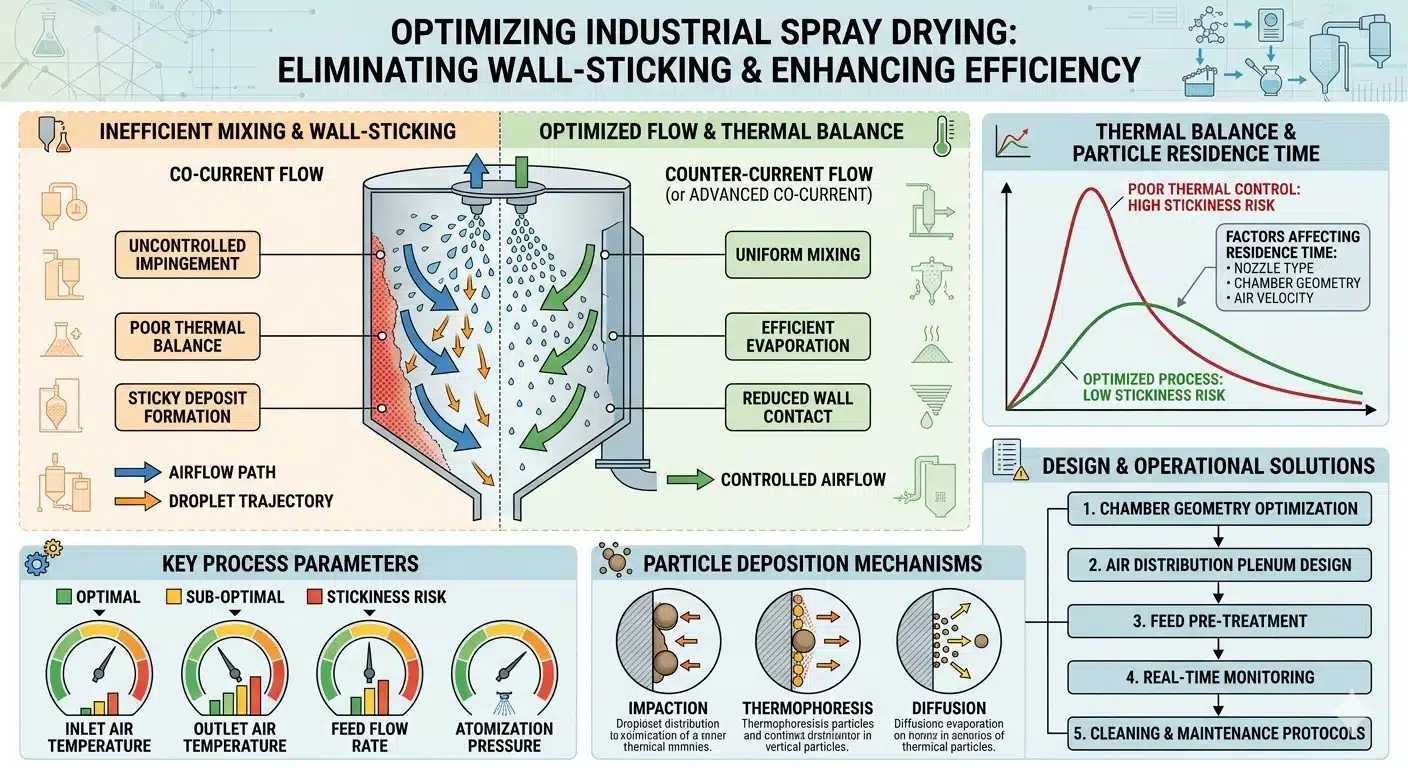
Spray drying process optimization is critical for industrial manufacturers seeking to eliminate wall-sticking problems and improve product yield. The spray drying process remains one of the most challenging operations in industrial manufacturing. However, the “wall-sticking” crisis—where semi-wet or thermoplastic particles adhere to the internal surfaces of the drying chamber—remains a primary bottleneck for spray drying equipment operational efficiency, resulting in yield loss, product degradation, and safety hazards like localized scorching. Solving this challenge requires a sophisticated engineering approach that balances the thermodynamics of the Glass Transition Temperature (TgT_g) with optimized airflow dynamics. At SINOTHERMO, we address these complexities through the integration of jacketed cooling systems to maintain wall temperatures below the “sticky point” (Tsticky≈Tg+20∘CT_{\text{sticky}} \approx T_g + 20^\circ \text{C}) and rotating air broom technology to continuously remediate fine powder accumulation. By synchronizing tower geometry, surface metallurgy, and dynamic thermal tuning, industrial operators can achieve continuous production cycles even with highly viscous or heat-sensitive materials such as pharmaceutical extracts and lithium-ion battery precursors.
The Thermodynamic Foundation: Glass Transition Temperature in Spray Drying Process Optimization
What is Tg? The Critical Threshold for Spray Drying Stability
スプレードライ工程の最適化において、液滴が安定した粉末粒子へと変化するプロセスは、溶媒の急速な除去によって支配されます。液滴が安定した粉末粒子へと変化する過程は、高温の気流中で水やNMPのような有機溶媒を急速に除去することによって制御されます。このプロセスは単なる状態変化ではなく、材料固有の粘着性との競争でもあります。食品・医薬品業界でスプレードライ製品の大部分を占める非晶質材料にとって、ガラス転移温度(TgT_g)は安定性を左右する重要なしきい値となります。乾燥中の粒子温度がこのTgT_gを超えると、材料は脆いガラス状態から粘性の高いゴム状態へと変化します。このゴム状態にある間、粒子表面は粘着性を帯び、接触した際にチャンバー壁や他の粒子に付着しやすくなります。
High-Risk Materials: Why Fructose, Glucose, and Citric Acid Stick in Spray Dryers
Research into sugar-rich foods in spray drying applications, such as fruit juices, highlights the severity of this spray drying challenge. Components like fructose and glucose have TgT_g values as low as 14°C and 31°C, respectively. When these materials are processed, the operating environment must be meticulously controlled to ensure the particle surface temperature remains below the sticky point, which is typically 10°C to 20°C above theTgT_g. If the thermal balance is disrupted, a catastrophic “meltdown” occurs on the tower walls, leading to a build-up that insulates the surface, further increasing localized temperatures and causing product browning or burning.
| 材料成分 | ガラス転移温度 (Tg) | 粘着点温度 (Tsticky) | リスクレベル |
| フルクトース | 14°C | 24- | 極めて高い |
| グルコース | 31°C | 41- | 高い |
| クエン酸 | 16°C | 26- | 極めて高い |
| マルトデキストリン (DE5) | 188°C | 198- | 低い(乾燥助剤) |
| 医薬品API | 可変 (40-) | Tg+ | 中~高 |
エンジニアリングソリューション:材料科学を超えたスプレードライヤーの設計
While materials science offers solutions like adding high-molecular-weight additives (e.g., maltodextrin) to raise the TgT_g of the feed, engineering-level solutions focus on managing the interaction between the particles and the dryer’s internal environment. The question then becomes: how can equipment design proactively prevent this thermodynamic failure?
Structural Fixes: Tower Geometry and Atomization Trajectory in Industrial Spray Dryers
スプレードライヤーの性能を最適化する塔高/直径(H/D)比
The physical architecture of the spray drying tower is the first line of defense against wall deposition. A mismatch between the atomizer’s spray pattern and the tower’s height-to-diameter (H/D) ratio is a frequent cause of chronic sticking. In centrifugal atomization systems, such as those featured in SINOTHERMO’s LPG-series, the liquid is propelled horizontally at high velocities. If the tower diameter is insufficient to accommodate the “mist distance”—the distance required for the droplet surface to dry and lose its initial kinetic energy—the droplets will inevitably strike the wall in a semi-wet state.Observations in high-capacity lithium slurry mixing suggest that for centrifugal atomizers, a larger tower diameter is often more beneficial than excessive height. Typical industrial dryers utilize H/D ratios between 3:1 and 5:1, but for heat-sensitive materials that are prone to sticking, “short-path” dryers with a 1:1 to 2:1 ratio are sometimes preferred to reduce the probability of wall contact. Furthermore, the cone angle at the bottom of the tower, usually set at 60°C, must be optimized to ensure that the dried powder slides effectively toward the discharge valve.
| Parameter | Impact on Wall Sticking | Recommended Strategy |
| Tower Diameter | Dictates mist distance and horizontal impact | Increase diameter for centrifugal atomization |
| Tower Height | Influences residence time and moisture removal | Match height to drying rate of slow-drying materials |
| Cone Angle | Controls gravity-assisted powder discharge | Standard 60°C; steeper for cohesive powders |
| Air Flow Pattern | Determines particle-gas contact and trajectory | Use air distributors to maintain center-flow |
壁面処理:スプレードライヤータワーの研磨とPTFEコーティング
形状だけでなく、内壁の金属表面処理も付着現象を左右する重要な要素です。表面が粗いと微粒子にとって「アンカーポイント」となり、ファンデルワールス力や静電気力によって粒子が蓄積しやすくなります。SINOTHERMOでは厳格な研磨処理プロトコルを実施し、医薬品・食品グレードのタワーにおいてRa≤0.4 μmRa \leq 0.4\,\mu mという表面平滑度を実現しています。特に付着しやすい難処理材料に対しては、ポリテトラフルオロエチレン(PTFE)などの非粘着コーティングを適用することで、低エネルギー表面を形成し、安定した結合の形成を防ぎ、粉末の付着を低減できます。
Thermal Barriers: Jacketed Cooling Systems for Spray Drying Process OptimizationThe Double-Wall Design: How Jacketed Cooling Technology Works in Spray Dryers
熱可塑性材料——乾燥に必要な温度で軟化または溶融する材料——を扱う場合、標準的な断熱では不十分です。従来型の乾燥機では、塔壁の温度が出口空気温度(多くの場合80°Cから100°C)と急速に平衡状態になります。TgTgが40°Cのエキスの場合、この温度では壁面は常に「粘着ゾーン」にとどまってしまいます。SINOTHERMO ZLPG-seriesは、ジャケット冷却技術によってこの課題に対応します。二重壁構造のチャンバーを設け、ジャケット内に周囲空気または冷却空気を循環させることで、内壁温度を50°C以下に維持できます。これにより熱バリアが形成され、中心気流から外れて壁面に接触した粒子も即座に冷却されます。この局所的な温度低下により、材料はゴム状態からガラス状態へと戻り、壁面への付着を防止します。
区画分割冷却戦略:ジャケット式装置における結露リスクの管理
ジャケット式システムの設計には、微妙なバランスが求められます。壁面温度が湿った排気の露点以下に下がると、結露が発生し、「濡れによる」付着を引き起こします。そのため、冷却システムは区分化する必要があり、空気温度が高い上部シリンダーではより強力な冷却を行い、湿度が高い下部コーン部では中程度の冷却を行うのが一般的です。
The Air Broom and Kinetic Remediation Technology in Industrial Spray Dryers
回転エアブラシの仕組み:機械式クリーニングソリューション
最適化された形状や断熱対策を施していても、壁面付近の緩やかな空気境膜に捕捉されやすい極微細な「ファイン(微粉)」の蓄積というリスクは依然として残ります。時間の経過とともに、これらのファインは絶縁層のような薄い層を形成し、最終的には局所的な過熱や製品の焦げ付きを引き起こす可能性があります。「エアブルーム」または「エアスイープ」装置は、この課題に対する機械的な解決策です。このシステムは、タワー内周に沿って動く高圧ノズルを一列に配置した回転アームで構成されています。SINOTHERMOでは、このシステムに圧縮空気(通常6〜8bar)を用いて高速の気流カーテンを生成し、壁面を「掃き清める」ようにしています。
重要な利点:連続洗浄とリアルタイム性能
エアブルームには、以下のような重要な利点があります。
- 1.連続クリーニング:プロセスを停止することなく、リアルタイムで粉末を除去します。
- 2.エアカーテンの形成:導入される二次空気が下方に流れる気流膜を形成し、粒子をタワー中心部に留める働きをします。
- 3.放熱効果:この払い落とし用の空気が壁面に最終的な局所冷却効果をもたらします。
PLC統合:材料特性に基づく動的システム制御
大規模な工業運転では、エアブルームを乾燥機のPLCと同期させ、材料固有の付着率に基づいてバースト時間と回転速度を調整する必要があります。この動的な清掃方式により、数日から数週間に及ぶ生産サイクルの間、塔内を清潔な状態に保つことができます。
結論:スプレー乾燥プロセス最適化における効率のためのエンジニアリングリチウムスラリーの課題:摩耗、粘度、バインダーマイグレーション
新エネルギー業界、特にリン酸鉄リチウム(LFP)およびニッケルコバルトマンガン(NCM)正極材料の製造は、スプレードライ技術にとって最も要求の厳しい用途の一つとなっています。これらのスラリーは研磨性が高く、粘度が高い上、乾燥プロセス中のバインダーの移行現象に対して敏感です。
バインダーマイグレーション問題:連続バッチにおいて収率低下が発生する理由
大容量リチウムスラリー混合における観察から、連続バッチで生じる「収率低下」は、多くの場合、バインダーが濃縮された微粉がタワー内壁に付着・蓄積することが原因であると考えられています。水分や溶剤が蒸発する過程で、バインダー(PVDFやSBRなど)は液滴表面へ移行する傾向があり、そのためバルク材料よりも本質的に粘着性が高くなります。これらのバインダー濃縮粒子が壁面に付着すると劣化を起こし、最終製品の化学組成が変化して、電池の電気化学性能を低下させる可能性があります。
SINOTHERMOのソリューション:回転式噴霧、温度制御、エアインジェクション
この課題を軽減するため、SINOTHERMOは以下のエンジニアリング戦略を採用しています。
- 1.Centrifugal Rotary Atomization: Using abrasion-resistant wheels (e.g., tungsten carbide) to handle the high-solid-content slurries while ensuring a uniform droplet size that minimizes wall impact.
- 2.Dynamic Temperature Modulation: Maintaining a precise outlet temperature (often 90°C to 105°C ) that is high enough to ensure a moisture content of but low enough to prevent the binder from softening.
- 3.Secondary Air Injection: Introducing clean air tangentially to the tower wall to prevent the binder-rich droplets from ever making contact with the surface.
| 特徴 | リチウムスラリーの要件 | SINOTHERMOのソリューション |
| 噴霧化 | 高耐摩耗性・高フィードレート | 強化ホイール搭載ロータリーアトマイザー |
| 純度 | 金属混入ゼロ | 316L/310Sステンレス鋼&セラミックライニング |
| 回収 | >収率 | 多段サイクロン+バグフィルター+エアブルーム |
| 安全性 | 防爆仕様(溶剤使用時) | GXPシリーズ不活性循環(窒素)システム |
運用の知恵:ダイナミックチューニングの技術
重要なバランス:入口温度、供給速度、出口温度
壁面付着の問題は、エンジニアリングだけで解決できるものではなく、装置の動的な熱バランスを深く理解した上で運転することが不可欠です。最も重要な運転上のポイントは、入口温度、供給速度、出口温度の関係です。入口温度(TinT_{in})は蒸発に利用可能な総エネルギー量を決定します。TinT_{in}を高くすると乾燥速度が上がり、粒子が「粘着ゾーン」に留まる時間が短くなるため、一般的には有利に働きます。しかし、供給速度が高すぎると、TinT_{in}が急速に消費されてしまい、出口温度(ToutT_{out})が低下し、相対湿度が高くなります。これが「半湿り」付着の主な原因であり、粒子が乾いた外殻を形成するための十分な時間やエネルギーを得られていないことを意味します。反対に、供給速度が低すぎると、ToutT_{out}が上昇して材料の融点に達し、「ホットメルト」付着を引き起こすことがあります。工業運転における「最適点」は、出口温度と材料のガラス転移温度との間に30°C〜50°Cのバッファーを維持することです。
起動・停止プロトコル:重要な操作手順
運転前予熱と停止時の溶剤フラッシュ
現場での観察によると、付着トラブルの多くは運転開始または終了時の最初もしくは最後の30分間に発生します。適切な起動手順としては、まずクリーンエアでタワーを予熱し、出口温度が安定するまで待つ必要があります。その後にのみ原料を投入すべきです。同様に、停止時には運転温度がまだ保たれている間に「溶剤フラッシュ」(水または純溶剤を使用)を行い、噴霧装置とタワー壁面を洗浄することで、残留粉末が表面上で冷えて固着するのを防ぐ必要があります。
結論:効率化とゼロエミッション生産のための工学設計
事後対応型の清掃から予防型の対策へ
「壁面付着」の危機は、正しい熱力学的知見と機械工学の組み合わせによって解決可能な産業課題です。ガラス転移温度を工程の決定的な制約として認識することで、メーカーは事後的な清掃対応から予防的な対策へと転換できます。SINOTHERMOのZLPGシリーズ抽出物乾燥機は、ジャケット冷却機構と回転式エアブルームを搭載し、医薬品から新エネルギーまで多岐にわたる業界において、前例のない歩留まりと製品の均一性を実現します。
カスタマイズソリューション:材料特性に合わせた設備の最適化
この危機を解決するには、「既製品」の設備から一歩踏み出し、材料固有の粘着特性に合わせて調整されたソリューションを採用することが必要です。優れた表面研磨仕上げ、最適化されたタワー形状、あるいは動的な温度制御のいずれによる場合でも、目指す目標は同じです。複雑な液体材料を、廃棄物ゼロで高付加価値な粉末へと変換することです。

Mark Gu
Passionate about enhancing customer experiences and streamlining operations, Mark focuses on building strong relationships, fostering innovation, and leading teams to achieve exceptional service and efficiency.
メールアドレス: mark.gu@sinothermo.com
電話: +86 18021972660