Drying in the pharmaceutical industry is one of the least visible and most consequential steps in manufacturing. It rarely appears in a product brochure, yet residual moisture quietly governs API stability, shelf life, powder flow, tablet compression, and — for many products — whether a batch passes or fails release testing.
The difficulty is that the same active ingredient can be ruined by the wrong approach. Too much heat degrades it. Too long under vacuum can shift its crystal form. Uneven drying leaves wet pockets and out-of-spec results that only surface during QC. Getting drying right is less about removing water quickly and more about removing it predictably, within parameters you can validate and repeat.
This guide explains why drying matters in pharma, the main methods in use, how to handle heat-sensitive APIs, and how to match equipment to the material rather than the other way around. It is written for the process engineers and procurement teams who have to live with the choice.
Why Drying in the Pharmaceutical Industry Matters
Drying gets disproportionate scrutiny in pharmaceutical manufacturing because the consequences of getting it wrong are expensive and often invisible until late. Four reasons in particular:
- Stability. Water drives hydrolysis and supports microbial growth. Target moisture — usually measured as loss on drying (LOD) or by Karl Fischer titration — is treated as a defined critical quality attribute, not a nice-to-have. The stability expectations themselves trace back to guidelines like ICH Q1A(R2).
- Crystal form. Drying conditions can move an API between hydrate states or between polymorphs. Because polymorphic form can change dissolution rate and bioavailability, an over-aggressive drying cycle can quietly alter how the finished drug performs in the body.
- Processability. Over-dried or under-dried granules flow and compress differently. That shows up downstream as inconsistent tablet weight, hardness, and content uniformity.
- Compliance. Drying runs under cGMP. Parameters are validated, endpoints are documented, and “we dried it until it looked dry” is not an acceptable record.
The practical takeaway: drying is a quality operation that happens to remove moisture, not a moisture-removal operation that happens to affect quality.
The Main Pharmaceutical Drying Methods
Different materials and process stages call for different equipment. The four methods below cover the large majority of pharmaceutical work.
Tray and vacuum tray drying
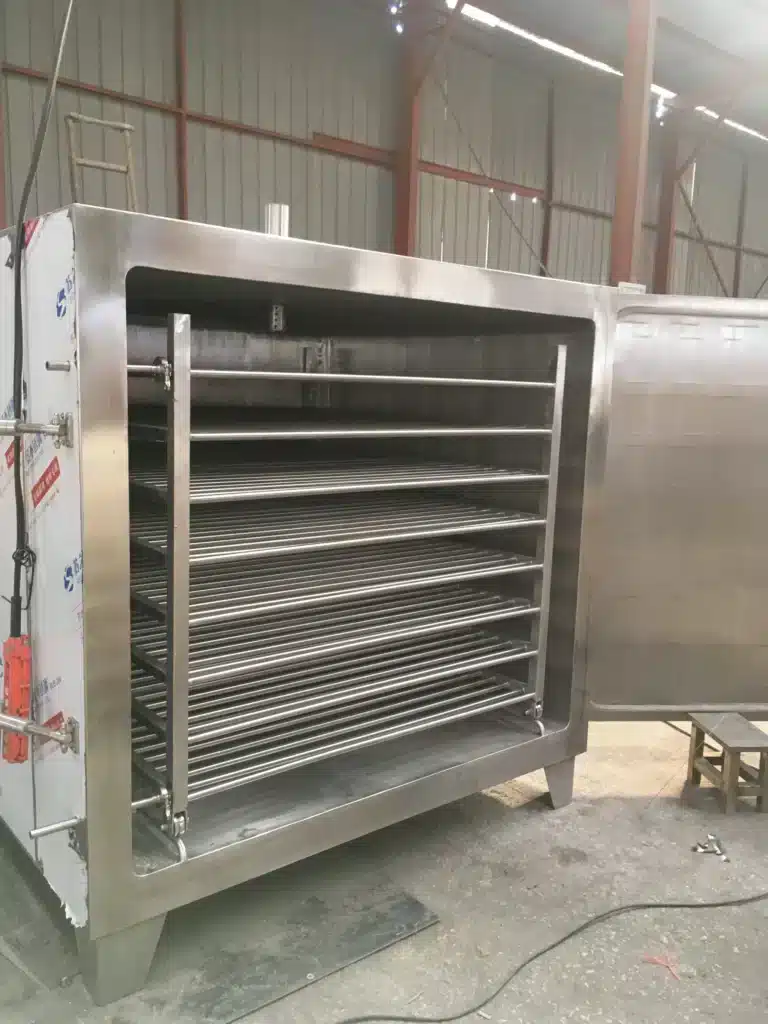
Material sits on trays inside a heated chamber. The key move in the pharmaceutical version is pulling a vacuum: lowering the chamber pressure lowers the boiling point of water and solvents, so evaporation happens at a much gentler temperature than it would at atmospheric pressure. That makes the vacuum tray dryer the standard choice for heat-sensitive APIs and solvent-wet filter cakes, where high temperature or air exposure would cause thermal degradation or oxidation.
It is slow and batch-based, and it asks for manual loading. But it is gentle, well understood, easy to validate, and forgiving of materials that other dryers struggle with. For exactly these reasons, a vacuum tray dryer remains a fixture in API and fine-chemical plants.
Fluid bed drying
Particles are suspended in a stream of warmed air so that each one dries quickly and evenly — the bed behaves almost like a boiling liquid. Fluid bed drying is the workhorse for drying granules after wet granulation, where speed and uniform moisture across the batch matter. It is fast and produces consistent results, but it does not suit sticky materials or very fine powders that won’t fluidize cleanly.
Spray drying
Spray drying converts a liquid feed directly into a dry powder in a single, continuous step. The feed is atomized into fine droplets in a stream of hot gas; each droplet dries in seconds, so the product stays far cooler than the inlet temperature suggests. That short residence time is why spray drying is considered gentle even for heat-sensitive materials.
In pharma it underpins spray-dried dispersions (used to improve the solubility of poorly soluble drugs), inhalation powders, and microencapsulation. When organic solvents are involved, a pharmaceutical spray dryer is typically run as a closed loop with inert nitrogen rather than air, to keep the solvent-laden atmosphere out of the flammable range. Pilot-scale spray dryers are common for formulation development before committing to production volumes.
Freeze drying and other methods
Freeze drying (lyophilization) removes water by sublimation from the frozen state and is the method of choice for the most fragile biologics and vaccines, where even mild heat is unacceptable. It is gentle but slow and energy-intensive. Beyond these four, microwave และ contact (conductive) drying serve niche cases where their specific heat-transfer behavior is an advantage.
Choosing the Right Method
A reliable rule of thumb: start from the material, not from the equipment you happen to own. Map the API’s heat and oxidation sensitivity and its physical state (wet cake, slurry, or solution) first, then pick the dryer that fits. The wrong match doesn’t announce itself immediately — it shows up weeks later as degradation, an unexpected polymorph, or a failed dissolution test.
| If your material is… | Consider | Why |
|---|---|---|
| Heat-sensitive, solvent-wet cake | Vacuum tray dryer | Evaporation at low temperature; minimal oxidation risk |
| Granules after wet granulation | Fluid bed dryer | Fast, uniform moisture across the batch |
| A liquid that must become a powder | Spray dryer | One continuous step; seconds-long, gentle drying |
| A poorly soluble API needing better solubility | Spray dryer (spray-dried dispersion) | Creates an amorphous dispersion to aid dissolution |
| The most fragile biologics or vaccines | Freeze dryer | Sublimation avoids heat entirely |
If your material sits between two of these rows, that ambiguity is exactly where a process trial pays for itself — and where it helps to talk through the options with an equipment partner before specifying a machine.
API Drying Considerations
API drying is the controlled removal of moisture or residual solvent from an active pharmaceutical ingredient down to a defined endpoint, done in a way that protects the molecule’s stability, crystal form, and purity under cGMP. Because the active ingredient is the most valuable material in the process — and the place where heat and oxidation damage cost the most — it earns extra care. Points engineers watch closely:
- Control the endpoint by measurement, not by clock. Use loss on drying or Karl Fischer to confirm you have hit the target moisture, rather than assuming a fixed time is enough. (Karl Fischer measures water specifically; LOD captures all volatiles, so the two can disagree when solvents are present — which is itself useful information.)
- Watch for polymorphic transitions at elevated temperature. A cycle that runs slightly too hot can convert the API to a different solid form with different solubility.
- Use vacuum or an inert atmosphere for oxidation- or solvent-sensitive APIs, so the material never sees the temperatures or the oxygen that would damage it.
- Validate and document the drying parameters. Reproducibility is the deliverable, not just dryness.
Equipment Overview
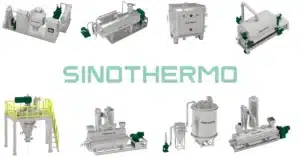
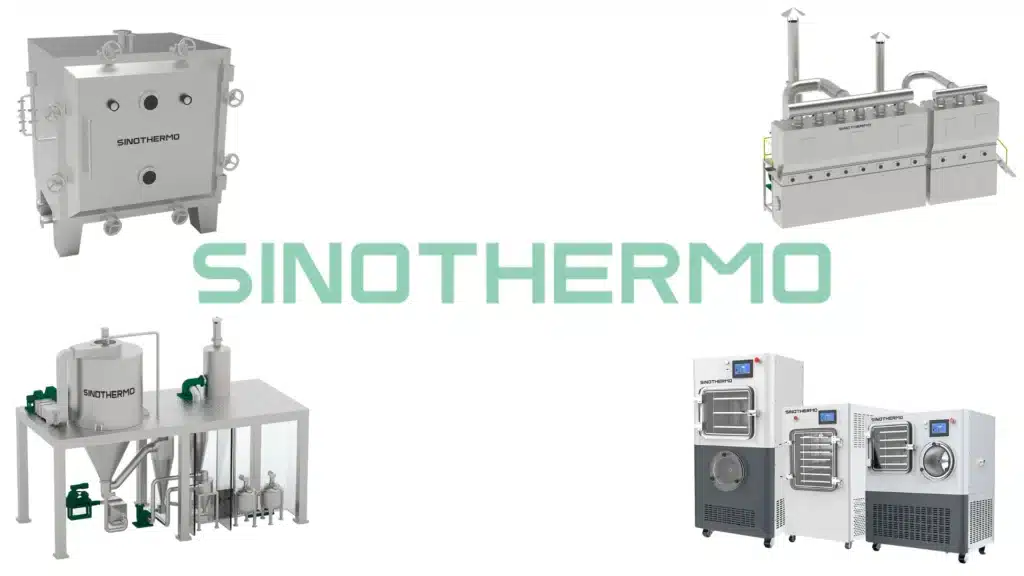
Below is how Sinothermo’s drying equipment maps to common pharmaceutical applications. Each equipment name should internal-link to its product page.
| Equipment | Typical pharmaceutical use |
|---|---|
| Vacuum tray dryer | Heat-sensitive APIs, solvent-wet filter cakes, oxidation-prone materials |
| Fluid bed dryer | Drying granules after wet granulation |
| Spray dryer / pilot spray dryer | Liquids → powder, spray-dried dispersions, inhalation powders, microencapsulation |
Sinothermo designs and builds industrial drying equipment, and much of our work is customized to a specific material and process rather than sold off a fixed spec sheet. If you can share your material’s heat sensitivity, physical state, batch size, and target moisture, we can advise which method fits before any quotation — see the consultation note at the end of this guide.
Common Mistakes to Avoid
A short list of the issues that most often turn a drying step into a deviation report:
- Ending the cycle by time instead of by tested moisture. Feed moisture and load vary; a fixed time does not.
- Choosing the dryer for throughput first. A faster dryer that degrades the API is slower in practice, once you count failed batches.
- Ignoring solvent flammability. Drying solvent-wet material in air, rather than an inert loop, is an avoidable safety exposure.
- Overlooking crystal form. Hitting the moisture spec but shifting the polymorph still fails the product.
คำถามที่พบบ่อย
What drying methods are used in the pharmaceutical industry?
The most common are tray and vacuum tray drying, fluid bed drying, spray drying, and freeze drying (lyophilization). The choice depends on the material’s heat sensitivity, its physical state, and the target moisture and crystal form.
Why is vacuum tray drying common for APIs?
Vacuum lowers the temperature at which water and solvents evaporate, so heat-sensitive APIs can be dried gently and with much less risk of thermal degradation or oxidation. It is also slow, well understood, and straightforward to validate — useful traits under cGMP.
What is API drying?
API drying is the controlled removal of moisture or residual solvent from an active pharmaceutical ingredient down to a defined endpoint, managed to protect stability, crystal form, and purity under cGMP. The endpoint is confirmed by loss on drying or Karl Fischer, not by drying time alone.
Can spray drying be used in pharma?
Yes. It is used for spray-dried dispersions that improve the solubility of poorly soluble drugs, for inhalation powders, and for microencapsulation. Because each droplet dries in seconds, the process is continuous and gentle on heat-sensitive materials; with organic solvents it runs as a closed nitrogen loop.
How do you measure when drying is complete?
By measuring residual moisture against a defined target — typically loss on drying (which captures all volatiles) or Karl Fischer titration (which measures water specifically). The endpoint is a validated specification, not a fixed time.
What is the difference between loss on drying and Karl Fischer?
Loss on drying measures total weight lost on heating, so it includes water และ any residual solvents. Karl Fischer measures water content specifically. When solvents are present the two readings differ, and that difference can itself flag incomplete solvent removal.