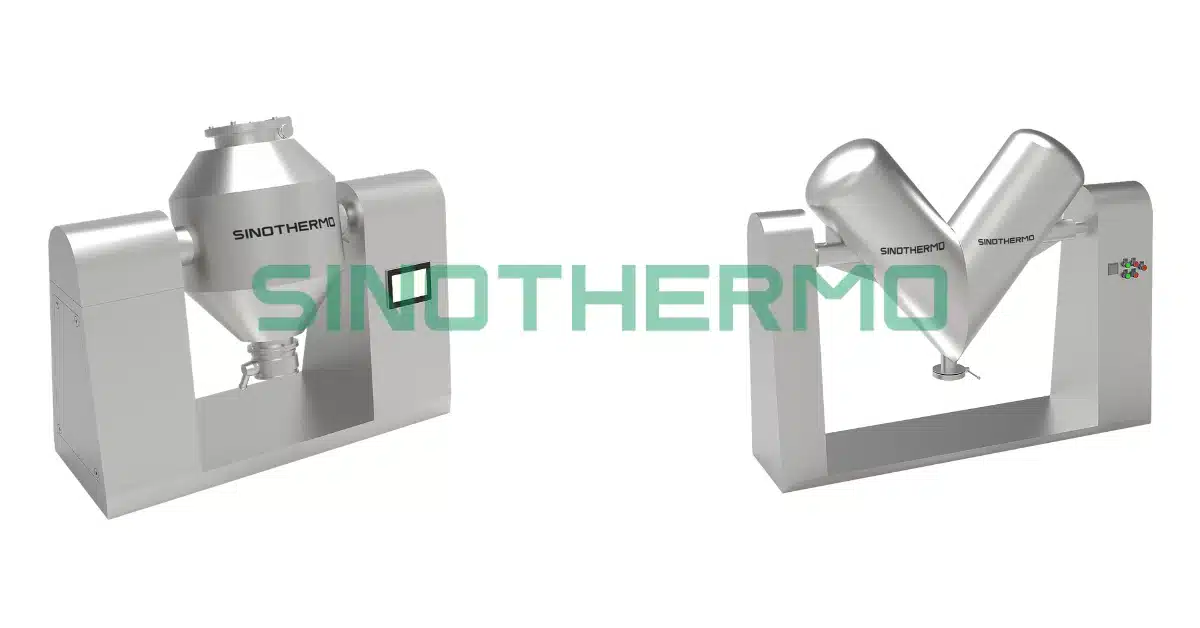
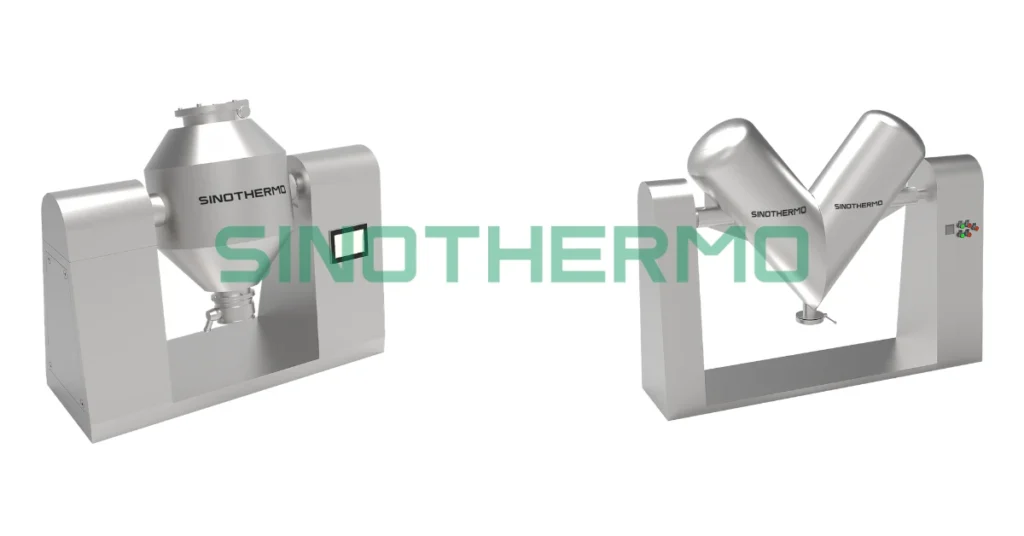
Quando uma formulação já está no tamanho de partícula correto e só precisa ser homogeneizada sem sofrer quebra, a resposta é quase sempre um misturador de tombamento — e os dois que dominam as linhas farmacêuticas e de químicos finos são o misturador de cone duplo e o misturador em V. Ambos giram o vaso inteiro para dobrar o pó suavemente sob a ação da gravidade, ambos evitam o desgaste causado por impulsores de alta velocidade e ambos são construídos para a produção limpa e validada exigida pelas BPF. O detalhe é que eles não são intercambiáveis: um descarrega de forma mais limpa e se ajusta a uma sala mais compacta, o outro mistura pós de fluxo livre mais rápido e de maneira mais uniforme, mas exige espaço livre acima. Este guia compara os dois da forma como um engenheiro de processo faria, para que você combine o misturador com o material, e não apenas com um catálogo.
Por que a escolha do misturador de tombamento importa
A função de um misturador parece simples — tornar o lote uniforme — mas a forma como ele alcança essa uniformidade determina se o produto sobrevive à etapa. Máquinas com agitadores internos (fita, pás, relha de arado) impõem cisalhamento: são potentes para materiais coesivos ou úmidos, mas podem fraturar grânulos friáveis, gerar finos, aquecer o lote e reter produto nas vedações do eixo. Os misturadores de tombamento adotam a abordagem oposta. Não há agitador interno algum — o vaso inteiro gira em um eixo horizontal, e o pó cai em cascata, se dobra e se difunde puramente pela gravidade. Isso significa mistura de baixo cisalhamento, atrito mínimo das partículas, ausência de zonas mortas ao redor de um eixo, e uma geometria interna simples, rápida de limpar e fácil de validar. Para misturas secas, de fluxo livre, sensíveis ao cisalhamento ou críticas para as BPF, esse é exatamente o comportamento desejado. A escolha entre os dois principais projetos de tombamento se resume então ao descarregamento, à área ocupada, ao tempo de mistura e à natureza do seu pó.
O que faz um misturador de cone duplo
Um misturador de cone duplo é um vaso em formato de dois cones unidos base a base por uma seção cilíndrica curta no meio, girando em um eixo horizontal. Ao girar, o pó é levantado em direção ao centro mais largo e depois canalizado pelos cones afunilados de volta em direção ao eixo — uma dobra convergente-divergente repetida que produz uma mistura homogênea com um manuseio notavelmente suave.
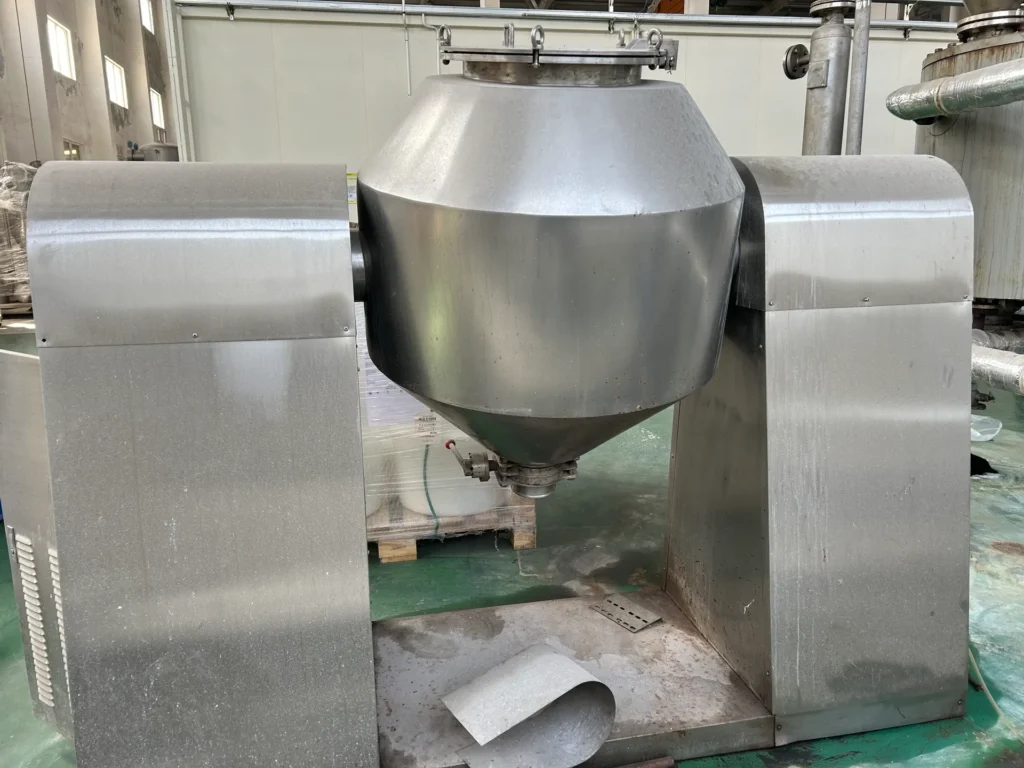
A vantagem definidora da geometria em cone é o descarregamento. Como ambas as extremidades se afunilam até um ponto, o vaso se esvazia quase completamente através de uma válvula inferior, deixando muito pouco pó residual aderido internamente — um benefício direto para ativos caros, para o controle de contaminação cruzada entre lotes e para a validação de limpeza. O formato simétrico também é compacto em planta e fácil de polir até um acabamento espelhado, sem cantos onde o pó possa se acumular.
Construído em SS316L com superfícies de contato polidas, um misturador de cone duplo é uma escolha natural para a mistura sob BPF de pós farmacêuticos, nutracêuticos, pré-misturas secas e grânulos lubrificados antes da compressão em comprimidos. Um Misturador de Cone Duplo proporciona essa ação suave e de baixo atrito com um descarregamento limpo e quase total, em uma área ocupada adequada para salas com restrição de altura.
Um misturador de cone duplo é adequado quando você precisa de um descarregamento limpo e quase completo, está lidando com materiais caros ou sensíveis ao cisalhamento, deseja uma máquina compacta, ou realiza trocas frequentes de produto que exigem limpeza rápida. Tenha cautela quando os pós forem fortemente coesivos ou precisarem ser misturados extremamente rápido — a ação suave do cone pode então levar mais tempo para alcançar a uniformidade total.
O que faz um misturador em V
Um misturador em V — às vezes chamado de misturador de duas cascas — é construído a partir de duas cascas cilíndricas unidas em formato de V e giradas em um eixo horizontal. A cada rotação, o pó é dividido entre os dois braços do V e depois recombinado na junção, um movimento contínuo de divisão e recombinação que produz uma mistura muito rápida e extremamente uniforme.
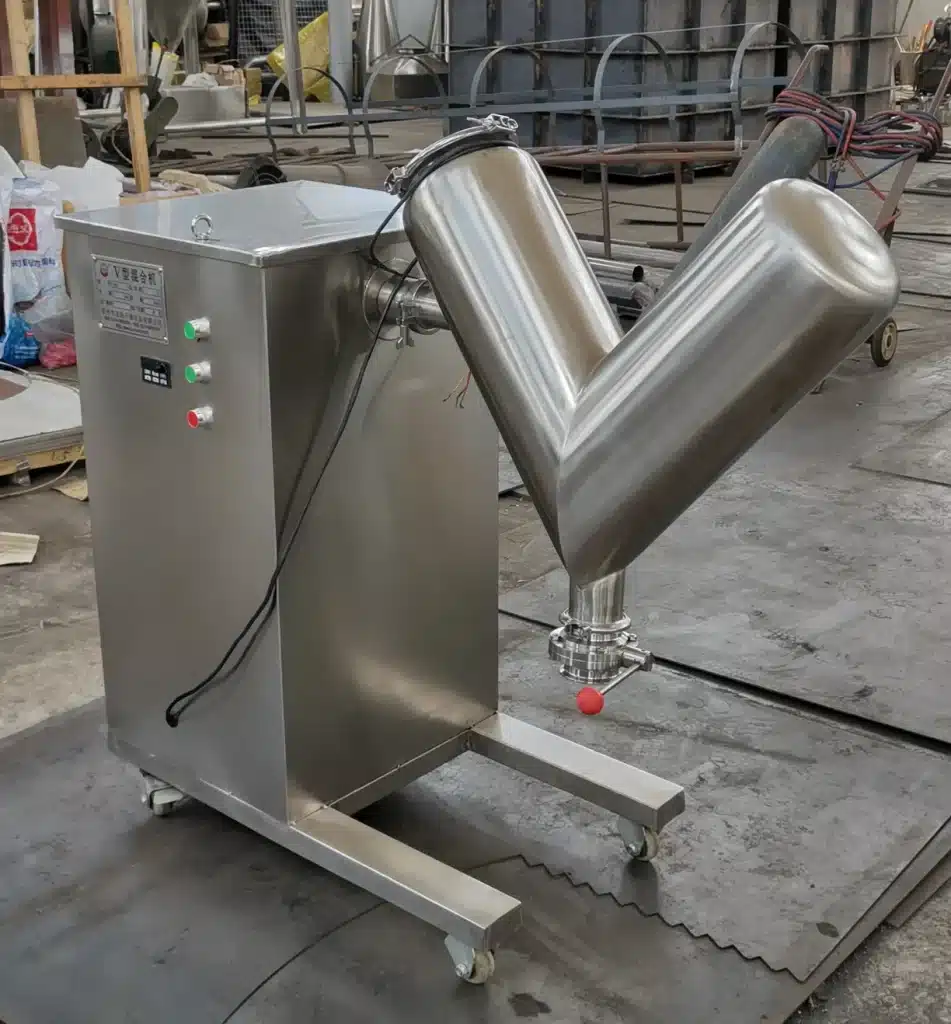
Essa geometria de divisão e recombinação é o ponto forte característico do V-blender. Para pós de fluxo livre com tamanho e densidade de partícula semelhantes, ele normalmente atinge uma mistura homogênea mais rapidamente do que um cone duplo e com excelente uniformidade — por isso é um equipamento de referência para pré-misturas de pós secos, misturas de excipientes farmacêuticos e pós alimentícios ou químicos. Assim como o cone duplo, trata-se de um verdadeiro misturador por tombamento: sem agitador interno, mistura suave de pós por gravidade, baixo cisalhamento, geração mínima de finos e componentes internos simples em SS316L, fáceis de limpar e validar. Uma barra intensificadora (agitador) pode ser adicionada através do eixo quando uma formulação precisa de um pouco mais de cisalhamento para quebrar aglomerados leves ou dispersar uma microdose.
As desvantagens são físicas. O V-blender é mais alto e exige mais espaço vertical acima da máquina para girar e, embora a descarga pela válvula do ápice seja boa, geralmente não é tão eficiente quanto a de um cone que converge para um único ponto. Um V Blender oferece essa mistura rápida e de alta uniformidade para cargas de fluxo livre onde há espaço vertical disponível.
Um V-blender é adequado quando seus pós têm fluxo livre e você precisa de uma mistura rápida e muito uniforme, quando você mistura componentes de tamanho e densidade semelhantes, ou quando há espaço vertical disponível. Tenha cautela quando a altura do teto for limitada, quando o resíduo quase nulo for essencial, ou quando os pós forem coesivos e resistirem ao fluxo por gravidade.
Cone duplo vs V-blender — lado a lado
| Misturador de Cone Duplo | V-Blender | |
|---|---|---|
| Tipo | Misturador por tombamento / gravidade, sem agitador | Misturador por tombamento / gravidade, sem agitador |
| Ação de mistura | Dobra convergente-divergente através dos cones | Divisão e recombinação através de duas carcaças |
| Nível de cisalhamento | Muito baixo — suave, atrito mínimo | Muito baixo — suave, atrito mínimo |
| Ideal para | Lotes sensíveis ao cisalhamento, de alto valor e com trocas frequentes | Misturas rápidas e muito uniformes de pós de fluxo livre |
| Descarga / resíduo | Excelente — quase total, converge para um ponto | Boa — pela válvula do ápice, com um pouco mais de resíduo |
| Ocupação de espaço | Compacto, menor altura | Mais alto, requer espaço vertical |
| Velocidade de uniformidade | Boa; mais lenta em pós coesivos | Rápida e altamente uniforme em pós de fluxo livre |
| GMP / limpeza | SS316L polido, fácil de validar | SS316L polido, fácil de validar |
| Extras opcionais | Variante de secagem a vácuo disponível | Barra intensificadora para aglomerados leves / microdosagem |
Para uma visão mais ampla de como a mistura se encaixa junto à granulação e à secagem em uma linha completa de formas sólidas, consulte nosso guia de compra de misturadores industriais.
Qual deles você deve escolher?
Comece pelo seu pó, não pela máquina. Se os componentes têm fluxo livre e são semelhantes em tamanho e densidade, e você dispõe da altura de teto necessária, um V-blender geralmente proporcionará a mistura mais rápida e uniforme. Se você valoriza uma descarga limpa e quase total, uma ocupação de espaço compacta, ou trabalha com ativos de alto valor e trocas frequentes, o misturador de cone duplo é a opção mais adequada. Ambos protegem grânulos sensíveis ao cisalhamento e ambos se validam facilmente conforme as normas GMP.
A ressalva importante: os misturadores de tombamento só funcionam bem em pós que fluem. Se o seu material for fortemente coesivo, pegajoso, ou contiver uma ampla variação de tamanhos de partícula e densidades que segregam sob gravidade, nem um cone duplo nem um misturador em V homogeneizarão de forma confiável — a gravidade sozinha não consegue superar a coesão, e uma barra intensificadora só fecha parcialmente essa lacuna. Para esses materiais, você precisa de um design de convecção forçada que movimente ativamente o pó com um agitador interno. Um Misturador de Fita Horizontal é a alternativa padrão: sua fita helicoidal dupla conduz pós coesivos e de múltiplas densidades a uma mistura uniforme independentemente do fluxo, e um misturador de relha de arado oferece uma alternativa de maior energia para casos mais difíceis. A regra prática: fluxo livre e sensível ao cisalhamento → misturador de tombamento; coesivo ou com ampla variação de tamanho → fita ou relha de arado.
Uma visão de engenharia de processos: comprove antes de especificar
Uma ficha técnica não pode dizer se a sua mistura específica atingirá uniformidade em um cone ou em um V, quanto tempo isso levará, ou quanto resíduo será deixado para trás. Dois pós que parecem idênticos no papel podem se comportar de maneira muito diferente ao serem tombados — fluxo, carga estática, distribuição de tamanho de partícula e densidade aparente influenciam o resultado. A forma confiável de escolher é testar o seu próprio material e medir a uniformidade da mistura, o tempo de mistura e o resíduo de descarga antes de se comprometer com uma máquina de produção.
Esta é a etapa que a maioria dos compradores pula e depois se arrepende. Como fabricante com visão de engenharia de processos e mais de 20 anos de experiência, a SINOTHERMO faz mais do que fornecer o misturador — ajudamos você a comprovar a mistura. Traga sua formulação ao nosso laboratório piloto interno, teste-a tanto em um misturador de cone duplo quanto em um misturador em V, e selecione com base em evidências: uniformidade amostrada, nível de enchimento, velocidade de rotação e tempo de ciclo. Cada máquina que construímos em seguida é projetada em torno do seu processo validado e acabada conforme o padrão GMP, e não adaptada de um modelo de prateleira.
Erros comuns a evitar
- Forçar um misturador de tombamento em pó coesivo. Se o material não flui sob gravidade, um misturador de cone duplo ou em V irá misturá-lo de forma insuficiente — especifique um misturador de fita ou de relha de arado, ou verifique o fluxo em um teste primeiro.
- Ignorar o espaço livre necessário para um misturador em V. O V gira em um arco alto; meça a altura do teto antes de se apaixonar pelos números de uniformidade — um cone duplo pode ser a única máquina que se encaixa.
- Sobrecarregar o vaso. Os misturadores de tombamento precisam de volume livre para cascatear; níveis de enchimento acima de aproximadamente 50–60% da capacidade do vaso prejudicam a ação de dobramento e prolongam o tempo de mistura. Ajuste o tamanho do lote à máquina.
- Negligenciar o resíduo de descarga em ativos caros. Com APIs de custo elevado, a descarga quase total de um cone duplo pode economizar mais por lote do que qualquer diferença na velocidade de mistura. Calcule o custo do resíduo, não apenas do rendimento.
- Pular o teste de uniformidade. O tempo de mistura não é um número de ficha técnica — depende do seu pó, do nível de enchimento e da velocidade. Confirme a uniformidade da mistura com o seu próprio material antes de comprar.
Conclusão
Os misturadores de cone duplo e os misturadores em V são primos próximos: ambos são misturadores de tombamento que giram todo o vaso para uma mistura suave de pós, ambos proporcionam mistura de baixo cisalhamento com atrito mínimo, e ambos são construídos em SS316L polido para mistura validada em GMP. A escolha depende do seu pó e do seu espaço disponível. Cargas de fluxo livre e espaço livre disponível favorecem a mistura rápida e de alta uniformidade do misturador em V; descarga limpa, footprint compacto e materiais caros ou sensíveis ao cisalhamento favorecem o cone duplo. E se o pó for coesivo ou propenso à segregação, saia completamente da família de tombamento e opte por um misturador de fita ou de relha de arado. A ficha técnica reduz as opções — um teste piloto com o seu próprio material confirma a escolha.
Não tem certeza se um misturador de cone duplo ou um misturador em V é ideal para o seu pó? Fale com nossos engenheiros de processo e agende um teste em nosso laboratório piloto — vamos ajudá-lo a decidir com base em dados reais de mistura, não em suposições.
Perguntas Frequentes
Qual é a diferença entre um misturador de cone duplo e um misturador em V?
Ambos são misturadores por tombamento (tumble blenders) que giram todo o vaso para misturar o pó suavemente por gravidade, sem agitador interno. O misturador de cone duplo dobra o pó através de dois cones unidos por uma parte cilíndrica central e descarrega de forma limpa por um único ponto, enquanto o misturador em V divide e recombina o pó através de duas cascas, proporcionando uma mistura mais rápida e uniforme de pós de fluxo livre. O cone duplo é mais compacto e tem descarga mais limpa; o misturador em V mistura pós de fluxo livre mais rapidamente, mas exige mais espaço vertical.
O misturador de cone duplo e o misturador em V são de baixo cisalhamento?
Sim. Ambos são misturadores por tombamento por gravidade, sem impulsor, pás ou fita dentro do vaso. O pó cai em cascata e se dobra sob seu próprio peso, resultando em mistura de baixo cisalhamento, com desgaste mínimo das partículas e pouquíssima geração de finos — ideal para grânulos sensíveis ao cisalhamento e materiais friáveis que um agitador de alta velocidade fraturaria.
Qual é melhor para a mistura farmacêutica em conformidade com as BPF (GMP)?
Ambos são adequados para mistura conforme as BPF: são construídos em SS316L polido, têm geometria interna simples, sem zonas mortas, e são fáceis de limpar e validar. O misturador de cone duplo costuma ser preferido quando a descarga quase total e a troca rápida de lote são prioridades, pois esvazia quase completamente e deixa pouquíssimo resíduo entre bateladas.
Quando não devo usar um misturador por tombamento?
Evite usar um misturador de cone duplo ou em V quando os pós forem fortemente coesivos, pegajosos ou tiverem uma ampla variação de tamanhos e densidades de partícula que se segregam sob gravidade. A gravidade sozinha não consegue homogeneizar esses materiais. Use um projeto de convecção forçada, como um misturador horizontal de fita ou um misturador de relha de arado, que impulsiona ativamente o pó até obter uma mistura uniforme.
O que é uma barra intensificadora e eu preciso de uma?
Uma barra intensificadora (agitador) é um eixo rotativo opcional adicionado através de um misturador em V para introduzir cisalhamento localizado. Ela ajuda a quebrar grumos leves e a dispersar adições muito pequenas (microdoses) em um lote grande. Você só precisa dela quando o movimento simples de tombamento não consegue quebrar aglomerados ou distribuir uniformemente um componente de baixa dosagem; a maioria das misturas de fluxo livre não a exige.
Qual deve ser o nível de enchimento de um misturador por tombamento para obter os melhores resultados?
Os misturadores por tombamento precisam de espaço livre para permitir que o pó caia em cascata e se dobre, portanto, geralmente funcionam melhor com cerca de 50–60% do volume do vaso ou menos. O excesso de enchimento reduz o movimento de tombamento, prolonga o tempo de mistura e pode prejudicar a uniformidade. Ajustar o tamanho do lote ao tamanho correto da máquina — confirmado em um teste piloto — é a forma mais confiável de dimensionar o misturador.

Mark Gu
Passionate about enhancing customer experiences and streamlining operations, Mark focuses on building strong relationships, fostering innovation, and leading teams to achieve exceptional service and efficiency.
E-mail: mark.gu@sinothermo.com
Telefone: +86 18021972660