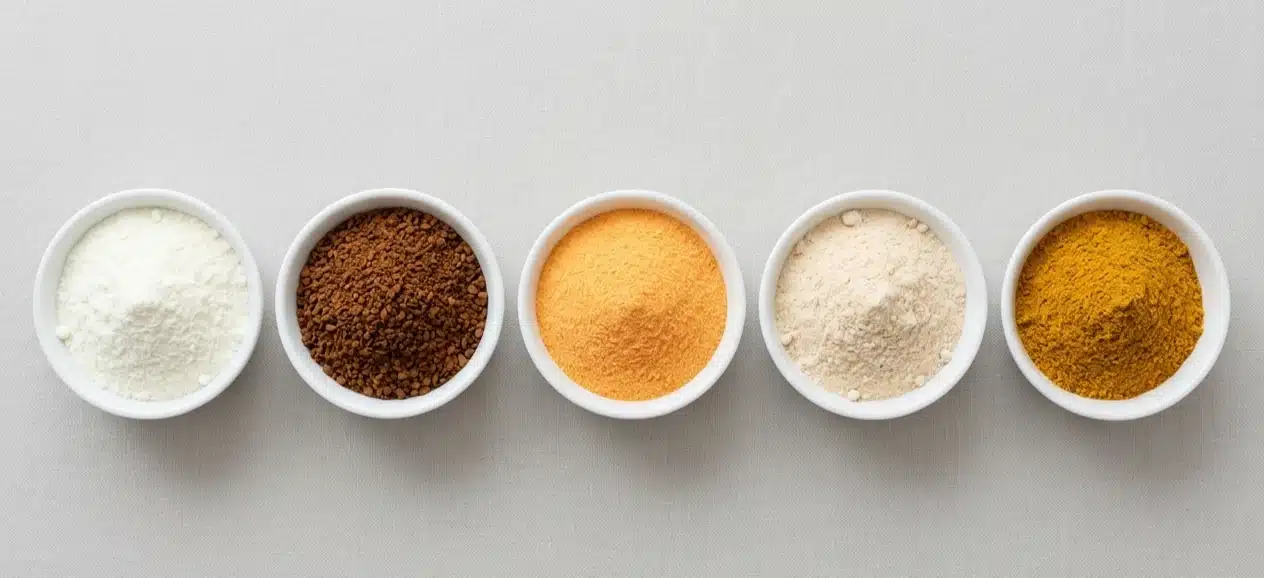
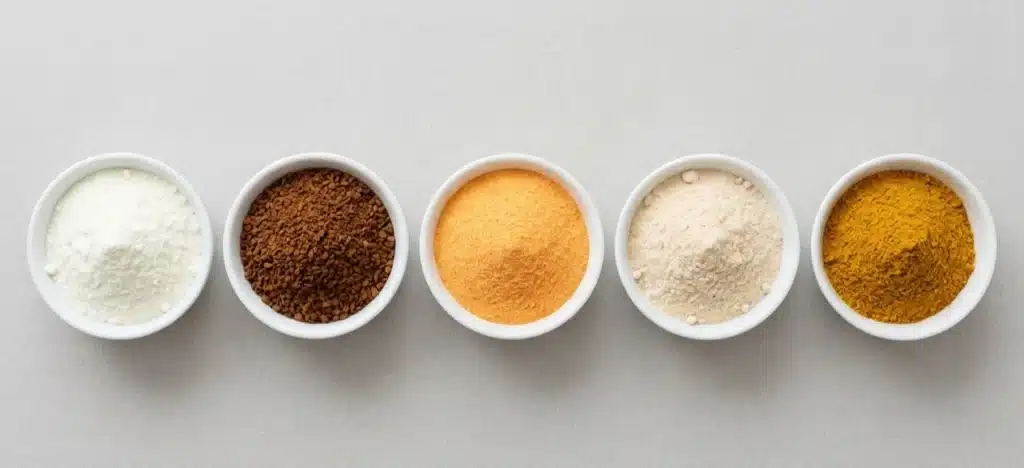
Basta caminhar por qualquer corredor de supermercado para passar por dezenas de produtos secos por atomização sem perceber: leite em pó, café instantâneo, aromatizantes em pó, pós de frutas e vegetais, fórmula infantil, tabletes de caldo, e até o creme não lácteo do seu café. A secagem por atomização de alimentos é o cavalo de batalha silencioso por trás da maioria desses pós, pois faz muito bem uma tarefa — transforma um líquido em um pó estável, solúvel e de fácil escoamento, de forma contínua e em escala industrial.
A tecnologia não é nova. A primeira patente de secagem por atomização data de 1872, e o processo se expandiu para a produção convencional de laticínios e café ao longo de meados do século XX. Hoje, é o método de secagem padrão para a grande maioria dos pós alimentícios e de bebidas em todo o mundo. Este guia explica onde a secagem por atomização é usada em alimentos, por que os fabricantes a escolhem, onde ela realmente apresenta limitações e o que observar nos equipamentos — para que, seja você um engenheiro de processos planejando uma nova linha ou um responsável por compras comparando fornecedores, possa tomar a decisão com confiança.
O Que É a Secagem por Atomização e Por Que os Fabricantes de Alimentos Confiam Nela
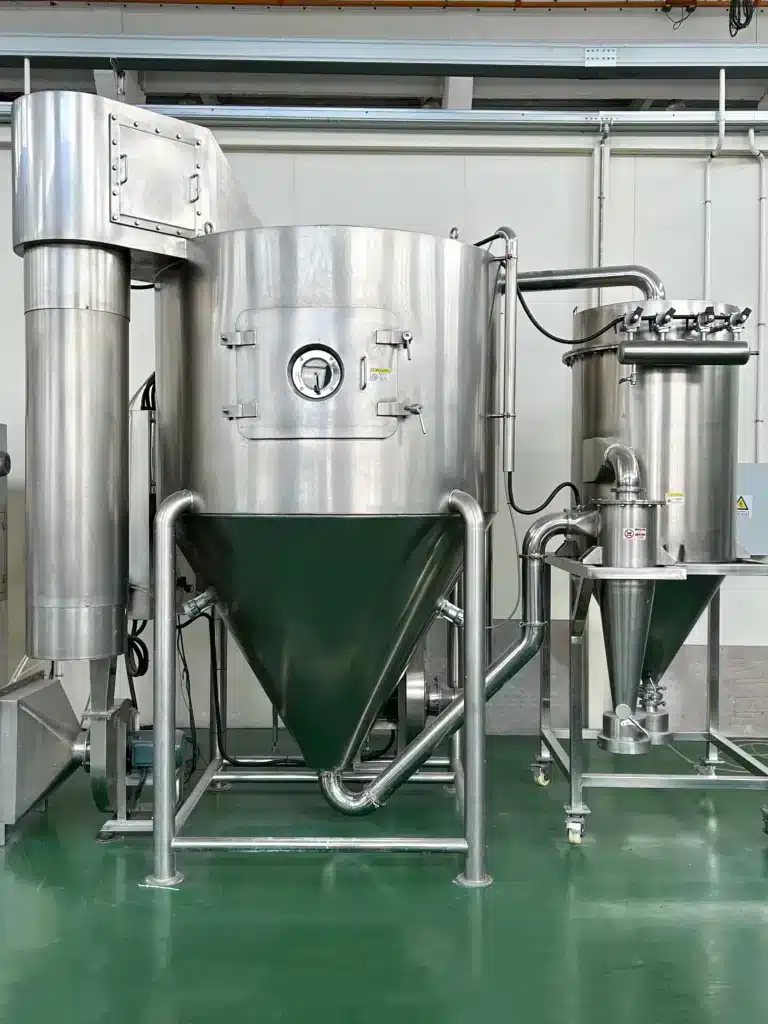
A secagem por atomização converte uma alimentação líquida (uma solução, emulsão ou suspensão) em um pó seco em uma única etapa contínua. O líquido é atomizado em milhões de gotículas finas dentro de uma câmara de secagem, onde encontra uma corrente de ar quente. Como cada gotícula tem uma relação área de superfície/volume enorme, a água evapora em questão de segundos — e o resfriamento evaporativo mantém a superfície da gotícula muito mais fria do que o ar de entrada enquanto a umidade ainda está sendo removida. Essa exposição térmica curta e relativamente branda é a razão pela qual ingredientes alimentícios sensíveis ao calor sobrevivem ao processo melhor do que as altas temperaturas de entrada poderiam sugerir.
Em um secador por atomização de alimentos típico, o ar de entrada é mantido entre cerca de 140 °C e 350 °C sob controle automático, com o ar de saída em torno de 80–90 °C — a faixa exata depende da alimentação e da umidade-alvo. É fundamental notar que o próprio pó nunca atinge a temperatura de entrada: o resfriamento evaporativo mantém cada gotícula bem abaixo do ar ao redor até que esteja quase seca. O pó final é separado do ar em um ciclone ou filtro de mangas — unidades bem projetadas para alimentos recuperam ≥95% do produto — e frequentemente é finalizado a jusante em um leito fluidizado para aglomeração, o que melhora a molhabilidade e confere aquele comportamento de dissolução “instantânea”.
Essa conversão de líquido em pó em uma única etapa — rápida, contínua e escalável — é o que torna a secagem por atomização de alimentos a opção econômica padrão, em vez de uma técnica de nicho.
Por Que a Indústria Alimentícia Usa a Secagem por Atomização
Alguns motivos práticos consolidaram essa tecnologia como padrão:
- Vida útil. A remoção da água interrompe o crescimento microbiano e retarda a deterioração, transformando um líquido perecível em um ingrediente que se mantém por meses sem refrigeração.
- Menor peso, menor custo. O pó é drasticamente mais barato de transportar e armazenar do que o líquido do qual se origina — concentrar a alimentação antes da secagem elimina a maior parte do custo de frete. (O leite integral, por exemplo, é composto por cerca de 87% de água antes do processamento.)
- Conveniência e consistência. Um pó padronizado é muito mais fácil de dosar, misturar e reconstituir do que um líquido variável, o que é importante tanto para a automação de fábrica quanto para o uso pelo consumidor final.
- Suave com ingredientes sensíveis ao calor. Como as gotículas secam em segundos e permanecem relativamente frias durante a evaporação, muitos aromatizantes, enzimas, probióticos e nutrientes sobrevivem melhor do que o esperado.
- Propriedades de partícula projetadas. O tipo de atomizador, a concentração da alimentação e as condições de secagem permitem que os produtores ajustem o tamanho de partícula, a densidade aparente e a solubilidade — de modo que a mesma planta possa produzir tanto um pó de aromatizante fino quanto um pó lácteo instantâneo mais grosseiro.
Aplicações Comuns na Indústria Alimentícia
| Produto | O que é seco por atomização | Observações |
|---|---|---|
| Leite em pó e derivados lácteos | Leite concentrado | Frequentemente aglomerado em leito fluidizado para dissolução instantânea — veja nosso guia sobre leite em pó |
| Café instantâneo | Extrato de café | Padrão para o mercado de massa; linhas premium costumam ser liofilizadas — veja nosso guia sobre café |
| Sabores e aromas | Emulsões de sabor | Geralmente encapsulados em um material de suporte para proteger compostos voláteis → secagem por atomização de sabores |
| Pós de frutas e vegetais | Sucos, purês | Alimentações ricas em açúcar são pegajosas e exigem suportes + controle rigoroso de temperatura → pó de fruta seco por atomização |
| Ovo em pó | Ovo líquido | Inteiro, clara ou gema |
| Fórmula infantil e nutrição | Líquidos misturados | Requisitos higiênicos e de qualidade mais rigorosos |
| Proteínas vegetais e não lácteos | Suspensões de ervilha/soja, creamers | Segmento em rápido crescimento impulsionado pela demanda por proteínas alternativas |
Microencapsulação: A Aplicação de Alto Valor da Secagem por Atomização
A secagem por atomização é uma das principais rotas industriais para a microencapsulação. Nesse processo, um sabor, óleo ou composto ativo é misturado a um material de parede — geralmente maltodextrina, goma arábica ou amido modificado — e seco de forma que cada partícula retenha o ativo dentro de uma casca protetora.
Isso proporciona três benefícios valiosos:
- 1.Protege aromas voláteis e óleos propensos à oxidação (por exemplo, ômega-3, óleos cítricos) da degradação.
- 2.Converte um óleo líquido de difícil manuseio em um pó fácil de manusear e de fluxo livre.
- 3.Controla a liberação — o ativo é liberado ao entrar em contato com umidade, calor ou variação de pH.
Sabores e ingredientes funcionais encapsulados apresentam margens muito superiores às dos pós de commodity, motivo pelo qual a secagem por atomização de sabores é um dos segmentos mais atrativos comercialmente no mercado de secagem de alimentos.
Onde a Secagem por Atomização Não é Suficiente
Ser transparente quanto às limitações faz parte da escolha do processo certo — e é nesse ponto que um fornecedor experiente conquista confiança, em vez de superestimar a tecnologia:
- Alimentações pegajosas e ricas em açúcar (sucos de fruta, mel, concentrados de alta frutose) amolecem próximo à sua temperatura de transição vítrea e tendem a grudar na parede da câmara. Geralmente exigem agentes de suporte, projetos de baixa temperatura ou engenharia especializada de câmara antiaderente.
- A perda de aroma é real. Mesmo com secagem rápida, os produtos mais sensíveis ao aroma (café premium, notas delicadas de frutas) podem justificar a liofilização, que preserva melhor os compostos voláteis, ainda que a um custo mais alto.
- Os ativos mais sensíveis ao calor — alguns biológicos, certas cepas de probióticos, enzimas delicadas — às vezes ainda exigem liofilização para atingir as metas de sobrevivência.
- Alta intensidade de capital e energia. Uma linha de secagem por atomização representa um investimento significativo, e a evaporação da água consome muita energia; concentrar a alimentação a montante (por meio de um evaporador ou membrana) é quase sempre a escolha certa antes mesmo de chegar ao secador.
A secagem por atomização é a opção econômica padrão para pós alimentícios — não uma solução universal. Um bom parceiro de processo saberá indicar quando ela não é a ferramenta ideal.
As Duas Formas de Atomização: Centrífuga vs Pressão
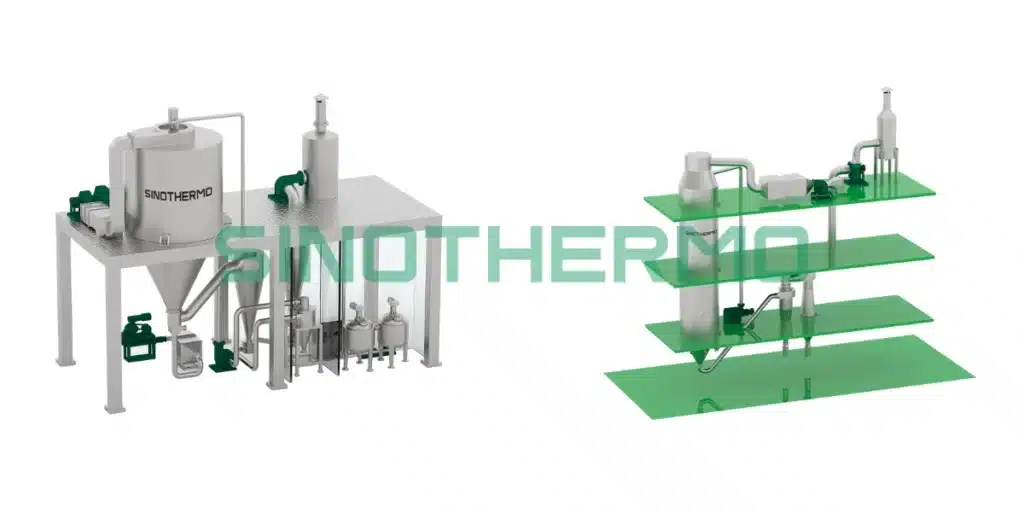
A forma como o líquido é fragmentado em gotículas define o pó que você obtém. Existem duas rotas principais na produção de alimentos, e na Sinothermo nós fabricamos ambas:
Secador por atomização centrífugo (disco rotativo). O produto é lançado por um disco giratório de alta velocidade, que o cisalha em uma névoa fina e uniforme. Nosso secador por atomização centrífugo (série LPG) opera o atomizador a aproximadamente 10.983–35.000 rpm, dependendo do tamanho, com ar de entrada a 140–350 °C (controle automático), saída a 80–90 °C, capacidade de evaporação de água de 5 a 6.500 kg/h e recuperação de pó seco ≥95%. Produz um pó fino e de fácil escoamento, sendo a escolha preferida para laticínios, café, ovo, proteína vegetal e a maioria dos pós alimentícios de fluxo livre. Suporta produtos de maior viscosidade do que os bicos aspersores e raramente entope.
Secador por atomização de pressão (bico aspersor). Aqui, uma bomba de alta pressão força o produto através de um bico fino. Nosso secador por atomização de pressão (série YPG) utiliza pressões de bombeamento de 2–10 MPa, ar de entrada a 140–350 °C, capacidade de evaporação de umidade de 50–1.000 kg/h, com umidade final do produto abaixo de 5% (podendo chegar a 0,5%) e recuperação de material >97% — ultrapassando 98% com uma etapa secundária de coleta de pó. A atomização por pressão tende a gerar um grânulo mais grosseiro e parcialmente oco, e a mesma máquina pode realizar tanto a granulação por aspersão quanto a secagem. É indicada para temperos, proteínas, amido, extrato de café, farinha de peixe e essência de carne.
| Centrífugo (disco rotativo) | Pressão (bico aspersor) | |
|---|---|---|
| Atomização | Disco giratório, 11k–35k rpm | Bomba de alta pressão, 2–10 MPa |
| Pó típico | Fino, de fácil escoamento | Mais grosseiro, frequentemente oco |
| Viscosidade do produto | Suporta maior viscosidade | Prefere menor viscosidade |
| Capacidade de evaporação | 5–6.500 kg/h (LPG) | 50–1.000 kg/h (YPG) |
| Taxa de recuperação | ≥95% | >97% (>98% com 2ª etapa) |
| Melhor aplicação | Laticínios, café, ovo, proteína | Temperos, amido, extratos, grânulos |
Secadores por Atomização Especiais para Produtos Alimentícios Difíceis
As limitações honestamente apresentadas acima não são becos sem saída — geralmente existe uma configuração projetada especificamente para cada caso:
- Extratos ricos em açúcar que queimam facilmente? Nosso secador por atomização para extratos utiliza um design de parede fria (temperatura da parede <80 °C) e uma vassoura de ar que varre a parede da torre, evitando que extratos botânicos e de frutas pegajosos carbonizem ou se acumulem. O ar de entrada opera em uma faixa mais suave, de 140–180 °C.
- Produtos sensíveis à oxidação ou a solventes? O secador por atomização de circulação fechada realiza a secagem sob gás inerte em um circuito selado — protegendo ingredientes facilmente oxidáveis e recuperando qualquer solvente em vez de liberá-lo para a atmosfera.
- Gorduras de baixo ponto de fusão e aditivos alimentares? Um granulador por resfriamento por aspersão (congelamento) atomiza um produto fundido — pó de gordura, óleo de palma, monoglicerídeos, estearatos — e o solidifica em contato com ar frio, sem qualquer remoção de água; 70–80% do calor é removido quase instantaneamente, formando partículas esféricas uniformes em segundos.
O Que “Grau Alimentício” Realmente Significa no Equipamento
Qualquer que seja o método de atomização escolhido, um secador por atomização para alimentos é construído conforme padrões sanitários (higiênicos) que serão rigorosamente avaliados por auditores de laticínios e nutrição infantil:
- Materiais em contato com o produto: aço inoxidável de grau alimentício — normalmente SS304 para a estrutura e SS316L para as superfícies em contato com o produto — com acabamento superficial controlado que resiste ao acúmulo de bactérias.
- CIP (Clean-In-Place): bolas de aspersão integradas e ciclos de limpeza validados, permitindo que a câmara, os dutos e o ciclone sejam limpos sem desmontagem.
- Geometria higiênica: soldas sem frestas, superfícies inclinadas, vedações sanitárias e uma câmara projetada para evitar acúmulo de pó (uma preocupação tanto de segurança alimentar quanto de risco de explosão de pó).
- Integração de sistema: a maioria das linhas de alimentos combina o secador com um evaporador a montante (para concentrar a alimentação e reduzir a energia de secagem) e um leito fluidizado a jusante (para aglomeração, instantaneização e resfriamento final).
- Controle e segurança: controle automático de temperatura de entrada/saída, alívio de explosão para pós combustíveis e automação baseada em receitas para lotes reprodutíveis.
Um secador por atomização para alimentos raramente é um equipamento padronizado de prateleira — a química da alimentação, as propriedades desejadas das partículas e a classe de higiene moldam a configuração adequada. Com mais de 20 anos construindo sistemas de secagem e uma equipe de engenharia interna, dimensionamos cada linha em torno do produto real, e não de um número de catálogo — o que é exatamente o que economiza custos no longo prazo.
Como Escolher o Secador por Atomização Certo para Alimentos
Um roteiro prático de decisão antes de solicitar orçamentos:
- 1.Defina a alimentação. Teor de sólidos, perfil de açúcar/gordura, viscosidade, sensibilidade ao calor e se você fará uma concentração prévia.
- 2.Defina o alvo do pó. Tamanho de partícula, densidade aparente, umidade, solubilidade/propriedades instantâneas e qualquer requisito de encapsulamento.
- 3.Estabeleça a classe de higiene. Laticínios e nutrição infantil exigem o projeto sanitário e de CIP mais rigoroso; pós de aromatizantes e ingredientes podem permitir mais flexibilidade.
- 4.Dimensione a capacidade. A taxa de evaporação (kg de água/h) importa mais do que o “tamanho da câmara”; planeje para um tempo de operação e ciclos de limpeza realistas.
- 5.Planeje a linha completa. Evaporador + secador + leito fluidizado + manuseio de pó — o custo total de propriedade e o uso de energia existem no nível do sistema, não apenas no secador isolado.
Se você conseguir responder de 1 a 4, um fornecedor competente pode dimensionar uma configuração e uma estimativa realista de energia/capacidade. Se um fornecedor apresentar um orçamento sem fazer essas perguntas, trate o número com cautela.
Principais Conclusões
A secagem por atomização de alimentos é a espinha dorsal da indústria de alimentos em pó — ela torna os líquidos estáveis, leves, consistentes e convenientes, ao mesmo tempo em que seca rápido o suficiente para proteger muitos ingredientes delicados. Ela se destaca em laticínios, café, aromatizantes, encapsulamento e em um segmento crescente de proteínas vegetais, mas tem limitações reais com alimentações pegajosas, com alto teor de açúcar e as mais sensíveis a aroma ou calor. No lado dos equipamentos, o design higiênico, o CIP e a integração inteligente da linha diferenciam um secador de alimentos confiável de um genérico.
Planejando uma linha de pó alimentício ou atualizando uma já existente? Nossos engenheiros de processo ajudam fabricantes de alimentos e bebidas a dimensionar sistemas de secagem por atomização com base na alimentação e nos alvos de pó reais — não em um folheto. Conte-nos sobre o seu produto e ajudaremos a dimensioná-lo com honestidade.
Perguntas Frequentes
Quais alimentos são produzidos por secagem por atomização?
Leite e pós lácteos, café instantâneo, aromatizantes em pó, pós de frutas e vegetais, pó de ovo, fórmula infantil, cremes não lácteos e pós de proteína vegetal são os alimentos mais comumente secos por atomização.
Por que a secagem por atomização é usada na indústria alimentícia?
A secagem por atomização de alimentos transforma líquidos em pós estáveis e solúveis que duram mais, custam muito menos para transportar e são mais fáceis de dosar e reconstituir — ao mesmo tempo em que seca rápido o suficiente para proteger muitos aromas e nutrientes sensíveis ao calor.
O que é microencapsulamento por secagem por atomização?
Trata-se de misturar um ingrediente (um aromatizante ou óleo) com um veículo, como maltodextrina ou goma arábica, e submetê-lo à secagem por atomização, de modo que cada partícula tenha o ativo selado dentro de uma casca protetora — melhorando a estabilidade e permitindo a liberação controlada.
A secagem por atomização é adequada para todos os alimentos?
Não. Alimentos pegajosos com alto teor de açúcar (sucos, mel) e os produtos mais sensíveis a aroma ou calor podem ser difíceis de processar e podem exigir agentes veiculantes, projetos de baixa temperatura ou liofilização como alternativa.
Quais temperaturas a secagem por atomização de alimentos utiliza?
O ar de entrada é tipicamente mantido entre cerca de 140 °C e 350 °C sob controle automático, com o ar de saída em torno de 80–90 °C. Como as gotículas secam em segundos com resfriamento evaporativo, o produto em si nunca atinge a temperatura de entrada.
Secador de atomização centrífugo vs. de pressão — qual devo usar para alimentos?
Os secadores centrífugos (disco rotativo) produzem um pó fino e de fluxo livre e conseguem processar cargas de maior viscosidade, sendo adequados para laticínios, café, ovo e pós proteicos. Os secadores de pressão (bico) produzem um grânulo mais grosseiro, muitas vezes oco, e também podem granular, o que os torna adequados para temperos, amido e extratos. A escolha correta depende da sua carga e da partícula desejada.
Secagem por atomização vs. liofilização para alimentos — qual é melhor?
A secagem por atomização é muito mais barata, contínua e de alta produtividade, ideal para a maioria dos pós. A liofilização preserva melhor o aroma e os ativos mais sensíveis ao calor, a um custo muito mais elevado — por isso é reservada para produtos premium ou frágeis.

Mark Gu
Passionate about enhancing customer experiences and streamlining operations, Mark focuses on building strong relationships, fostering innovation, and leading teams to achieve exceptional service and efficiency.
E-mail: mark.gu@sinothermo.com
Telefone: +86 18021972660