Evaluating fluid bed dryer manufacturers comes down to one question the datasheet cannot answer: will your specific material actually fluidize, or will it channel, agglomerate or segregate in their design? Everything else — batch versus continuous experience, GMP and ATEX readiness, filtration design, quotation scope, after-sales support — is verifiable with a specific question and a specific piece of evidence.
Take this framework to every supplier on your shortlist, including the ones you have not shortlisted yet. It does not require you to become a fluidization specialist — only to insist that claims be evidenced rather than asserted.
This article stays on the supplier-evaluation layer. For the equipment itself, see the fluid bed dryer guide; for the wider selection framework across dryer types, see how to choose an industrial dryer.
Why fluidization behaviour matters more than the spec sheet
A fluid bed dryer suspends particles in an upward air stream. Whether a given material fluidizes cleanly depends on particle size distribution, density, moisture and cohesiveness — properties that look similar on paper but behave very differently in air:
- Very fine or cohesive powders can channel, where air punches through one path instead of fluidizing the bed evenly, or they agglomerate into clumps the airflow cannot lift.
- Wide particle-size distributions segregate — fines entrain into the filters while coarse particles stay under-fluidized at the bottom of the bed.
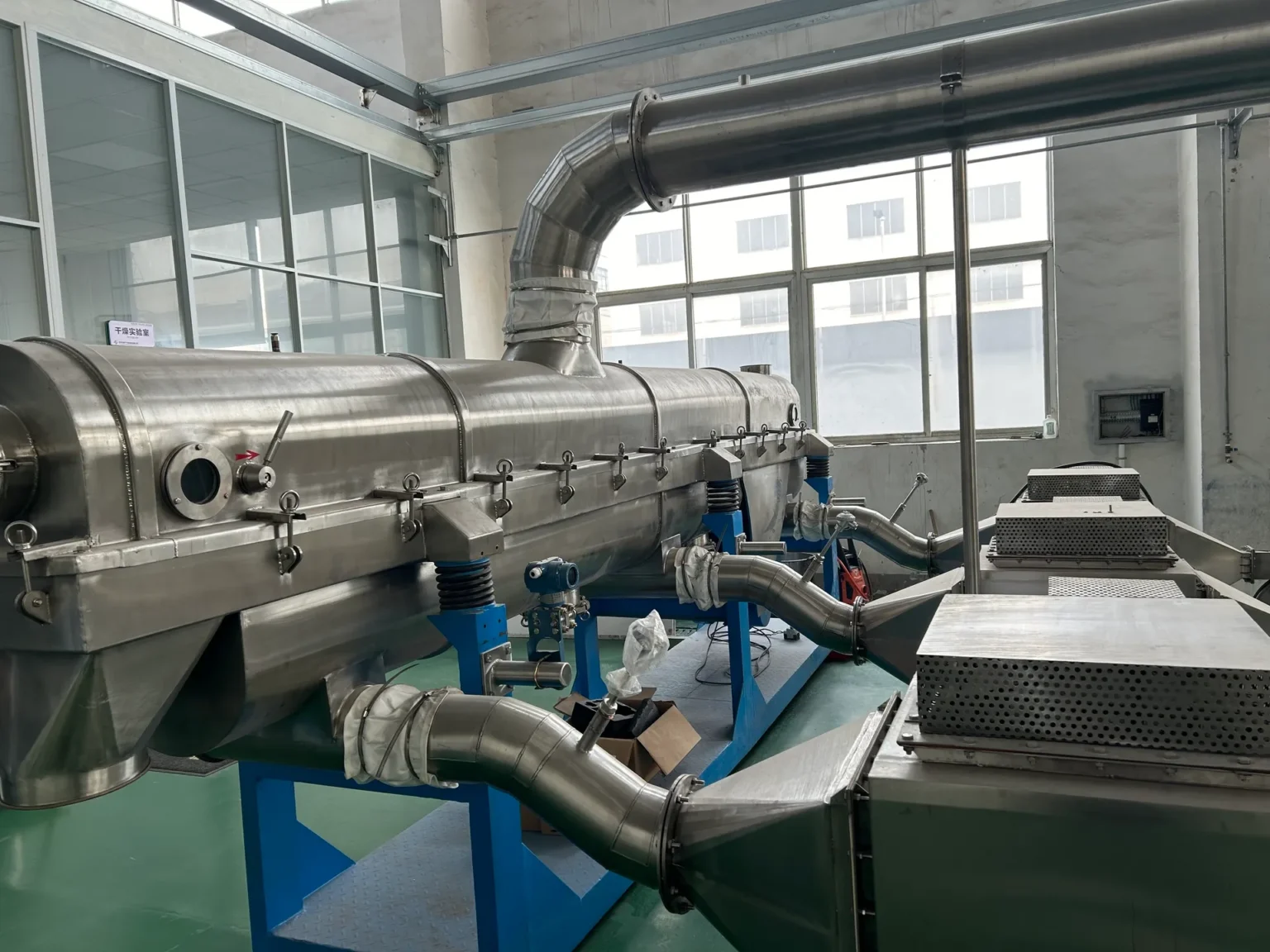
- Sticky or high-moisture feeds often need a vibrating fluid bed rather than a conventional static one, because vibration keeps borderline material moving that plain airflow cannot.
A manufacturer who can test your actual material tells you, before you order, whether you need a conventional fluid bed, a vibrating one, or a different dryer type entirely. One who cannot is pricing a box, not a process.
What to evaluate in a fluid bed dryer manufacturer
1. Fluidization testing capability
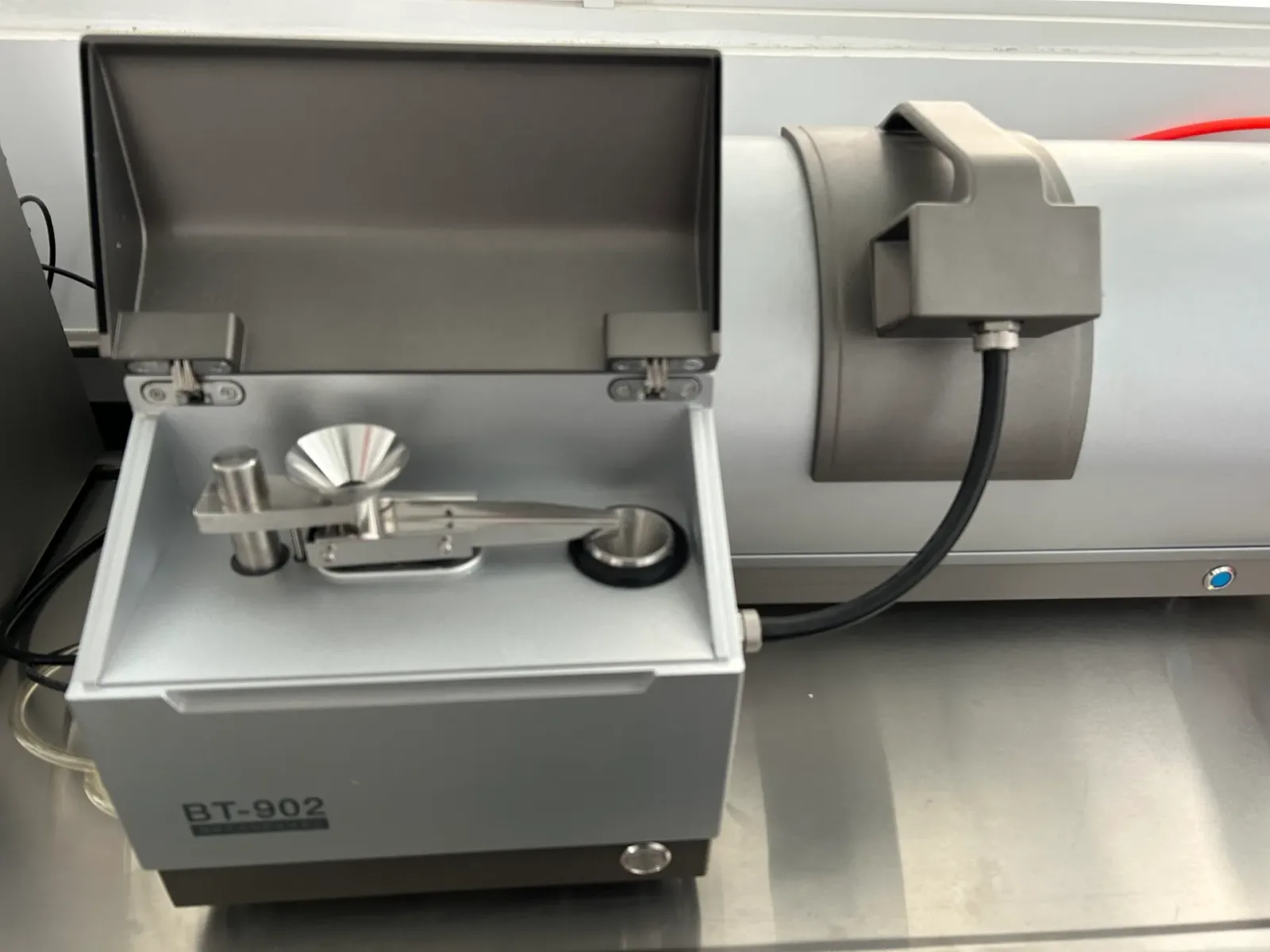
Ask for: a trial run on your actual material, not a similar one; a written deliverable — air velocity, bed temperature, moisture curve and observed fluidization behaviour; and whether the trial is chargeable.
A passing answer treats the trial as an engineering service with a defined output, stated in advance. Expect it to be paid — an instrumented trial consumes lab time and instrumentation hours. A fee is not a warning sign; a trial promised with no defined deliverable is.
Slow down if the "lab" is a partner facility they cannot schedule, the trial can only run on a substitute material of their choosing, or the result comes back as verbal reassurance plus a quotation rather than a document your process team can check.
2. Batch and continuous experience
Batch units suit pharmaceutical granules and plants that change products frequently; continuous units suit high-throughput single-product runs in food, chemical or mineral processing. Ask which the supplier has actually delivered — not which configuration they list on a brochure.
| Batch fluid bed | Continuous fluid bed | |
|---|---|---|
| Best for | Pharma granules, frequent product changeover, smaller volumes | High-throughput food, chemical, mineral powders |
| Changeover | Straightforward; suits multi-product plants | Slower; suited to single-product runs |
| Validation | Easier to document per GMP batch record | Needs continuous-process control and monitoring |
Deciding this before you shortlist narrows the supplier pool considerably — the equipment differences behind this choice are covered in the fluid bed dryer guide.
3. Vibrating fluid bed capability
Not every supplier builds vibrating units, and the capability matters for wide particle-size ranges, sticky feeds, and materials that will not fluidize cleanly in a conventional static bed. Ask for a reference application, not just a product photo. Our vibrating fluid bed dryer for coconut powder case shows one such material where vibration made the difference.
4. Filtration and dust handling
Bag filter design, cleaning mechanism and fines recovery are where product yield is won or lost. Ask how the filter is cleaned (pulse-jet, mechanical shaking), how frequently, and what fraction of fines typically reports to the filter versus the product outlet for a material like yours.
5. GMP capability for pharmaceutical duty
If you are drying pharmaceutical granules, ask about product-contact surface finish, CIP/WIP provision, containment at charge and discharge points, and the documentation package — material certificates, IQ/OQ support, drawings.
6. ATEX / explosion protection
Essential for combustible powders. Ask for the design basis — dust classification, the standard the design follows (ATEX in the EU, NEC/NFPA in North America, corresponding standards elsewhere), and which protective measures (inerting, explosion venting, isolation) are included — not just a verbal claim that the unit is "ATEX compliant."
7. Integration with granulation or coating
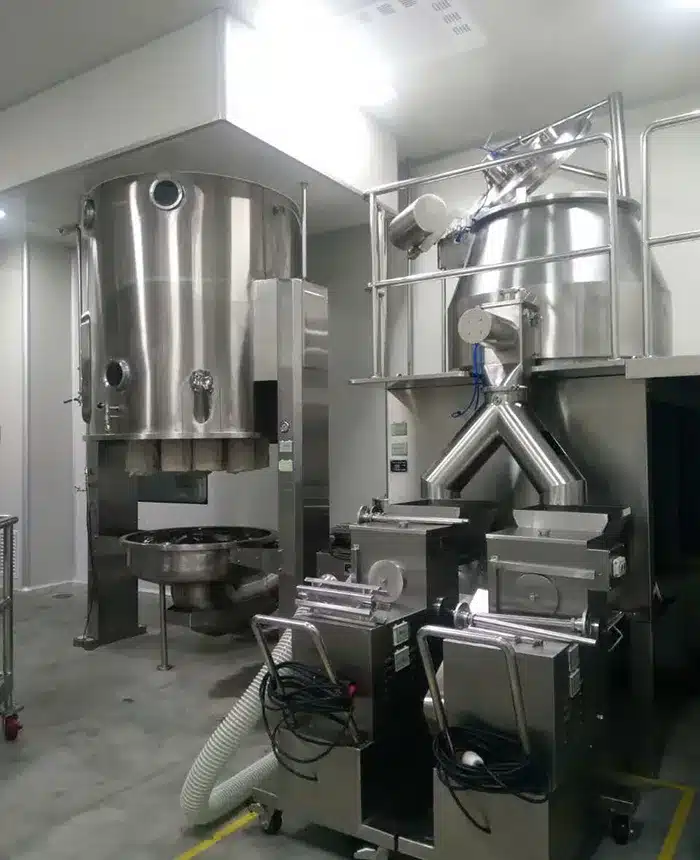
Many processes combine fluid bed drying with granulation or coating in a single unit. Ask whether the supplier engineers integrated systems or only sells standalone dryers — the answer tells you whether they think in terms of your process or just your machine. See our fluid bed granulator range for what an integrated line looks like.
Bring every quotation onto one baseline
Fluid bed dryer quotations are hard to compare because scope boundaries genuinely differ between suppliers — some quote a drying chamber, some quote a full system. Issue a one-page scope sheet and require every supplier to mark each line included / optional / excluded:
- Capacity as kilograms of water evaporated per hour, with the inlet air temperature and target outlet moisture it assumes — not feed rate alone
- Distributor plate design and whether it is specified for your particle size or supplied as standard
- Air heater, including energy source
- Filter type, cleaning mechanism, and number of stages
- Control system: panel, PLC, instrumentation, recipes, data logging
- Explosion-protection measures, itemised, for your dust classification
- Documentation package
- Installation supervision, commissioning, operator training
- Spare parts kit, itemised
A bottom-line number only means something once every supplier has answered the same lines.
Red flags to watch for
None of these means a supplier is untrustworthy. Each means you need one more answer before proceeding.
- 1.No interest in testing your material. Fluidization behaviour is material-specific; a supplier who will not test is transferring all the risk to you.
- 2.A distributor plate presented as one-size-fits-all. Plate design should reflect your particle size and density, not a standard part number regardless of material.
- 3.Throughput quoted with no moisture target attached. A kilograms-per-hour figure means nothing without the inlet and target outlet moisture it assumes.
- 4.Vague explosion-protection claims for a combustible powder. Ask for the design basis, not a checkbox.
- 5.No named after-sales owner. Support that lasts until the invoice clears is a real risk on equipment you will run for years.
Supplier evaluation checklist
| Area | Ask for | Passes when | Watch for |
|---|---|---|---|
| Fluidization testing | Trial on your material; written parameter report | Defined deliverable, stated fee | Partner lab; verbal results only |
| Batch/continuous experience | Units actually delivered, not just listed | Specific references named | Vague "we can do both" |
| Vibrating fluid bed | Reference application on a comparable material | Case evidence provided | No vibrating units ever built |
| Filtration | Cleaning mechanism, fines recovery rate | Explained with your material in mind | Generic "bag filter included" |
| GMP readiness | Surface finish, CIP/WIP, documentation | Itemised and demonstrable | "GMP compliant" with no detail |
| ATEX / explosion protection | Design basis, dust classification, measures | Specific standard and measures named | Verbal claim only |
| Integration | Standalone dryer vs full granulation line | Both offered, explained | Dryer-only supplier claiming full-line expertise |
| Quotation scope | Every line marked included / optional / excluded | All suppliers answer the same lines | Price compared before scope aligned |
Where SINOTHERMO fits
We would rather you applied this checklist to us than took our word for it. SINOTHERMO builds batch, continuous and vibrating fluid bed dryers, and integrates fluid bed drying with granulation where the process calls for it, from our own factory with 20+ years of experience in industrial drying. Our in-house pilot laboratory runs fluidization trials on your actual material and returns documented air velocity, temperature and throughput data — a paid engineering service you can use to size equipment, from us or anyone else. See the facility on the testing lab page.
Not sure your powder will fluidize cleanly? Send us a sample. We will test it and document the parameters you need to specify with confidence, ours included.
✉️ mark.gu@sinothermo.com · 📱 WhatsApp: +86 180 2197 2660 · 🌐 www.sinothermo.com · 💬 Request a pilot test
SINOTHERMO — Process Engineering Infrastructure.
Frequently asked questions
How do I choose a fluid bed dryer manufacturer?
Prioritise suppliers who will test your actual material's fluidization behaviour rather than a similar one, who can name specific batch and continuous units they have delivered, and who can demonstrate relevant compliance — GMP documentation for pharmaceutical duty, a named explosion-protection design basis for combustible powders.
Why does fluidization testing matter before buying a fluid bed dryer?
Because not all powders fluidize cleanly. Fine or cohesive materials can channel or agglomerate, and wide particle-size distributions can segregate, with fines reporting to the filter while coarse particles stay under-fluidized. A trial on your material reveals whether you need a conventional, vibrating, or different dryer type before you commit to a design.
What is the difference between a batch and continuous fluid bed dryer?
Batch units dry a fixed charge per cycle and suit pharmaceutical and multi-product plants with frequent changeovers, because the batch record is easier to document per GMP. Continuous units feed material through steadily and suit high-throughput single-product production in food, chemical or mineral processing.
Do I need a vibrating fluid bed dryer?
Possibly. Vibrating designs help with wide particle-size ranges, sticky feeds, and materials that will not fluidize cleanly in a conventional static bed, because the added motion keeps borderline material moving that plain airflow cannot. A fluidization test on your actual material is how you find out.
What should I ask about explosion protection for a combustible powder?
Ask for the dust classification the design assumes, the standard it follows — ATEX in the EU, NEC/NFPA in North America, corresponding standards elsewhere — and which specific protective measures are included, such as inerting, explosion venting or isolation. A verbal assurance that a unit is "ATEX compliant" is not the same as a stated design basis.
How do I compare fluid bed dryer quotations that are scoped differently?
Issue a one-page scope sheet and require each supplier to mark every line included, optional or excluded: capacity as water evaporated per hour with its assumed inlet temperature and target moisture, distributor plate design, filter type and cleaning mechanism, control system, explosion-protection measures, documentation, installation and commissioning, and the spare parts kit. Compare bottom-line prices only once every supplier has answered the same lines.

Mark Gu
Passionate about enhancing customer experiences and streamlining operations, Mark focuses on building strong relationships, fostering innovation, and leading teams to achieve exceptional service and efficiency.
Email: mark.gu@sinothermo.com
Phone: +86 18021972660