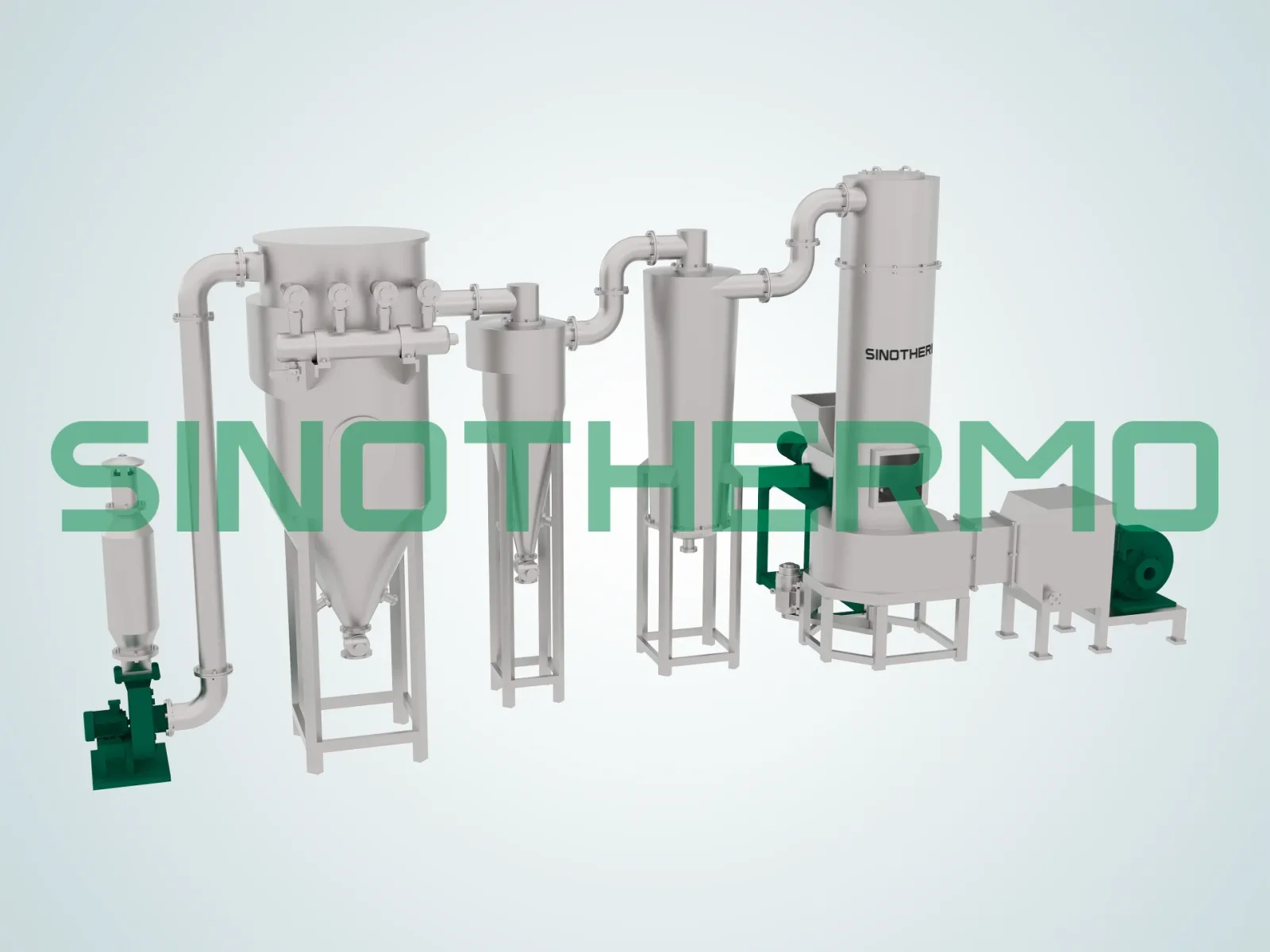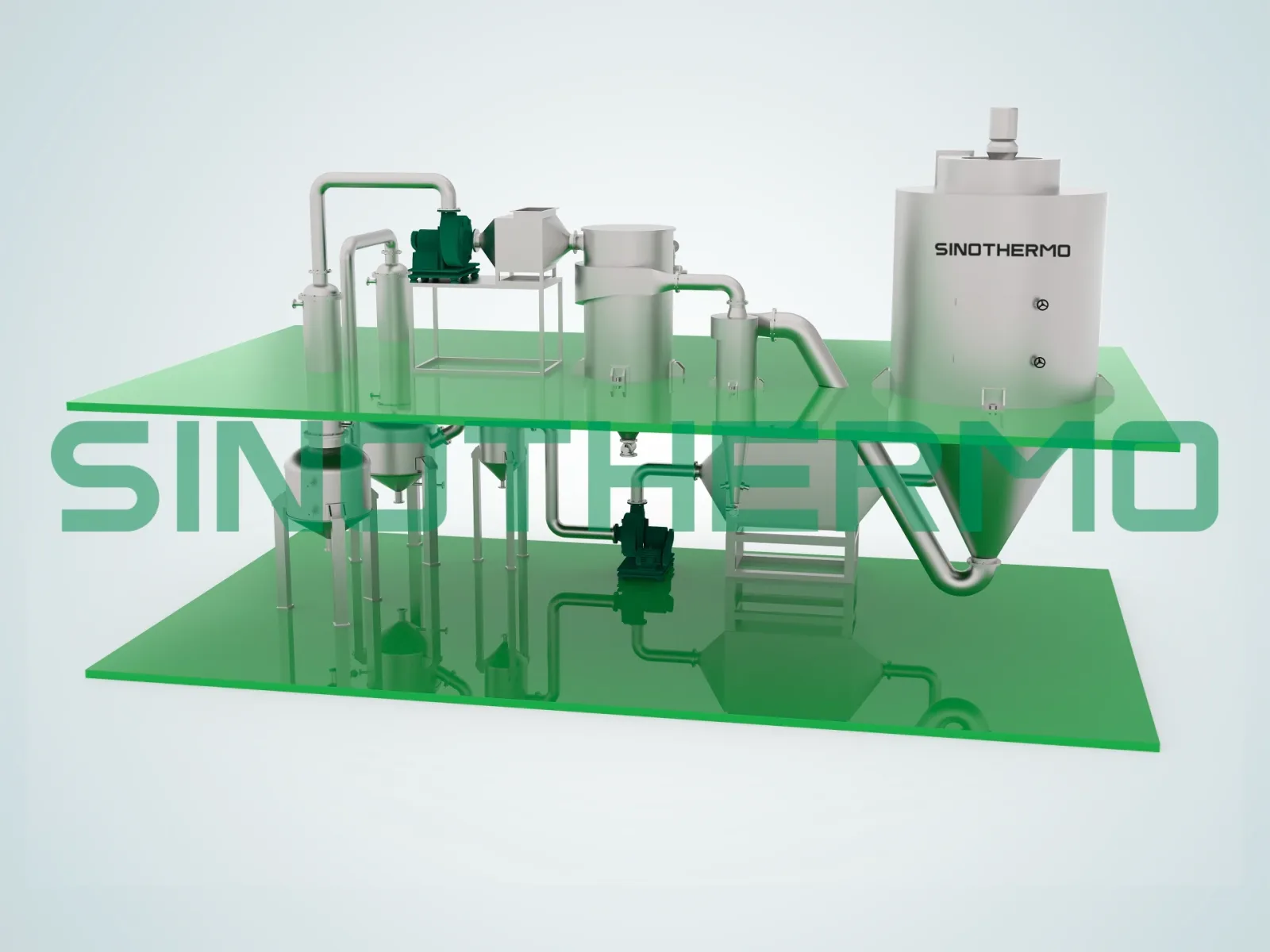
A closed loop spray dryer circulates an inert gas, usually nitrogen, through the drying chamber instead of venting hot air to atmosphere. Because the gas carries almost no oxygen, it can dry feeds that contain flammable organic solvents or oxygen-sensitive actives, and because the loop is sealed, the evaporated solvent can be condensed and recovered rather than released.
If your feed is a water-based solution, you do not need one. A conventional open-cycle spray dryer is cheaper, simpler and well understood. A closed loop system earns its place in a narrow set of cases: the liquid you are spraying contains ethanol, acetone, isopropanol or another organic solvent; the powder oxidises when it meets hot air; or environmental rules mean the solvent cannot be vented. This guide explains how the loop works, where it fits, and what to ask before you buy.
Quick Context: why open-cycle drying stops working with solvents
In an open-cycle spray dryer, ambient air is heated, passes through the chamber, picks up the evaporated water, and leaves through a filter and exhaust fan. That is fine for water. It becomes dangerous when the evaporated liquid is a flammable solvent, because the exhaust stream is then a mixture of air and solvent vapour. Anywhere that mixture sits between its lower and upper explosive limits and meets an ignition source, such as a static discharge or a hot surface, you have a fire or explosion hazard.
There are two ways to remove that hazard. You can control the vapour concentration, which is hard to guarantee across a whole batch. Or you can remove the oxygen, which makes ignition impossible whatever the solvent concentration. The closed loop design takes the second route.
How a closed-loop spray dryer works
The basic sequence is the same as any spray dryer: atomise the feed, contact the droplets with hot gas, evaporate, separate the powder. What changes is everything around the gas.
- 1.Inert gas supply — the system is purged with nitrogen until the oxygen level falls below a set limit, commonly monitored by an oxygen analyser that interlocks with the heater and feed pump. The exact limit depends on the solvent and your safety standard, so treat any figure in a quotation as something to confirm against your own risk assessment.
- 2.Heating and drying — the circulating gas is heated, then enters the chamber, where it meets the atomised feed. Solvent and any water evaporate into the gas.
- 3.Powder separation — a cyclone and, where needed, a bag filter separate the dry powder. The gas, now carrying solvent vapour, leaves the powder collection stage.
- 4.Condensation and solvent recovery — the gas passes through a condenser, where the solvent is cooled below its dew point and collected as liquid. The stripped gas is reheated and sent back to the chamber.
- 5.Make-up and pressure control — a small amount of fresh nitrogen replaces losses, and the loop is held at a controlled slight pressure so air cannot leak in.
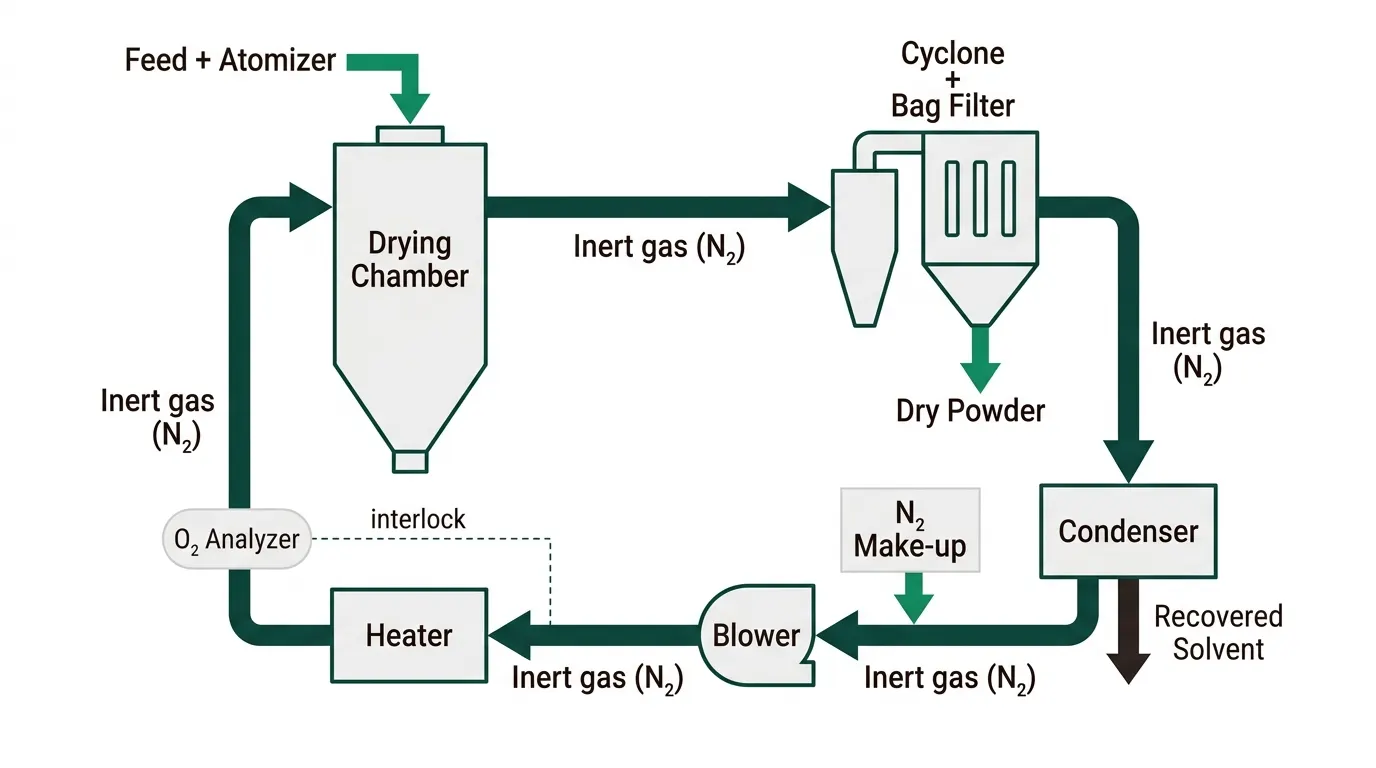
SINOTHERMO's closed circulation spray dryer is built on this principle: a sealed inert-gas loop, solvent recovery from the feed, and an anaerobic, explosion-proof design. It delivers powder at 3 to 8 percent moisture across an inlet gas range of 100 to 300 °C, which is comparable to conventional spray drying performance.
Where a closed loop spray dryer is worth the extra cost
A closed loop system costs more than an open-cycle machine of the same evaporation capacity. It needs a condenser, a nitrogen supply, an oxygen analyser, a gas-tight chamber and a more involved control system. Choose it only when one of these applies.
Solvent-based feeds. Resin solutions, coating polymers, pigment suspensions prepared in solvent carriers, and many specialty chemical intermediates are dissolved or dispersed in organic solvent. Spraying them with air is not an option.
Oxygen-sensitive products. Some actives oxidise at drying temperature even when the liquid is aqueous. Certain cosmetic actives, bio-based materials and fine chemicals lose activity or change colour in the presence of oxygen. An inert loop protects them.
Pharmaceutical intermediates. Spray drying is widely used to make amorphous solid dispersions, which are commonly prepared in organic solvent mixtures. If you are developing this kind of product, see our overview of pharmaceutical spray drying for the process background.
Solvent value or compliance. If the solvent is expensive, or if venting it would breach emission limits, recovery pays for part of the equipment and removes a compliance problem.
Battery and advanced materials. Some precursor and electrode slurries use organic solvents and are sensitive to moisture and oxygen. Our article on inert gas drying for battery materials covers the wider picture, and solvent recovery in vacuum rotary drying shows the alternative when the material is a paste rather than a sprayable liquid.
Closed loop vs open cycle: the comparison
| Factor | Open-cycle spray dryer | Closed loop spray dryer |
|---|---|---|
| Drying gas | Heated ambient air | Recirculated nitrogen or other inert gas |
| Suitable feeds | Aqueous solutions, slurries, emulsions | Organic solvents, flammable feeds, oxygen-sensitive feeds |
| Solvent handling | Vented or scrubbed | Condensed and recovered |
| Oxygen in chamber | Ambient level | Held below a set limit by analyser |
| Relative capital cost | Lower | Higher (condenser, gas system, sealing, analyser) |
| Running cost | Air heating and fan power | Nitrogen make-up, condenser cooling, reheating |
| Main risk | Explosive mixture with solvents | Air leakage into the loop |
The running cost point is often missed. A closed loop cools the gas to condense the solvent and then reheats it, so the energy balance differs from an open cycle, and the cooling duty depends on the solvent and the evaporation rate. Ask the supplier for a utility sheet that covers nitrogen consumption, cooling water or chiller load, and heating power, rather than only the heater rating.
What to specify before you request a quotation
Equipment suppliers can only size a closed loop system if they know your material. Gather these points first.
The solvent system. Name every solvent and its approximate ratio in the feed. Boiling point, flash point, and whether it is miscible with water all affect the condenser design and the gas temperature.
Solids content and viscosity. These decide the atomiser choice and the achievable throughput. A dilute, low-viscosity feed can be sprayed through a nozzle. A viscous or high-solids feed may need a different atomiser. For atomiser trade-offs, read our guide to spray dryer atomization.
Thermal limits of the product. The maximum product temperature, glass transition temperature if the product is amorphous, and degradation temperature set the inlet and outlet limits.
Target powder properties. Particle size, bulk density, residual solvent limit and residual moisture. Residual solvent in particular may be a regulatory specification, and it often needs a secondary drying step after the spray dryer.
Capacity. State the feed rate you want to process, in litres or kilograms per hour. Evaporation capacity depends on the solvent, because a solvent with a lower latent heat evaporates faster per unit of heat input than water does, so water-based capacity figures cannot be copied across directly.
Site and safety conditions. Hazardous-area classification, available nitrogen supply, cooling utilities, and applicable standards for your market.
Common mistakes to avoid
Buying a closed loop machine for an aqueous feed. If there is no solvent and no oxygen sensitivity, the extra complexity gives you nothing. Use a standard system such as the pressure spray dryer or centrifugal spray dryer.
Treating "explosion-proof" as a single feature. Explosion protection is a system property. It depends on oxygen control, ignition source control, grounding of powder-handling parts, venting or suppression design, and the area classification. Ask which of these the supplier includes, and which remain your responsibility.
Ignoring powder handling after the dryer. A powder that leaves the chamber under nitrogen may still contain residual solvent. Collection vessels, transfer lines and packaging need the same care as the dryer itself.
Skipping the trial. Solvent feeds behave differently from water feeds. Droplet drying rate, skin formation and particle morphology all change. A trial on your own material gives you residual solvent data, powder properties and scale-up parameters before you commit capital. Our testing laboratory runs paid pilot trials for this purpose, and the report you receive supports both your specification and your safety case.
Underestimating sealing. Any air leak raises the oxygen level and trips the interlock. Ask about the sealing design, the oxygen monitoring method, and how the system behaves on a power failure.
How to de-risk the decision
Start with the feed, not the machine. Write down the solvent, the solids and the product limits. Then decide whether you need full solvent recovery, only oxygen exclusion, or both. Finally, test. A pilot run on your material gives measured numbers for inlet and outlet temperature, powder moisture and residual solvent, which is what a safe and economical full-scale design is built from.
If you are still deciding between spray drying and other approaches for a solvent-wet product, read how vacuum drying with solvent recovery compares, and use the spray dryer machine guide for general selection principles.
Conclusion
A closed loop spray dryer is the right tool when the feed is solvent-based or oxygen-sensitive and the powder has to come out dry, free-flowing and safe to handle. It trades higher equipment cost for safe operation and solvent recovery. Define your solvent system and product limits first, confirm utilities and safety requirements, and validate on a real sample before specifying the full machine.
Next step: Request a pilot test with your own feed, and our engineers will recommend a loop configuration based on the results. Pilot testing is a paid service.
Frequently asked questions
What is the difference between a closed loop spray dryer and a standard spray dryer?
A standard spray dryer heats ambient air, passes it through the chamber once and vents it. A closed loop spray dryer recirculates an inert gas such as nitrogen in a sealed circuit, which removes oxygen and lets the evaporated solvent be condensed and recovered.
Can a closed loop spray dryer handle flammable solvents like ethanol or acetone?
Yes, that is its main purpose. Keeping the oxygen level below a set limit with an analyser and interlocks removes the oxygen needed for combustion. The exact limit and safety design should be confirmed against your solvent and local standards.
Does a closed loop spray dryer recover the solvent?
Yes. The gas leaving the powder collector passes through a condenser, where the solvent is cooled to a liquid and collected. The cleaned gas is reheated and returned to the chamber. The recovery rate depends on the solvent and the condenser design.
What inlet temperature does a closed circulation spray dryer use?
SINOTHERMO's closed circulation spray dryer operates across an inlet gas range of 100 to 300 °C and produces powder at 3 to 8 percent moisture. The temperature you actually use depends on your solvent and the thermal limits of your product.
Is a closed loop spray dryer more expensive to run than an open cycle dryer?
Usually yes. You pay for nitrogen make-up, condenser cooling and reheating the circulating gas. Part of that can be offset if the recovered solvent has value or if recovery lets you meet emission limits.
Do I need a closed loop spray dryer for an aqueous feed?
Normally not. If the feed is water-based and the product is not oxygen-sensitive, an open-cycle spray dryer is simpler and cheaper. A closed loop is justified by solvent content, oxygen sensitivity or emission rules.
How do I know the right size for my project?
Provide the solvent system, solids content, feed rate and product limits. A pilot trial on your own material gives the measured data needed to size a production machine. Pilot testing is a paid service, and you can request one through our contact page.

Mark Gu
Passionate about enhancing customer experiences and streamlining operations, Mark focuses on building strong relationships, fostering innovation, and leading teams to achieve exceptional service and efficiency.
Email: mark.gu@sinothermo.com
Phone: +86 18021972660