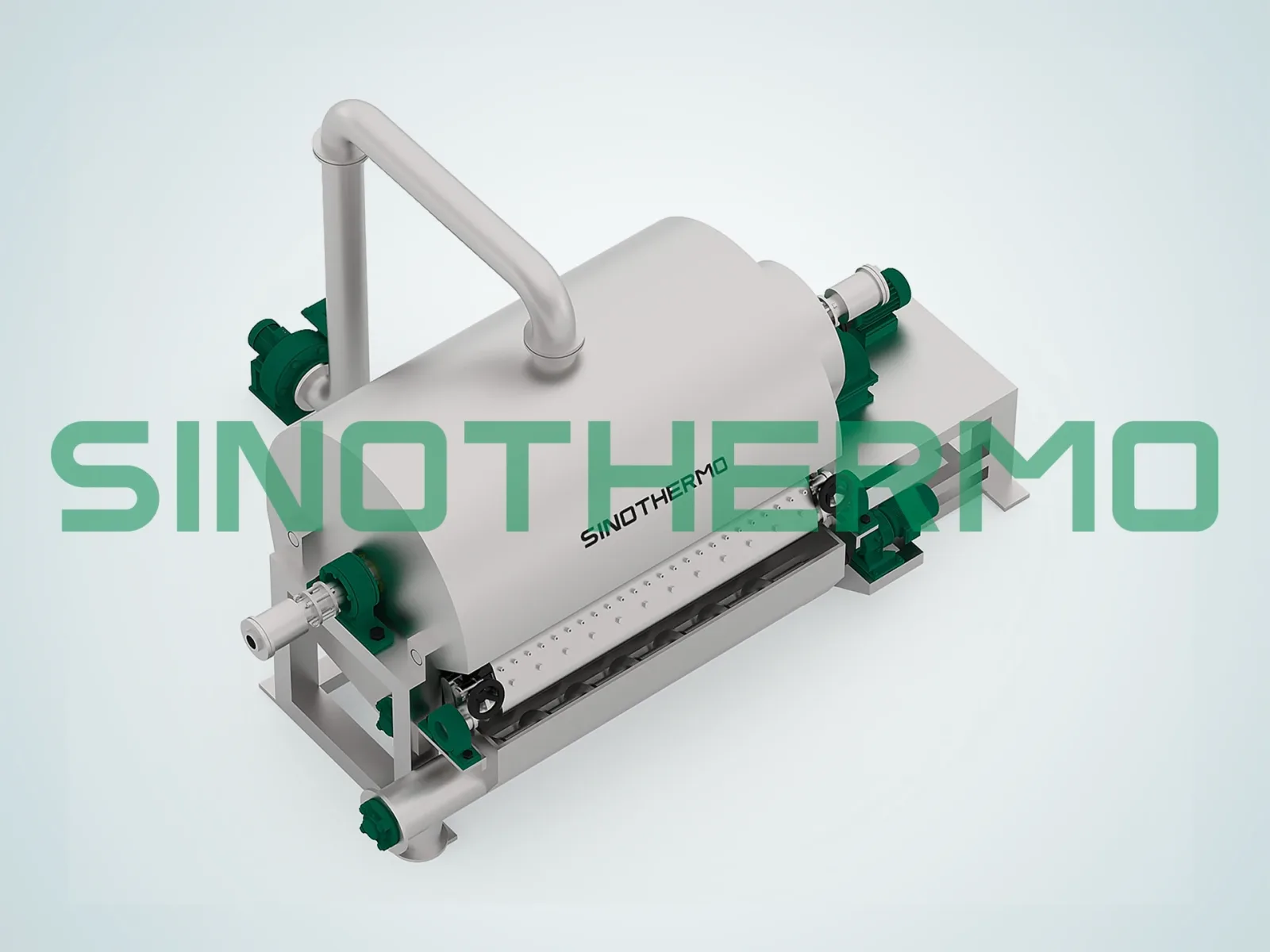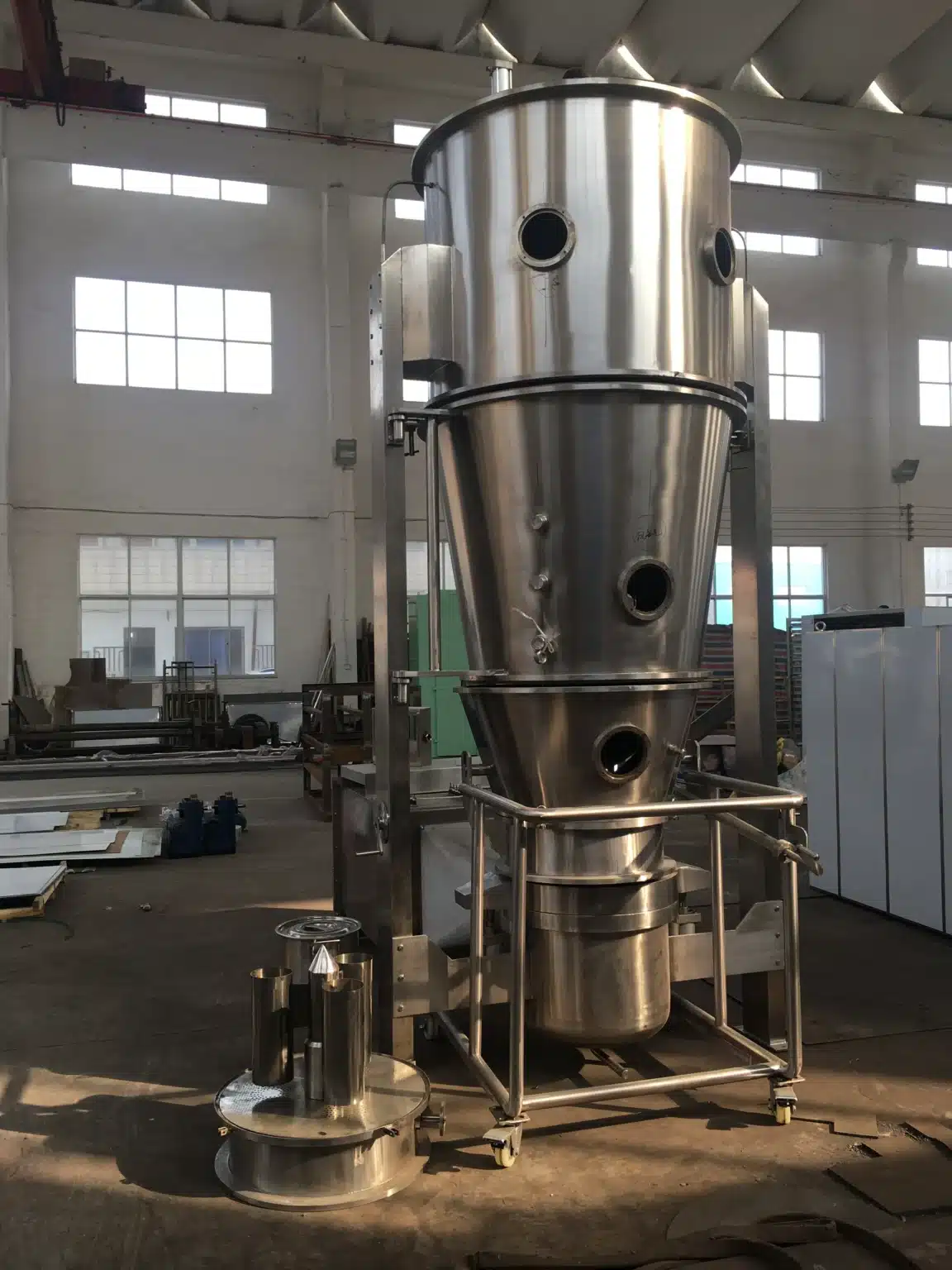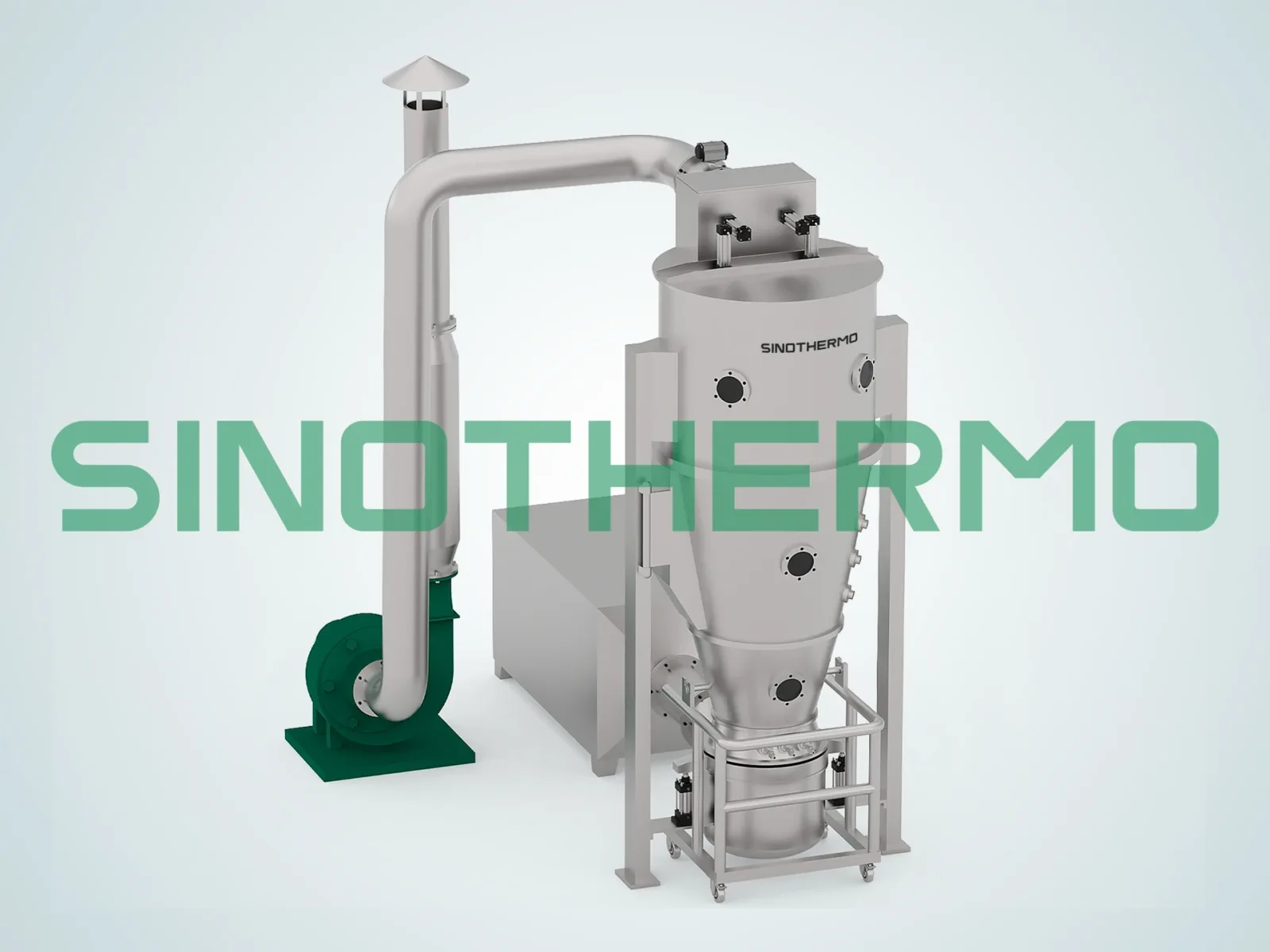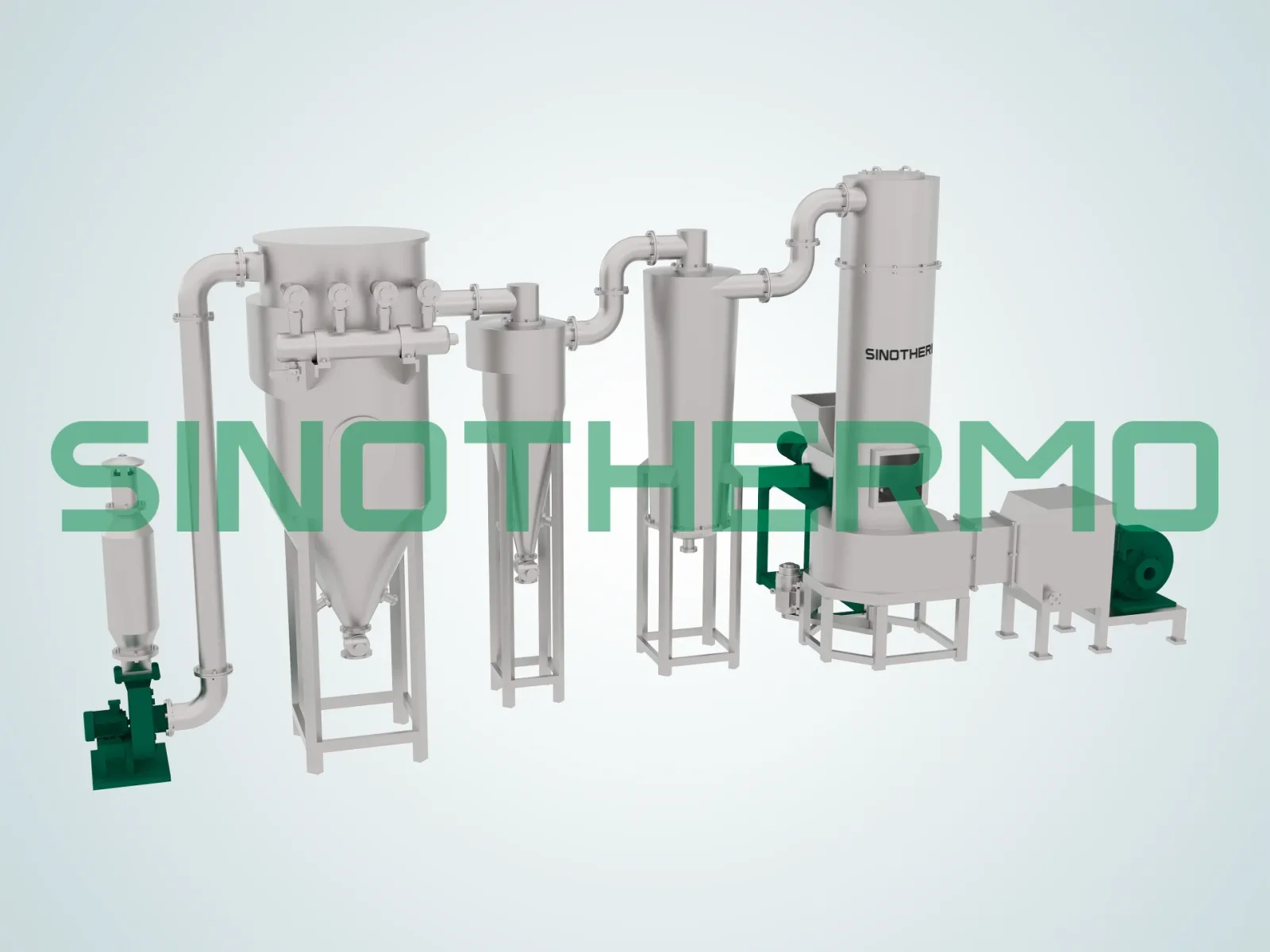
A spin flash dryer combines a mechanical agitator, a classifying air stream, and flash drying in a single vessel. A rotor at the base breaks up incoming paste or filter cake while hot air entering tangentially dries the fragments and carries the fine, dried particles upward — coarse wet lumps stay behind until they're small and dry enough to be lifted. Residence time for the product that leaves is only seconds.
Its value is that it replaces what would otherwise be a multi-step train: pre-breaker, feeder, dryer, and mill. One machine takes a stiff cake in and delivers dry powder out.
Quick context: the recurring pattern behind this purchase
The spin flash dryer shows up downstream of the same upstream step again and again: a filtration or centrifugation process produces a wet cake, and that cake has to become a handleable powder. Pigments, dyes, inorganic salts, catalysts, clays — the chemistry varies enormously, but the shape of the problem is identical. Without a spin flash dryer, that conversion typically needs a pre-breaker to reduce lump size, a feeder that can meter stiff cake consistently, a drying step, and a mill afterward to hit final particle size. The spin flash dryer's real value proposition is collapsing that four-step train into one vessel.
How it works
- 1.Feed — paste, filter cake, or sludge enters near the bottom via a screw or pump, straight into the agitated zone.
- 2.Mechanical disintegration — a rotor spinning close to the chamber wall breaks up lumps and prevents material from sticking and building up. This is what lets the machine accept material far too stiff and cohesive for a conventional flash or spray dryer.
- 3.Tangential hot air entry — heated air enters tangentially at the base, creating a swirling, rising flow.
- 4.Built-in classification — this is the elegant part. Only particles that are small enough and dry enough get carried upward by the air. Heavier wet lumps fall back into the rotor zone to be broken down further. The dryer therefore self-selects: nothing leaves until it meets both criteria.
- 5.Flash drying in transit — particles dry in seconds while rising through the hot gas.
- 6.Classifier and collection — an adjustable classifier at the top sets the maximum particle size that escapes; product is collected in a cyclone and/or bag filter.
The combination of mechanical disintegration plus aerodynamic classification is the design's real contribution. It is why a spin flash dryer handles feeds that would plug a pneumatic flash dryer and can't be atomised by a spray dryer.
Why residence time in seconds matters
Because dried product leaves within seconds of becoming dry, the material's thermal exposure is minimal despite high inlet air temperatures (often 150–400 °C).
This surprises people: inlet air can be very hot, yet the product stays cool. While free moisture is evaporating, the particle sits near the gas wet-bulb temperature — evaporative cooling holds it there. The particle only approaches gas temperature once it's dry, and by then it's already leaving. So many heat-sensitive materials dry successfully in a spin flash dryer, which is exactly the same principle that lets spray dryers handle heat-sensitive feeds.
The corollary: outlet temperature is the control variable that matters, not inlet. Inlet temperature sets capacity; outlet temperature determines product moisture and thermal exposure.
Compared with the alternatives
| Spin flash dryer | Pneumatic flash dryer | Spray dryer | Paddle / rake vacuum | |
|---|---|---|---|---|
| Feed | Paste, filter cake, sludge | Free-flowing wet powder | Pumpable liquid | Paste, cake |
| Pre-breaking needed | No — built in | Yes | No | No |
| Residence time | Seconds | Seconds | Seconds | Hours |
| Product | Powder (size-classified) | Powder | Powder, engineered particles | Preserves particles |
| Operation | Continuous | Continuous | Continuous | Batch |
| Footprint | Compact | Tall ducting | Large chamber | Moderate |
| Solvent recovery | Difficult | Difficult | Needs closed loop | Straightforward |
| Best when | Cake → powder, one step | Feed already granular | Liquid → controlled particles | Heat-sensitive, solvent-wet |
Against a pneumatic flash dryer: the spin flash handles sticky, cohesive cake that a pneumatic unit can't accept without upstream breaking. If your feed is already free-flowing, a pneumatic dryer is simpler and cheaper.
Against a spray dryer: the spin flash takes feeds that can't be pumped or atomised, and has a much smaller footprint. But it gives far less control over particle size and morphology — if particle engineering is the point, use a spray dryer. See our pharmaceutical spray drying guide for that comparison in a regulated context.
Against vacuum paddle or rake: the spin flash is continuous, dramatically faster, and cheaper per tonne. But it's a hot-air dryer: no meaningful solvent recovery, no oxygen exclusion, and higher (if brief) thermal exposure. For solvent-wet or oxygen-sensitive material, vacuum wins — see our vacuum rake vs paddle dryer comparison.
Applications
Chemical — pigments and dyes, inorganic salts, catalysts, kaolin and clays, calcium carbonate, precipitated silica, agrochemical actives. This is the dominant market: filter cake in, dry powder out.
Minerals — fine mineral concentrates and processed clays.
Food — starch and modified starches, plant proteins, some fibre products; wet cakes from separation that need to become powder.
Pharmaceutical and fine chemical — intermediates that tolerate brief thermal exposure and are supplied as a wet cake.
Environmental — drying sludges for volume reduction and disposal-cost saving.
The recurring pattern: a filtration or centrifugation step produces a cake, and that cake has to become a handleable powder. That's the spin flash dryer's job.
What to specify
- Guaranteed evaporation rate at your feed moisture and target outlet moisture — on your material
- Inlet and outlet temperature range, and which is used for control (outlet should be)
- Rotor design, speed and drive power — the disintegration duty depends on cake strength
- Classifier type and adjustability — this sets top particle size
- Feed system matched to your cake consistency — screw, pump, or piston; a feeder that can't deliver stiff cake consistently will limit the whole plant
- Air heating source — direct gas fired, indirect, steam, or electric
- Product collection — cyclone, bag filter, or both, plus fines recovery
- Exhaust treatment — scrubber or filtration if required by your emissions permit
- Explosion protection — most dried organic powders are combustible; confirm ST class and protection concept
- Materials of construction for abrasive or corrosive duty
- Wear parts — rotor, liner — and their expected life with your material
- Cleaning access for product changeover
- Trial on your actual cake, at its real moisture and consistency
The specification error to avoid
Quoting on evaporation rate without agreeing the feed consistency. A spin flash dryer's throughput is limited by two different things: the air's capacity to evaporate water, and the rotor's capacity to disintegrate the cake. Which one binds depends on how stiff and cohesive your cake is.
Two suppliers can quote the same evaporation rate while assuming quite different feed consistencies — and the one whose assumption is wrong will underperform badly in practice. Always state your cake's moisture content and consistency, and ask which constraint governs at that condition.
Common mistakes to avoid
- Quoting evaporation rate without stating feed consistency. The number is meaningless without knowing whether the air or the rotor governs throughput at your material's actual stiffness.
- Assuming a feeder designed for one cake consistency will handle another. A feeder that can't meter your cake consistently limits the entire plant regardless of how capable the dryer itself is.
- Treating rotor and liner wear as an afterthought. These are wear parts on an abrasive duty; their expected life with your specific material should be part of the initial specification conversation, not a surprise a year in.
- Expecting fine particle-size control from a classification-only system. The classifier sets a maximum size, not a tight distribution — if your product needs engineered particle characteristics, this isn't the technology for that.
- Skipping a trial because the material "should" behave like a similar one. Disintegration and drying behaviour are specific to the actual cake — chemically similar materials can behave very differently once a rotor and hot air are involved.
Where SINOTHERMO fits
We build spin flash dryers along with the spray dryers, fluid beds, and vacuum dryers they compete against — so if your feed turns out to be better suited to a different machine, we can tell you that.
Two things need measuring for this technology, and neither is predictable from composition: how your cake disintegrates, and the drying curve at the resulting particle size. Our pilot lab runs your material at its real moisture and consistency, and reports achievable outlet moisture, particle size distribution, evaporation rate per unit, which constraint governs throughput, and product quality. Pilot testing is a paid pre-sales engineering service and you keep the full report — the data you need to compare any supplier's quotation properly.
Frequently asked questions
What is a spin flash dryer used for?
Drying pastes, filter cakes, and sludges directly into powder in one continuous step — pigments, dyes, inorganic salts, catalysts, clays, starches, plant proteins, and agrochemicals. It's typically installed downstream of a filter or centrifuge, where a wet cake has to become a handleable dry powder.
How is a spin flash dryer different from a normal flash dryer?
A conventional pneumatic flash dryer needs free-flowing wet material and separate upstream equipment to break up lumps. A spin flash dryer has a rotor built into its base that disintegrates stiff, sticky cake as it enters, plus aerodynamic classification so only particles that are small and dry enough leave. It accepts feeds a pneumatic dryer cannot.
Can a spin flash dryer handle heat-sensitive materials?
Often yes, despite inlet air temperatures of 150–400 °C. While free moisture evaporates, the particle stays near the gas wet-bulb temperature through evaporative cooling, and dried product leaves within seconds. Outlet temperature — not inlet — determines the actual thermal exposure.
What is the residence time in a spin flash dryer?
Seconds for the product that leaves. Coarse or still-wet lumps remain in the agitated zone and are recirculated until they're small and dry enough for the air stream to carry them upward, so the machine self-selects what exits and when.
Spin flash dryer or spray dryer — which should I choose?
Choose the spin flash dryer when the feed is a paste or filter cake that can't be pumped or atomised, and when footprint matters. Choose the spray dryer when the feed is a pumpable liquid and you need control over particle size, bulk density, or morphology, since the spin flash dryer offers little particle engineering.
Cake disintegration behaviour decides whether this machine suits your feed — and whether air or rotor limits your throughput. We'll measure both.
✉️ mark.gu@sinothermo.com · 📱 WhatsApp: +86 180 2197 2660 · 🌐 www.sinothermo.com · 💬 Request a pilot test
SINOTHERMO — Process Engineering Infrastructure.

Mark Gu
Passionate about enhancing customer experiences and streamlining operations, Mark focuses on building strong relationships, fostering innovation, and leading teams to achieve exceptional service and efficiency.
Email: mark.gu@sinothermo.com
Phone: +86 18021972660