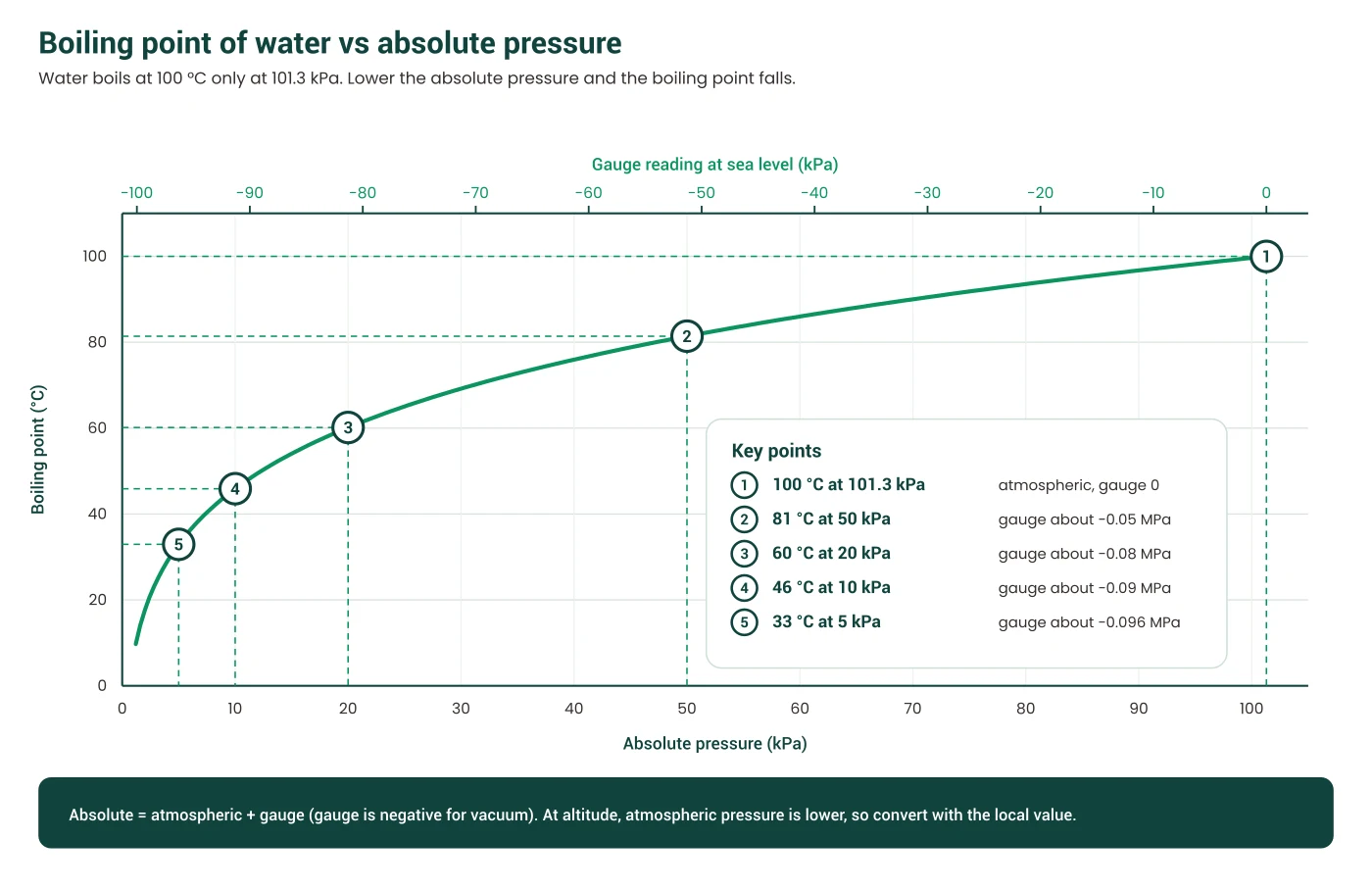
Water boils at 100 °C only at standard atmospheric pressure (101.325 kPa). Reduce the absolute pressure and the boiling point falls: about 81 °C at 50 kPa, 60 °C at 20 kPa, 46 °C at 10 kPa and 33 °C at 5 kPa. This is the physical reason vacuum dryers can dry heat-sensitive products at low temperature. The one trap is pressure units: a vacuum gauge reads relative to the atmosphere, while the boiling point depends on absolute pressure.
Quick Context: why engineers care
A liquid boils when its vapour pressure equals the pressure above it. Lower the pressure above water and the boiling point drops with it. Vacuum drying uses this to evaporate water or solvent from a product at a temperature the product can tolerate. A material that would degrade at 100 °C can be dried at 45 to 60 °C under moderate vacuum, with a heated surface only slightly above that.
This page gives the numbers you need to choose a vacuum level, and explains the gauge and absolute pressure conversion that causes many specification errors. If you are choosing equipment, the next step is vacuum drying equipment: how to choose by material, and for the general principles see the industrial vacuum dryer guide.
Boiling point of water vs absolute pressure
The values below are calculated from the Antoine equation for water between 1 and 100 °C. They are accurate to a fraction of a degree for engineering use.
| Absolute pressure (kPa) | Absolute pressure (mbar) | Boiling point of water (°C) |
|---|---|---|
| 101.3 | 1013 | 100.0 |
| 90 | 900 | 96.7 |
| 80 | 800 | 93.5 |
| 70 | 700 | 90.0 |
| 60 | 600 | 86.0 |
| 50 | 500 | 81.4 |
| 40 | 400 | 75.9 |
| 30 | 300 | 69.2 |
| 20 | 200 | 60.1 |
| 15 | 150 | 54.0 |
| 10 | 100 | 45.9 |
| 7 | 70 | 39.1 |
| 5 | 50 | 32.9 |
| 3 | 30 | 24.1 |
| 2 | 20 | 17.6 |
Two things stand out. First, the curve is steep at low pressure: going from 20 kPa to 10 kPa lowers the boiling point by about 14 °C, while going from 100 kPa to 90 kPa lowers it by only 3 °C. Second, the lower you go, the bigger the vacuum pump, condenser and vapour line must be, because water vapour at low pressure occupies an enormous volume. At 5 kPa, one kilogram of water vapour fills about 28 cubic metres; at 20 kPa, about 7.7 cubic metres.
Gauge pressure vs absolute pressure
Most vacuum gauges on dryers read gauge pressure: the difference between the vessel pressure and the surrounding atmosphere. A gauge reading of -0.095 MPa means the vessel is 0.095 MPa (95 kPa) below atmospheric pressure. The pressure that determines the boiling point is the absolute pressure:
Absolute pressure = atmospheric pressure + gauge pressure (where gauge pressure is negative for vacuum)
At sea level, atmospheric pressure is 101.3 kPa. The table converts common gauge readings.
| Gauge reading (kPa) | Gauge reading (MPa) | Absolute pressure (kPa) | Water boiling point (°C) |
|---|---|---|---|
| 0 | 0 | 101.3 | 100.0 |
| -10 | -0.010 | 91.3 | 97.1 |
| -30 | -0.030 | 71.3 | 90.5 |
| -50 | -0.050 | 51.3 | 82.0 |
| -60 | -0.060 | 41.3 | 76.7 |
| -70 | -0.070 | 31.3 | 70.2 |
| -80 | -0.080 | 21.3 | 61.5 |
| -90 | -0.090 | 11.3 | 48.3 |
| -95 | -0.095 | 6.3 | 37.1 |
A "-0.09 MPa" vacuum sounds almost perfect, but it still leaves 11 kPa of absolute pressure and a boiling point of 48 °C. The last few kilopascals matter a lot, which is why the quality of the vacuum pump decides how low the drying temperature can go.
Altitude correction. If your plant is at altitude, atmospheric pressure is lower, so the same gauge reading means a deeper absolute vacuum. At 1,500 m, atmospheric pressure is about 84 kPa, so a gauge reading of -0.08 MPa corresponds to roughly 4 kPa absolute, not the 21 kPa you would get at sea level. Always convert using the local atmospheric pressure.
The formula behind the chart
The vapour pressure of water between 1 and 100 °C follows the Antoine equation:
log10(P) = A - B / (C + T)
with P in mmHg, T in °C, and for water A = 8.07131, B = 1730.63, C = 233.426. Rearranged for the boiling point at a given pressure:
T = B / (A - log10(P)) - C
To use it, convert your absolute pressure to mmHg (multiply kPa by 7.50062), then calculate. For example, at 20 kPa absolute: P = 150.0 mmHg, log10(P) = 2.176, so T = 1730.63 / (8.07131 - 2.176) - 233.426 = 60.1 °C. The result matches the chart.
For other solvents, the constants are different. Solvents with lower boiling points will boil at lower temperatures under the same vacuum, and mixtures follow different rules, so always use data for your actual solvent.
What this means for vacuum drying
Product temperature is not the heat source temperature
The boiling point tells you the temperature at which liquid evaporates at the surface of the product. It does not fix the temperature of the heating medium. In a conduction vacuum dryer, steam, hot water or thermal oil heats the jacket or agitator, and the product surface sits close to the boiling point while free moisture remains. The temperature difference between the heated surface and the evaporating liquid drives the heat flow, so a hotter heat source dries faster, within the limits of what the product tolerates.
SINOTHERMO's vacuum conduction dryers operate with heat source temperatures from 50 °C to 200 °C, depending on the model. The vacuum paddle dryer, vacuum rake dryer and vacuum horizontal disc dryer list 50 to 200 °C; the static vacuum cabinet dryer lists a heat source below 100 °C.
Choosing a vacuum level
A practical approach is to set the vacuum level from the maximum product temperature:
- 1.Find the highest temperature the product can safely reach while wet.
- 2.Choose an absolute pressure whose boiling point is a few degrees below that temperature.
- 3.Check that the vacuum pump and condenser can reach and hold that pressure at the vapour load.
For example, a product that must stay below 60 °C needs an absolute pressure below about 20 kPa, which is a gauge reading of about -0.08 MPa at sea level. A product limited to 45 °C needs about 10 kPa absolute, or about -0.09 MPa gauge.
Falling-rate drying
Once surface moisture has gone, the product temperature rises toward the heat source temperature, and the boiling point of free water no longer limits it. In the final stage, the vacuum helps by lowering the partial pressure of the remaining solvent, so bound moisture leaves at lower temperature than it would at atmospheric pressure. This is why a deeper vacuum is often used at the end of the cycle even if early drying can be done at a moderate vacuum.
Solvents
For solvent-wet products, the boiling point under vacuum determines whether the solvent can be condensed at the available coolant temperature. A solvent that boils at 40 °C under the chosen vacuum needs coolant colder than 40 °C in the condenser, usually well colder. If the condenser cannot condense the vapour, it reaches the pump. Check the solvent's vapour pressure curve before specifying the vacuum system. For a detailed look at the pump side, see vacuum pump and condenser sizing for vacuum dryers.
A worked example
The numbers are illustrative, not customer data.
A producer dries a heat-sensitive extract paste that begins to degrade above 55 °C. The vacuum dryer is at sea level.
- 1.A boiling point of about 50 °C leaves a safe margin. From the chart, 50 °C corresponds to roughly 12 kPa absolute.
- 2.At sea level, 12 kPa absolute is about -89 kPa gauge, or -0.089 MPa.
- 3.The pump must hold this level against the evaporating vapour. If the evaporation load is 300 kg of water per batch over 5 hours (60 kg/h), the vapour volume at 12 kPa is roughly 60 x 12.5 = about 750 m³/h, which the vacuum system must handle through the condenser. The condenser removes most of that vapour by condensing it, so the pump mainly handles non-condensables and the residual vapour.
This shows why a target product temperature sets a vacuum level, and the vacuum level sets the size of the condenser and pump.
Common Mistakes to Avoid
- 1.Using gauge pressure as if it were absolute. A -0.09 MPa reading is not 90 kPa absolute; it is about 11 kPa absolute.
- 2.Ignoring altitude. Atmospheric pressure at your site changes the conversion.
- 3.Assuming the product is at the boiling point throughout. After free moisture is gone, the product warms up.
- 4.Specifying a deep vacuum without a condenser. The vapour volume at low pressure is large, so the condenser does most of the work.
- 5.Using water data for solvents. Each solvent has its own vapour pressure curve.
- 6.Forgetting air leaks. Leakage limits the achievable vacuum and raises the pump load.
Test Before You Specify
The right vacuum level for a real product depends on its sensitivity, structure and drying behaviour. SINOTHERMO runs paid pilot testing so you can find the drying temperature, vacuum level and cycle time on your own material. Request a pilot test and the results are yours to use with any supplier. We build and sell equipment and do not offer contract drying.
Frequently Asked Questions
At what temperature does water boil under vacuum?
It depends on the absolute pressure. At 50 kPa water boils at about 81 °C, at 20 kPa at about 60 °C, at 10 kPa at about 46 °C and at 5 kPa at about 33 °C.
What is the boiling point of water at -0.09 MPa gauge?
At sea level, -0.09 MPa gauge is about 11 kPa absolute, where water boils at roughly 48 °C.
What is the difference between gauge and absolute vacuum?
Gauge vacuum is measured relative to the surrounding atmosphere. Absolute pressure is measured relative to a perfect vacuum. Absolute equals atmospheric plus gauge, with gauge negative for vacuum.
How do I calculate the boiling point of water at a given pressure?
Use the Antoine equation, T = 1730.63 / (8.07131 - log10(P)) - 233.426, with P in mmHg and T in °C, valid between 1 and 100 °C.
Does vacuum drying always happen at the boiling point?
Only while free liquid remains on the surface. Once it is gone, the product warms toward the heating medium temperature, so the product temperature limit still needs to be checked for the final stage.
Why is a deeper vacuum harder to achieve?
Because water vapour at low pressure occupies a very large volume, the pump and condenser must be larger, and air leaks have a bigger effect.
Does SINOTHERMO offer contract drying?
No. SINOTHERMO builds and sells drying equipment and offers paid pilot testing.

Mark Gu
Passionate about enhancing customer experiences and streamlining operations, Mark focuses on building strong relationships, fostering innovation, and leading teams to achieve exceptional service and efficiency.
Email: mark.gu@sinothermo.com
Phone: +86 18021972660