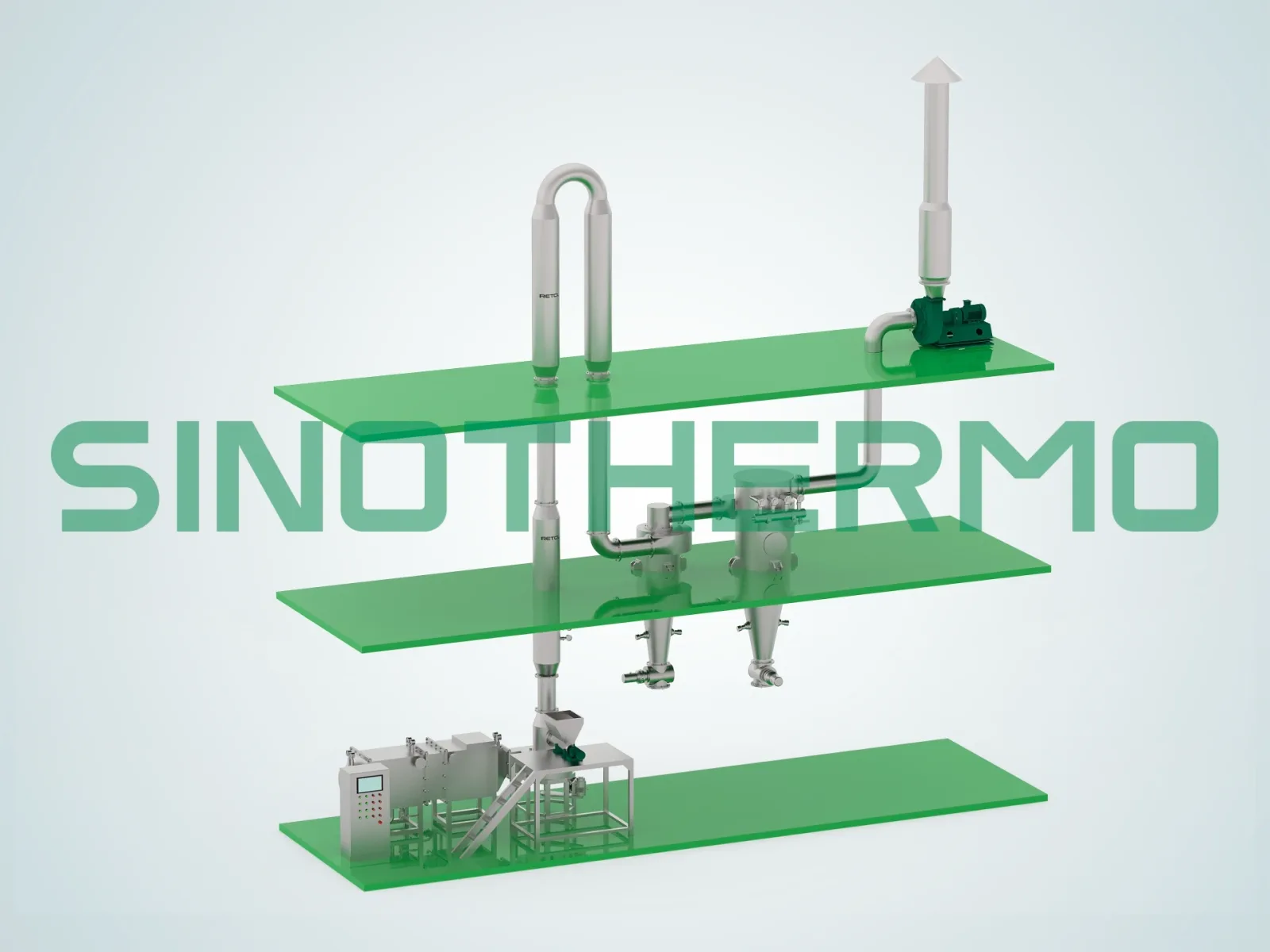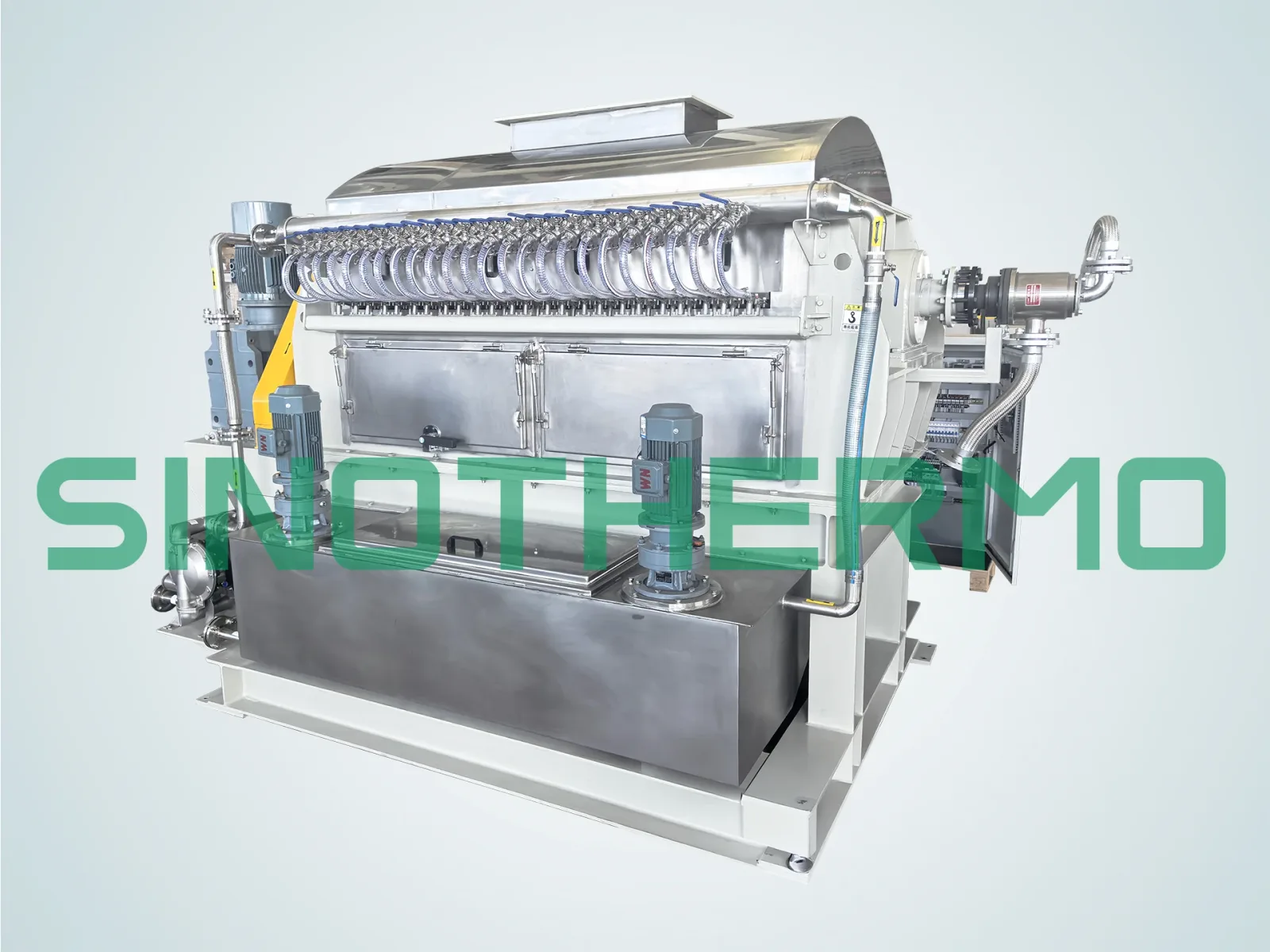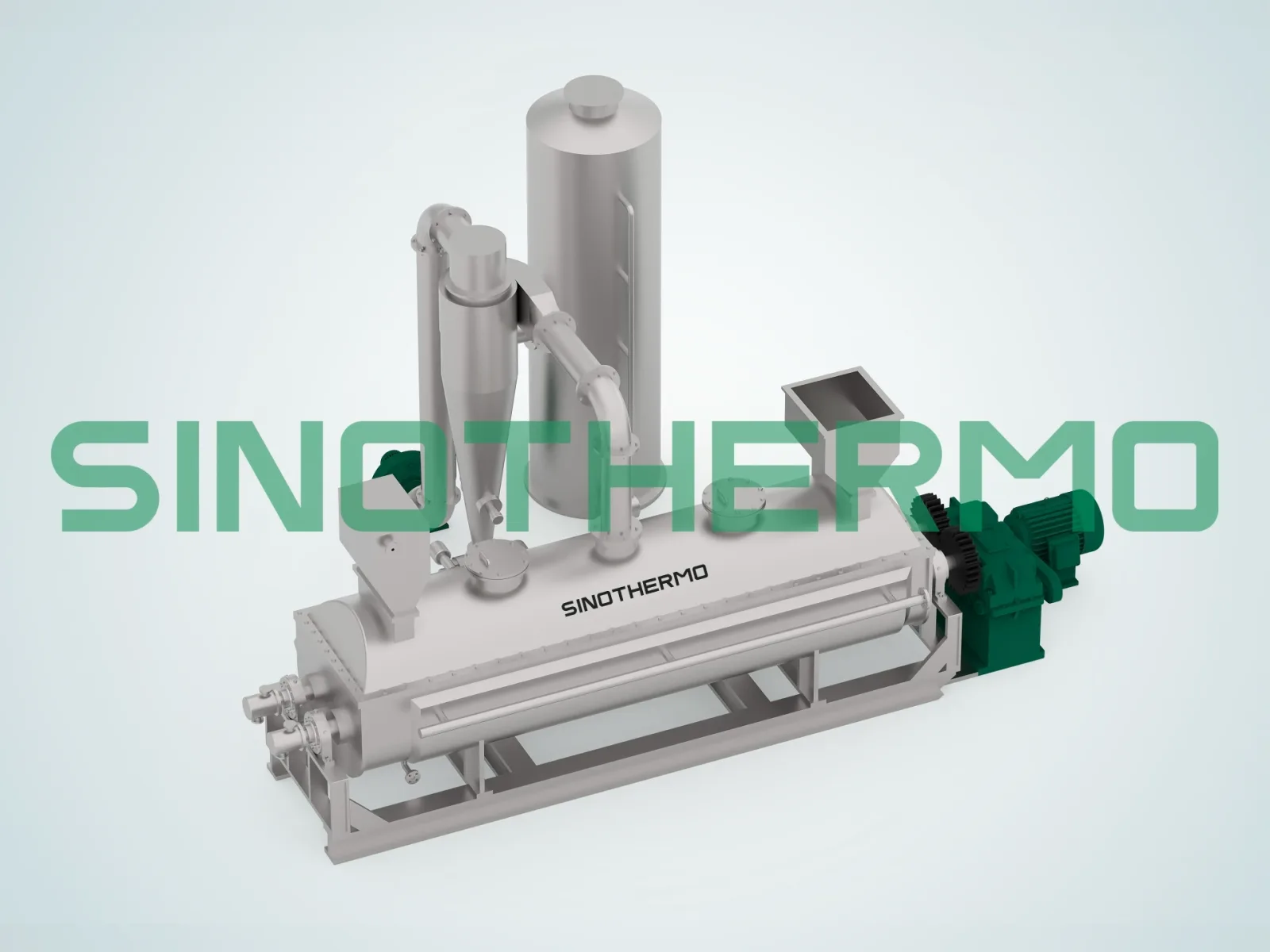
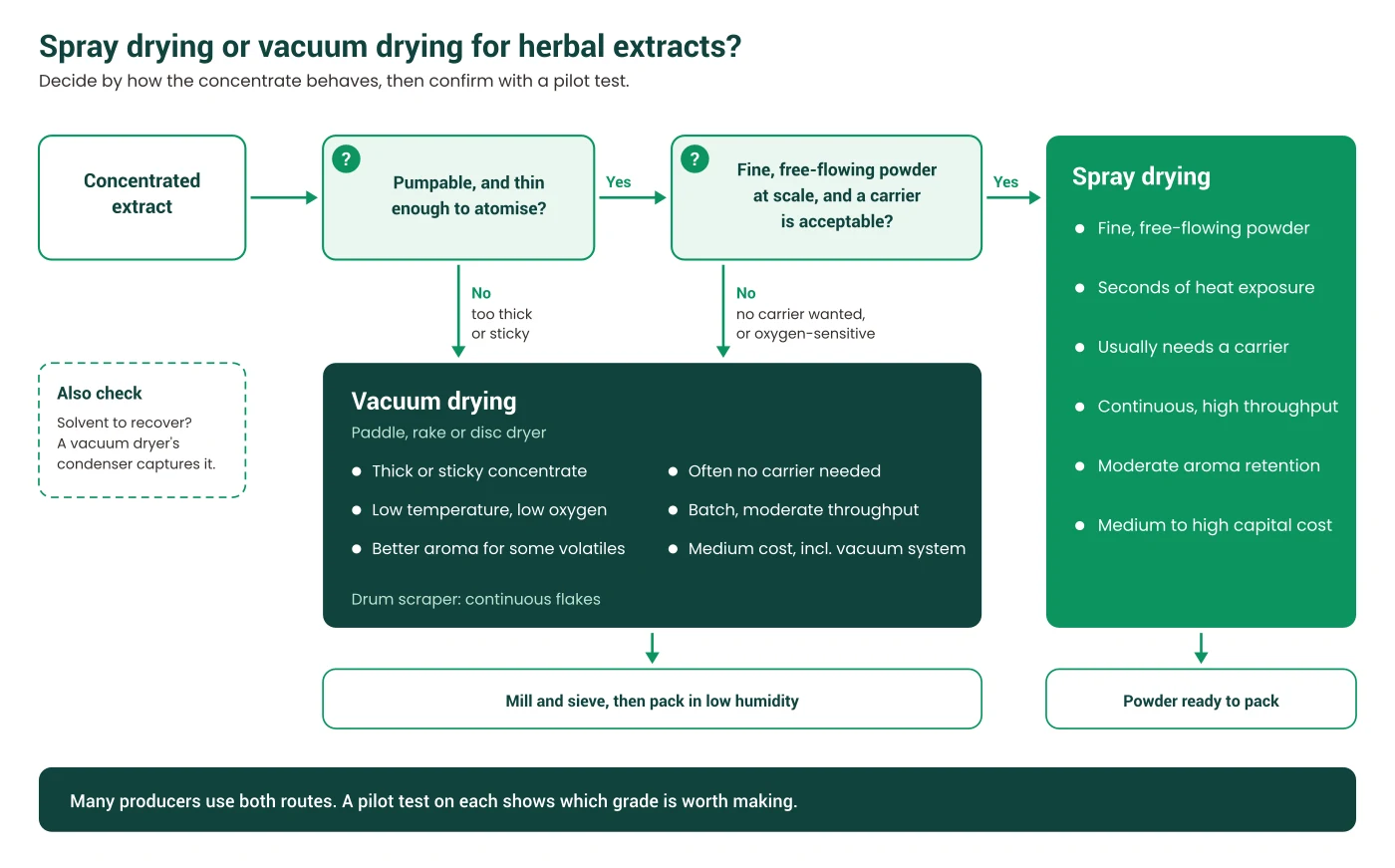
Spray drying makes fine, free-flowing powder from a pumpable extract in seconds; vacuum drying dries a thick, concentrated extract at low temperature in a sealed vessel, then the dry cake is milled. Choose spray drying when the extract is pumpable and you want a fine powder at scale. Choose vacuum drying when the extract is a thick paste that will not atomise, when it is very sticky, or when low temperature and low oxygen matter most. Many producers use both, depending on the product.
Quick Context: two routes to the same powder
A herbal or plant extract starts as a dilute liquid, is concentrated by evaporation, and is then dried to a powder. The last step can be done in two main ways.
- Spray drying atomises the liquid into a hot air chamber. Droplets dry in seconds and fall out as fine powder.
- Vacuum drying spreads a thick concentrate over heated surfaces under vacuum. Water leaves at a low temperature, and the dried product is crumbled and milled.
Both are used for herbal extracts, and neither is always better. This guide compares them for extract work. For the spray side in detail, see spray drying herbal and plant extracts, and for the wider comparison with freeze drying see spray drying vs freeze drying.
Why extracts are difficult to dry
Extracts are rich in sugars, organic acids and other low-melting components. These become sticky and plastic when warm and moist, so the extract coats walls and agitators. They are also often hygroscopic, so the dried powder absorbs moisture and cakes in storage. Active components and aroma can be sensitive to heat and oxygen. Every method has to manage stickiness, stability and heat sensitivity together.
Side-by-side comparison
| Factor | Spray drying | Vacuum drying |
|---|---|---|
| Feed | Pumpable liquid, usually a concentrated solution with a carrier | Thick concentrate or paste, can be very viscous |
| Product form | Fine, free-flowing powder, controlled particle size | Dry cake or lumps, then milled to powder |
| Heat exposure | Very short, seconds | Longer, hours, but at low temperature |
| Temperature | Hot air; extract spray dryer lists 140–180 °C inlet with tower walls below 80 °C | Heat source 50–200 °C on rake, paddle and disc dryers; product temperature set by vacuum |
| Oxygen | Air | Very low oxygen under vacuum |
| Carrier (maltodextrin etc.) | Usually needed to prevent stickiness | Often not needed, so higher extract content in the powder |
| Throughput | Continuous, high | Batch, moderate |
| Aroma retention | Moderate | Better for some volatile components, since the temperature is low and the vessel is sealed |
| Downstream | Powder ready to pack | Needs milling and sieving |
| Capital cost | Medium to high | Medium, includes the vacuum system |
When spray drying is the better choice
- The extract is pumpable after concentration.
- You want fine, free-flowing powder directly, with controlled particle size.
- Volume is high and continuous.
- A carrier is acceptable in the label.
- Heat exposure of seconds is tolerable.
When vacuum drying is the better choice
- The concentrate is too thick or sticky to atomise.
- You want no carrier, or a very high extract content.
- The active or aroma is sensitive to oxygen, or you want the lowest practical temperature.
- Batches are small to medium and varied, with frequent product changes.
- A solvent other than water is involved and should be recovered. Vacuum conduction drying can condense and capture solvent vapour.
SINOTHERMO's agitated vacuum dryers for this duty are the vacuum paddle dryer, vacuum rake dryer and vacuum horizontal disc dryer, which dry liquids, slurries, pastes and mashes into powder. For thin-film continuous drying of a thick paste into flakes, see the vacuum drum scraper dryer. The static vacuum cabinet dryer suits small batches with a heat source below 100 °C.
Choosing Between Paddle, Rake, Disc and Drum Scraper for Extracts
All four vacuum machines suit pastes, but they differ.
- Vacuum paddle dryer. Hollow paddles add heating surface, which speeds drying and is useful for sticky, sugary concentrates.
- Vacuum rake dryer. The simplest agitator; works for extracts that are not too sticky and where modest throughput is acceptable.
- Vacuum horizontal disc dryer. Hollow discs add the most heating surface and suit larger batches where cycle time matters.
- Vacuum drum scraper dryer. A continuous film process that turns thick paste into flakes at 5 to 8 percent moisture. It suits higher-volume thick extracts, and the flakes are milled afterwards. Film behaviour depends on the extract, so test it first.
For small research or high-value batches, the static vacuum cabinet dryer is an option: trays sit on heated shelves, with a heat source below 100 °C. It is simple but slow, and it gives a cake that must be broken up.
Quality Points Specific to Extracts
Marker compounds. Extracts are usually specified by active or marker compound content. Check that the content is the same before and after drying, since losses to heat or oxidation show up here. Report results on a dry-weight basis.
Solubility and dispersion. Customers often care how quickly the powder dissolves. Spray-dried powder is fine and tends to dissolve quickly; milled vacuum-dried cake can be tuned by mill and sieve selection.
Colour, aroma and taste. Over-heating gives a burnt note and darker colour. These are checked by sensory and colour tests alongside the trial.
Microbiology and residual solvent. Some markets require limits on microbial counts and residual solvents. Low temperature drying does not sterilise, and solvent removal needs an agreed endpoint. Discuss both with the quality team before the trial.
Hygroscopicity and packaging. Sugary extract powders absorb moisture quickly. Plan milling, sieving and packing in low humidity, with moisture-barrier packaging.
Cleaning and changeover. If the plant handles several extracts, cleaning between products is part of the machine choice. Ask about access, cleaning methods and residue between batches.
Handling the sticky stage in a vacuum dryer
Extract concentrates often pass through a plastic, gluey phase and then a foam, then a brittle solid. To manage this:
- 1.Control foaming. Fill the vessel to a safe level, raise the vacuum gradually and use a vapour space large enough for the foam. Some extracts foam heavily when vacuum is applied too quickly.
- 2.Keep agitation running. Slow, steady agitation keeps renewing the heated surface and prevents crusting.
- 3.Moderate the heating medium early. A very hot wall on a wet, sugary extract can scorch it.
- 4.Dry to a brittle end point. The product is easiest to mill when it is fully brittle but not over-dried.
- 5.Plan the milling. Hygroscopic powder should be milled and packed in low humidity.
A worked example
The numbers are illustrative, not customer data.
A producer has two extracts.
- Extract A is a thin, concentrated solution that pumps well. It is a candidate for spray drying with a carrier. A spray dryer gives a fine powder in one step and runs continuously.
- Extract B is a thick, sugary paste at high solids that cannot be atomised without heavy dilution, and the customer wants no carrier. A vacuum paddle dryer dries it at low temperature, then the cake is milled.
Both extracts are in the same plant, and the right route is different for each. A pilot test on each confirms the yield, quality and cost.
Scale-Up and Batch Consistency
Extract customers expect the same powder lot after lot, so the drying recipe must be repeatable. Record the concentrate solids, fill level, vacuum profile, heating medium temperature and end-point moisture for each batch, and keep them fixed when moving from pilot to production. Heat transfer area per kilogram of batch changes with scale, so cycle time will not scale linearly; use the pilot data as the estimate and confirm it in the first production batches. Variation in the incoming extract, such as season or origin of the plant material, also changes viscosity and stickiness, so a robust recipe has a range, not a single set point.
Combining the Two Routes
Some producers use both in sequence. A thin extract is concentrated by evaporation, dried by spray drying for the main grade, and the same concentrate, if too thick, goes to a vacuum paddle dryer for a no-carrier grade. Running both from one concentrate lets you offer a fine, carrier-based powder and a high-content, carrier-free powder, and a pilot test on each shows which grades are worth making.
What to Send for a Quotation
- Plant material, extraction solvent and concentration method
- Solids content and viscosity of the feed
- Carrier allowed or not
- Target moisture and powder specification (particle size, solubility)
- Heat-sensitive actives and their temperature limits
- Batch size or throughput, and number of products
- Whether solvent recovery is needed
Common Mistakes to Avoid
- 1.Choosing by habit. Test both routes where the extract allows.
- 2.Atomising an extract that is too viscous, which blocks nozzles and builds up on walls.
- 3.Applying full vacuum to a foaming extract in one step.
- 4.Over-drying, which makes powder harder to mill or leaves a burnt note.
- 5.Ignoring hygroscopicity. Package in low humidity.
- 6.Forgetting the milling step in the cost comparison for vacuum drying.
Test Before You Specify
Extracts behave differently from batch to batch. SINOTHERMO runs paid pilot tests on both spray and vacuum routes, so you can compare powder quality, yield and cost on your own extract. Request a pilot test and the results are yours to use with any supplier. SINOTHERMO can supply either dryer as a complete line with the vacuum or air-handling system, condenser, heating or cooling units and controls, and does not offer contract drying.
Frequently Asked Questions
Should I spray dry or vacuum dry my herbal extract?
Spray dry if the concentrate is pumpable and you want a fine powder at scale. Vacuum dry if it is too thick or sticky to atomise, if you want to avoid a carrier, or if low temperature and low oxygen matter most.
Do I need a carrier like maltodextrin?
Spray drying usually needs a carrier to prevent stickiness. Vacuum drying often does not, though milling and storage still need care for hygroscopic extracts.
Does vacuum drying damage heat-sensitive actives?
Vacuum lowers the boiling point, so the product dries at low temperature in a low-oxygen vessel. The result depends on the active, so test it.
Is the powder from vacuum drying as fine as spray-dried powder?
Not directly. Vacuum-dried product is a cake or lumps that are milled, so particle size is set by the mill. Spray drying produces fine powder directly.
Can I recover solvent from an extract?
Yes, in a vacuum conduction dryer, a condenser captures the solvent vapour.
Can SINOTHERMO supply a complete line?
Yes. We can supply the dryer with the vacuum or air-handling system, condenser, heating or cooling units and controls.
Does SINOTHERMO offer contract drying?
No. SINOTHERMO builds and sells drying equipment and offers paid pilot testing.

Mark Gu
Passionate about enhancing customer experiences and streamlining operations, Mark focuses on building strong relationships, fostering innovation, and leading teams to achieve exceptional service and efficiency.
Email: mark.gu@sinothermo.com
Phone: +86 18021972660