Spray drying turns a liquid into powder in seconds using hot gas, at low cost per kilogram and with continuous output. Freeze drying removes water by sublimation under vacuum at very low temperature, which preserves structure and activity better but costs much more per kilogram and runs in batches. For most products the decision comes down to one question: does the product lose value when it is exposed to heat, even briefly? If not, spray drying is usually the better choice. If it does, freeze drying may be the only workable option.
This guide compares the two on the factors that decide a purchase: product quality, cost, throughput, powder properties and scale-up. It also covers the cases where neither alone is right.
Quick Context: two different ways of removing water
Both methods turn a liquid or wet material into a dry solid, but the physics differ.
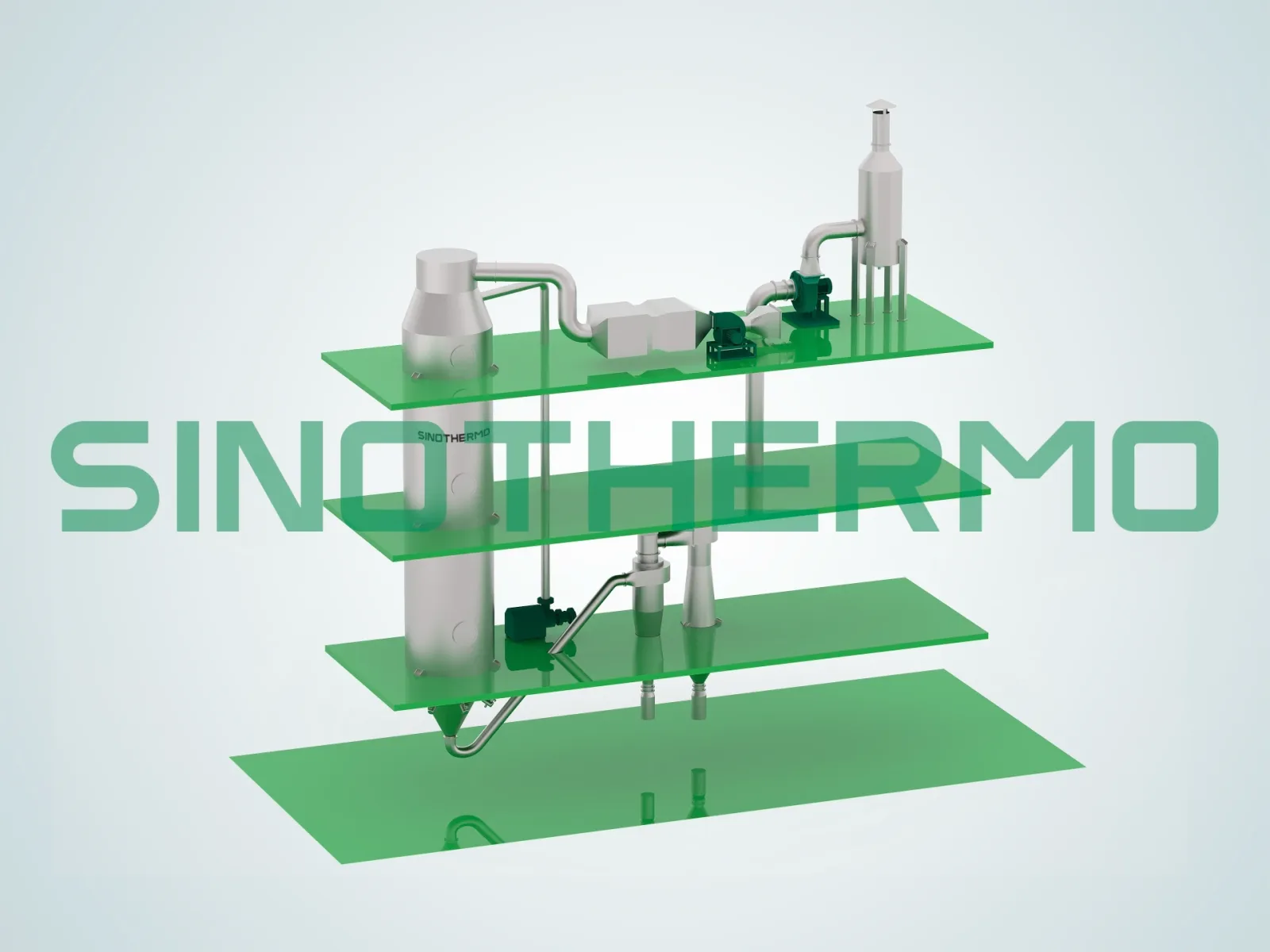
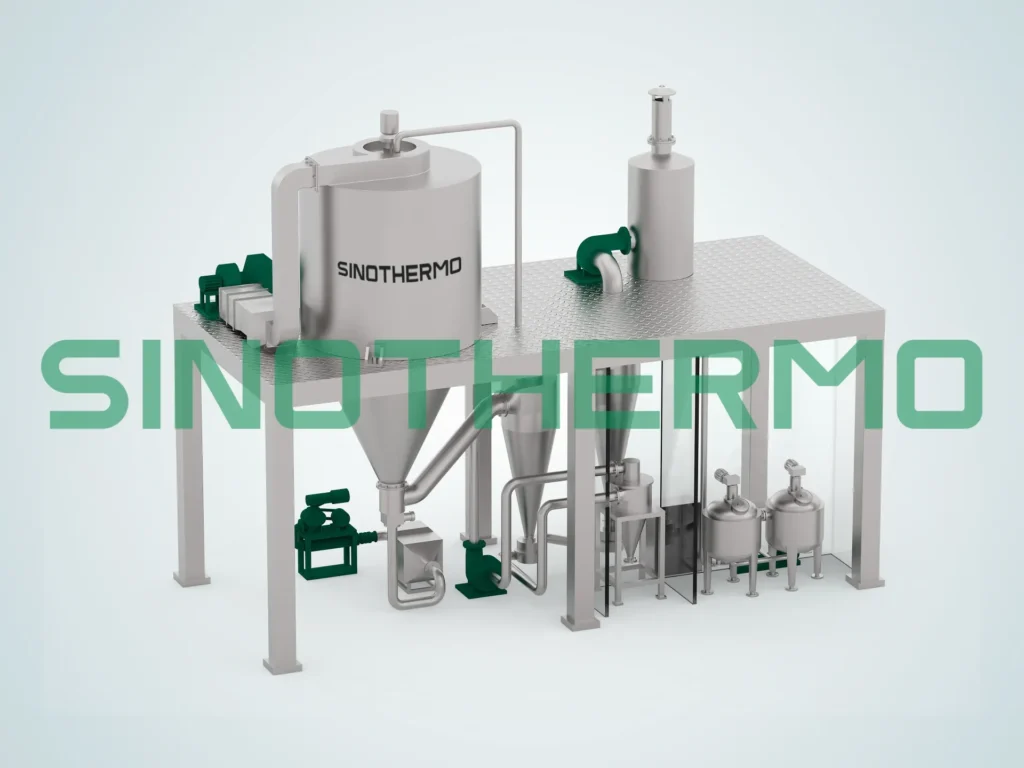
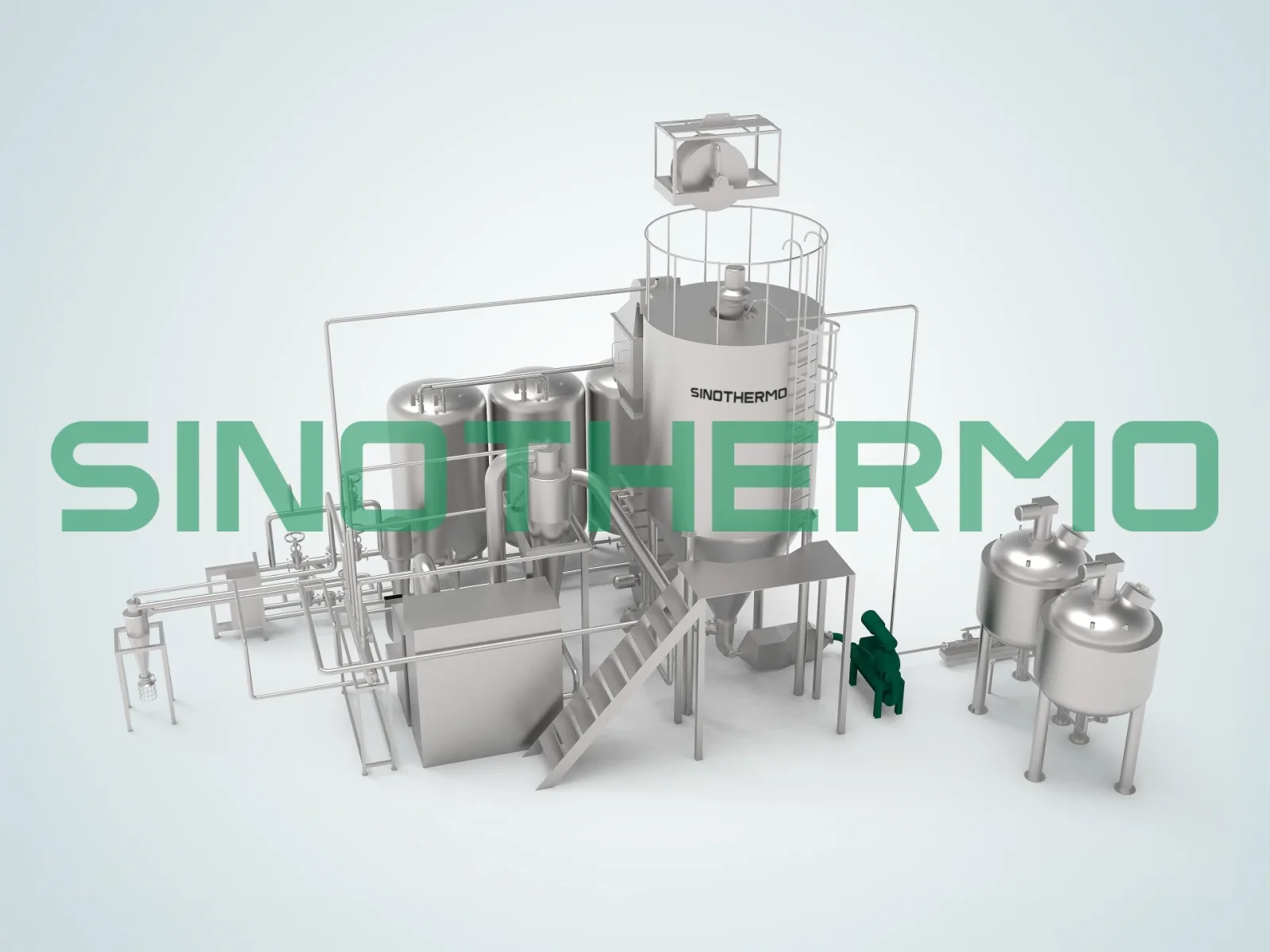
Spray drying atomises the liquid into fine droplets and brings them into contact with hot gas. Water evaporates from each droplet in roughly a few seconds, and the droplet becomes a dry particle. The process is continuous. For the full mechanism, see how spray drying works.
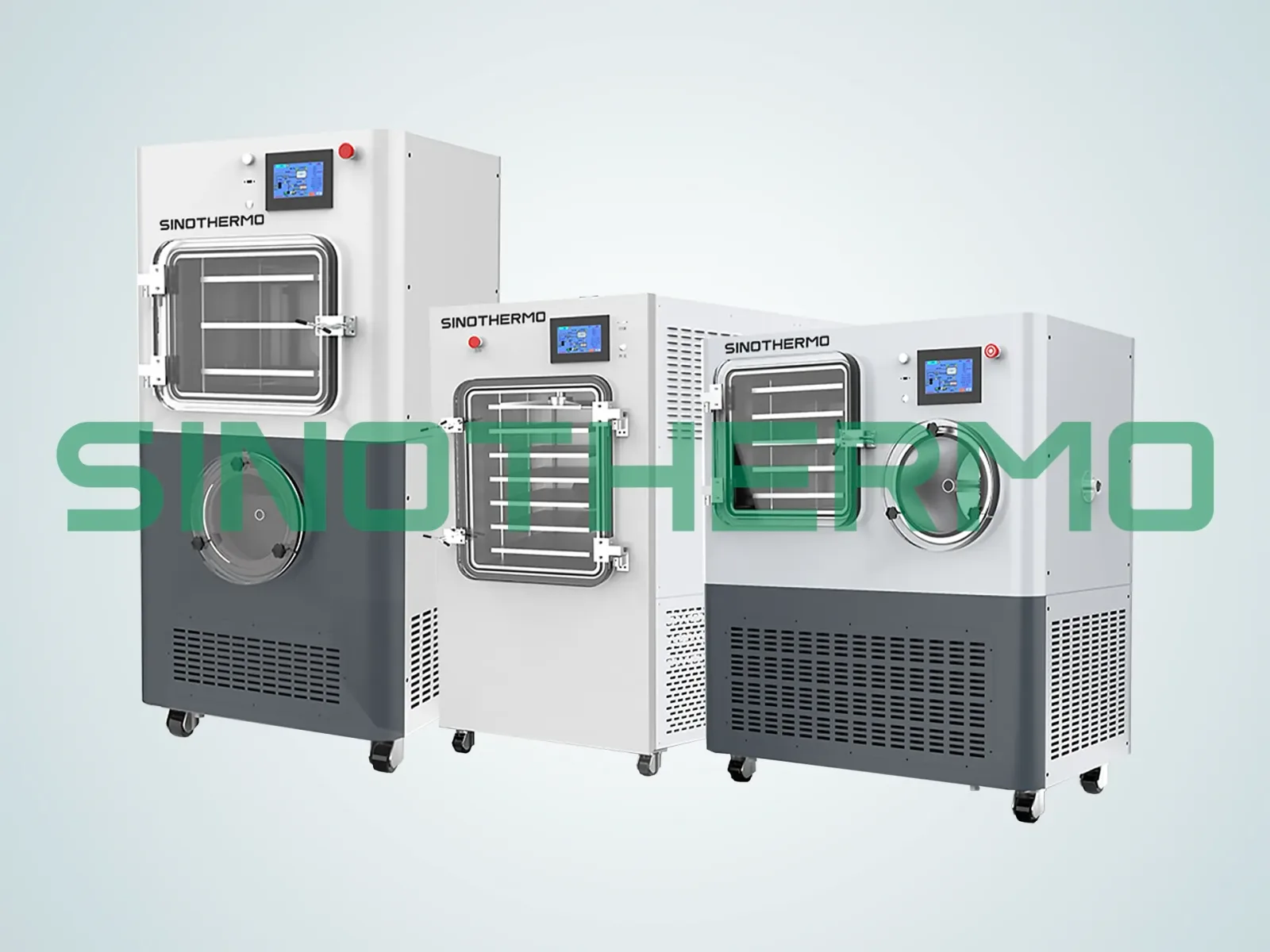
Freeze drying, also called lyophilization, freezes the product, then lowers pressure and adds gentle heat so the ice sublimates directly to vapour without passing through the liquid phase. The product keeps its frozen structure, leaving a porous solid. The cycle is a batch and commonly runs many hours to days, depending on the material and load.
The key difference is the product temperature during water removal. In a spray dryer the particle surface stays near the wet-bulb temperature while it contains moisture, which protects it for the short drying time, but the equipment runs at high gas temperatures. In a freeze dryer the product stays frozen throughout the main drying stage.
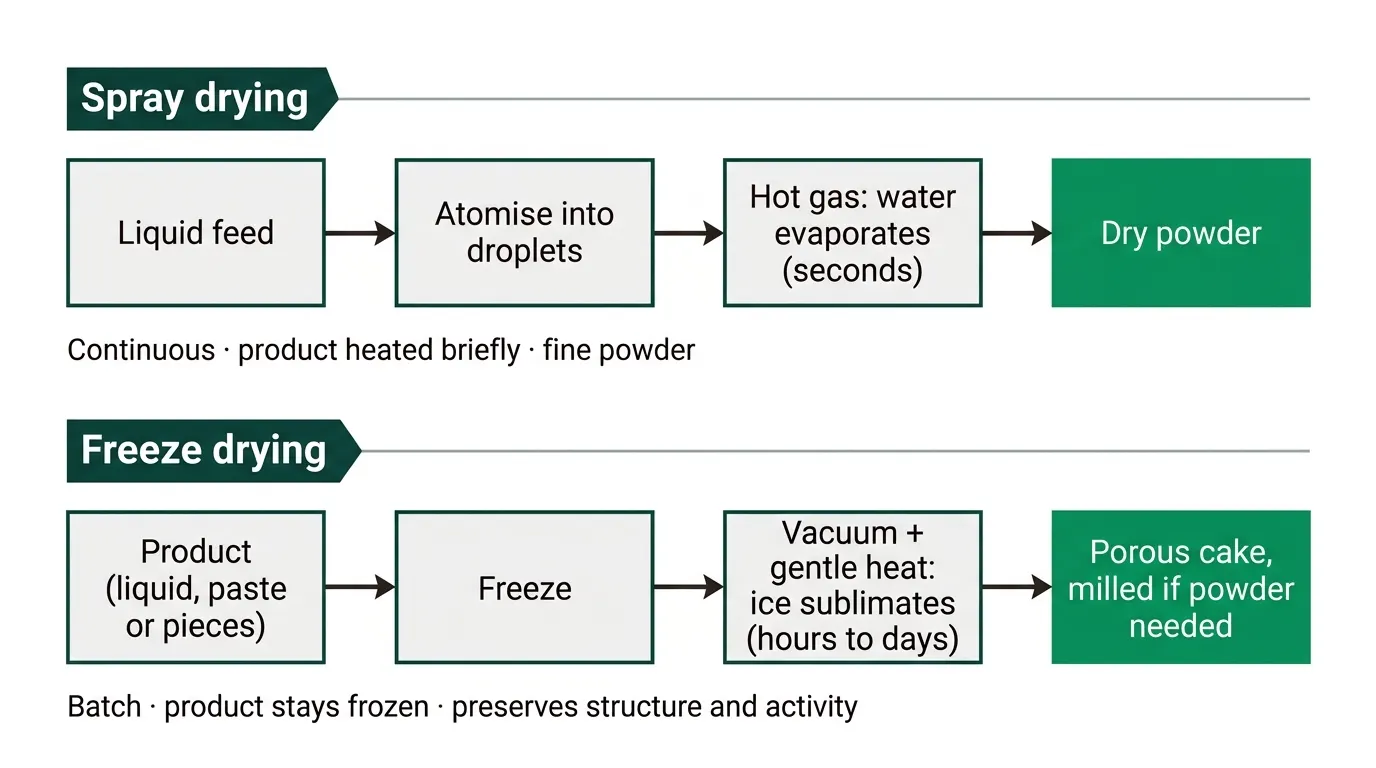
Side-by-side comparison
| Factor | Spray drying | Freeze drying |
|---|---|---|
| Mode | Continuous | Batch |
| Drying time | Seconds per particle | Many hours to days per batch |
| Product temperature | Heated (short exposure) | Frozen during primary drying |
| Typical powder form | Fine or granular, often hollow spheres | Porous cake, usually milled afterwards |
| Heat-sensitive actives | Suitable for many, with tuned conditions | Best protection available |
| Volatile aroma retention | Moderate losses possible | Better retention |
| Throughput | High, scales to tonnes per day | Limited by chamber and cycle time |
| Cost per kilogram | Lower | Substantially higher |
| Capital and utilities | Moderate | High (vacuum, refrigeration, long cycles) |
| Feed | Pumpable liquid | Liquid, paste or solid pieces |
| Best fit | Commodity and mid-value powders | High-value, sensitive or structured products |
Cost ratios vary widely with product and scale, so ask any supplier for a cost model on your material. As a rule, freeze drying costs significantly more per kilogram of water removed, because of the long cycle time and the energy needed for freezing and vacuum.
Product quality: what each method protects
Activity and structure
Freeze drying is the gold standard for biologicals, vaccines, enzymes, live cultures and other materials where protein structure or cell viability decide value. The low temperature and absence of liquid water minimise degradation.
Spray drying can still work for many sensitive materials. Probiotics, enzymes and vitamins are spray dried commercially, usually with protective carriers such as maltodextrin or other excipients, and with careful control of outlet temperature. Viability losses are typically higher than with freeze drying, so the question is whether the loss is acceptable at the price difference.
Flavour and aroma
Spray drying exposes volatile compounds to hot gas, so some aroma loss is possible. Encapsulation in a carrier matrix reduces this, and spray drying is widely used for flavour powders for that reason. Freeze drying retains aroma better but costs more.
Particle properties
Spray dried particles are generally small and fairly uniform, and particle size can be tuned through atomiser choice and feed properties. You can read more in our article on spray dryer atomization. Freeze dried material is a porous cake that dissolves quickly, but it usually needs milling to make a free-flowing powder.
Solubility and rehydration
Freeze dried products rehydrate fast because of the open porous structure. Spray dried powders can also dissolve well, especially when agglomerated or instantised, but the particle structure is denser.
Cost: where the money goes
Spray drying cost drivers are the evaporation load, the inlet temperature, the heat source and the scale. Because the process is continuous and high-throughput, the fixed cost is spread across a large volume. For a breakdown of what moves the price, see our spray dryer cost guide.
Freeze drying cost drivers are the chamber size, the shelf area, the cycle time, the refrigeration and vacuum capacity, and the energy per batch. A long primary-drying stage ties up expensive equipment, so throughput per machine is low.
A simple way to compare is to work out the value of the finished product per kilogram. If the dried product sells for a high price per kilogram and loses significant value when heated, the freeze dryer cost can be justified. If the product is a bulk ingredient or intermediate, spray drying will almost always win on economics.
Scale and throughput
Spray dryers scale from laboratory units to industrial machines with evaporation capacities in the hundreds or thousands of kilograms of water per hour. SINOTHERMO's pressure spray dryer and centrifugal spray dryer lines cover small to large capacity.
Freeze dryers scale by adding shelf area and chamber volume, and by installing multiple units. Production capacity per machine is far smaller. For lab and pilot work, a benchtop freeze dryer or pilot freeze dryer lets you generate samples before committing to a production system.
Decision guide: which one for which product
| Your product | Usually choose | Why |
|---|---|---|
| Milk, whey, coffee, tea, bulk food ingredients | Spray drying | Low cost, high volume |
| Flavours, essential oils, encapsulated actives | Spray drying | Carrier encapsulation protects volatiles |
| Ceramic slurries, pigments, detergent bases, chemicals | Spray drying | Granule size and flow are the goal, not preservation |
| Pharmaceutical dispersions and inhalable powders | Spray drying | Particle engineering |
| Vaccines, biologics, sensitive enzymes, live cultures | Freeze drying | Activity and viability decide value |
| High-value extracts where aroma matters | Freeze drying, or test spray drying first | Quality premium may cover the cost |
| Products that must keep a solid shape | Freeze drying | Spray drying always produces powder |
| Unknown or borderline | Test both on a small scale | Measure losses before choosing |
For the spray drying cases above, see our guides to spray dried milk powder, instant coffee and pharmaceutical spray drying.
A worked way to compare cost per kilogram
Take two candidate products and ask the same four questions of each.
- 1.What does one kilogram of finished powder sell for? A bulk food ingredient and a high-value botanical active sit in very different price bands.
- 2.How much of that value is lost if the product is heated briefly? If the answer is "none" or "a few percent", spray drying is the default. If it is "most of it", freeze drying is the candidate.
- 3.How much water must be removed per kilogram of powder? A feed at 20 percent solids carries four kilograms of water per kilogram of solids, and every kilogram must be evaporated or sublimed. The more water, the more the energy and cycle-time difference matters.
- 4.What volume do you need per year? A few hundred kilograms a year may fit a small freeze dryer. Hundreds of tonnes a year is spray dryer territory.
Write the answers down and ask suppliers to quote against them. A supplier who cannot explain how their cost per kilogram changes with solids content and volume has not modelled your case.
Using both
Some products pass through both. A liquid may be freeze dried at laboratory scale to produce reference samples, then spray dried for commercial production once the formulation and process parameters are proven. Others are spray dried to a powder and then agglomerated or granulated for flow and dissolution.
If your product is a high-value extract, you can also test whether a protective carrier lets spray drying reach your quality target. That test is often cheaper than assuming freeze drying is needed.
Common mistakes to avoid
Choosing freeze drying by default because it sounds gentler. For a product that is not heat-sensitive, you are paying a large premium for quality you do not need.
Choosing spray drying without checking heat tolerance. If the active loses activity above a certain temperature, short exposure may still be too much. Check with a small trial.
Comparing machine prices instead of cost per kilogram. The cost that matters is total cost per kilogram of finished product, including energy, labour, yield and cycle time.
Ignoring the powder you need. If the next process step needs a free-flowing powder with defined particle size, spray drying gives you one directly. Freeze dried cake needs milling, which adds a step and may expose the product to moisture.
Skipping the scale-up check. Lab freeze dryer cycles do not translate directly to production cycles, and lab spray dryer results do not always scale. Pilot data reduces the risk. Our guide to the pilot spray dryer covers what a pilot trial should measure.
Conclusion
Use spray drying when you need a continuous, low-cost process that makes powder with controlled particle size, and when your product tolerates a short thermal exposure. Use freeze drying when activity, structure or aroma decide the product value and the price per kilogram supports the cost. When it is not obvious, test both on your material and compare the measured quality and the cost per kilogram.
Next step: Request a pilot test for spray drying on your own material. Our testing lab runs paid trials and reports inlet and outlet conditions, powder properties and yield.
Frequently asked questions
Is spray drying cheaper than freeze drying?
Yes, in almost every case. Spray drying is continuous and high-throughput, so cost per kilogram is much lower. Freeze drying runs long batch cycles under vacuum and refrigeration, which raises both capital and operating cost per kilogram.
Which method preserves more nutrients and activity?
Freeze drying generally preserves activity and aroma better because the product stays frozen. Spray drying can still work well for many nutrients and probiotics when carriers and temperatures are tuned, with higher losses than freeze drying.
Can spray drying be used for heat-sensitive products?
Often yes. Droplets stay cooler than the gas while they contain moisture, and drying takes seconds. Using a lower inlet temperature, a carrier, and careful outlet temperature control protects many heat-sensitive materials. A trial confirms the loss for your product.
What powder do I get from each method?
Spray drying gives a fine or granular powder, often with hollow spherical particles. Freeze drying gives a porous cake that usually needs milling to become a free-flowing powder.
Can I scale a lab freeze dryer result to production?
Not directly. Cycle times and conditions change with load and shelf geometry. Use the lab result as a guide and confirm at pilot scale before specifying a production machine.
Which is better for pharmaceutical products?
It depends on the product. Freeze drying is standard for many vaccines and biologics. Spray drying is used for particle engineering, such as amorphous solid dispersions and inhalable powders.
How do I decide if I am not sure?
Run a small trial on each method and compare activity, powder properties and estimated cost per kilogram. Pilot testing is a paid service, and you can request one through our contact page.

Mark Gu
Passionate about enhancing customer experiences and streamlining operations, Mark focuses on building strong relationships, fostering innovation, and leading teams to achieve exceptional service and efficiency.
Email: mark.gu@sinothermo.com
Phone: +86 18021972660