In spray drying, the inlet temperature sets how much heat the process can deliver, and the outlet temperature tells you how dry the powder is and how hot the product has been. The outlet temperature is the one to control. You set it by adjusting feed rate, and you choose the inlet temperature to give the dryer enough capacity without exceeding what your product can tolerate.
Most spray drying problems that look like "wrong temperature" are really a mismatch between these two numbers and the material. A powder that is sticky, a powder that is too wet, a powder that has lost activity: each has a temperature explanation, and each has a different fix. This guide explains what inlet and outlet temperature do, how they relate, typical ranges for different materials, and a step-by-step way to tune them.
Quick Context: two temperatures, two jobs
Inlet temperature is the temperature of the drying gas as it enters the chamber. It defines the heat available to evaporate water. A higher inlet temperature means more evaporation capacity from the same airflow, so a smaller or cheaper dryer can do the same job.
Outlet temperature is the temperature of the gas leaving the chamber, measured before the powder collection stage. It reflects the heat left after evaporation. For a given airflow, outlet temperature rises when you feed less liquid and falls when you feed more.
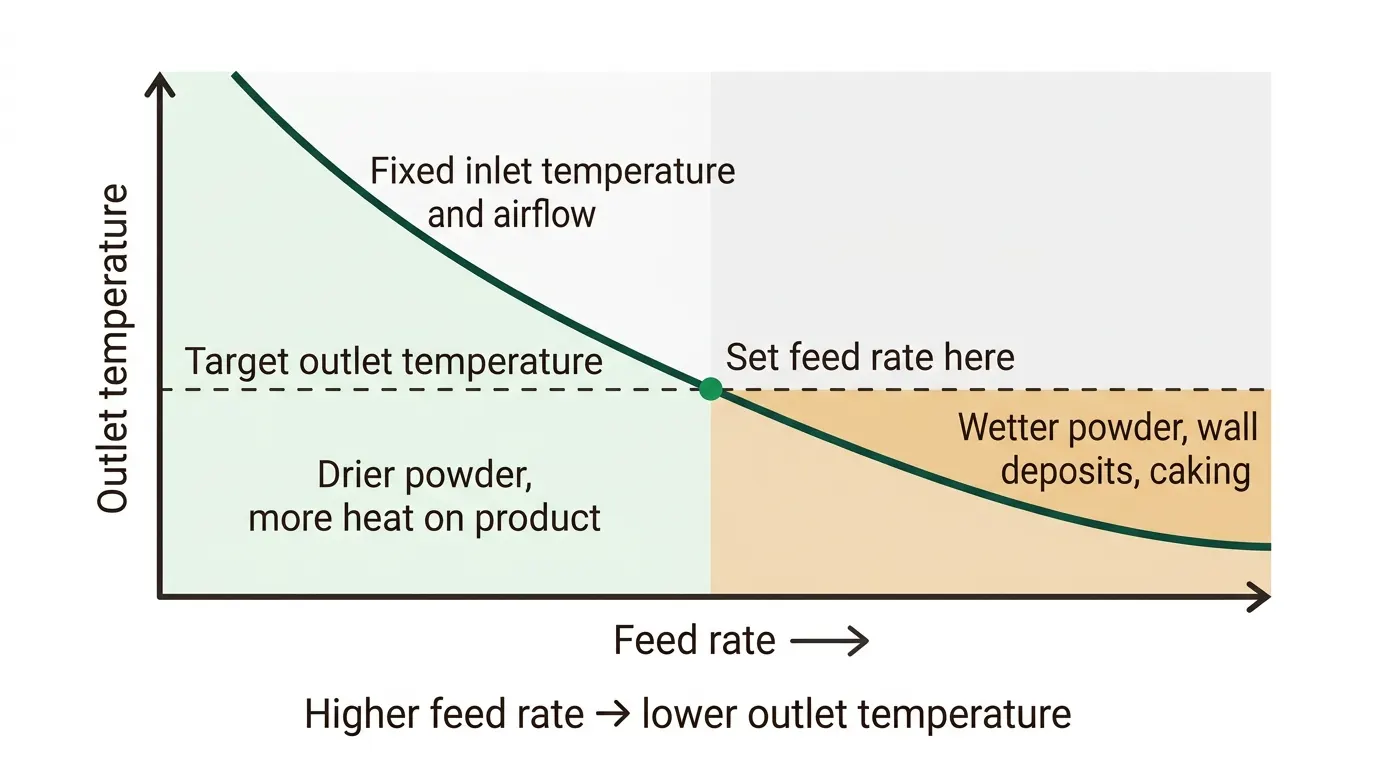
The reason outlet temperature matters more is that it is the best practical indicator of two things at once: the residual moisture of the powder, and the temperature that the dried particles have reached. You cannot set it directly. You control it indirectly: raise the feed rate and the outlet temperature falls, lower the feed rate and it rises.
For the full mechanism, see how spray drying works.
How the two temperatures relate
Heat delivered to evaporate water comes from the drop in gas temperature between inlet and outlet. In simple terms, the heat removed from the gas equals the heat used to evaporate the water and heat the feed and product, plus losses.
That gives three useful rules of thumb:
- 1.At fixed inlet temperature and airflow, a higher feed rate lowers the outlet temperature, because more water takes more heat. The powder comes out wetter.
- 2.At fixed feed rate, a higher inlet temperature raises the outlet temperature, and the powder comes out drier.
- 3.The difference between inlet and outlet is your working heat budget. A very small difference means the dryer is under-loaded and inefficient. A very large difference means you are pushing the dryer hard and risk wet powder if anything changes.
Droplets do not reach the gas temperature while they still contain water. Evaporation holds the particle surface near the wet-bulb temperature, which is far below the inlet temperature. That is why spray drying can handle heat-sensitive materials at inlet temperatures of 150 °C or more. The danger arrives at the end of drying, when the particle has lost its water and can heat up toward the outlet temperature.
What each temperature does to the product
| Change | Effect on powder | Typical risk |
|---|---|---|
| Higher outlet temperature | Lower residual moisture, better flow, less caking in storage | Thermal degradation, loss of volatiles, scorching, thermoplastic stickiness |
| Lower outlet temperature | Gentler on product | Wet powder, wall deposits, caking, microbial risk |
| Higher inlet temperature | More capacity; often a harder, less porous particle surface | Skin formation, hollow or cracked particles, product damage if outlet also rises |
| Lower inlet temperature | Gentler start, softer drying | Lower capacity, more energy per kilogram if airflow must rise |
Particle structure also responds. Fast surface drying at very high inlet temperature can form a dry shell while the core is still wet, and the particle may balloon or crack. For ceramics this affects how granules collapse when pressed, and we discuss that in spray drying ceramics.
Why stickiness depends on temperature
For sugar-rich, extract and many food feeds, the controlling factor is the glass transition temperature of the dried material. Below it the material is a rigid glass and free-flowing. Above it the surface softens and becomes tacky. The glass transition temperature falls as the powder holds more moisture, so a wetter particle sticks at a lower temperature.
A commonly cited rule of thumb is that sticking starts at a temperature roughly 10 to 20 °C above the glass transition temperature of the powder at its moisture content. That is a guide, not a guarantee, and the exact offset depends on the material, so verify by trial. The practical consequence is simple: to avoid wall sticking with a sticky feed you either lower the temperature the particle reaches, raise its glass transition temperature with a carrier such as maltodextrin, or cool the wall. Our guides to spray drying plant extracts and solving wall sticking go deeper.
Typical temperature ranges
The table gives starting points, not recipes. Every formulation is different, and the right setting comes from a trial.
| Material or case | Inlet temperature | Outlet temperature | What to watch |
|---|---|---|---|
| General water-based solution or slurry | 150 to 250 °C typical | About 70 to 100 °C | Balance moisture against product damage |
| Sticky extracts, sugar-rich feeds | SINOTHERMO extract spray dryer: 140 to 180 °C | Often lower; set by moisture and glass transition | Wall deposits; use carrier and cooled wall |
| Heat-sensitive actives, probiotics, enzymes | Moderate to low inlet; protective carrier | Keep as low as moisture allows | Activity and viability loss |
| Ceramic slurry | SINOTHERMO pressure spray dryer: 150 to 350 °C | Set to hit target granule moisture | Hollow granules at very high inlet |
| Chemical and mineral powders | SINOTHERMO centrifugal spray dryer: 150 to 500 °C | About 80 to 90 °C on the LPG series | Dust, deposits, drying rate |
| Solvent-based feed in inert loop | SINOTHERMO closed circulation: 100 to 300 °C | Set by solvent and product limits | Residual solvent, oxygen level |
The SINOTHERMO figures come from our product data for the pressure, centrifugal, extract and closed circulation spray dryers. The general water-based ranges are typical industry values and should be confirmed for your material.
Powder moisture also depends on the product. SINOTHERMO's dryers typically deliver 3 to 8 percent moisture on the extract and closed circulation models, and the pressure spray dryer lists below 5 percent, with 0.5 percent achievable in some cases.
A step-by-step way to tune temperature
- 1.Find the product limit — establish the temperature at which your product degrades, discolours or loses activity, and the glass transition temperature of the dried powder if the material is amorphous. This gives the ceiling for the outlet temperature.
- 2.Set the target moisture — decide the maximum residual moisture the powder can have for storage and downstream use. This gives the floor for the outlet temperature.
- 3.Choose a starting inlet temperature — pick one in the middle of the dryer's range, lower if the feed is sensitive.
- 4.Run at low feed rate first — confirm atomisation and airflow are stable.
- 5.Raise feed rate until the outlet temperature reaches target — the feed rate that gives your outlet temperature is the dryer's capacity on your material at that inlet.
- 6.Measure the powder — check moisture, particle size, bulk density and the quality test that matters for your product.
- 7.Adjust one variable at a time — if powder is too wet, reduce feed rate or raise inlet. If product is damaged, lower the inlet temperature and accept a lower feed rate. If particles are hollow or cracked, lower the inlet temperature or raise the solids content.
- 8.Record the result — log inlet, outlet, feed rate, airflow, atomiser setting and powder properties so you can reproduce and scale up.
Common mistakes to avoid
Setting the inlet temperature to the maximum the dryer allows. A high inlet temperature gives capacity, not quality. Choose it from your product limits.
Controlling by inlet temperature alone. Without watching outlet temperature you cannot tell whether the powder is wet or over-dried.
Ignoring ambient humidity. Humid inlet air carries water into the chamber and lowers drying capacity. In humid climates, dehumidified air can stabilise the process.
Using the lab dryer's temperatures directly at production scale. Chamber size, residence time and atomiser change with scale. Treat lab settings as a starting point and confirm at pilot scale. See the pilot spray dryer guide.
Forgetting the collection step. Powder that leaves the chamber warm can pick up moisture in the collector or packaging. Cool and seal quickly.
Skipping the trial. Temperature limits depend on your formulation and carrier. A pilot test on your own feed gives measured numbers. Our testing lab runs paid trials and reports operating conditions, moisture and powder properties.
Conclusion
Treat the inlet temperature as a capacity and design choice and the outlet temperature as the control variable for powder quality. Find your product's limit, set the target moisture, and use feed rate to land the outlet temperature between the two. For sticky or heat-sensitive feeds, change the formulation or the dryer design before you change the temperature.
Next step: Request a pilot test with your own feed. Pilot testing is a paid service, and the report gives you the inlet and outlet temperatures, feed rate and powder properties to specify a production dryer.
Frequently asked questions
What is the typical inlet temperature for spray drying?
It depends on the material and the dryer. For general water-based feeds, inlet temperatures between about 150 and 250 °C are common. SINOTHERMO's pressure spray dryer operates across a 150 to 350 °C inlet range, the centrifugal spray dryer across 150 to 500 °C, and the extract spray dryer uses 140 to 180 °C.
What is the typical outlet temperature?
Commonly about 70 to 100 °C for water-based feeds. The outlet temperature should be set by the target powder moisture and the thermal limit of your product. On SINOTHERMO's LPG centrifugal series the outlet is around 80 to 90 °C.
How do I control the outlet temperature?
Mainly through feed rate. Increasing the feed rate lowers the outlet temperature, and decreasing it raises the temperature. Inlet temperature and airflow also change it.
Why is my powder sticky or caking?
Usually because the particle reached a temperature above its sticking point while it still held moisture, or because the dried powder absorbed moisture afterwards. Lower the product temperature, raise the glass transition temperature with a carrier, use cooled walls or dehumidified air, and seal the powder quickly.
Can I spray dry heat-sensitive products at high inlet temperatures?
Often yes, because evaporation keeps the particle surface near the wet-bulb temperature while it contains water. The risk comes from the outlet temperature and the final drying stage, so control it carefully and use protective carriers where needed.
How do I know the right temperature for my product?
Run a trial. A pilot test measures moisture, particle properties and product quality at a few inlet and outlet combinations. Pilot testing is a paid service, and you can request one through our contact page.

Mark Gu
Passionate about enhancing customer experiences and streamlining operations, Mark focuses on building strong relationships, fostering innovation, and leading teams to achieve exceptional service and efficiency.
Email: mark.gu@sinothermo.com
Phone: +86 18021972660