Spray drying is the standard method for preparing ceramic powder for dry pressing. A ceramic slurry is atomised into droplets inside a hot chamber, and each droplet dries into a roughly spherical granule that flows freely, fills a die uniformly and presses into a strong green body. The result is controlled granule size, density and moisture that milled powder alone cannot deliver.
Fine ceramic powders flow badly. They bridge in hoppers, trap air, and fill dies unevenly, which leads to density variation, cracking and warping after firing. Spray drying solves this by forming granules from a slurry of the ceramic powder, water and binder. This guide covers how the process works, what controls granule quality, and how to choose between a pressure nozzle and a centrifugal atomiser.
Quick Context: why ceramic powder needs granulating
Press-forming ceramics requires powder that behaves like a fluid when it fills the die and like a solid when it is compacted. Raw powder meets neither requirement. Granules do. The properties that matter for pressing are:
- Flowability. Granules must pour quickly and evenly into the die cavity.
- Granule size distribution. A controlled distribution gives good packing and reduces density gradients.
- Granule density and hardness. Granules must be strong enough to survive handling but must collapse under pressing so that the body is uniform.
- Moisture content. A consistent moisture level gives repeatable green strength.
Spray drying controls all four through slurry composition and dryer settings.
The process, step by step
- 1.Slurry preparation — ceramic powder, water, a binder such as polyvinyl alcohol or an equivalent, a dispersant to control viscosity, and sometimes a lubricant are milled or mixed into a stable slurry. Slurries with a high solids content save energy but must remain pumpable. Typical figures differ by material, so confirm them for your formulation.
- 2.Screening and storage — the slurry is sieved to remove oversize particles, which would block nozzles, and held in an agitated tank to prevent settling.
- 3.Atomisation — a high-pressure pump forces the slurry through a nozzle, or a spinning disc throws it off the edge. Either way the slurry breaks into droplets.
- 4.Drying — droplets meet hot air in the drying tower. Water evaporates quickly, and the ceramic particles and binder consolidate into granules.
- 5.Collection — granules fall to the cone and leave through a discharge valve. Fine material is separated in a cyclone and bag filter and can be returned to the slurry.
- 6.Cooling and screening — granules are cooled and screened, and then stored in moisture-controlled bins before pressing.
For the underlying principles, see our introduction to how spray drying works.
What controls granule quality
| Variable | Effect on the granule |
|---|---|
| Slurry solids content | Higher solids give denser granules and lower energy use, but raise viscosity |
| Binder type and amount | Controls granule strength and green body strength |
| Dispersant | Keeps viscosity low so high solids can be atomised |
| Atomiser type and pressure or speed | Sets droplet size, and therefore granule size |
| Inlet air temperature | Affects drying rate and granule structure; too high can form hollow or cracked shells |
| Outlet temperature | Controls residual moisture |
| Feed rate | Interacts with outlet temperature and moisture |
| Chamber design and airflow | Affect residence time and wall deposits |
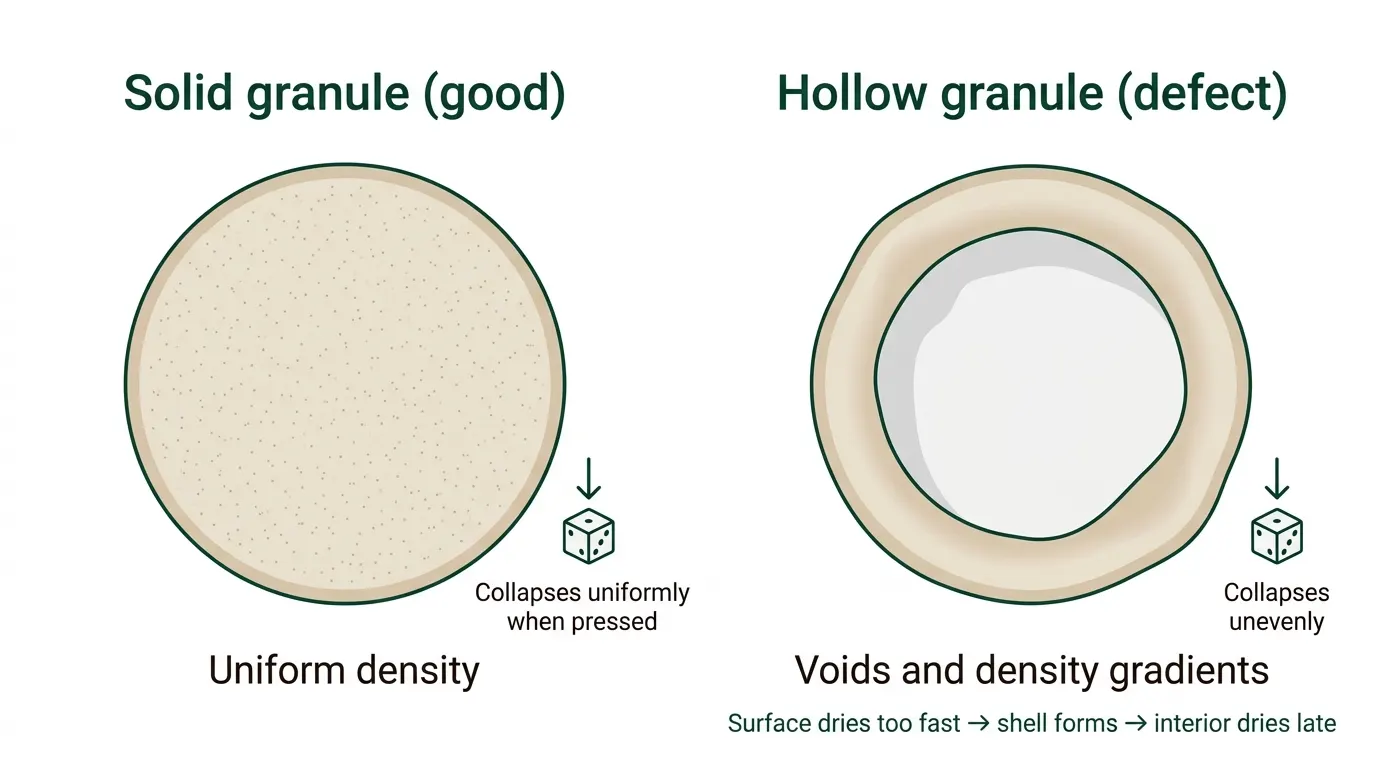
Hollow granules are a typical defect. If the droplet surface dries too fast, a shell forms and the interior dries slowly, creating a hollow or dimpled particle that does not collapse uniformly when pressed. Lower inlet temperature, a higher solids slurry, or a different binder usually helps. The right balance is found by testing.
Pressure nozzle or centrifugal: which atomiser for ceramics?
Both are used for ceramic slurry, and the choice depends on the granule size you want and the scale.
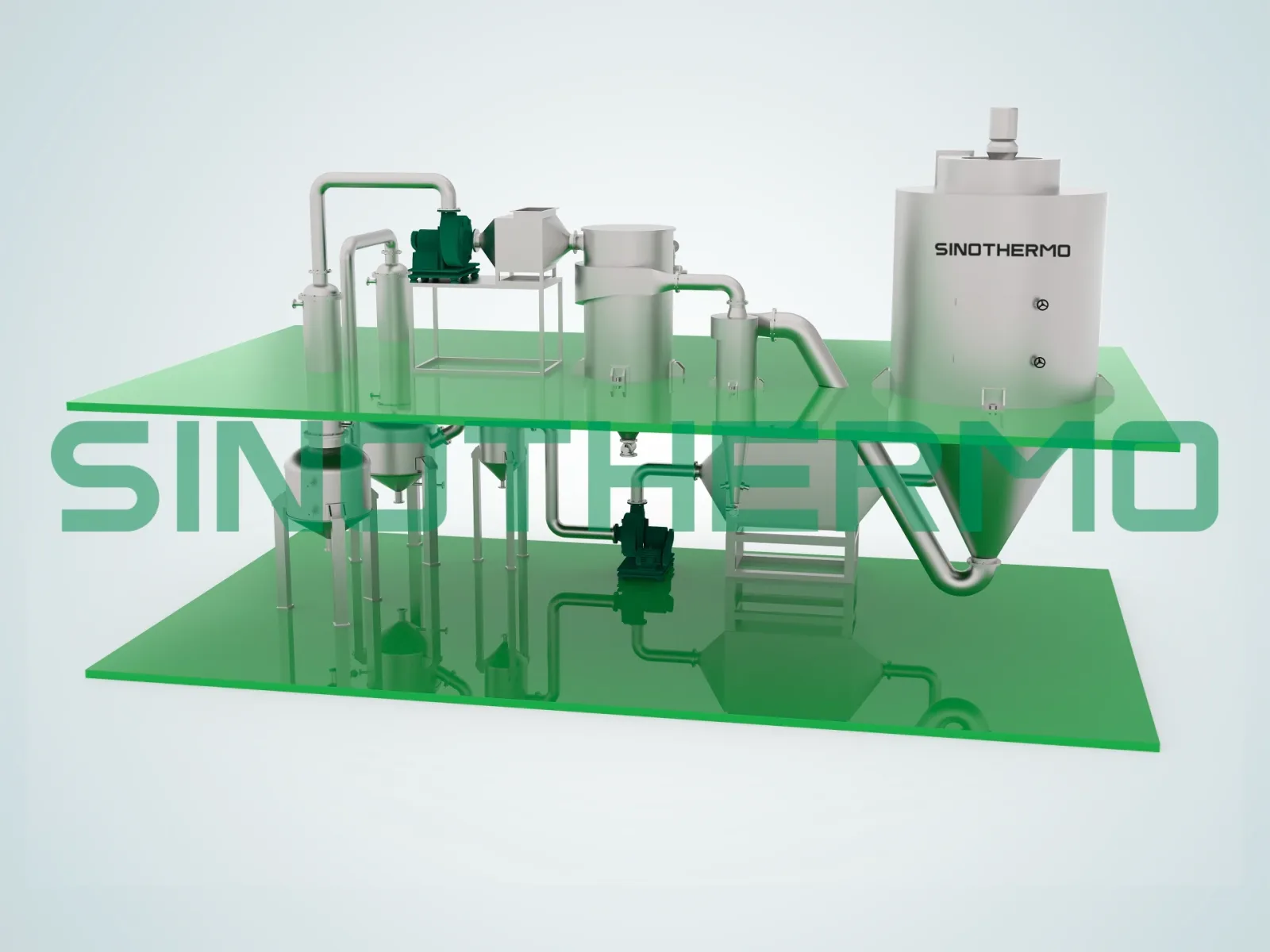
Pressure nozzle spray dryer. A high-pressure pump pushes slurry through a nozzle at the top of the tower. This produces relatively coarse granules and a narrow range, and it is common for ceramic tile and technical ceramic powder. Nozzle and pressure selection control droplet size, so the same machine can make coarser or finer granules. SINOTHERMO's pressure spray dryer covers an inlet air range of 150 to 350 °C and evaporation capacity from 50 up to 1,000 kg/h across the YPG-50 to YPG-1000 models. It handles ceramic slurry and produces free-flowing granules with uniform size and density for pressing.
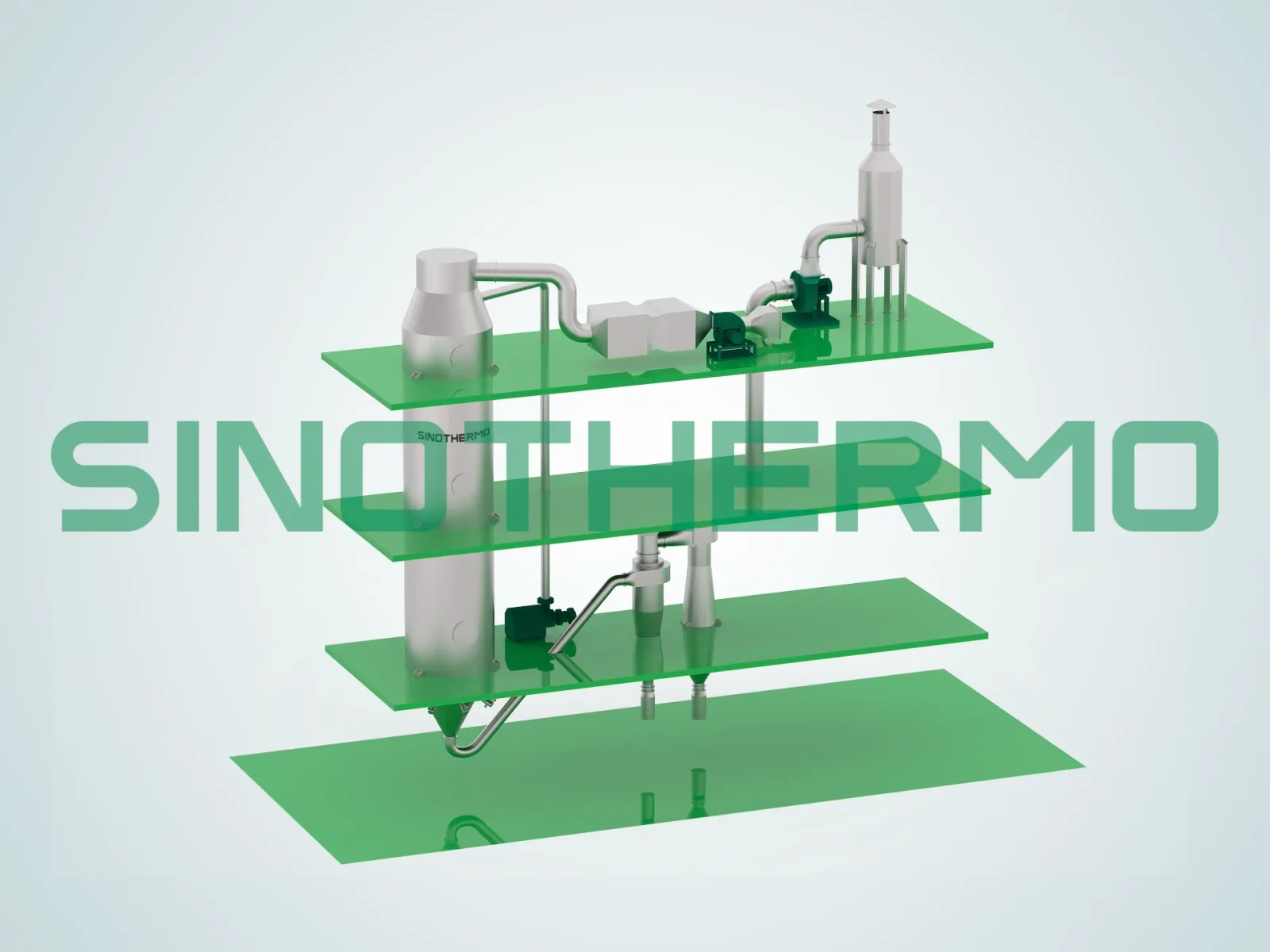
Centrifugal spray dryer. A spinning disc atomises the slurry. Centrifugal atomisers handle viscous and abrasive feeds without nozzle blocking, and produce finer particles that suit some technical ceramics and powders. SINOTHERMO's centrifugal spray dryer has models from LPG-5 to LPG-200-2000, with evaporation from 5 up to 2,000 kg/h.
| Choose | When |
|---|---|
| Pressure nozzle | You want coarser, free-flowing press granules, for example tiles and structural ceramics |
| Centrifugal | You have a viscous or abrasive slurry, need finer particles, or want to avoid nozzle wear |
Abrasive ceramic slurries wear nozzle orifices, which changes droplet size over time. If you choose a nozzle system, ask about wear-resistant orifice materials and the replacement interval. Our guide to spray dryer atomization compares the two in more detail.
Heat source and operating cost
Ceramic spray drying runs at high inlet temperatures, so the heat source is a large part of operating cost. SINOTHERMO pressure and centrifugal dryers can be fitted with electric heating, steam plus electric, fuel oil, gas, or a hot air furnace on larger models, depending on the model. At production scale, gas or a hot air furnace is typically the lower-cost choice where available, and electric heating suits small lines and pilot work. Confirm the heat source options for the specific model when you request a quotation.
For a cost discussion, see our spray dryer cost guide.
Slurry preparation matters as much as the dryer
Many granule problems start before the slurry reaches the dryer. Three habits make a large difference.
Mill to a stable particle size. A slurry whose particle size drifts from batch to batch changes viscosity and droplet formation. Keep milling time and the resulting particle size distribution under control.
Add the binder in a controlled sequence. Binder added too early may be degraded by milling, and added too late may not mix evenly. Record the sequence and keep it the same.
Age and de-air the slurry. Entrained air creates voids in the granule. A short holding time in an agitated tank lets bubbles escape and viscosity stabilise.
Check viscosity and solids before each run, not only when there is a problem. A simple routine saves hours of troubleshooting on the dryer.
Which ceramics use spray drying?
- Wall and floor tile bodies. Large volume, coarse press granules.
- Technical and structural ceramics. Alumina, zirconia and silicon-based powders pressed into parts.
- Electronic ceramics. Capacitor and insulator powders where granule uniformity affects electrical properties.
- Refractories and abrasives. Pressed shapes requiring consistent density.
- Ceramic proppants and catalyst supports. Spherical granules from slurry.
Our ceramics sector page lists the full equipment range, including dryers and pulverisers for raw ceramic materials.
Common mistakes to avoid
Ignoring slurry rheology. A slurry that settles or thickens will block pipes and nozzles. Control the dispersant and keep the slurry agitated.
Chasing the highest solids content. Very high solids lower evaporation load but make atomising difficult. Choose the highest solids that still sprays consistently.
Setting the outlet temperature too high. Over-dried granules lose binder activity and press poorly. Too wet and they stick and cake. Fix the target moisture from your press requirement.
Selecting capacity from the evaporation rate alone. The ceramic production rate depends on slurry solids content. Convert your required output in tonnes of powder per hour to slurry feed and then to evaporation load.
Skipping the pilot trial. Slurry behaviour depends on your raw materials and binder system. A pilot trial confirms granule size, moisture and flow, and gives scale-up parameters. Our testing lab runs paid trials on your slurry.
How to specify a ceramic spray dryer
Prepare the following before you request a quotation:
- Ceramic type and particle size of the milled powder.
- Slurry solids content, viscosity and binder system.
- Required granule size range and moisture.
- Target production in tonnes per hour of dry powder.
- Available heat source, power and fuel.
- Site constraints such as tower height.
Conclusion
Spray drying is how ceramic powder becomes press-ready. The process gives you control over granule size, density and moisture, and the right dryer depends on your slurry and production rate. Match the atomiser to the slurry, choose a heat source that fits your site, and confirm granule quality in a trial before specifying the full line.
Next step: Request a pilot test with your ceramic slurry. Pilot testing is a paid service, and the results guide the dryer selection and operating parameters.
Frequently asked questions
What is spray drying used for in ceramics?
It converts a ceramic slurry into free-flowing granules suitable for dry pressing. The granules fill the die evenly and press into uniform green bodies, which reduces cracking and warping after firing.
What is the difference between a pressure nozzle and a centrifugal spray dryer for ceramics?
A pressure nozzle system pumps slurry through a nozzle and typically produces coarser, narrow-range granules. A centrifugal system uses a spinning disc, handles viscous or abrasive slurry well, and tends to make finer particles.
What inlet temperature is used for ceramic spray drying?
SINOTHERMO's pressure spray dryer operates across a 150 to 350 °C inlet air range. The temperature you use depends on the slurry, the binder and the granule structure you want, and should be set through trials.
Why are some spray dried ceramic granules hollow?
If the droplet surface dries too quickly, a shell forms and the interior dries later, leaving a hollow or dimpled granule. Lowering inlet temperature, raising slurry solids or changing the binder usually helps.
How do I choose the capacity of a ceramic spray dryer?
Start from the dry powder output you need in tonnes per hour. Convert it to slurry feed using the slurry solids content, then to water evaporation. Dryer models are rated by evaporation capacity in kg/h.
Can nozzles handle abrasive ceramic slurry?
Abrasive slurry wears nozzle orifices over time, which changes droplet size. Ask about wear-resistant orifice materials and the replacement interval, or consider a centrifugal atomiser.
How do I confirm a dryer suits my slurry?
Run a pilot trial. It measures granule size, moisture and flow on your own slurry. Pilot testing is a paid service, and you can request one through our contact page.

Mark Gu
Passionate about enhancing customer experiences and streamlining operations, Mark focuses on building strong relationships, fostering innovation, and leading teams to achieve exceptional service and efficiency.
Email: mark.gu@sinothermo.com
Phone: +86 18021972660