Spray dryer cost is driven far more by evaporation capacity, materials of construction, and process requirements than by brand or country of origin — which is why quotes for "the same size dryer" routinely differ by two to three times. This guide breaks down what actually moves the number, how purchase cost relates to running cost over the life of the plant, and what to put in your enquiry so the quotes you receive are comparable and firm rather than indicative.
If you are building a budget, the uncomfortable truth is that "spray dryer" is not a product with a price — it is a category of engineered systems. Two buyers who both say "we need a spray dryer for 200 kg/h" can end up with machines that share a shape and almost nothing else: different atomizers, different alloys, different heating sources, different separation trains, different compliance packages. The spread in their invoices is not a negotiating failure. It is the specification doing exactly what it should.
The good news is that the drivers are knowable, and most of them are decided by your material rather than by your supplier. Understand them and you can budget with confidence, compare offers fairly, and avoid the two expensive outcomes at either end — buying a machine that cannot make your product, or paying for capability your process will never use.
Why the same nominal capacity gets 2-3x different quotes
Before the individual factors, it helps to see the mechanism behind the spread.
"Capacity" in a spray dryer enquiry is usually stated as product output — kilograms of powder per hour. But a spray dryer is not sized on powder output. It is sized on evaporation capacity: the kilograms of water (or solvent) it must remove per hour. A feed at 20% solids and a feed at 45% solids producing the same powder tonnage impose completely different evaporation loads, which means different chamber volumes, different air handling, and different heating power. When a buyer supplies only the powder figure, each supplier fills the gap with its own assumption — and the quotes diverge before anyone has quoted anything wrong.
Layer on top of that the fact that inlet temperature is capped by the heat sensitivity of your product. A material that tolerates a high inlet temperature evaporates more water per unit of airflow, so the machine can be physically smaller for the same duty. A heat-sensitive material forces a lower inlet temperature, a gentler temperature difference, and therefore a larger chamber to achieve the same evaporation. Same output, bigger machine, higher cost — decided entirely by the feed.
This is why the single most effective thing a buyer can do to control spray dryer cost is not to negotiate harder. It is to specify better. For the underlying process mechanics behind these numbers, our guide on how spray drying works covers the atomization-to-separation sequence in detail.
The 6 factors that set spray dryer price
1. Evaporation capacity — the single biggest driver
Evaporation capacity determines chamber diameter and height, air volume, fan and heater sizing, and the size of the entire downstream separation train. Cost rises with capacity, but not linearly: doubling evaporation does not double the price, because some components scale more slowly than others, while others (structural steel, installation height, foundations, ducting runs) can rise sharply once you cross thresholds where a different construction approach is needed.
Two practical consequences for budgeting. First, oversizing "for future growth" is far more expensive than it looks, because the whole system scales together — bigger chamber, bigger heater, bigger fan, bigger dust collector, bigger building. Second, if your growth plan is real, it is usually cheaper to design a line that can be duplicated than to buy one oversized machine that runs inefficiently at part load for years.
2. Materials of construction
304 stainless steel is the standard baseline for contact parts. Costs rise when your feed or your industry demands more:
- 316L stainless for chloride-bearing, acidic, or otherwise corrosive feeds. The premium is real, but so is the alternative — a corroded chamber contaminating product and needing replacement years early.
- Electropolished and pharma-grade finishes, specified by surface roughness, for pharmaceutical and high-purity applications. Surface finish is a labour-intensive requirement, and it applies to every contact surface, not just the chamber.
- Special alloys or linings for aggressive chemistry, which sit well above stainless.
The cost lever here is precision. Specify the higher grade only where it contacts product. Blanket-specifying 316L for the full system, including non-contact structure and ducting, adds cost with no process benefit — and it is one of the most common ways a quote gets inflated without the buyer noticing.
3. Atomizer type
Atomization is where the powder's particle size, distribution, and morphology are decided, and the choice has a direct cost consequence.
- Pressure nozzles are mechanically simple and lower cost. They produce coarser particles, need high-pressure pumping, and are less tolerant of feed variation and abrasive solids because the orifice wears. A pressure spray dryer suits feeds that are stable, pumpable, and where a coarser, free-flowing granule is acceptable or desirable.
- Centrifugal (rotary disc) atomizers cost more — a precision high-speed drive is a significant assembly in its own right — but handle a far wider range of feeds, including viscous and mildly abrasive slurries, and give finer, more uniform powder. A centrifugal spray dryer is the default where feed variability is high or particle uniformity is critical.
- Two-fluid nozzles are typically used at laboratory and pilot scale, and for very fine powders, at the price of compressed-air consumption in the running cost column.
The trap is treating this as a pure capital decision. The atomizer also sets chamber geometry: a rotary atomizer throws a wide spray pattern and needs a wider chamber, while nozzles produce a narrower, taller plume. Changing atomizer type late in a project can therefore change the entire vessel, which is exactly why it should be settled by trial rather than by preference. Our guide to spray dryer atomization compares the three types against feed properties in more depth.
4. Heating source
The heater is the clearest example of capital cost and operating cost pulling in opposite directions.
| Heating source | Capital cost | Running cost | Typical fit |
|---|---|---|---|
| Electric | Lowest to install, simplest controls | Highest per unit of heat in most regions | Lab and pilot scale; small production; sites with no steam infrastructure |
| Steam | Moderate — needs a boiler or existing steam header | Low where steam already exists | Plants with site steam; moderate inlet temperatures |
| Natural gas / LPG (direct or indirect fired) | Moderate to high | Low where gas is available | Mid to large scale; higher inlet temperatures |
| Thermal oil | Higher upfront | Low, and reaches high inlet temperatures without pressure vessels | Large scale, high-temperature duty |
Two rules of thumb that survive most projects. At laboratory and pilot scale, electric almost always wins because running hours are low and simplicity is worth more than efficiency. At production scale running multiple shifts, the energy bill dominates the lifetime cost, and the cheaper machine to buy is frequently the more expensive plant to own.
Note also that indirect firing (a heat exchanger between combustion and process air) costs more than direct firing but keeps combustion products out of the product stream — mandatory for food and pharmaceutical duties, and often decisive for anything with a clean-label claim.
5. Compliance, automation, and options
This category is where two otherwise identical machines separate most dramatically, because compliance requirements are not negotiable once they apply:
- GMP execution — documentation packages, material traceability, validated surface finishes, sanitary design of every joint and drain.
- CE marking and regional conformity for the destination market.
- ATEX or equivalent explosion protection for combustible powders or solvent-based feeds — venting, suppression, containment, grounding, and rated instruments throughout.
- CIP (clean-in-place) systems, which add spray balls, drainable design, pumps, tanks, and controls, and typically reshape the chamber geometry.
- PLC / SCADA automation, recipe control, data logging, and 21 CFR Part 11-style audit trails where required.
The budgeting error here is treating these as a shopping list to trim. They are usually determined by your product, your market, and your regulator, and discovering one late — after the vessel design is frozen — is far more expensive than including it from the start.
6. Auxiliary equipment and system scope
The last factor is the one that causes the most confusion when comparing quotes: what is actually in the box.
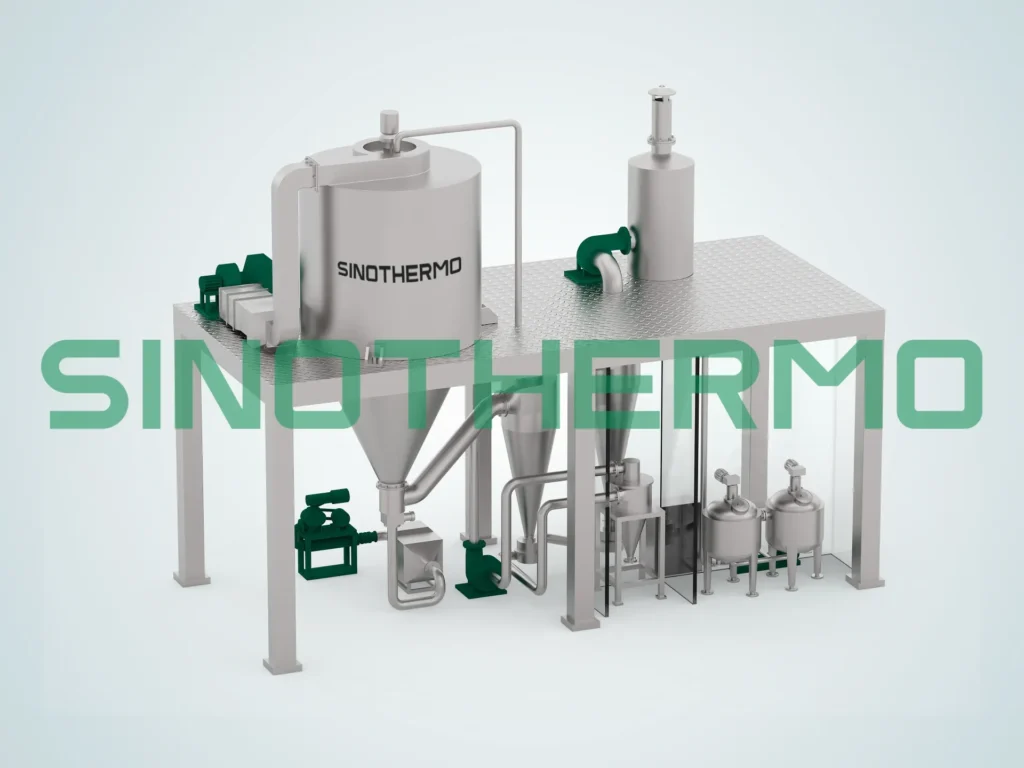
A bare drying chamber is not a working plant. A complete spray drying system usually includes feed preparation and pumping, the air heater, the chamber, primary separation (cyclone), secondary separation (bag filter), exhaust fan and ducting, controls, and powder discharge. Beyond that baseline, scope can extend to wet scrubbers, integrated or external fluid-bed for second-stage drying and agglomeration, solvent-recovery condensers for organic-solvent feeds, nitrogen closed-loop circuits for oxygen-sensitive or flammable products, conveying, and packing.
Each of these is a genuine cost. None of them is optional if your process needs it. A supplier who quotes only the chamber will always look cheaper than one who quotes the working plant, and the difference will reappear later as change orders. This is the single most important thing to normalise before comparing offers.
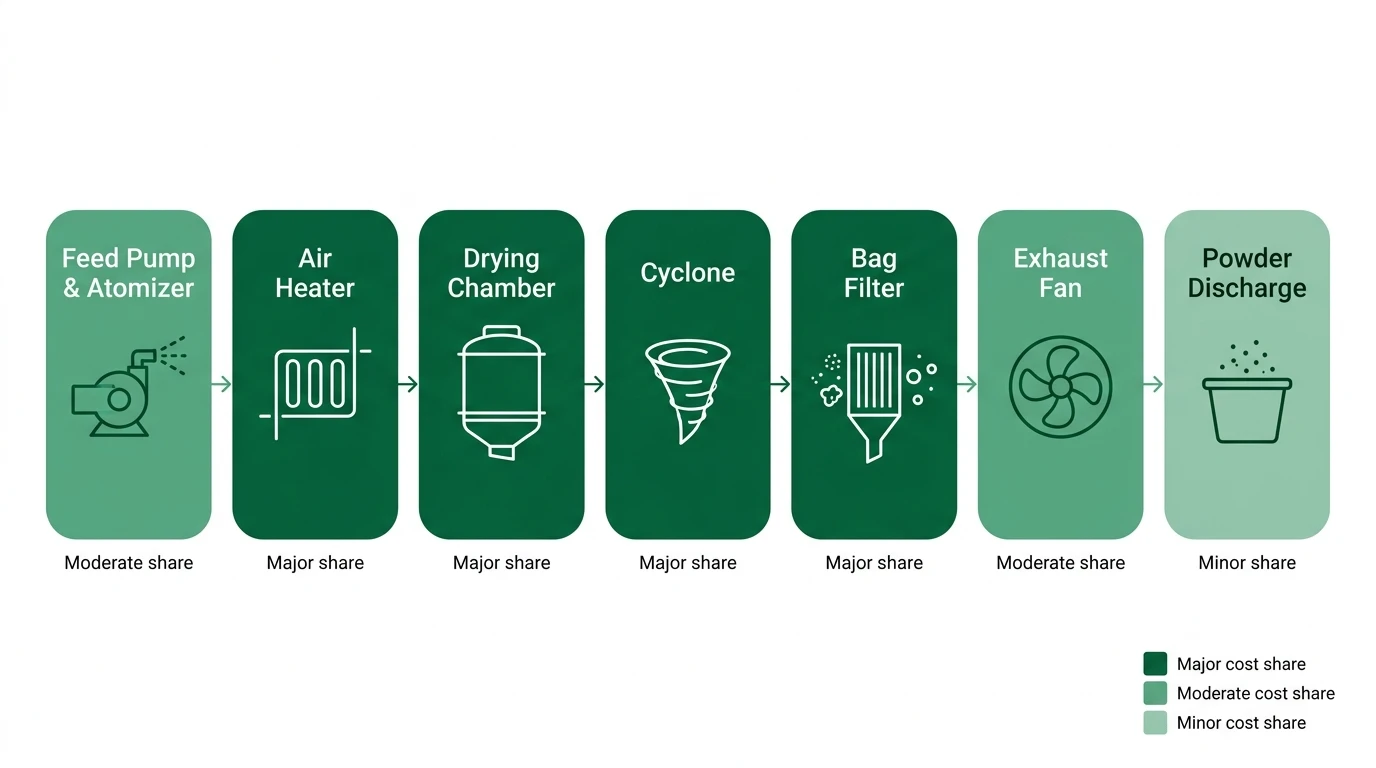
Where the money actually sits in a spray drying system
Comparing quotes gets much easier once you know roughly which sub-systems carry the weight.
| Sub-system | Share of total system cost | What moves it |
|---|---|---|
| Drying chamber and structure | Major | Evaporation duty, material grade, surface finish, insulation, height |
| Air heater | Major | Heating source, inlet temperature, indirect vs direct firing |
| Atomizer assembly | Moderate to major | Rotary vs nozzle, capacity, sanitary execution |
| Separation train (cyclone, bag filter, scrubber) | Major | Powder fineness, emission limits, recovery target |
| Fans, ducting, insulation | Moderate | Air volume, plant layout, noise limits |
| Controls and automation | Moderate | PLC scope, data integrity requirements, recipe control |
| Compliance package | Moderate to major | GMP, ATEX, CE, validation documentation |
| Installation, commissioning, training | Moderate | Site location, scope split, local labour |
Read that table alongside your own enquiry. If a quote is dramatically lower than the others, the difference is almost always in the separation train, the compliance package, or the installation scope — the three areas most easily left out without the omission being obvious.
Purchase cost versus running cost
Capital cost is a single event. Running cost repeats every shift for a decade or more, and for a production spray dryer it usually overtakes the purchase price well within the equipment's life.
The main operating cost lines:
- Energy. The dominant cost by a wide margin. Spray drying is thermally intensive by nature — you are evaporating water with hot air. Inlet temperature, outlet temperature, feed solids concentration, and heat recovery all move this number every hour the plant runs.
- Feed solids concentration. The highest-leverage variable in the whole economics, and it sits upstream of the dryer. Every percentage point of water removed by a cheaper method first — evaporation, membrane concentration, filtration, decanting — is water the dryer does not have to boil. Concentrating the feed before spray drying is routinely the largest single lever on lifetime operating cost.
- Product recovery. Powder that leaves through the stack is lost revenue plus an emissions problem. A better separation train raises capital cost and lowers running cost, and the trade-off is easy to evaluate once you know your product's value.
- Labour and cleaning downtime. CIP costs capital, saves labour hours, and returns production time. High-changeover plants recover it quickly; single-product plants may not.
- Maintenance and wear parts. Nozzle orifices, atomizer wheels and bearings, filter bags, seals. Abrasive feeds accelerate all of these.
- Compressed air and utilities, particularly with two-fluid nozzles and pulse-jet filter cleaning.
The practical implication for budgeting is to evaluate offers on the cost of owning the plant, not the cost of buying the machine. A design with heat recovery, a higher-efficiency separation train, and a feed concentration step ahead of the dryer will lose a first-round price comparison and win the decade.
How cost scales from lab to pilot to industrial
The three scales are not the same machine in three sizes. They exist for different purposes, and the cost logic differs accordingly.
- Lab spray dryer. Bench-scale units for formulation and feasibility, working with gram-to-kilogram quantities. Lowest capital cost, almost always electrically heated, usually a two-fluid nozzle. The purpose is to answer "can this material be spray dried at all, and roughly under what conditions."
- Pilot spray dryer. The bridge, and the scale where most money is saved or lost. A pilot spray dryer runs continuously with the same atomization principle and separation logic as production, generating data that scales. Mid-range capital cost — and the cheapest insurance available against specifying a production line incorrectly.
- Industrial spray dryer. Cost scales with evaporation duty, and this is where materials, compliance, heating source, and system scope open the widest spread. It is also where operating cost decisively outweighs capital cost.
The differences in geometry, residence time, and heat transfer between these scales are exactly why data does not transfer automatically between them. Our comparison of lab, pilot and industrial spray dryers covers what does and does not scale.
Why "spray dryer for sale" listings rarely give a real number
Search "spray dryer for sale" and you will find listed prices. They are rarely the price you will pay, and the reason is structural rather than commercial.
Feed properties — viscosity, solids content, heat sensitivity, abrasiveness, whether the carrier is water or solvent — together with the target powder specification — particle size distribution, residual moisture, bulk density, flowability, dispersibility — determine the required evaporation capacity and the correct configuration. A listed price corresponds to one configuration for one assumed duty. Change any of those inputs and you have changed the machine.
There is a second reason worth naming plainly. A listing that quotes a low number for a nominal capacity is usually quoting a bare chamber against optimistic assumptions: high feed solids, high inlet temperature, coarse powder, minimal separation, no compliance package. Every one of those assumptions can be true for someone. The question is whether they are true for you.
What to ask before you request a quote
Accurate quotes come from complete enquiries. Before you send an RFQ, have answers ready for the following — and expect any serious supplier to ask for them.
About your material
- 1.Feed solids concentration (%), and whether it can be raised before drying.
- 2.Viscosity at feed temperature, and whether the feed is Newtonian.
- 3.Aqueous or solvent-based — and if solvent, which one and at what concentration.
- 4.Heat sensitivity: the maximum product temperature the material tolerates, and for how long.
- 5.Abrasiveness and any tendency to stick to hot surfaces.
- 6.Whether the powder is combustible, hygroscopic, or oxygen-sensitive.
About your product specification
- 1.Target residual moisture.
- 2.Target particle size distribution and bulk density.
- 3.Required flowability, dispersibility, or solubility behaviour.
- 4.Whether agglomeration or instantising is required.
About the plant
- 1.Required output, and whether that is powder out or water evaporated.
- 2.Operating hours per day and days per year.
- 3.Available utilities: electricity, steam, gas, thermal oil, compressed air, chilled water.
- 4.Site constraints, especially available height.
- 5.Applicable compliance regime: GMP, CE, ATEX, food-contact, local emission limits.
About the offer itself
- 1.Exactly which sub-systems are included, and which are excluded.
- 2.What guaranteed performance figures are offered, and under which feed conditions.
- 3.What is included in installation, commissioning, and operator training.
- 4.Spare-parts scope and lead times.
- 5.Whether the quoted performance is based on a trial with your material or on calculation.
That last question is the one that separates a firm price from an indicative one. For a broader framework covering dryer selection before you get to spray drying specifically, see our guide on how to choose an industrial dryer.
How to budget accurately
- 1.Define your feed. Solids, viscosity, heat sensitivity, aqueous versus solvent-based. These set the evaporation load and the temperature ceiling.
- 2.Set your target powder specification. Particle size, moisture, flowability, bulk density. These set the atomizer and the separation train.
- 3.List required compliance. GMP, CE, ATEX, food or pharma-grade materials. These are structural, not optional extras.
- 4.Decide your scale honestly. Present output and realistic growth. Duplicable lines usually beat one oversized machine.
- 5.Budget the plant, not the machine. Include separation, controls, installation, commissioning, training, and the utilities work the dryer will need.
- 6.Model the running cost. Energy, recovery losses, maintenance, cleaning downtime, over at least five years.
- 7.Run a pilot trial. Confirm evaporation capacity, temperature window, and configuration on your actual material. This is the only route to a firm, comparable quote — and to a machine that makes the product you specified.
For a wider technical view of configurations and where each one fits, our spray dryer machine guide is the companion piece to this cost breakdown.
Common mistakes to avoid
- Quoting on powder output instead of evaporation capacity. The dryer is sized on water removed per hour. Give suppliers the powder figure alone and each one substitutes its own feed-solids assumption, which is the main reason "identical" quotes are not comparable.
- Comparing quotes with different scopes. A bare chamber will always beat a complete plant on price. Normalise the scope — separation train, controls, installation, commissioning, utilities — before comparing a single figure.
- Choosing a heating source on capital cost alone. Electric heating is the cheapest to install and usually the most expensive to run at production scale. Over a multi-shift decade, the energy line dominates. Decide on lifetime cost, not on the quotation.
- Over-specifying materials across the whole system. Upgrade contact parts where the chemistry demands it. Blanket-specifying premium alloy or surface finish on non-contact structure and ducting adds cost with no process benefit.
- Discovering compliance requirements late. GMP finishes, ATEX protection, and CE conformity change the vessel design, not just the paperwork. Adding one after the design is frozen is far more expensive than including it at enquiry stage.
- Scaling from a datasheet instead of a trial. Evaporation capacity, temperature window, and powder behaviour are properties of your material. Generic tables do not capture stickiness, wall deposition, or thermal degradation — and those are what turn a good quote into a bad plant. Many of the problems documented in our spray dryer troubleshooting guide trace back to exactly this shortcut.
Get an accurate price: trial your material first
The two numbers that decide what a spray dryer costs you — the evaporation capacity your material actually requires, and the temperature window it tolerates while still meeting the powder specification — cannot be read off a table. They are measured.
That is why SINOTHERMO runs an in-house pilot laboratory. Send us your material, or bring it, and we trial it before anything is specified: we measure the drying curve, establish the inlet and outlet temperature window, check for wall deposition and stickiness, confirm the atomizer type that gives your target particle size, and produce a powder sample you can test. That trial output is what turns an indicative budget number into a firm, defensible quote — for the right machine.
Backed by 20+ years of experience across food, chemical, pharmaceutical, ceramic and battery-material duties, our engineers use that trial data to size the chamber, the heater, and the separation train correctly the first time. And because we design and build to the process rather than from a catalogue, deep customization is the normal route rather than a surcharge — including specialised configurations such as the extract spray dryer for botanical and herbal extracts, where feed stickiness and thermal sensitivity dictate a chamber and separation design a standard unit cannot deliver.
SINOTHERMO — Process Engineering Infrastructure. We solve the process problem, not just sell a machine.
Conclusion
Spray dryer cost is not a number waiting to be discovered — it is an outcome of decisions, most of which your material makes for you. Evaporation capacity sets the scale. Materials of construction, atomizer type, heating source, compliance, and system scope set the spread around it. Running cost, driven above all by energy and feed solids concentration, decides what the plant costs to own long after the invoice is paid.
Buyers who specify precisely, compare like-for-like scope, and validate on their own material get quotes that hold. Buyers who shop on a nominal capacity figure get the 2-3x spread, and eventually a change order.
Budgeting a spray dryer and unsure what capacity your material actually needs? Send us a sample: our testing lab confirms the evaporation duty and configuration so your quote — and your plant — is right the first time. Talk to our engineers.
✉️ mark.gu@sinothermo.com · 📱 WhatsApp: +86 180 2197 2660 · 🌐 www.sinothermo.com
SINOTHERMO — Process Engineering Infrastructure.
FAQ
What is the average cost of a spray dryer?
There is no meaningful average, because a spray dryer is an engineered system rather than a catalogue product. Cost is set primarily by evaporation capacity, materials of construction, atomizer type, heating source, compliance requirements, and how much of the surrounding plant is included in the scope. A bench-scale laboratory unit and an industrial production line differ by orders of magnitude, and even two industrial dryers of the same nominal capacity can differ substantially once those factors are fixed correctly for the material.
Why do spray dryer quotes vary so much between suppliers?
Because nominal capacity alone does not specify a machine. Suppliers may assume different feed solids concentrations and inlet temperatures, quote different atomizer types and material grades, and include different amounts of the surrounding plant — separation train, controls, installation, commissioning. A quote covering only the drying chamber will always look cheaper than one covering a working plant. Normalising scope and stating evaporation duty rather than powder output removes most of the spread.
Is a centrifugal or pressure-nozzle spray dryer cheaper?
Pressure nozzles are mechanically simpler and lower in capital cost, but they produce coarser powder, are less tolerant of feed variation, and wear faster with abrasive solids. Centrifugal rotary atomizers cost more because of the precision high-speed drive, yet handle a wider range of feeds and give finer, more uniform powder. The atomizer also sets chamber geometry, so it should be chosen on process fit and confirmed by trial rather than on capital cost alone.
What ongoing costs should I budget for after buying a spray dryer?
Energy is by far the largest, since spray drying evaporates water with hot air. Beyond that, budget for product lost through the separation train, maintenance and wear parts such as nozzle orifices, atomizer wheels and filter bags, cleaning downtime and labour, and utilities such as compressed air. Feed solids concentration is the highest-leverage variable of all: water removed by a cheaper method upstream is water the dryer never has to boil.
Should I buy a pilot spray dryer before ordering an industrial line?
A pilot trial is essential; owning a pilot dryer is a separate question. Pilot-scale work establishes the evaporation capacity, temperature window, atomizer type, and powder characteristics that a production line must be designed around, and it is the cheapest insurance available against specifying an industrial dryer incorrectly. Companies with continuous development programmes often justify their own pilot unit, while a single project is usually better served by trialling the material in a supplier's pilot laboratory.
How can I get an accurate spray dryer price?
Define your feed properties and target powder specification, list the compliance regime that applies, state the required evaporation duty rather than only powder output, and specify exactly which sub-systems the quote must include. Then run a pilot trial on your actual material. A trial confirms the evaporation capacity and configuration the process genuinely needs, which is the basis for a firm and comparable quote rather than an indicative figure from a generic listing.

Mark Gu
Passionate about enhancing customer experiences and streamlining operations, Mark focuses on building strong relationships, fostering innovation, and leading teams to achieve exceptional service and efficiency.
Email: mark.gu@sinothermo.com
Phone: +86 18021972660