There is no single price for a vacuum dryer, because the same working volume can be built as a simple jacketed rake dryer or as a fully automated, solvent-recovery system with a hollow-disc agitator. Seven factors set the price: machine type, heating area, materials of construction, the vacuum and condenser system, heating and cooling utilities, automation and safety options, and testing and installation. This page explains each so you can compare quotations on the same basis. We do not publish list prices because a fair quote needs your material and duty.
Quick Context: why a price list does not exist
If you are searching for "vacuum dryer price", you probably want a number. The honest answer is that two machines with the same working volume can differ greatly in cost, and the cause is usually not the vessel. It is what the vessel is made of, how much heated surface is inside, and what is connected to it. A quotation that omits the vacuum pump, condenser or heating skid is not comparable to one that includes them.
For a sister article on a different dryer family, see spray dryer cost. To choose the right machine first, read vacuum drying equipment: how to choose by material.
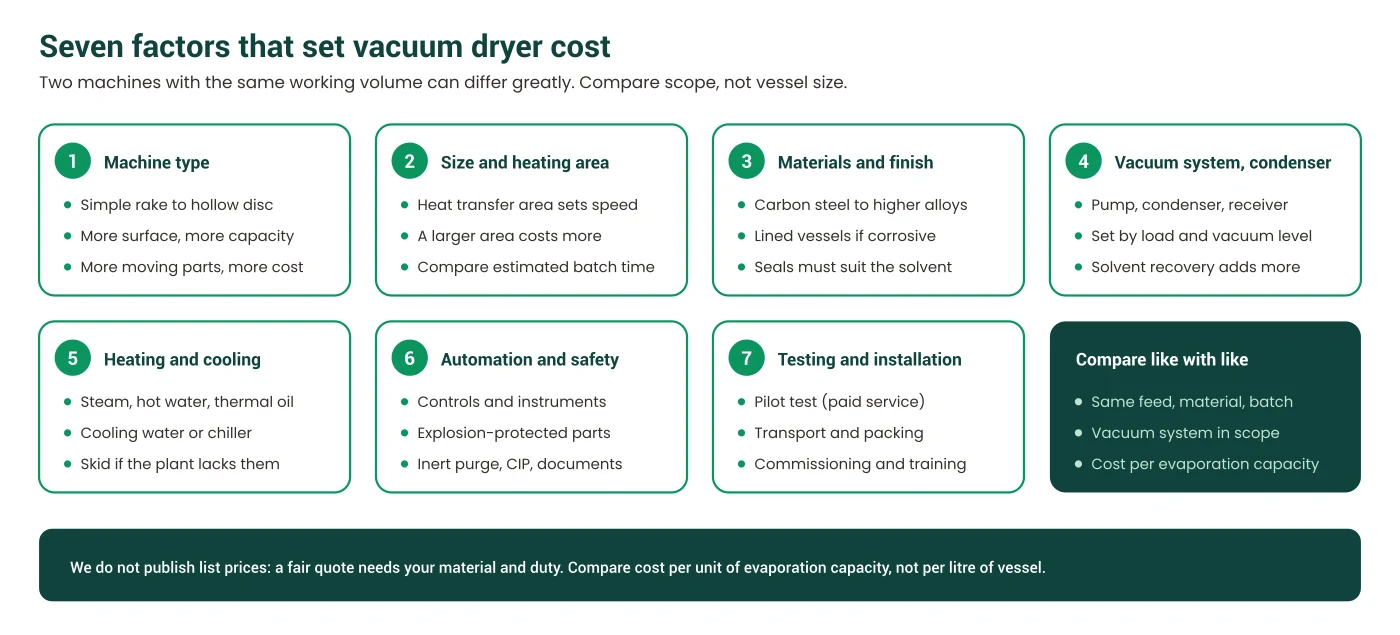
Factor 1: Machine type
Different vacuum dryers have different internal complexity.
- Vacuum rake dryer: simplest agitator, lowest heating surface per litre.
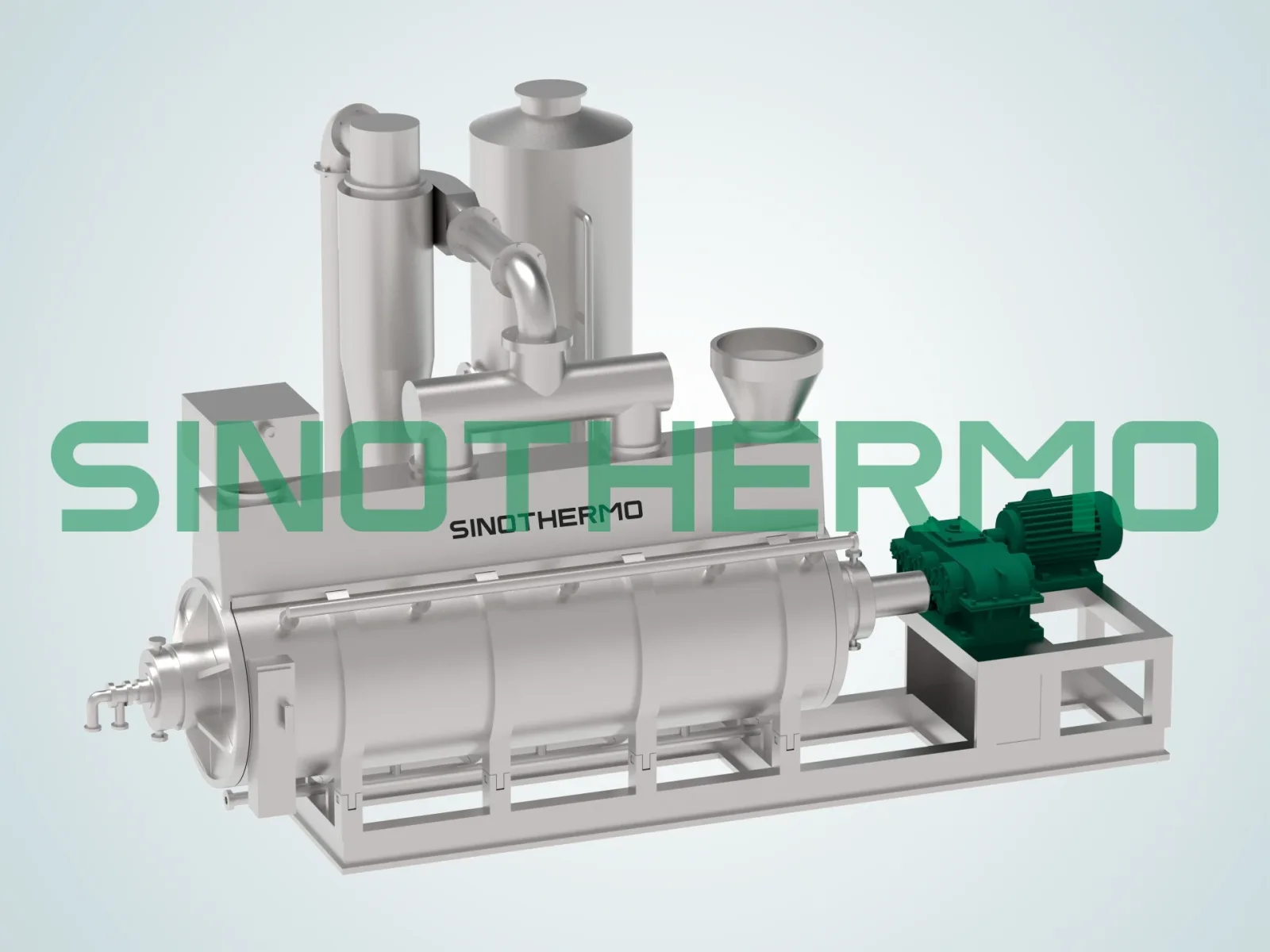
- Vacuum paddle dryer and vacuum horizontal disc dryer: hollow agitators add heating area and manufacturing complexity.
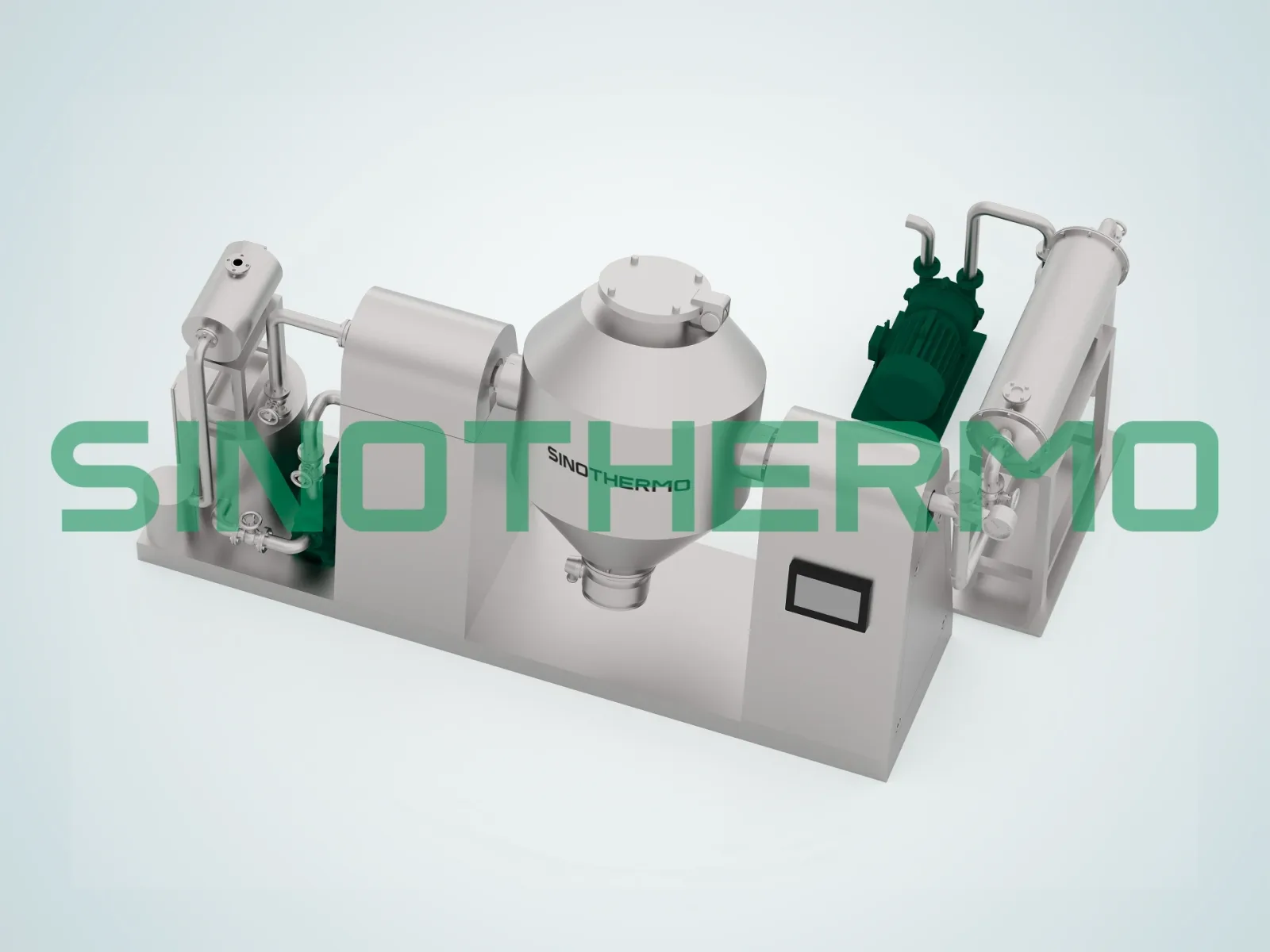
- Double-cone rotary vacuum dryer: rotating shell with rotary union and seals.
- Static vacuum cabinet dryer: shelves, trays and a rectangular vessel.
- Vacuum vertical plate dryer and vacuum drum scraper dryer: continuous machines with vacuum-tight feed and discharge.
More internal heating surface and more moving parts raise manufacturing cost, and they also raise drying capacity. The right comparison is cost per unit of evaporation capacity, not cost per litre of vessel.
Factor 2: Size and heating area
Capacity depends on the heat transfer area as much as on the vessel volume. A larger heating area costs more, and delivers a shorter batch. When two quotations differ, compare working volume, heat transfer area and estimated batch time side by side. The vacuum horizontal disc dryer article explains why heating area matters.
Factor 3: Materials of construction and finish
The material in contact with the product has a large effect on cost.
- Carbon steel is the lowest cost, for non-corrosive, non-hygienic products.
- Stainless steel (various grades) is the usual choice for chemicals, food and pharmaceutical intermediates.
- Higher alloys or lined vessels are needed for corrosive products such as acids and chlorides.
- Surface finish (polishing, electropolishing) matters for hygiene and for products that stick.
- Seals and gaskets must suit both the product and the solvent.
Tell the supplier what the product is, including pH, chloride content and solvents, because material choice can change the price noticeably.
Factor 4: Vacuum system and condenser
The vacuum pump, condenser, condensate receiver and piping can be a large share of the total. The pump type (liquid ring, rotary vane, dry screw), the condenser area and the coolant (cooling water or chilled water) are all set by the evaporation load, vacuum level and solvent. A deeper vacuum or a solvent-recovery duty needs more equipment. See vacuum pump and condenser sizing for how these are sized.
Check that every quotation states whether the vacuum system is included, and at what capacity and ultimate vacuum.
Factor 5: Heating and cooling utilities
The dryer needs a heat source (steam, hot water or thermal oil) and, usually, cooling water. If your plant has steam and cooling water at the right conditions, no extra equipment is required. If not, a heating skid, such as a hot-water unit or thermal-oil heater, and a chiller may have to be added. These can be quoted with the dryer or supplied by you. Make sure the scope is clear.
Factor 6: Automation, instrumentation and safety
Options that change the price include:
- Control system and recipe control, from simple manual control to automatic temperature and vacuum control
- Instruments: pressure, temperature, level and motor load
- Explosion-protected motors and electricals when flammable solvents are present
- Inert gas (nitrogen) purge and vacuum breaking
- Cleaning-in-place provisions and manholes
- Documentation, certificates and validation support for regulated industries
The more regulated the industry, the larger this portion of the price.
Factor 7: Testing, delivery, installation and training
Total cost of ownership includes more than the machine.
- Pilot testing before purchase, to confirm drying time and product quality. SINOTHERMO's pilot testing is a paid service.
- Transport and packing, especially for export.
- Installation and commissioning, on site.
- Operator training and spare parts.
Compare what each quotation includes, and whether installation and commissioning are in scope.
Running cost: the other half of the picture
Purchase price is only one part of the cost of drying. Over the life of the dryer, the main running costs are:
- Heating energy: steam, hot water or thermal oil to evaporate the liquid.
- Vacuum system energy and consumables: pump power, sealing liquid or oil, and cooling water.
- Labour: loading, unloading and cleaning, especially for batch machines.
- Maintenance: seals, bearings and wear parts.
- Product loss: a dryer that dries gently and keeps the product intact saves money in yield.
A machine with a lower purchase price that dries slowly or loses product can be more expensive in total.
Complete Line vs Machine Only
SINOTHERMO can supply a complete line, not just the dryer: vacuum system, condenser, dust filter, heating or cooling units, piping and controls. A complete-line quotation has one scope, one point of responsibility and a vacuum system matched to the dryer, which removes the most common reason two quotations cannot be compared. If you receive a machine-only quotation from another supplier, add the missing items before comparing prices.
Where Money Is Saved, and Where It Is Not
Saved without risk:
- Give the supplier complete, accurate process data, so it does not add safety margins for unknowns.
- Reuse existing utilities (steam, cooling water) instead of buying new heating or cooling skids.
- Use a dewatering step ahead of the dryer, such as a filter or centrifuge, so less water has to be evaporated. Less water means a smaller dryer.
- Standardise on one dryer for several similar products rather than buying a machine for each.
Savings that cost more later:
- Downgrading the product-contact material for a corrosive or hygienic product.
- Leaving out the condenser, which sends solvent to the pump and shortens its life.
- Undersizing the vacuum pump, so the dryer never reaches its design pressure and batches take longer.
- Skipping a pilot test and buying the wrong machine type.
Typical Delivery Scope: A Checklist
Use this list to check what is in and out of the price.
| Item | In the quotation? |
|---|---|
| Dryer vessel and agitator | |
| Drive, gearbox and motor | |
| Shaft seal and rotary union | |
| Vacuum pump | |
| Condenser and condensate receiver | |
| Dust filter or separator | |
| Control cabinet and instruments | |
| Heating skid (hot water, thermal oil) | |
| Chiller or cooling water unit | |
| Piping, valves and supports | |
| Installation and commissioning | |
| Training and documentation | |
| Spare parts kit |
Ask each supplier to fill in the table. The empty cells reveal what the other quote leaves out.
How to Compare Quotations Fairly
Ask every supplier to quote on the same basis:
- 1.Same feed, same initial and final moisture, same batch size or throughput
- 2.Same product-contact material
- 3.Vacuum system included, with stated ultimate vacuum and capacity
- 4.Heating and cooling utilities listed
- 5.Installation, commissioning and training listed
- 6.Spare parts and warranty terms
- 7.Delivery terms and time
Then compare the price against heat transfer area and estimated batch time.
What to Send for an Accurate Quotation
- Product name, feed form and viscosity or particle size
- Initial and target moisture or residual solvent
- Batch size or throughput
- Solvent type, and whether recovery is needed
- Maximum allowable product temperature
- Heat source and cooling water available
- Hazardous area classification, if any
- Required certificates or documentation
A worked example of why quotes differ
The numbers are illustrative, not customer data, and no prices are implied.
Two suppliers quote for a 1,200 L working-volume dryer.
- Quote A is a vacuum rake dryer in stainless steel with a single agitator, without a vacuum system.
- Quote B is a vacuum paddle dryer in stainless steel with hollow paddles, a liquid ring pump, a condenser and basic automation.
Quote B is higher, but it includes more heating area, a vacuum system and controls. Dividing the quotes by working volume would make A look better. Dividing by evaporation capacity, and adding the vacuum system that A leaves out, can reverse the ranking. Comparing like with like is the only fair method.
Timing and Lead Time
Price is not the only commercial variable. Lead time depends on size, materials and options, and special alloys or custom vacuum systems take longer. Ask for a delivery schedule that separates design, manufacturing, factory test, shipping and commissioning, and agree what happens if the schedule slips. For export projects, confirm packing, documentation and the Incoterms that apply, because freight and insurance can add a meaningful share to the delivered cost.
Common Mistakes to Avoid
- 1.Comparing price per litre of vessel. Compare per unit of evaporation capacity.
- 2.Leaving out the vacuum system. It is part of the dryer.
- 3.Choosing the cheapest material for a corrosive product. Replacement costs more.
- 4.Ignoring utilities. A heating skid or chiller may be needed.
- 5.Skipping testing. An undersized or wrong machine costs far more than a test.
- 6.Not asking about spare parts and service.
Test Before You Buy
A pilot test is the cheapest way to avoid buying the wrong dryer. Request a pilot test and the data is yours to use with any supplier. For a quotation, send us your material and duty and we will prepare a proposal. SINOTHERMO builds and sells equipment and does not offer contract drying.
Frequently Asked Questions
How much does a vacuum dryer cost?
It depends on the machine type, heating area, materials, vacuum system, utilities and automation. We do not publish list prices because a fair quote needs your material, batch size and solvent.
What is the biggest factor in vacuum dryer cost?
Size and heating area are usually first, followed by materials of construction and the vacuum system.
Is the vacuum pump included in the price?
Not always. Check each quotation for the pump, condenser and receiver, and their capacity.
Why do two quotations for the same size differ so much?
Because machine type, heating area, materials, vacuum system and automation differ. Compare on evaporation capacity and scope, not vessel volume.
Is a vacuum dryer expensive to run?
Running cost comes from heating energy, vacuum system power and cooling water, labour and maintenance. A dryer that is gentle on the product also saves yield.
Can I test before buying?
Yes. SINOTHERMO offers paid pilot testing so you can confirm drying time and product quality before you decide.
Does SINOTHERMO offer contract drying?
No. SINOTHERMO builds and sells drying equipment and offers paid pilot testing.

Mark Gu
Passionate about enhancing customer experiences and streamlining operations, Mark focuses on building strong relationships, fostering innovation, and leading teams to achieve exceptional service and efficiency.
Email: mark.gu@sinothermo.com
Phone: +86 18021972660