Conduction drying heats the product through a hot surface it touches; convection drying heats it with hot air flowing through or around it. Conduction dryers (vacuum rake, paddle, disc, plate, drum scraper, CD dryer) suit pastes, slurries, solvent-wet and heat-sensitive products and let you recover solvent. Convection dryers (fluid bed, flash, belt, pneumatic, spray) suit free-flowing or atomisable products, handle large throughputs and run continuously at lower capital cost. The feed form and the temperature limit usually decide which one.
Quick Context: two ways to put heat into wet material
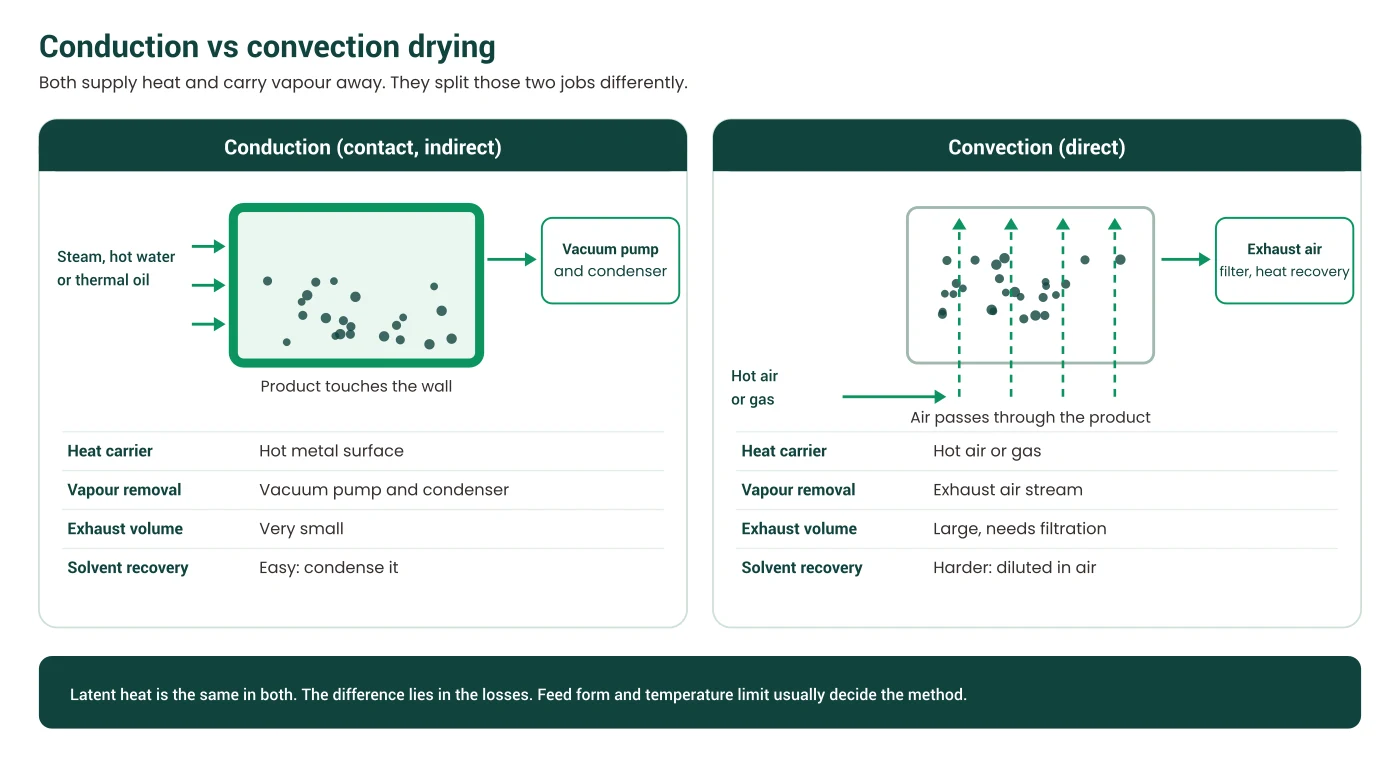
Drying is two jobs at once: supply heat to turn liquid into vapour, and carry the vapour away. The two methods split those jobs differently.
- Conduction (contact, indirect) drying. Heat passes through a metal wall from steam, hot water or thermal oil into the product. The vapour is removed separately, usually by vacuum and a condenser. There is little or no gas flowing through the product.
- Convection (direct) drying. Hot gas, usually air, passes through or around the product, giving up heat and carrying the vapour away in the same stream. The hot air is the heat carrier and the vapour carrier.
That single difference drives almost every other difference between the two families.
Side-by-side comparison
| Factor | Conduction drying | Convection drying |
|---|---|---|
| Heat carrier | Hot metal surface | Hot air or gas |
| Vapour removal | Vacuum pump and condenser (or small purge) | Exhaust air stream |
| Typical feed | Liquids, slurries, pastes, filter cakes, solvent-wet solids | Free-flowing solids, granules, filter cakes (flash), liquids that can be atomised (spray) |
| Exhaust volume | Very small | Large, needs filtration and often heat recovery |
| Solvent recovery | Easy, condense it | Harder, solvent is diluted in a large air stream |
| Heat-sensitive products | Excellent under vacuum | Good if residence time is short |
| Oxygen exposure | Low, sealed vessel | High unless inert gas is circulated |
| Throughput | Moderate, size set by heating area | High, size set by air volume |
| Operation | Mostly batch, some continuous | Mostly continuous |
| Dust handling | Low | Needs cyclones and bag filters |
How conduction drying works
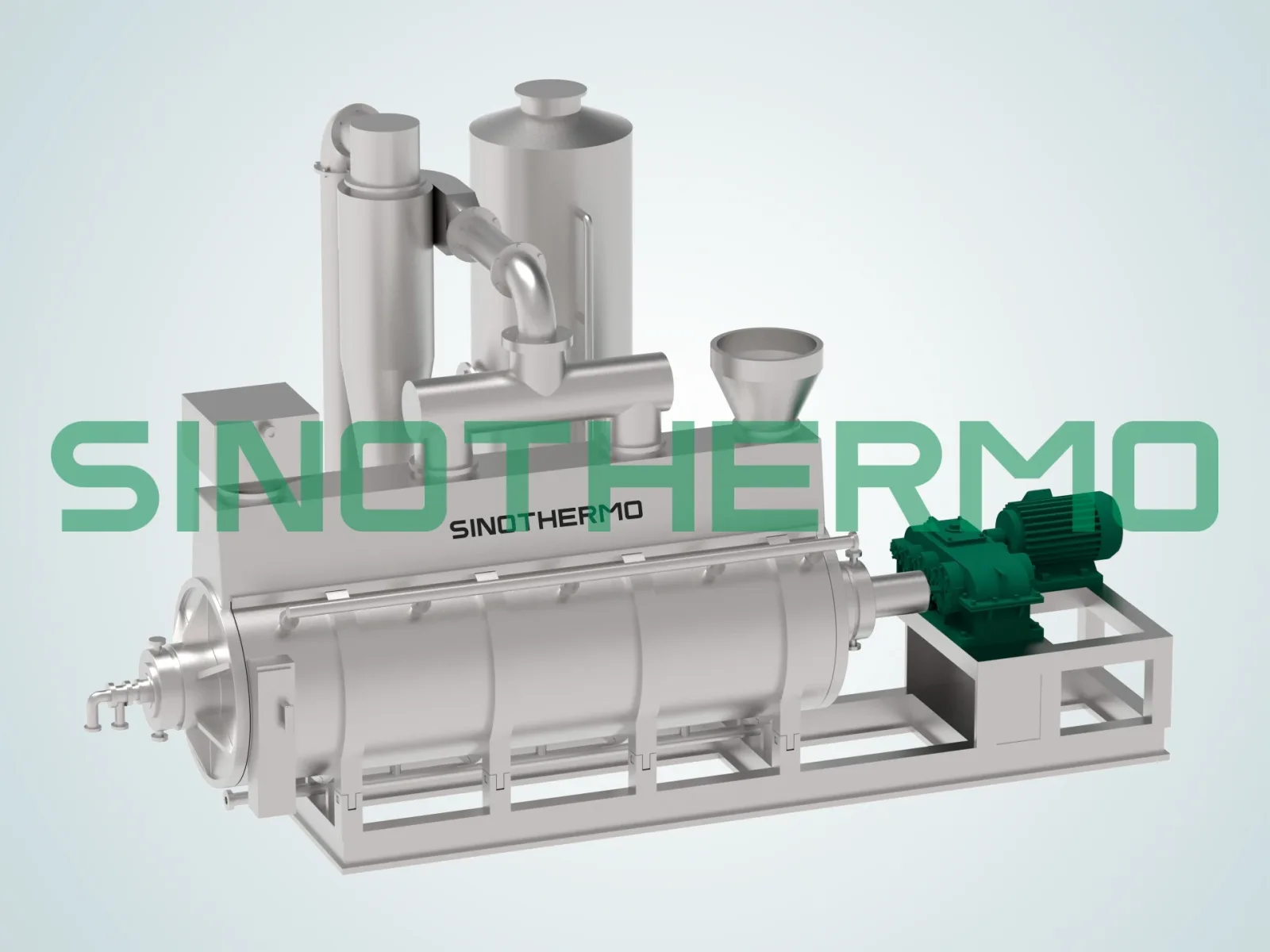
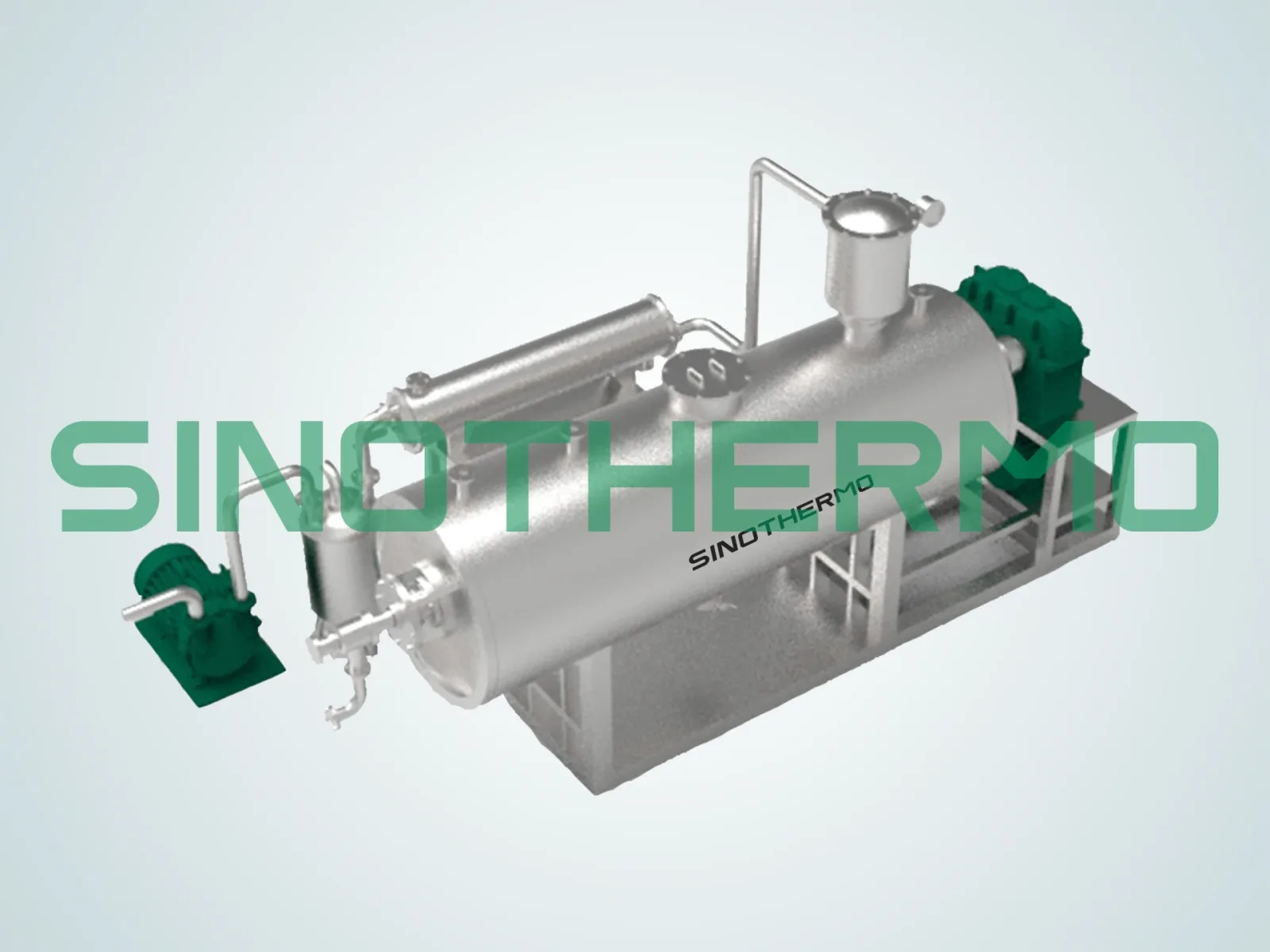
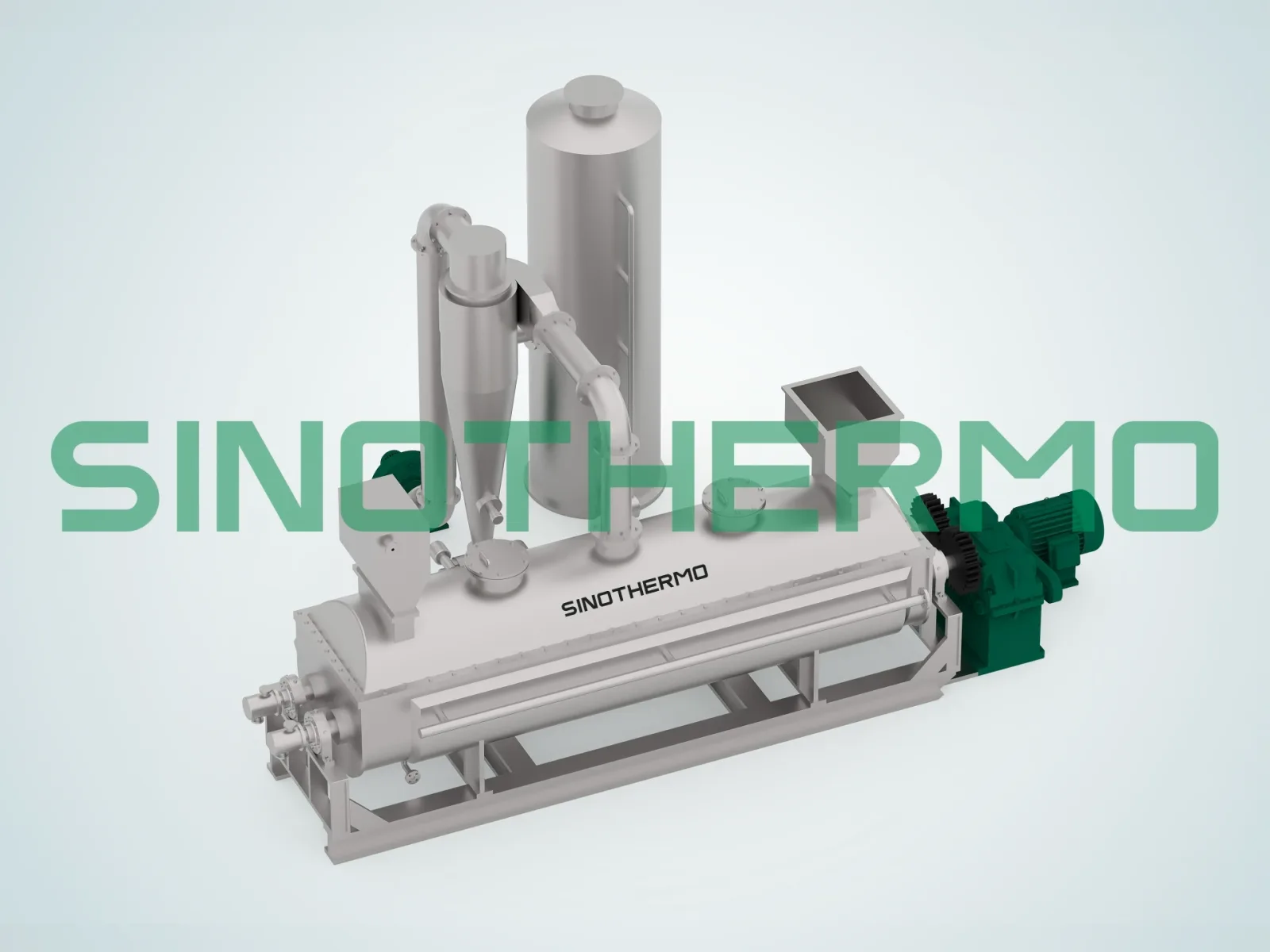
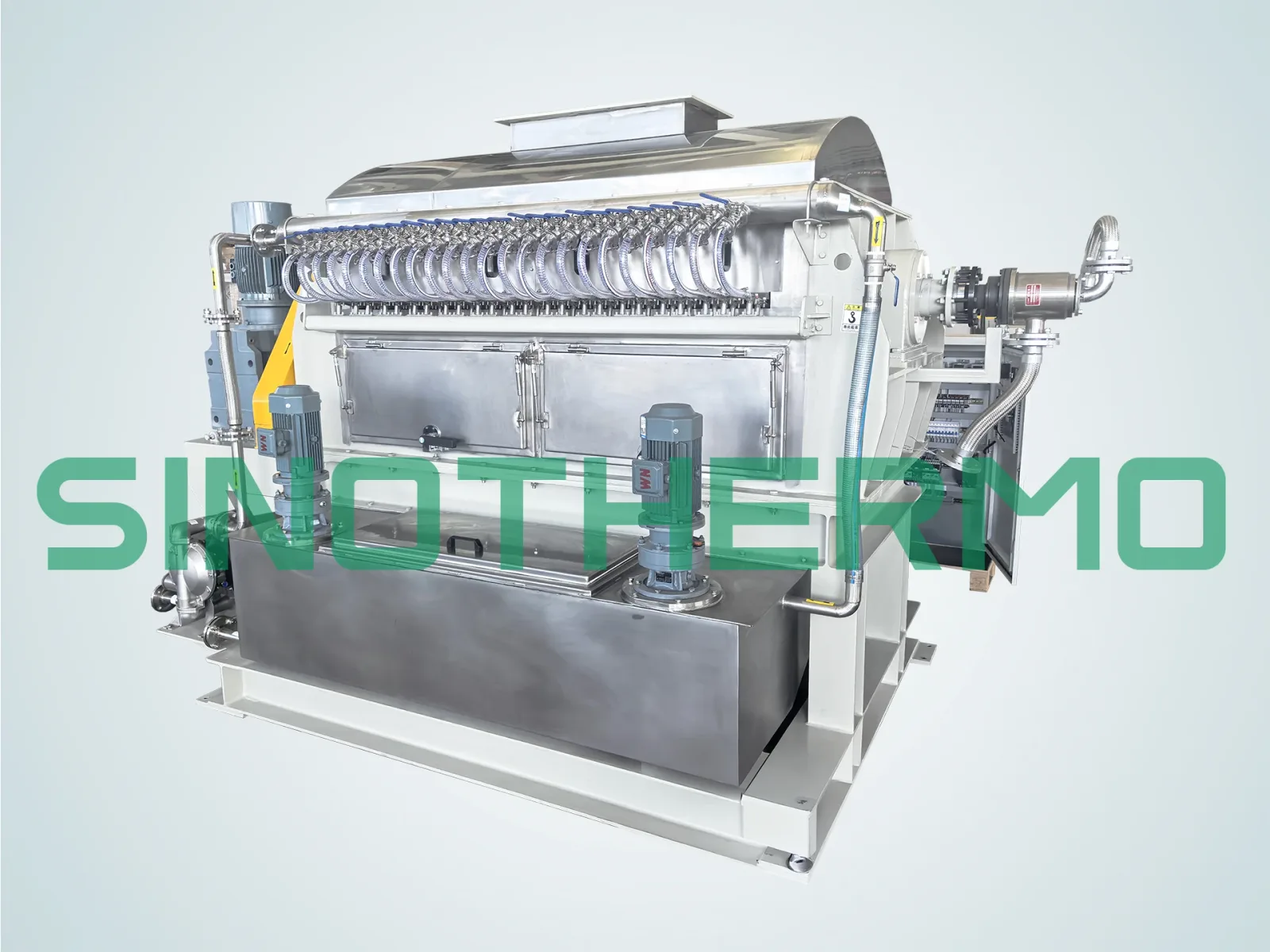
In a conduction dryer the product touches a heated surface: a jacket, hollow agitator, disc, plate or drum. Heat moves by contact. Because no air is blown through the product, there is no dust carryover and very little exhaust to treat. Combined with vacuum, the product dries at a low temperature in a sealed, low-oxygen vessel.
SINOTHERMO's conduction dryers include:
- Vacuum rake dryer, vacuum paddle dryer and vacuum horizontal disc dryer: agitated batch dryers for liquids, slurries, pastes and mashes, heat source 50 to 200 °C.
- Vacuum vertical plate dryer: continuous drying of loose powders and granules, heat source below 200 °C.
- Vacuum drum scraper dryer: continuous thin-film drying of thick pastes into flakes.
- CD dryer: continuous disc dryer for liquids and pastes, with thermal efficiency listed at 80 to 85 percent.
- Static vacuum cabinet dryer: batch tray drying, heat source below 100 °C.
Our conduction drying technology page lists the range.
How convection drying works
In a convection dryer, hot air contacts the product directly. In a fluid bed dryer, air flows up through a bed of granules and floats them. In a flash dryer, particles are carried in a fast air stream. In a belt dryer, air passes through a bed spread on a mesh belt. In a spray dryer, droplets dry in a hot air chamber.
SINOTHERMO's convection dryers include:
- Spin flash dryer: filter cakes and loose solids, inlet air 140 to 220 °C.
- Pneumatic dryer: loose, non-viscous solids, inlet air below 200 °C.
- Belt dryer: permeable solids on a mesh belt, inlet air below 200 °C.
- Horizontal fluidized bed dryer and vertical fluidized bed dryer: powders and granules, inlet air below 100 °C.
- Centrifugal spray dryer: liquids to powder, inlet air 150 to 500 °C.
Heat Transfer Basics: Why the Two Methods Behave Differently
Heat flow in any dryer follows the same relationship: heat rate equals the heat transfer coefficient, times the area, times the temperature difference. The two methods improve each term differently.
In conduction dryers, area is the lever. The coefficient between a metal wall and a wet, agitated product is high while the product is wet, and falls as it dries and becomes a powder with air gaps between particles. To raise capacity you add heating surface: hollow paddles, discs, plates or a larger jacket. This is why conduction dryers are rated by heat transfer area in square metres, as in the disc dryer range of 3.2 to 19.2 m² main heating area, and why a hollow-disc or hollow-paddle machine dries faster than a plain jacketed vessel of the same volume.
In convection dryers, air volume and temperature are the levers. The coefficient between hot air and a particle depends on air velocity and particle size. Fine particles in a fast air stream, as in a flash dryer, transfer heat very quickly. To raise capacity you move more air or use hotter air, which is why convection dryers are rated by evaporation capacity at a stated inlet temperature, as on the spin flash dryer range.
The falling-rate stage hurts both. Once the surface is dry, moisture has to diffuse out from inside the product, and the drying rate drops whatever method you use. In conduction dryers, the heated surface can then raise the product temperature quickly, so the product temperature limit must be watched. In convection dryers, the air temperature set point limits how hot the product can get.
Safety and Environment
Oxygen and dust. A convection dryer mixes hot air with fine organic powder, which can create a dust explosion risk. Controls include inlet temperature limits, explosion venting and, for some products, inert gas circulation. A vacuum conduction dryer works with very little oxygen in a sealed vessel, so the risk profile is different.
Solvents. Drying a solvent-wet product in hot air sends solvent vapour into the exhaust, where it must be treated or captured. In a vacuum conduction dryer the vapour goes to a condenser and can be recovered, which is both safer and often cheaper.
Emissions and noise. Large air volumes mean fans, filters and possible emission control. Conduction dryers have a much smaller exhaust.
Cleaning and changeover. Convection dryers have large internal volumes and filters to clean, while agitated conduction dryers have internal surfaces that must be reached. In both cases, cleaning access and changeover time need to be discussed during specification.
Energy and cost: what really differs
Latent heat is the same. Evaporating a kilogram of water needs roughly the same energy in either method. The difference lies in losses.
Convection loses heat in the exhaust. The hot air leaving the dryer carries heat away. Heat recovery from exhaust air can improve efficiency but adds equipment.
Conduction loses little in the exhaust because vapour leaves through a condenser, and the product is heated through a wall. The CD dryer lists 80 to 85 percent thermal efficiency, a figure from the product page. Vacuum adds pump power, and for deep vacuum the pump and condenser add to capital cost.
Capital cost. For high-volume free-flowing products, a convection dryer is usually cheaper per kg/h of water evaporated, because air handling scales well. For small-to-medium volumes of sticky, heat-sensitive or solvent-wet products, conduction vacuum dryers often win because they avoid product loss, give solvent recovery and need little exhaust treatment.
Product value. If the product is high-value (pharmaceutical intermediates, fine chemicals, specialty pigments), the product quality benefits of conduction under vacuum usually outweigh the extra cost per kilogram evaporated.
Which one for which material
| Material | Likely choice | Why |
|---|---|---|
| Sticky paste or slurry | Conduction (paddle, disc, drum scraper, CD) | Needs a heated wall and agitation or a thin film |
| Solvent-wet cake | Conduction under vacuum | Sealed system, solvent recovery |
| Heat-sensitive powder | Conduction under vacuum, or short-residence convection | Low temperature or short exposure |
| Free-flowing granules | Convection (fluid bed, belt) | Air passes easily through the bed |
| Filter cake to fine powder | Convection (spin flash) | Fast drying with de-lumping |
| Pumpable liquid to powder | Convection (spray dryer) | Atomisation gives fine powder |
| Oxygen-sensitive or flammable | Conduction under vacuum | Low oxygen, sealed vessel |
A worked example
The numbers are illustrative, not customer data.
Two products are made in the same plant. Product A is a free-flowing granule at 18 percent moisture, produced at 800 kg/h. Product B is a solvent-wet paste at 40 percent solvent, produced at 150 kg per batch.
- Product A is permeable and free-flowing. A fluid bed dryer or belt dryer is the natural choice, because the throughput is high and air passes easily through the bed.
- Product B is a paste with flammable solvent. A sealed vacuum dryer such as a vacuum paddle dryer is the natural choice, because it avoids blowing solvent vapour in air, allows solvent recovery and handles the sticky stage.
The two products use different methods in the same plant because their feeds are different.
Common Mistakes to Avoid
- 1.Choosing by price per machine. Compare the cost per kilogram of water removed, including exhaust treatment and vacuum system.
- 2.Using convection on a sticky feed. It will clog the air path.
- 3.Using conduction for very high throughput of free-flowing material. The heating surface needed becomes large and costly.
- 4.Forgetting the exhaust. A convection dryer needs filtration and may need solvent abatement.
- 5.Ignoring oxygen. Hot air and fine organic dust can create explosion hazards.
- 6.Assuming one method is "better". They fit different jobs.
Test Before You Specify
Drying behaviour depends on the material, so test it. SINOTHERMO runs paid pilot testing on both conduction and convection equipment, so you can compare methods on your own product. Request a pilot test and the results are yours to use with any supplier. SINOTHERMO builds and sells equipment and does not offer contract drying. For how to choose among all dryer types, see how to choose an industrial dryer.
Frequently Asked Questions
What is the difference between conduction and convection drying?
Conduction drying heats the product through a hot surface in contact with it. Convection drying heats it with hot air flowing through or around it.
Which is more energy efficient, conduction or convection drying?
Latent heat is the same, but conduction usually loses less heat in the exhaust. Convection can approach it with heat recovery. The CD dryer product page lists 80 to 85 percent thermal efficiency.
Is a vacuum dryer a conduction dryer?
Most industrial vacuum dryers are conduction dryers. They heat through a wall and remove vapour through a condenser.
Which method is better for heat-sensitive products?
Conduction under vacuum dries at low temperature. Convection can also work if residence time is very short, such as in flash and spray dryers.
Can conduction dryers recover solvent?
Yes. The vapour goes to a condenser, so solvent can be collected.
Which dryer is better for large throughput?
Convection dryers usually scale better for large volumes of free-flowing products.
Does SINOTHERMO offer contract drying?
No. SINOTHERMO builds and sells drying equipment and offers paid pilot testing.

Mark Gu
Passionate about enhancing customer experiences and streamlining operations, Mark focuses on building strong relationships, fostering innovation, and leading teams to achieve exceptional service and efficiency.
Email: mark.gu@sinothermo.com
Phone: +86 18021972660