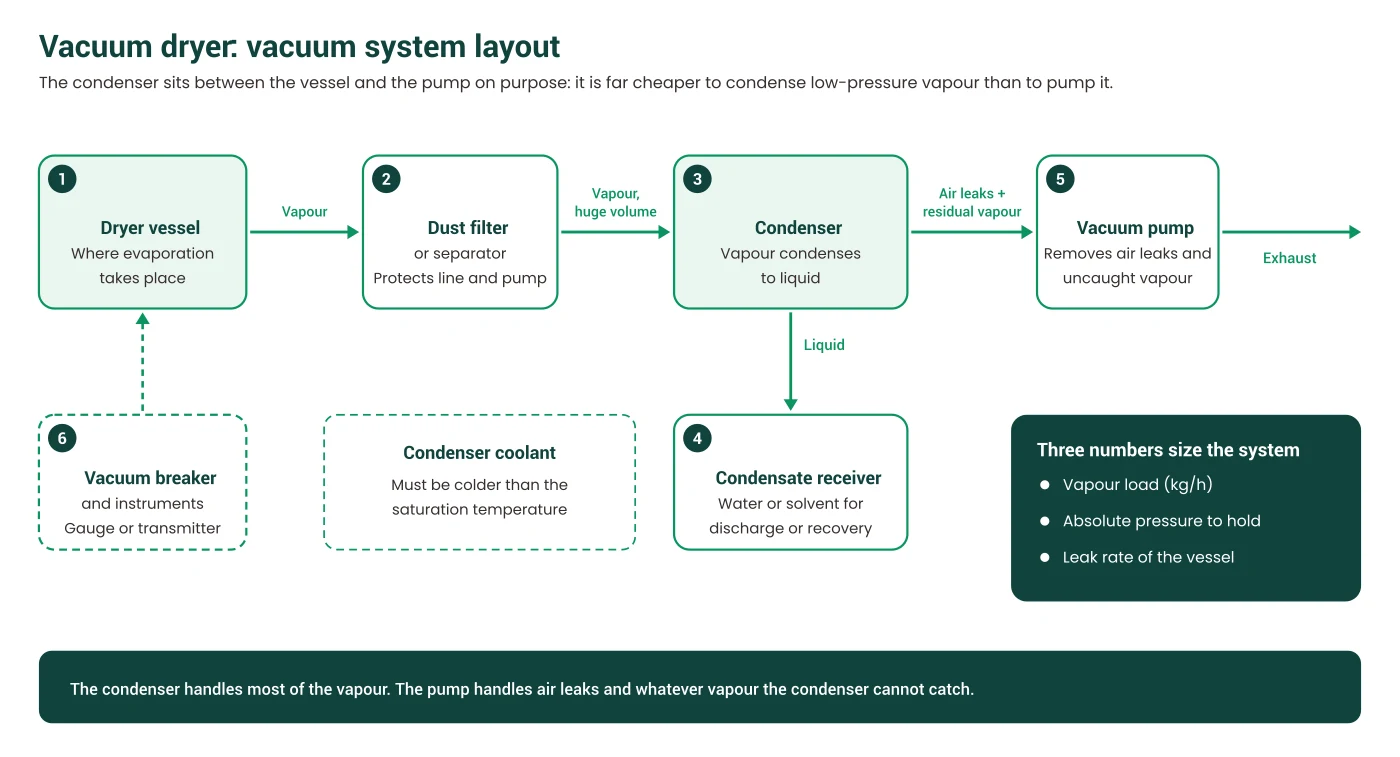
Size a vacuum dryer's vacuum system from three numbers: the vapour load you must remove (kg of water or solvent per hour), the absolute pressure you need to hold, and the leak rate of the vessel. The condenser removes most of the vapour by condensing it; the pump removes non-condensable gas (air leaks) and whatever vapour the condenser cannot catch. Choose the pump type from the solvent, and always size the condenser for the solvent's vapour pressure at the available coolant temperature.
Quick Context: the dryer is only as good as its vacuum system
A vacuum dryer's heating surface determines how fast heat can enter the product. The vacuum system determines whether the vapour can leave. If the vapour cannot leave fast enough, pressure rises in the vessel, the boiling point rises with it and drying slows. Many underperforming dryers have a heating surface that is fine and a vacuum system that is too small, or a condenser whose coolant is too warm.
This guide explains how to size the system. It follows on from boiling point of water under vacuum, which gives the pressure and temperature relationship, and from vacuum drying equipment: how to choose by material, which covers choosing the dryer.
The vacuum system layout
A standard vacuum dryer system runs in this order:
- 1.Dryer vessel: where evaporation takes place.
- 2.Dust filter or separator: protects the line and the pump from entrained powder.
- 3.Condenser: cools the vapour so that it condenses to liquid.
- 4.Condensate receiver: collects the water or solvent for discharge or recovery.
- 5.Vacuum pump: removes non-condensable gas and residual vapour.
- 6.Vacuum breaker and instruments: a pressure gauge or transmitter, and a valve to release vacuum safely.
The condenser sits between the vessel and the pump on purpose. Vapour at low pressure occupies a huge volume, and it is far cheaper to condense it than to pump it.
Step 1: Work out the vapour load
The vapour load is the mass of liquid that must leave the product each hour. For a batch dryer, this is the evaporation per batch divided by the drying time during the constant-rate phase, which is when the load peaks.
Evaporation per batch = wet mass minus final mass, where final mass = dry solids divided by (1 minus target moisture fraction).
For example, 600 kg of paste at 55 percent moisture dried to 5 percent leaves 270 kg of dry solids, a final mass of about 284 kg and 316 kg of water to evaporate. If the constant-rate phase lasts 3 hours, the peak vapour load is about 105 kg/h.
The peak load, not the average, sizes the condenser. The pump is sized by the non-condensable load plus the residual vapour.
Step 2: Decide the operating pressure
Set the absolute pressure from the maximum product temperature, using the boiling point table. If the product can reach 60 °C, an absolute pressure around 20 kPa is a reasonable target. Remember that the specification is absolute pressure; the gauge reading depends on local atmospheric pressure.
The lower the pressure, the larger the vapour volume and the more demanding the condenser and pump become. Choose the least vacuum that protects the product, not the deepest vacuum available.
Step 3: Size the condenser
A condenser removes heat. The duty is the vapour load multiplied by the latent heat of vaporisation, which is about 2,350 kJ/kg for water at 60 °C (about 0.65 kW per kg/h).
Using the earlier example, 105 kg/h of water vapour needs about 105 x 2,350 / 3,600 = about 69 kW of condenser duty.
Then check three things:
- Coolant temperature. The vapour condenses at its saturation temperature for the vessel pressure. At 20 kPa, that is about 60 °C for water, so cooling water at 25 to 30 °C gives a comfortable temperature difference. At 5 kPa, water vapour saturates at about 33 °C, so cooling water at 30 °C will barely condense it and you need chilled water.
- Heat transfer area. Area = duty / (U x logarithmic mean temperature difference). Condenser suppliers use their own U values, which depend on the presence of non-condensables, so ask them to size from your duty, pressure and coolant temperature.
- Pressure drop. The line from the vessel to the condenser must be short and large in diameter. At low pressure, small pressure drops cause large losses in vacuum level at the product.
For solvents, use the solvent's latent heat and saturation curve in place of water's. Lower-boiling solvents may need a refrigerated condenser, or a second cold trap, to avoid reaching the pump.
Step 4: Size the vacuum pump
The pump has two jobs:
- 1.Remove non-condensable gas. This comes from air leaking into the vessel and from gas released by the product.
- 2.Remove vapour the condenser cannot catch. This depends on how cold the condenser is relative to the vapour's saturation temperature.
For sizing, the usual approach is to calculate the leak rate and add a margin. Leak rate depends on the vessel, the shaft seals and the number of flanges and valves. A common way to quantify leakage is a pressure-rise test: isolate the vessel at the working pressure and measure how fast pressure rises. A well-built, clean system has low leakage.
Ask the supplier for an agreed pressure-rise limit and test it at commissioning. If the measured rise is much higher than agreed, find the leak before blaming the pump.
Pump capacity is quoted as volumetric flow at a given inlet pressure. Pumps lose capacity at low inlet pressure, so use the capacity curve at your operating pressure, not the headline figure.
Pump type comparison
| Pump type | Strengths | Limits | Typical fit |
|---|---|---|---|
| Liquid ring | Tolerates vapour, droplets and dust; simple, robust | Ultimate vacuum limited by sealing liquid vapour pressure (water-sealed rings reach roughly 3 to 4 kPa); needs sealing liquid and its disposal | Water-based drying, wet service |
| Rotary vane (oil-sealed) | Deep vacuum, compact | Oil contamination by vapour; oil changes | Dry, clean service behind a good condenser |
| Dry screw | No oil or sealing liquid; handles solvents when heated; low contamination | Higher purchase cost | Pharmaceutical, solvent recovery, clean service |
| Roots blower with backing pump | High capacity at low pressure | Added cost and complexity | Deep vacuum with large vapour loads |
| Steam or water ejector | No moving parts; handles corrosive vapours | High utility consumption | Corrosive duty, existing steam supply |
Choose the pump from the solvent first, vacuum level second and cost third.
A worked example
The numbers are illustrative, not customer data.
A pigment paste is dried in a 1,200 L working-volume vacuum dryer. Wet mass is 600 kg at 55 percent moisture, target 5 percent, absolute pressure 15 kPa (water boils at about 54 °C), peak vapour load 105 kg/h.
- 1.Condenser duty: about 69 kW. At 15 kPa, water vapour condenses at about 54 °C. Cooling water entering at 30 °C and leaving at about 38 °C gives a log-mean temperature difference near 20 °C. With an assumed overall heat transfer coefficient of 500 W/m²K for a condenser carrying some non-condensables, area = 69,000 / (500 x 20) = about 6.9 m². A supplier will round up and add a margin.
- 2.Vapour volume if it all went to the pump: at 15 kPa, one kg of water vapour is about 10 m³, so 105 kg/h would be about 1,050 m³/h. That is far too large for a pump, which is why the condenser matters.
- 3.Pump: with a well-sized condenser, the pump deals with leakage and a small residual vapour fraction. A pump with a few tens of m³/h at 15 kPa inlet pressure is typical for this scale, and the supplier should confirm using its capacity curve. For a clean, solvent-free duty, a liquid ring pump is a common choice.
The figures are for illustration. Pump and condenser must be sized by the supplier from the real vapour load, pressure, coolant and solvent.
Common Mistakes to Avoid
- 1.Sizing the pump for the vapour load. The condenser should handle the vapour. The pump handles the rest.
- 2.Quoting pump capacity at atmospheric pressure. Capacity falls at low inlet pressure.
- 3.Ignoring coolant temperature. Warm coolant can make a condenser useless at deep vacuum.
- 4.Long, narrow vapour lines. Pressure drop at the vessel is higher than the gauge at the pump shows.
- 5.Ignoring leaks. Leaks limit the achievable vacuum. Test the pressure rise at commissioning.
- 6.Using the wrong pump for solvents. Oil-sealed pumps can be contaminated, and flammable solvents need explosion-protected equipment.
What to Send With a Quotation Request
- Product, solvent and the amount to evaporate per batch or per hour
- Peak evaporation rate if known
- Target absolute pressure or maximum product temperature
- Cooling water or chilled water temperature available
- Whether solvent recovery is needed
- Hazardous area classification, if any
Supplied as a Complete Line
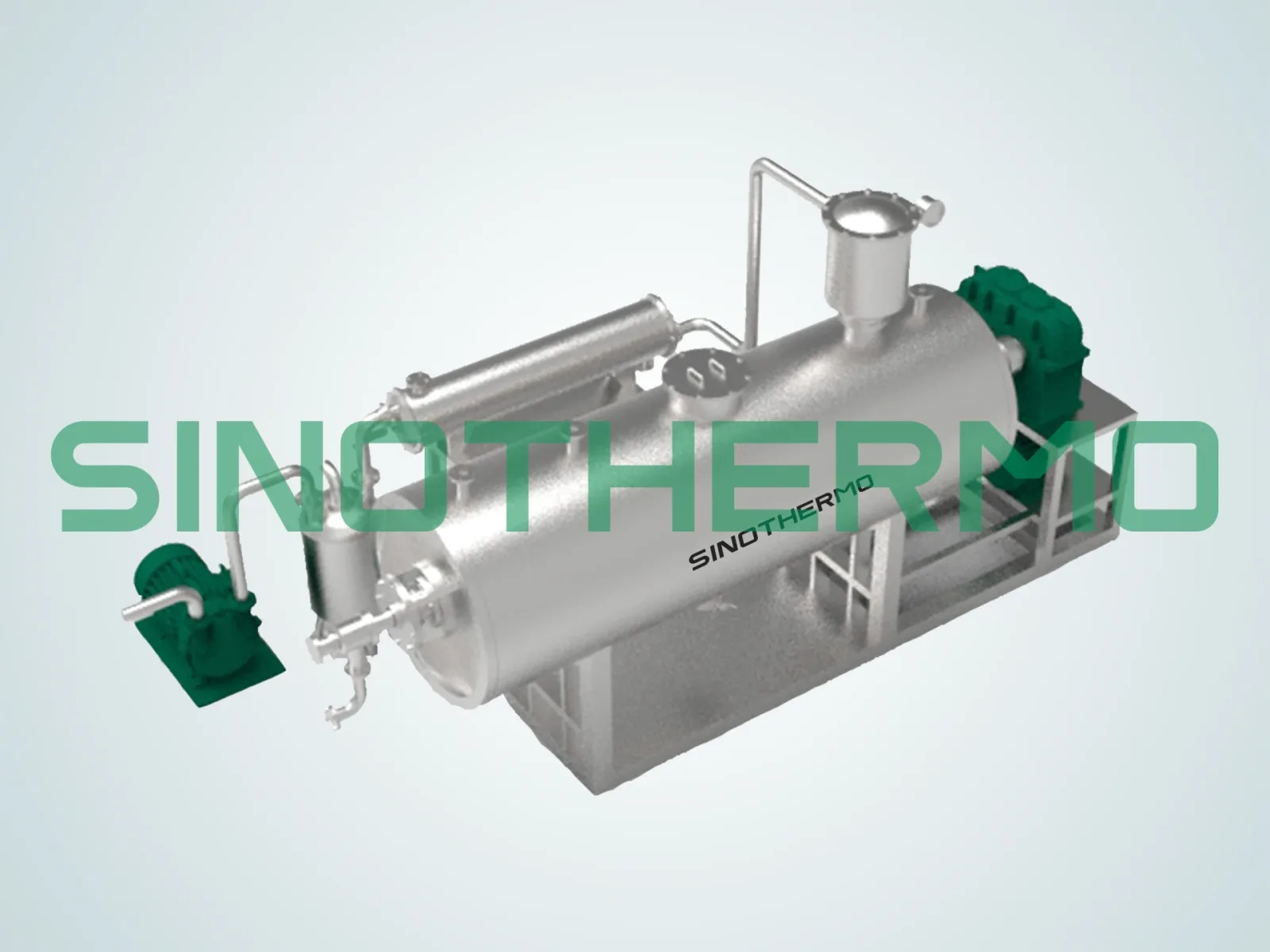
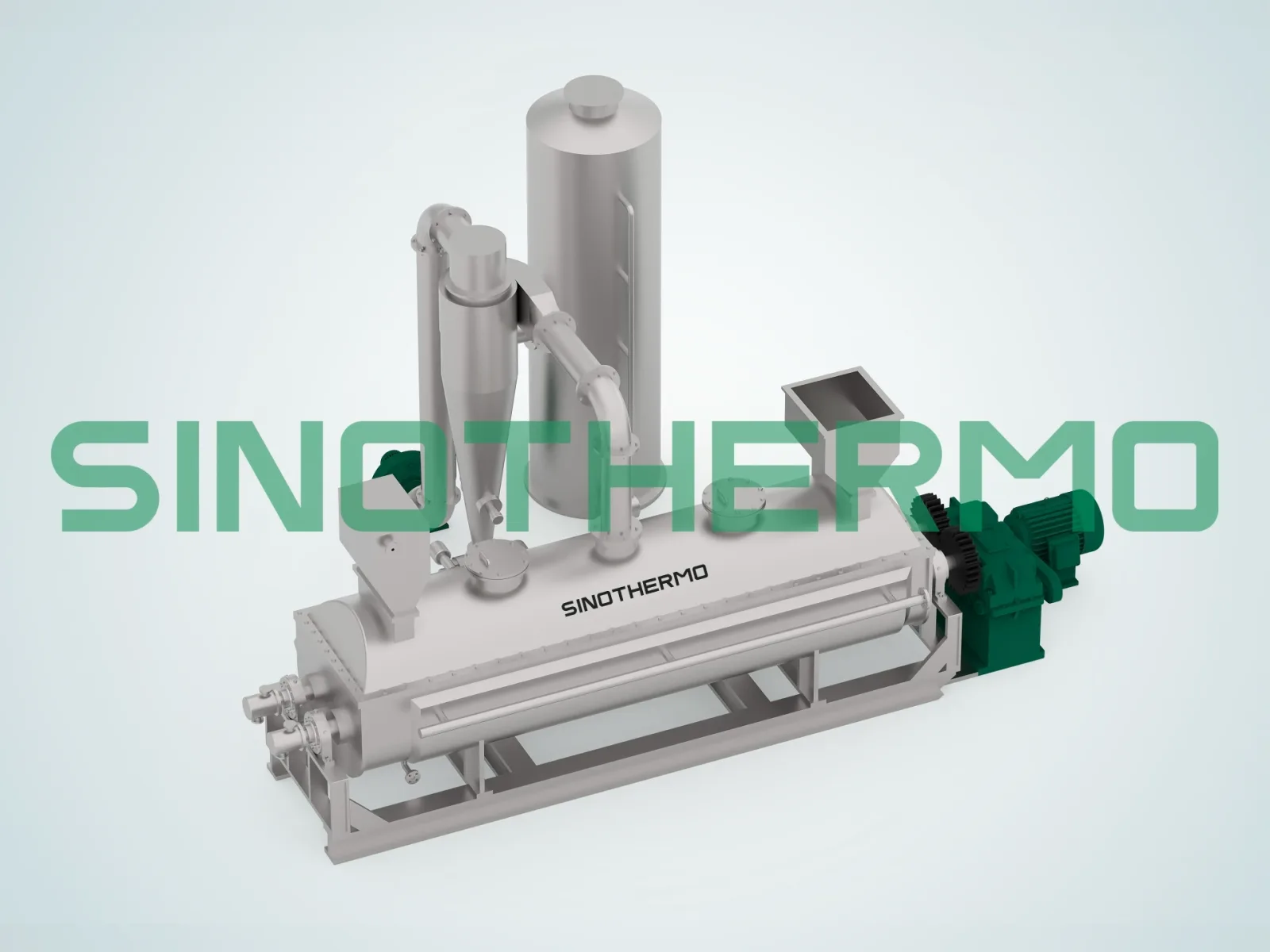
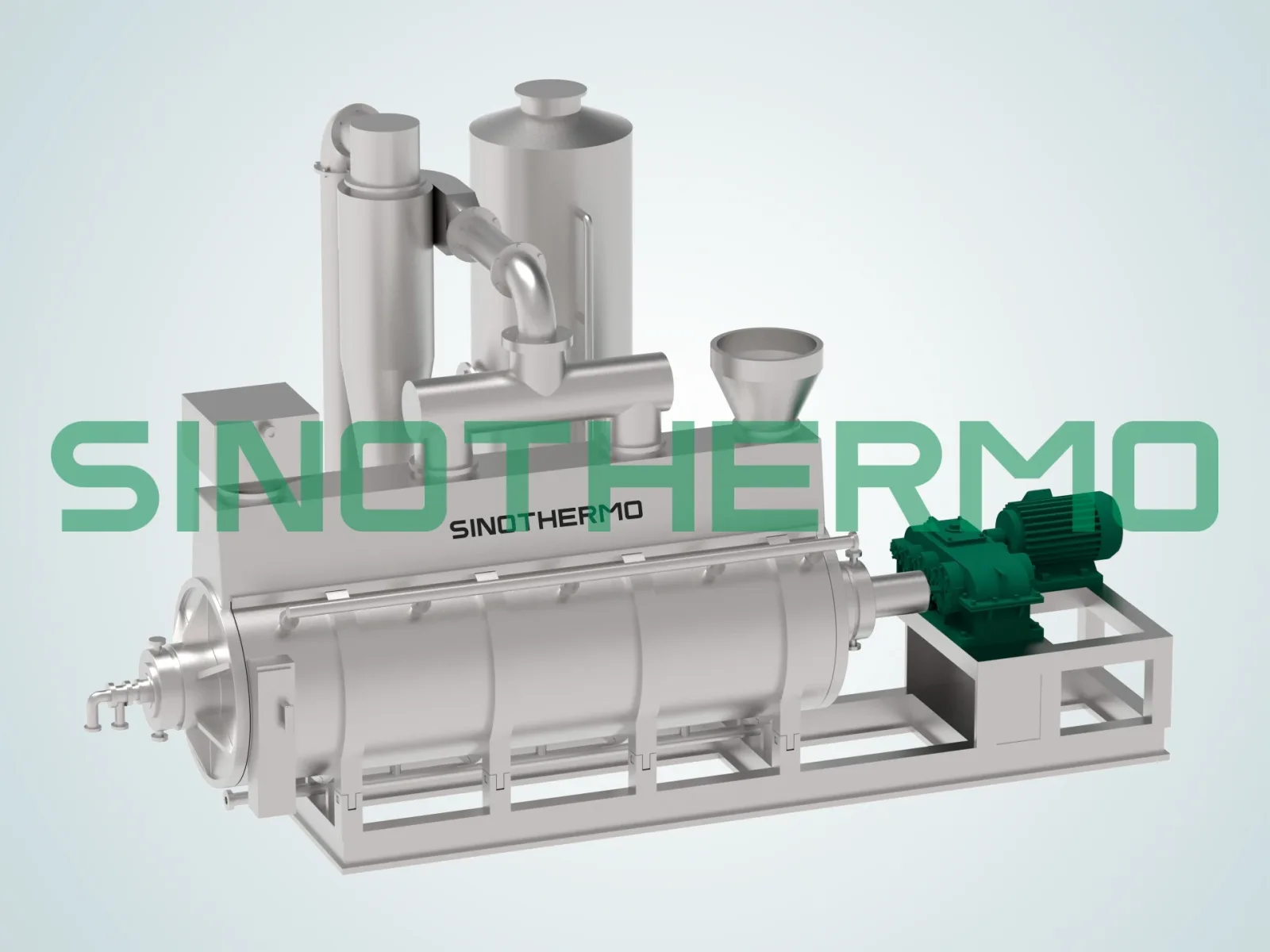
SINOTHERMO can supply the dryer as a complete line: the dryer itself plus the vacuum pump, condenser, condensate receiver, dust filter, heating or cooling units, piping and controls, matched to your vapour load and vacuum level. Sizing the whole system together avoids the common problem of a good dryer paired with an undersized pump or warm condenser. Send us your product and duty and we will size the line for you.
Test Before You Specify
A pilot test measures real evaporation rates, foaming and vapour loading on your product, which are the inputs for sizing the vacuum system. Request a pilot test and the results are yours to use with any supplier. SINOTHERMO builds and sells equipment and does not offer contract drying. For the dryer side, see conduction drying technology and the vacuum drying technology page.
Frequently Asked Questions
How do I size a vacuum pump for a vacuum dryer?
Calculate the non-condensable load from vessel leakage and product outgassing, add residual vapour not condensed, and select a pump that delivers that capacity at your operating inlet pressure, with a margin.
Do I need a condenser on a vacuum dryer?
In almost every case, yes. A condenser removes most of the vapour as liquid, protects the pump and allows solvent recovery.
Which vacuum pump is best for a vacuum dryer?
It depends on the solvent and vacuum level. Liquid ring pumps suit wet, water-based duty. Dry screw pumps suit solvents and clean service. Oil-sealed vane pumps suit dry, clean service behind a good condenser.
What vacuum level do I need?
Use the lowest vacuum that keeps the product below its maximum temperature. The boiling point table gives the pressure for a target temperature.
What cooling temperature does the condenser need?
Colder than the vapour's saturation temperature at the vessel pressure, with a margin. Water vapour at 5 kPa saturates at about 33 °C, so deep vacuum needs chilled water.
How do I check for leaks?
Isolate the vessel at working vacuum and measure how fast pressure rises. A high rise rate points to a leak.
Does SINOTHERMO offer contract drying?
No. SINOTHERMO builds and sells drying equipment and offers paid pilot testing.

Mark Gu
Passionate about enhancing customer experiences and streamlining operations, Mark focuses on building strong relationships, fostering innovation, and leading teams to achieve exceptional service and efficiency.
Email: mark.gu@sinothermo.com
Phone: +86 18021972660