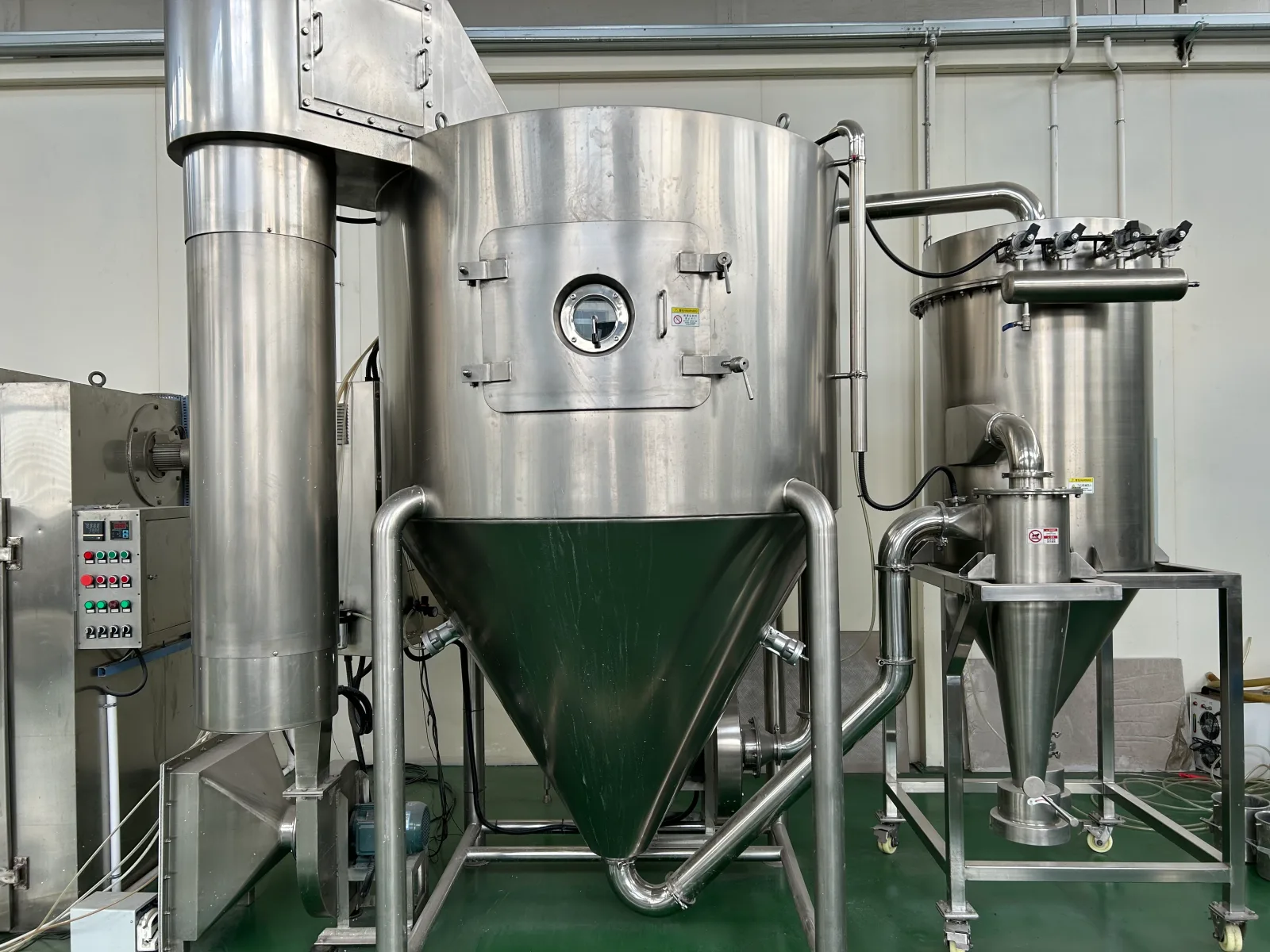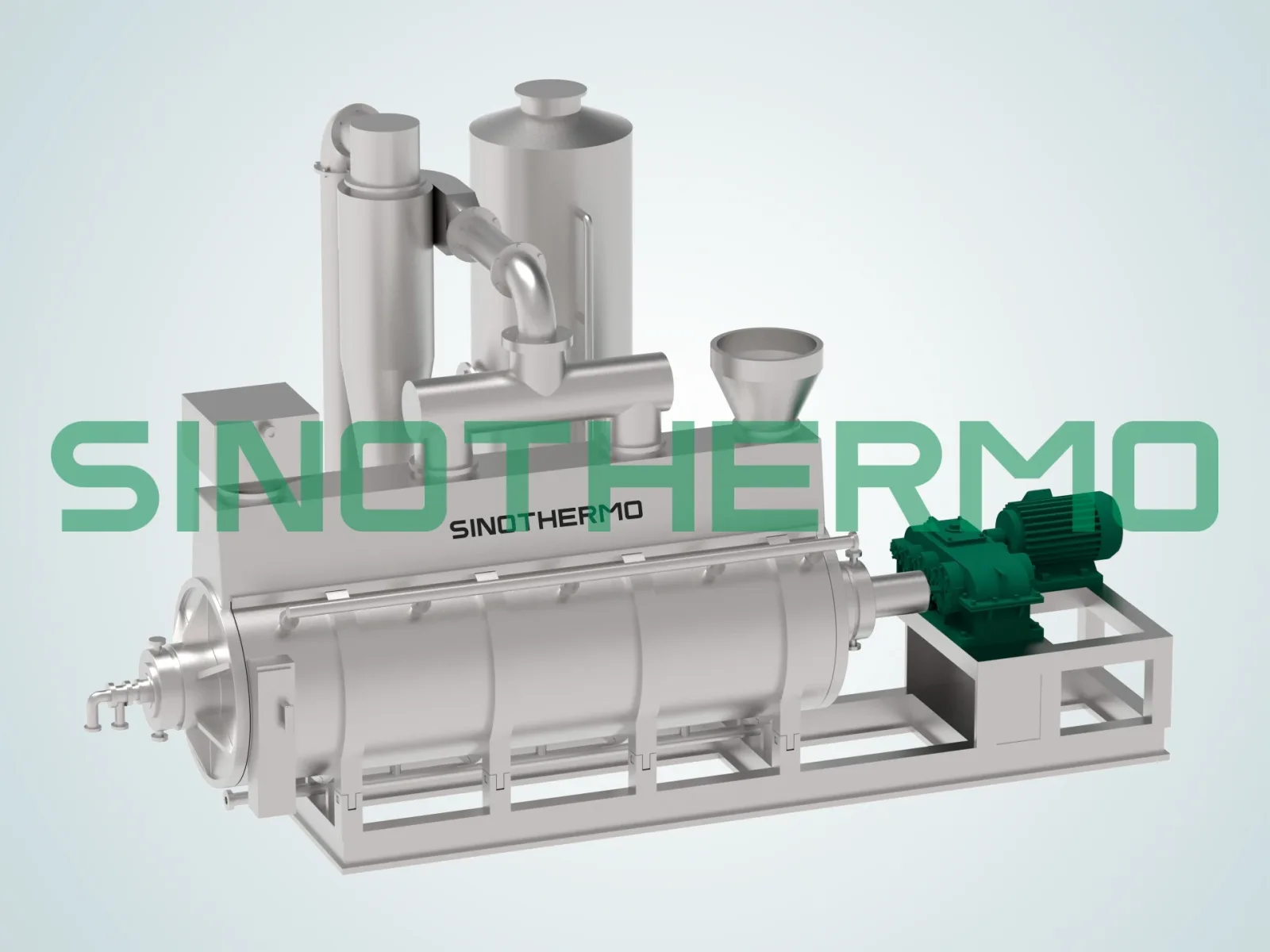
A vacuum horizontal disc dryer is a sealed, jacket-heated vessel with a shaft of hollow discs that carry heating medium. The discs add heating surface far beyond the jacket alone, so liquids, slurries, pastes and mashes dry into powder faster and at lower temperature than in many rake or paddle dryers. Sizes for SINOTHERMO's ZYG series run from 500 to 7,000 L total volume, with a heat source between 50 and 200 °C and final moisture of 3 to 10 percent.
Quick Context: where the disc dryer fits
Vacuum conduction dryers are the workhorses of fine chemical, pharmaceutical intermediate, pigment and specialty material drying. Within the family, the choice usually comes down to how much heating surface the agitator adds and how well it keeps the product from sticking. The rake dryer has the simplest agitator and the least added surface. The paddle dryer adds wedge-shaped hollow paddles. The disc dryer adds a stack of hollow discs on a rotating shaft, which gives the most heating surface per litre of vessel for many materials.
If you are still comparing all nine vacuum and conduction machines, read vacuum drying equipment: how to choose by material first. This article goes deep on one of them.
How a vacuum horizontal disc dryer works
- 1.Charge. Wet material is pumped or loaded into a horizontal cylindrical vessel. The vessel is then sealed.
- 2.Evacuate. A vacuum pump (with a condenser ahead of it) lowers the pressure in the vessel. Lower pressure lowers the boiling point of the liquid in the product, so water or solvent can evaporate at a much lower temperature.
- 3.Heat. Steam, hot water or thermal oil flows through the jacket, through the hollow discs and through the hollow shaft. Heat conducts directly into the product from all of these surfaces.
- 4.Agitate. The shaft turns slowly, between 6 and 30 rpm on the standard ZYG range. The discs lift and turn the batch, renew the contact surface and give mild crushing so lumps do not harden.
- 5.Condense. Vapour leaves the vessel, passes through the condenser and is collected as liquid. If the liquid is a solvent, it can be recovered.
- 6.Discharge. When the product reaches the target moisture, it is discharged as free-flowing powder at 3 to 10 percent moisture.
Because there is no hot-air stream, product losses to exhaust are very low, and the sealed low-oxygen environment makes the machine suitable for flammable, explosive, organic-solvent-wet and easily oxidised materials.
Why the discs matter
In a jacketed vessel, heat only enters through the wall. As the vessel gets larger, volume grows faster than wall area, so large batches dry more slowly. Hollow discs fix this by putting heated surface inside the batch. SINOTHERMO's ZYG-7.0 offers 19.2 m² of main heat transfer area, plus a further 5.77 m² on the heated shaft. The ZYG-0.5 offers 3.2 m² and 0.9 m².
More heating area means a higher evaporation rate for the same batch. The product page lists a typical drying intensity of 15 to 20 kg of water per square metre per hour. Treat this as a range for suitable materials, not a guarantee. Actual rates depend on the product, its viscosity as it dries and how much vacuum the pump can hold.
Disc dryer vs rake vs paddle
| Feature | Vacuum rake | Vacuum paddle | Vacuum horizontal disc |
|---|---|---|---|
| Heating surface beyond the jacket | Limited | Hollow wedge paddles | Hollow discs on heated shaft |
| Typical heat source | 50–200 °C | 50–200 °C | 50–200 °C |
| Typical final moisture | 3–10% | 3–10% | 3–10% |
| Best for | Non-sticky products, simpler duty | Sticky, crusty products needing self-wiping | Pastes and mashes where heating area per litre matters |
| Series | ZPG, 300–6,000 L working | KJG, 3–110 m² | ZYG, 300–4,200 L working |
For the paddle and rake comparison in detail, read vacuum rake vs paddle dryer and paddle dryer selection. The short version is that the disc dryer is worth testing when your product dries slowly in a rake machine, or when you need a compact vessel for a large evaporation load.
ZYG series sizing
| Model | Total volume (L) | Working volume (L) | Main heat transfer area (m²) | Motor (kW) |
|---|---|---|---|---|
| ZYG-0.5 | 500 | 300 | 3.2 | 3–5.5 |
| ZYG-1.0 | 1,000 | 600 | 5.1 | 5.5–7.5 |
| ZYG-2.0 | 2,000 | 1,200 | 8.7 | 7.5–15 |
| ZYG-3.0 | 3,000 | 1,800 | 10.6 | 11–18.5 |
| ZYG-5.0 | 5,000 | 3,000 | 14.3 | 22–37 |
| ZYG-7.0 | 7,000 | 4,200 | 19.2 | 37–55 |
Other sizes in the series are ZYG-0.75, 1.5, 4.0 and 6.0. Standard design values are a jacket pressure of 0.8 MPa, a vessel pressure range of -0.1 to 0.15 MPa and a noise level of 65 dB(A) or below. Anything outside these values is specified at order.
See the full table on the vacuum horizontal disc dryer product page.
How to size: work out the water to evaporate per batch (initial minus final moisture, multiplied by dry mass), choose a working volume that fits the batch, then check that the heating area can deliver the evaporation in an acceptable time. A pilot test gives the real drying rate.
Typical applications
The disc dryer is used wherever a wet, heat-sensitive or solvent-containing product has to become a powder:
- Fine chemicals and intermediates: filter cakes and pastes from synthesis.
- Pigments and dyes: pastes where shade and particle quality must be preserved.
- Pharmaceutical intermediates: low-temperature, sealed drying with solvent recovery.
- Resins and polymer powders: heat-sensitive materials that must not cure or degrade.
- Food additives, flavours and extracts: aroma-sensitive materials that need low temperature.
What can go wrong, and how to avoid it
Crusting on the walls. Some pastes form a hard layer before they dry through. Keep the agitator speed in the range that keeps the product moving, and consider a pilot run to find the critical stage.
Agglomeration. Wet material can form balls that dry on the outside but not inside. The mild crushing action of the discs helps, but very sticky products may need a different machine such as a vacuum paddle dryer.
Vacuum limited by the pump. The dryer will not dry below the boiling point the vacuum system can support. Size the pump and condenser to the evaporation load, not to the vessel.
Cleaning between products. Discs add surface area, which is great for drying but harder to clean. If you run many products, discuss cleaning access with the supplier up front.
Common Mistakes to Avoid
- 1.Choosing by total volume. Working volume is about 60 percent of total volume on the ZYG range.
- 2.Picking the disc dryer for a free-flowing powder. If the feed is already a loose powder, a double-cone rotary vacuum dryer or ribbon conical dryer is usually the better fit.
- 3.Using drying intensity from another machine. The 15 to 20 kg/(m²·h) range belongs to this machine and material class only.
- 4.Leaving out the condenser and pump in the quotation.
- 5.Skipping a pilot test for a sticky or foaming product.
A Batch Cycle in Practice
A typical batch on a vacuum disc dryer moves through four phases, and knowing them helps you read test data.
- 1.Heat-up. The jacket, discs and shaft bring the product up to its evaporation temperature. The vacuum is pulled at the same time. This phase uses energy but removes little water.
- 2.Constant-rate drying. Free water evaporates quickly while the product is still wet and heat transfer is at its best. Most of the water leaves in this phase. The agitator keeps the product turning, so no part of the batch sits on the wall and bakes.
- 3.Falling-rate drying. As surface moisture runs out, the rate slows because moisture has to diffuse out from inside the particles. This is where the last few percent of moisture take a disproportionate share of the batch time.
- 4.Finishing and discharge. The product is brought to the target moisture, the vacuum is released with air or nitrogen, and the powder is discharged.
Because the falling-rate phase often decides the cycle time, the final moisture target matters. Specifying 3 percent instead of 8 percent can lengthen the batch noticeably, so set the target from what the downstream process needs, not from habit.
A Worked Sizing Example
The numbers below are illustrative, not customer data.
A producer has 600 kg of wet paste per batch at 55 percent moisture and wants a powder at 5 percent moisture.
- Dry solids: 600 x 0.45 = 270 kg
- Final mass at 5 percent moisture: 270 / 0.95 = about 284 kg
- Water to evaporate: 600 - 284 = about 316 kg
If the drying rate averaged 15 kg of water per square metre per hour (the lower end of the range on the product page), a machine with 8.7 m² of main heating area would need about 316 / (15 x 8.7) = 2.4 hours of evaporation time, plus heat-up and discharge. In this example a ZYG-2.0 (1,200 L working volume, 8.7 m²) would hold the batch comfortably. A real project must confirm the drying rate by test, because paste behaviour, foaming and crusting can move the rate well above or below this figure.
Materials of Construction and Options to Discuss
Contact parts are normally stainless steel, and the choice of grade, surface finish and seals depends on the product. When you discuss a quotation, raise these points early:
- Product-contact material: corrosion resistance if the feed contains acids, chlorides or solvents.
- Shaft seal type: a reliable vacuum seal is critical, especially with solvents.
- Heating medium: steam, hot water or thermal oil, and its temperature and pressure at your site.
- Condenser and vacuum pump: sized to the evaporation load and the solvent.
- Explosion protection: if flammable solvents are present, specify the zone and the inerting method.
- Cleaning access: manholes, spray balls or other provisions for product changeover.
Test Before You Buy
SINOTHERMO operates a paid pilot testing laboratory where vacuum conduction dryers can be tested on your material. You can request a pilot test to get drying time, final moisture, powder quality and observations on sticking or foaming. The test data is yours to keep, whichever supplier you choose.
Related reading
- Industrial vacuum dryer guide
- Conduction drying technology
- Vacuum rake vs paddle dryer
- Paddle and disc dryer guide
Frequently Asked Questions
What is a vacuum horizontal disc dryer used for?
It dries liquids, slurries, pastes and mashes into powder under vacuum. It is used for chemical intermediates, pigments, resins and heat-sensitive products where low temperature and a sealed vessel matter.
How is a vacuum disc dryer different from a vacuum paddle dryer?
Both add heating surface through hollow agitators. The paddle dryer uses wedge-shaped hollow paddles with a self-wiping action, which helps sticky products. The disc dryer uses hollow discs on a heated shaft, which gives a large heating area in a compact vessel.
What final moisture can a vacuum disc dryer reach?
The standard range is 3 to 10 percent moisture. Lower values depend on the product, drying time and vacuum level.
What heat source does a disc dryer use?
Steam, hot water or thermal oil, with a heat source temperature from 50 to 200 °C.
Can a vacuum disc dryer recover solvent?
Yes. Vapour passes through a condenser, so solvent can be collected instead of released.
How do I choose the right ZYG size?
Start from batch working volume and the water to be removed, then confirm the heating area is enough. A pilot test gives the real drying rate.
Does SINOTHERMO provide a test before purchase?
Yes. Pilot testing is a paid service. You can request one through the contact page.

Mark Gu
Passionate about enhancing customer experiences and streamlining operations, Mark focuses on building strong relationships, fostering innovation, and leading teams to achieve exceptional service and efficiency.
Email: mark.gu@sinothermo.com
Phone: +86 18021972660