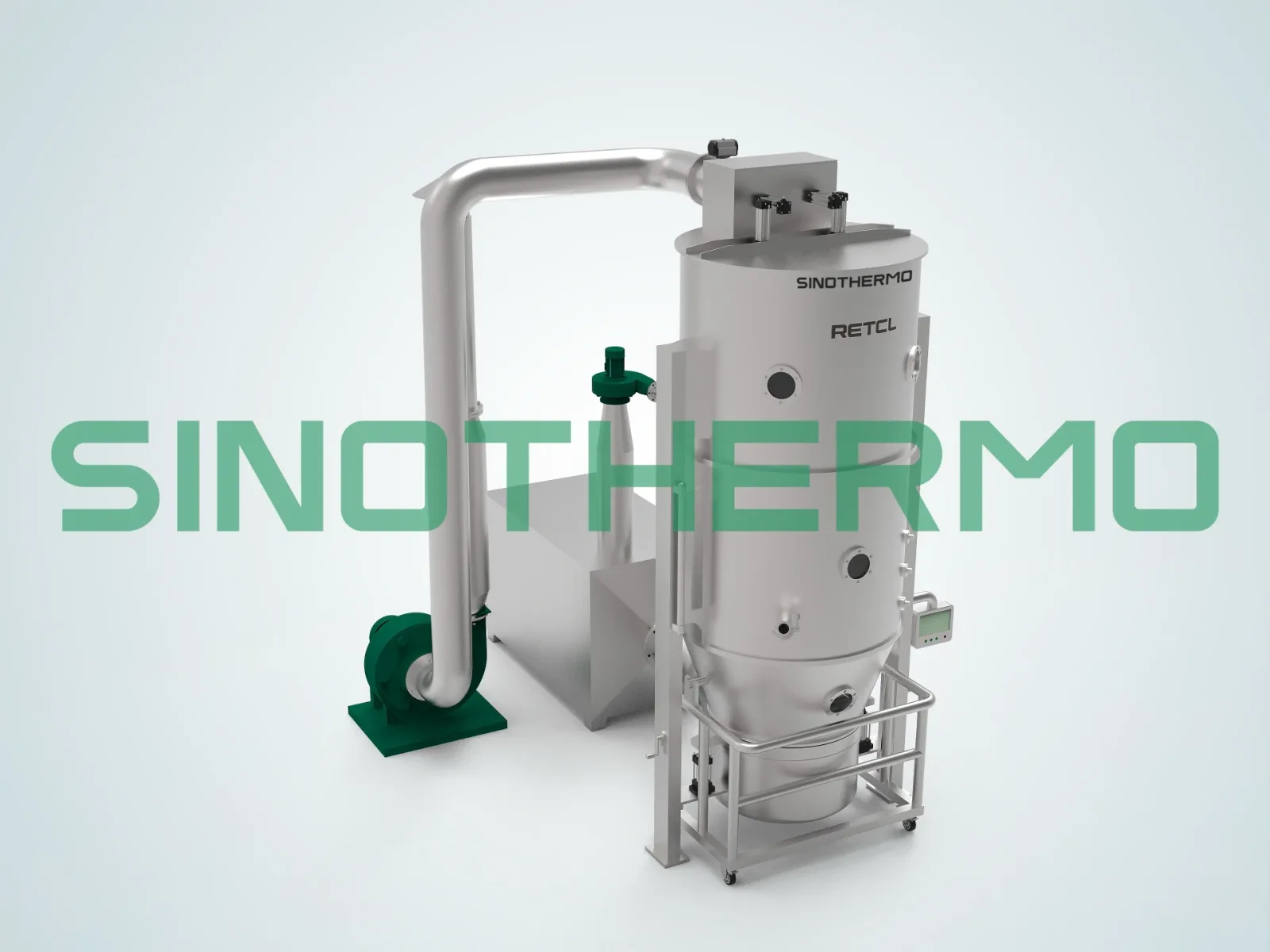
Spray granulation sprays a liquid onto particles held in motion in a stream of hot air, so the liquid dries onto the particle surface and the granule grows. In a fluid bed spray granulator the particles are a carrier or seed powder, and the sprayed liquid is the active material or binder. The product is a granule, larger and denser than spray dried powder, that flows well, produces little dust and dissolves predictably.
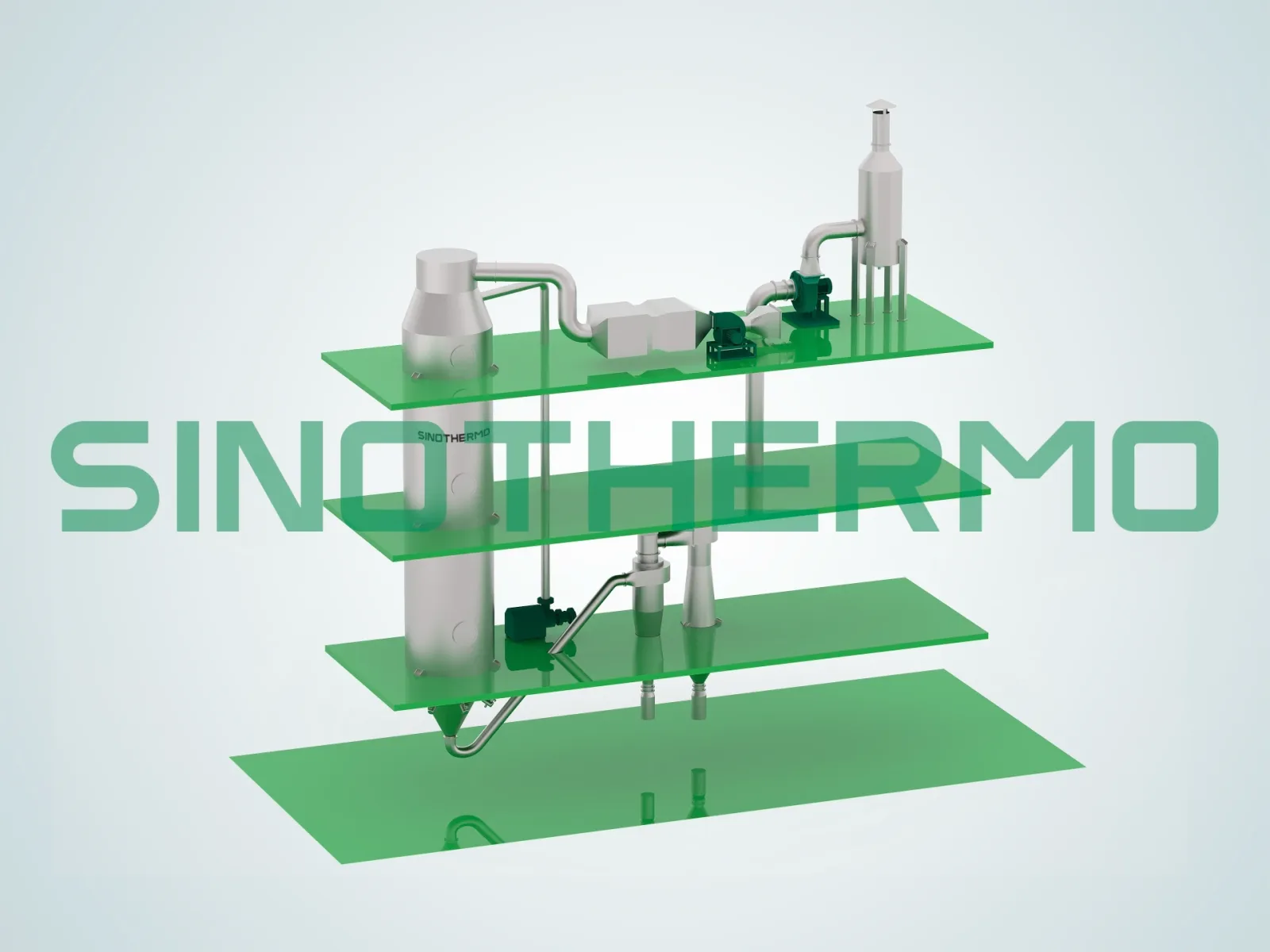
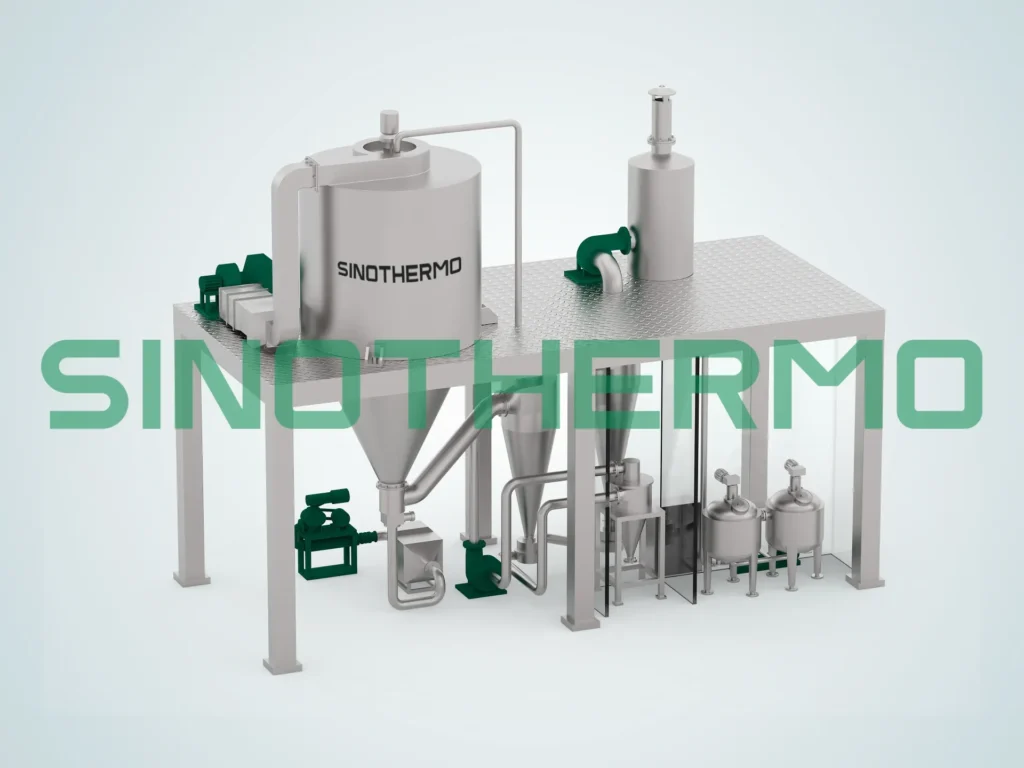
Spray drying and spray granulation both spray a liquid into hot air, and both end with a dry solid, so they are easy to confuse. The difference is what the liquid lands on. In a spray dryer it dries in free fall as separate droplets and leaves as fine powder. In a spray granulator it lands on particles that are already in the bed and builds on them. That single difference changes the particle size, the temperature profile and the formulations each process suits. This guide explains both, shows where each fits, and gives you a way to choose.
Quick Context: three routes from liquid to solid
| Route | What happens | Typical product |
|---|---|---|
| Spray drying | Liquid atomised into hot gas; droplets dry in free fall | Fine powder, often hollow particles |
| Spray granulation (fluid bed) | Liquid sprayed onto a fluidised bed of particles; layers build on them | Dense granules, medium size |
| Wet granulation after mixing | Powder wetted with binder, then dried | Irregular granules |
For the free-fall route see how spray drying works. For the fluidised bed mechanism, including how a granulator differs from a dryer, see fluid bed granulator vs dryer. For wet granulation after mixing, see wet vs dry granulation.
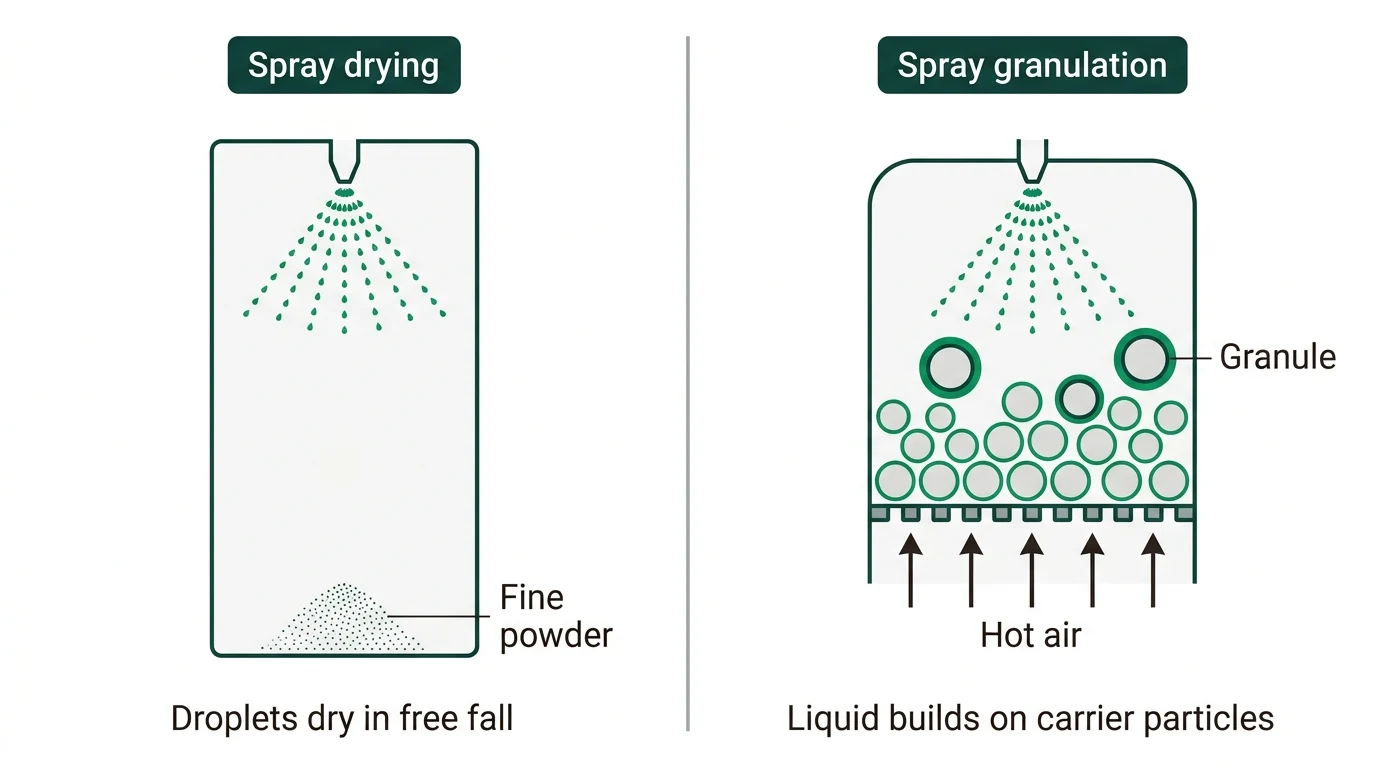
How fluid bed spray granulation works
- 1.Form the bed. Carrier or seed powder is loaded into the vessel. Air blown upward through a perforated plate lifts and circulates the particles so they behave like a boiling liquid.
- 2.Spray the liquid. A nozzle sprays the liquid, such as an extract, solution or binder, onto the moving bed. Top spray, bottom spray and tangential spray configurations exist, and the choice affects granule structure.
- 3.Wet, stick and grow. Droplets wet the particle surfaces. Particles collide and either coat or bridge together, forming larger granules.
- 4.Dry in the same bed. Hot air evaporates the liquid while spraying continues. A balance between spray rate and drying rate keeps the bed from becoming too wet or too dry.
- 5.Cool and discharge. The granules are cooled in the vessel and discharged at the target moisture.
Mixing, drying and cooling happen in one unit, with no separate transfer step.
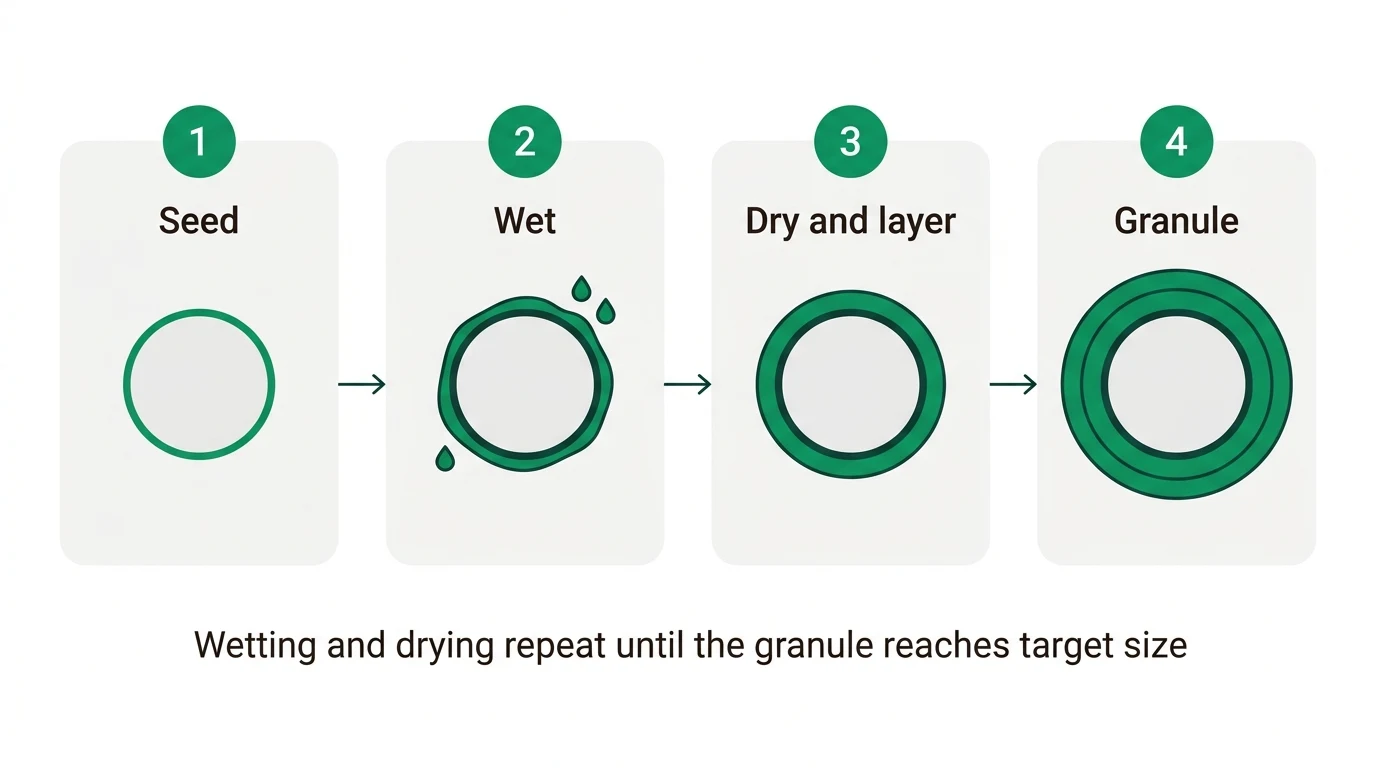
SINOTHERMO's carrier-based approach: the PGL spray granulator
SINOTHERMO's fluidized bed spray granulator (PGL series) is designed for formulations that are mostly carrier with a smaller proportion of liquid active:
- Input: carrier materials in powder form, and the main material in liquid form.
- Method: the carrier forms the fluidised bed and acts as seed particles. The main material, typically a liquid extract and a smaller part of the batch, is sprayed from above and merges with the carrier particles at the edge of the bed.
- Output: solid, medium-sized granules at 3 to 5 percent moisture.
- Process type: spray fluidised bed wet granulation, with mixing, drying and cooling in the same bed.
- Strength: the low-temperature, carrier-supported approach suits heat-sensitive liquid extracts and other main materials that would degrade at higher temperature.
For other granulation needs SINOTHERMO also builds the fluidized bed granulator and a Wurster-type coating granulator. The fluid bed granulator category lists the range.
Spray granulation vs spray drying: how to choose
| Factor | Spray dryer | Fluid bed spray granulator |
|---|---|---|
| Particle form | Fine powder, often hollow | Denser granule, medium size |
| Particle size | Typically fine to medium | Larger; grows with spray time |
| Flow and dust | Fine powder can be cohesive and dusty | Good flow, low dust |
| Feed | Pumpable liquid, can be the whole product | Liquid sprayed onto a carrier or seed bed |
| Formulation | Liquid is the product (with optional carrier) | Carrier-rich formulations; active is a small share |
| Heat exposure | Short, high gas temperature, wet-bulb protection | Lower temperature, longer residence in the bed |
| Process mode | Continuous | Batch in most pharmaceutical and herbal setups |
| Typical scale | Small to very large | Small to medium |
| Best fit | Fine powders from solutions and slurries | Granules from liquid extracts and actives on carriers |
Choose spray drying when the liquid is the product, you want a fine powder, you need continuous high-throughput production, and the product tolerates the process temperatures.
Choose spray granulation when you want a free-flowing granule rather than a fine powder, the formulation is mostly excipient or carrier, the active is a heat-sensitive liquid extract, or the downstream step (capsule filling, tableting, sachet filling) needs flow and low dust.
Consider both in sequence when a spray-dried powder needs to become a granule for handling. A spray dryer followed by a granulation step is common for products that dissolve poorly as fine powder.
Applications
- Herbal and botanical extracts. Liquid extract sprayed onto a carrier such as maltodextrin, starch or an excipient, producing a granule that flows and does not cake. See also spray drying herbal and plant extracts, which covers the spray dryer route for the same feeds.
- Pharmaceutical granules. High-excipient formulations where a liquid active is sprayed onto a carrier bed.
- Food flavours and ingredients. Liquid flavour or extract granulated onto a food-grade carrier.
- Cosmetic actives. Liquid actives granulated onto a powder carrier for stable formulation.
- Bio-based materials. Liquid materials that need low-temperature, carrier-supported granulation.
Process variables that control granule quality
| Variable | Effect |
|---|---|
| Spray rate | Higher rate wets the bed more; too high gives lumps and bed collapse, too low gives fines |
| Inlet air temperature and airflow | Control the drying rate and fluidisation; must balance against spray rate |
| Atomising air pressure | Sets droplet size; finer droplets give finer, denser granules |
| Binder or liquid concentration | Affects viscosity, granule strength and spray stability |
| Carrier particle size | The seed size sets the starting point for granule growth |
| Nozzle position and type | Top, bottom or tangential spray changes granule structure and coating quality |
| Bed moisture | The key balance. Monitor product temperature or exhaust humidity to keep it in range |
Granule growth depends on a balance between wetting and drying. If the bed gets too wet, particles stick into lumps and fluidisation fails. If it is too dry, droplets dry before they land and form fines. Most troubleshooting in spray granulation is about restoring that balance.
Reading a formulation: which route does it point to?
Take two example formulations to see how the decision works in practice. The figures are illustrative, not product data.
Formulation A: a herbal extract with 15 percent of the final product weight as active solids and 85 percent as excipient. The active is a liquid extract that is sticky and heat-sensitive. The customer fills capsules and sachets and needs a granule that flows without dust. The extract is a small part of the batch and the rest is carrier, which is exactly the situation a carrier-based spray granulator is designed for. Spray drying the extract alone would produce a sticky, hygroscopic fine powder that would then need blending with excipients and probably granulating anyway.
Formulation B: a water-soluble flavour with 90 percent active solids sold as a free-flowing powder. The liquid is the product, volume is high, and fine particle size is acceptable. There is no carrier bed to build on, so spray granulation has nothing to grow from. A spray dryer, with a carrier such as maltodextrin added to the feed if needed, is the right process.
The pattern is straightforward. A high proportion of carrier or excipient points to granulation. A high proportion of active in the liquid points to spray drying. Borderline cases, such as a formulation that is half carrier, are where a trial earns its cost.
Scale-up notes
Spray granulation scales by batch size. A pilot bed gives you spray rate, product temperature and exhaust humidity targets, which you then carry into a larger vessel. Three points help the transfer.
- 1.Keep the ratio of spray rate to airflow, not the absolute spray rate. A larger bed takes proportionally more liquid, but the balance of wetting and drying must hold.
- 2.Match the nozzle arrangement. A top-spray result does not transfer to a bottom-spray unit.
- 3.Check fluidisation at the larger diameter. Dead zones and channelling appear differently in a bigger bed. Record how the bed moves during the pilot trial.
For the continuous alternative, a spray dryer at production scale is sized by water evaporation. The method is in spray dryer sizing.
Common mistakes to avoid
Specifying a fluid bed dryer when you need granulation. A dryer has no spray system. Check that the quotation includes nozzles, a pump and spray controls. See fluid bed granulator vs dryer.
Treating it as a fine powder process. Granulation makes granules. If your product must be a fine powder, use a spray dryer.
Ignoring carrier choice. The carrier decides flow, dissolution and compatibility with the active. Test it in a trial.
Setting the spray rate by feel. Use a measured spray rate against product temperature or exhaust humidity, and record it for scale-up.
Skipping the trial. Granule size, strength and dissolution depend on formulation. A pilot run on your own carrier and liquid shows what you will get. Our testing lab tests granulators as well as dryers, reporting particle size, strength, flowability and dissolution, and the work is a paid service.
Conclusion
Spray granulation builds granules on a carrier from a sprayed liquid, and it is the right route when you want flow, low dust and gentle treatment of a liquid active in a carrier-rich formulation. Spray drying is the right route when you want fine powder, continuous throughput and the liquid itself is the product. If you are unsure, test both on your material.
Next step: Request a pilot test with your liquid and carrier. Pilot testing is a paid service, and the report compares granule or powder properties so you can choose the process on measured results.
Frequently asked questions
What is spray granulation?
Spray granulation sprays a liquid onto particles held in motion in hot air, usually in a fluid bed. The liquid dries onto the particles and builds granules. The result is a dense, free-flowing granule with low dust.
What is the difference between spray granulation and spray drying?
In spray drying the liquid dries in free fall as separate droplets and becomes fine powder. In spray granulation the liquid lands on particles in a bed and builds on them, so the product is a larger, denser granule.
What is a fluid bed spray granulator?
A fluidised bed vessel with a spray system. Carrier or seed powder is suspended in upward-flowing hot air, a liquid is sprayed onto it, and the granules grow and dry in the same bed. SINOTHERMO's PGL model uses a carrier bed with a sprayed liquid extract.
What moisture content do the granules have?
SINOTHERMO's fluidized bed spray granulator delivers granules at 3 to 5 percent moisture, depending on the process settings.
Which products suit spray granulation?
Liquid herbal and botanical extracts on carriers, high-excipient pharmaceutical formulations, food flavours, cosmetic actives and bio-based liquids that need low-temperature granulation.
Can I use a spray dryer instead?
If you want a fine powder and your product tolerates the process, yes. If you need a granule with good flow and low dust, or the formulation is mostly carrier, spray granulation is usually the better fit. A trial on your material will confirm.
How do I find out which process suits my product?
Run a trial. Pilot testing is a paid service, and you can request one through our contact page. We compare the powder or granule properties from each route.

Mark Gu
Passionate about enhancing customer experiences and streamlining operations, Mark focuses on building strong relationships, fostering innovation, and leading teams to achieve exceptional service and efficiency.
Email: mark.gu@sinothermo.com
Phone: +86 18021972660