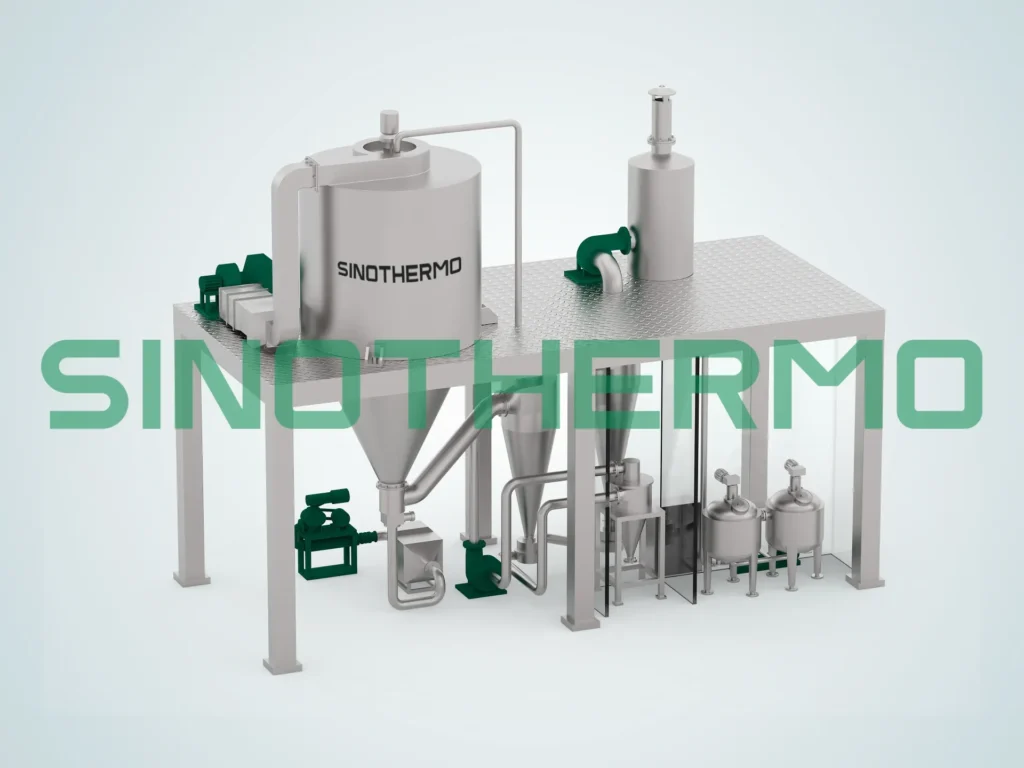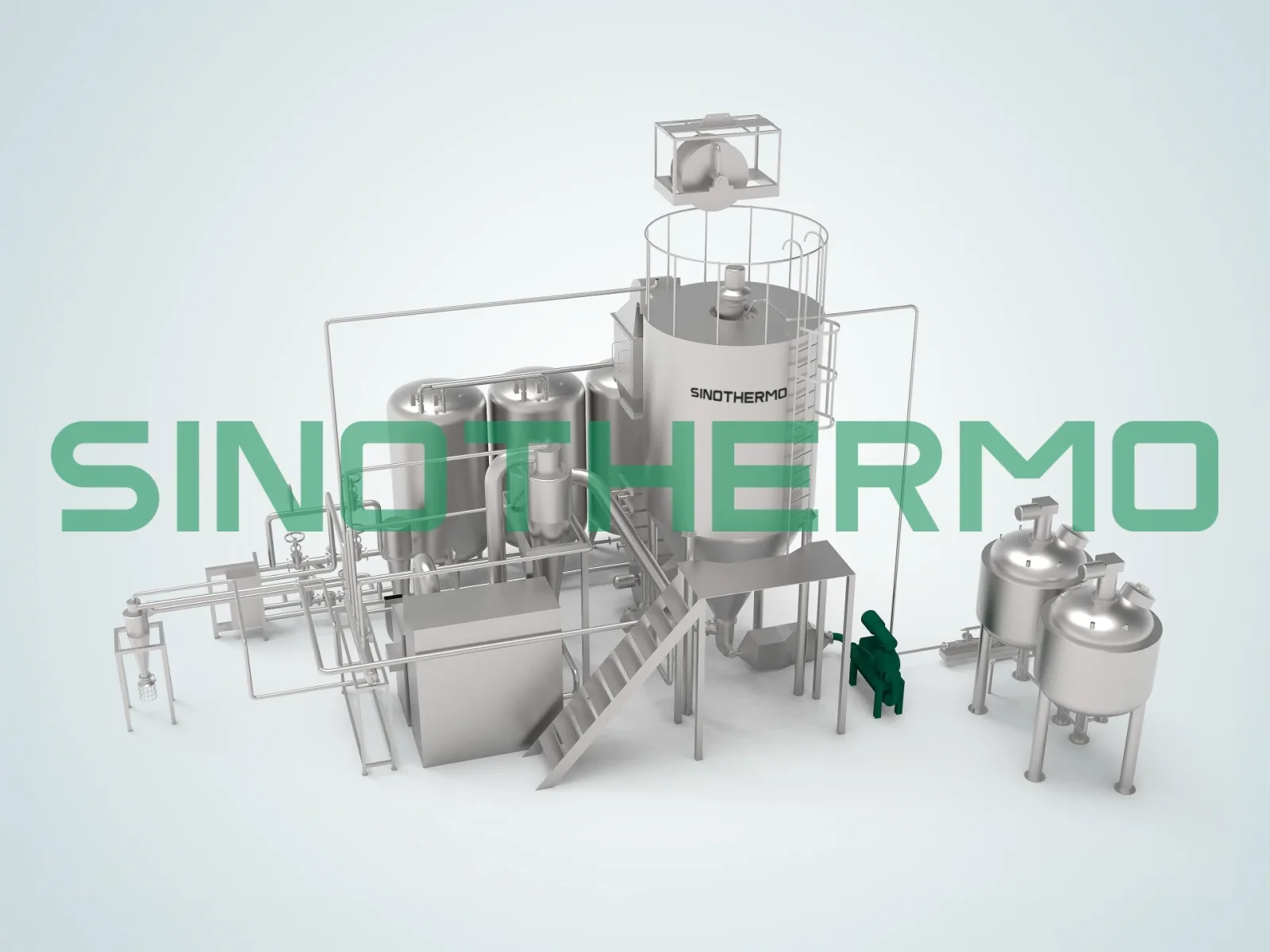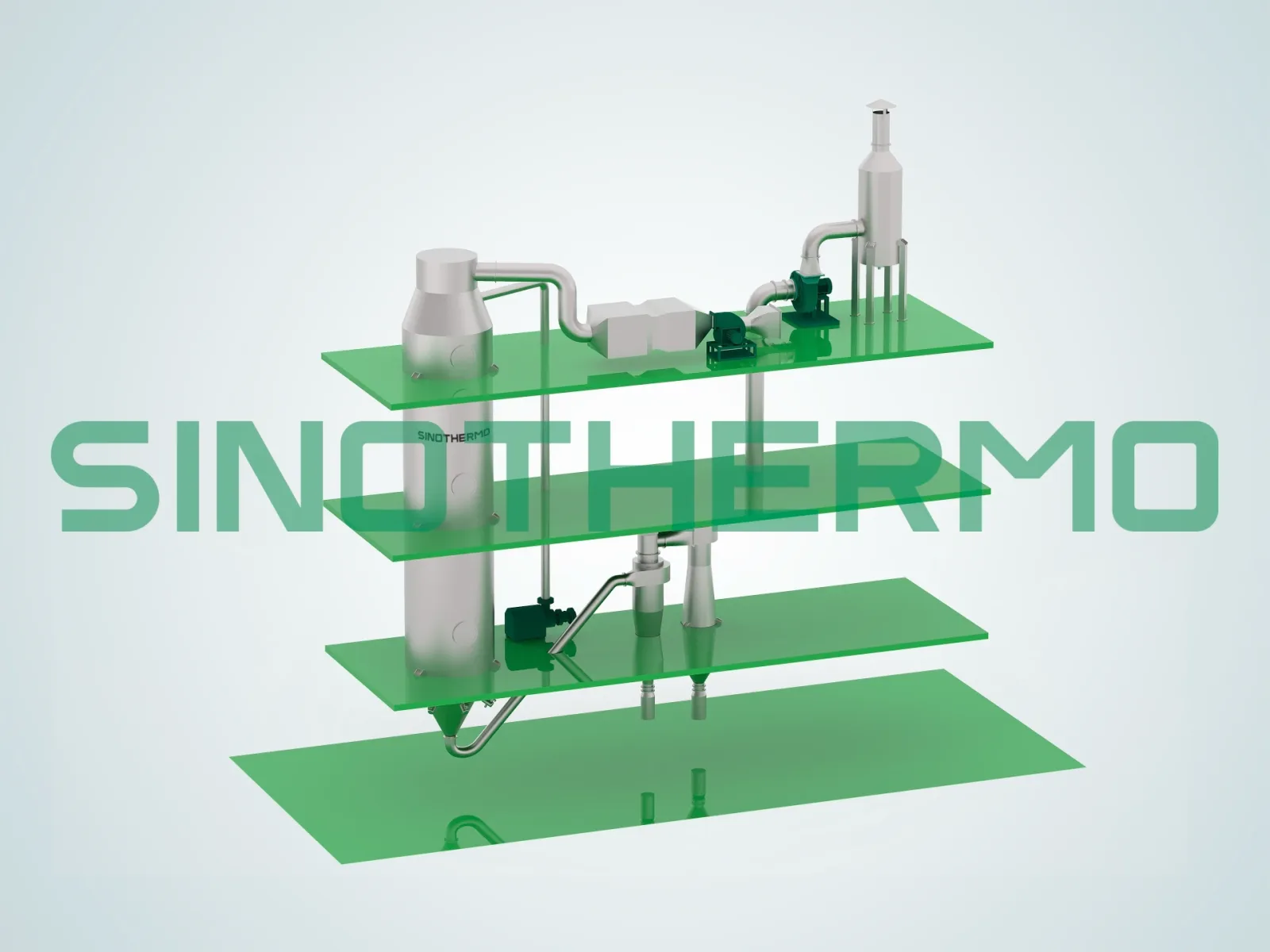
A spray dryer is sized by evaporation capacity, the kilograms of water it removes per hour, not by powder output or tower height. To size one, convert your required powder output into water to evaporate using the feed solids content, then estimate the heat and airflow needed from the inlet and outlet temperatures. The calculation below is for a first estimate; a pilot trial and a supplier's design confirm the final machine.
Many quotation problems start with the wrong number. A buyer who asks for "a 100 kg/h spray dryer" may mean 100 kg/h of powder, 100 kg/h of feed or 100 kg/h of water evaporated, and these differ by a factor of two or more. This guide shows how to turn your process target into the number that matters, with a worked example you can adapt.
Quick Context: why evaporation capacity is the sizing number
Almost all the energy and most of the equipment size in a spray dryer is driven by how much water has to leave the droplets. That determines the heat input, the airflow, the chamber volume needed for residence time and the size of the fan and collection system. Two dryers with the same chamber height can have very different water removal rates, depending on gas temperature and airflow.
Model ranges are therefore labelled by evaporation. SINOTHERMO's pressure spray dryer runs from the YPG-50 at 50 kg/h to the YPG-1000 at 1,000 kg/h, and the centrifugal spray dryer runs from the LPG-25 at 25 kg/h to the LPG-200-2000 range at 200 to 2,000 kg/h of water.
Step 1: Define what you need
Gather these inputs before you calculate.
| Input | Symbol | Example |
|---|---|---|
| Powder output | P (kg/h) | 100 |
| Powder residual moisture (wet basis) | w_p | 4 percent |
| Feed solids content | x_f | 30 percent |
| Feed temperature | T_f | 20 °C |
| Inlet gas temperature | T_in | 200 °C |
| Outlet gas temperature | T_out | 90 °C |
| Ambient air temperature | T_a | 20 °C |
Choose T_in and T_out from your product limits. If you are unsure how, read spray drying temperature: inlet and outlet guide first.
Step 2: Convert powder output to feed and water to evaporate
- 1.Dry solids in the powder: P × (1 − w_p) = 100 × (1 − 0.04) = 96 kg/h of solids.
- 2.Feed rate needed: solids ÷ feed solids fraction = 96 ÷ 0.30 = 320 kg/h of feed.
- 3.Water entering with the feed: 320 − 96 = 224 kg/h.
- 4.Water left in the powder: 100 − 96 = 4 kg/h.
- 5.Water to evaporate: 224 − 4 = 220 kg/h.
Check: feed 320 kg/h = powder 100 kg/h + evaporated water 220 kg/h. The balance closes.
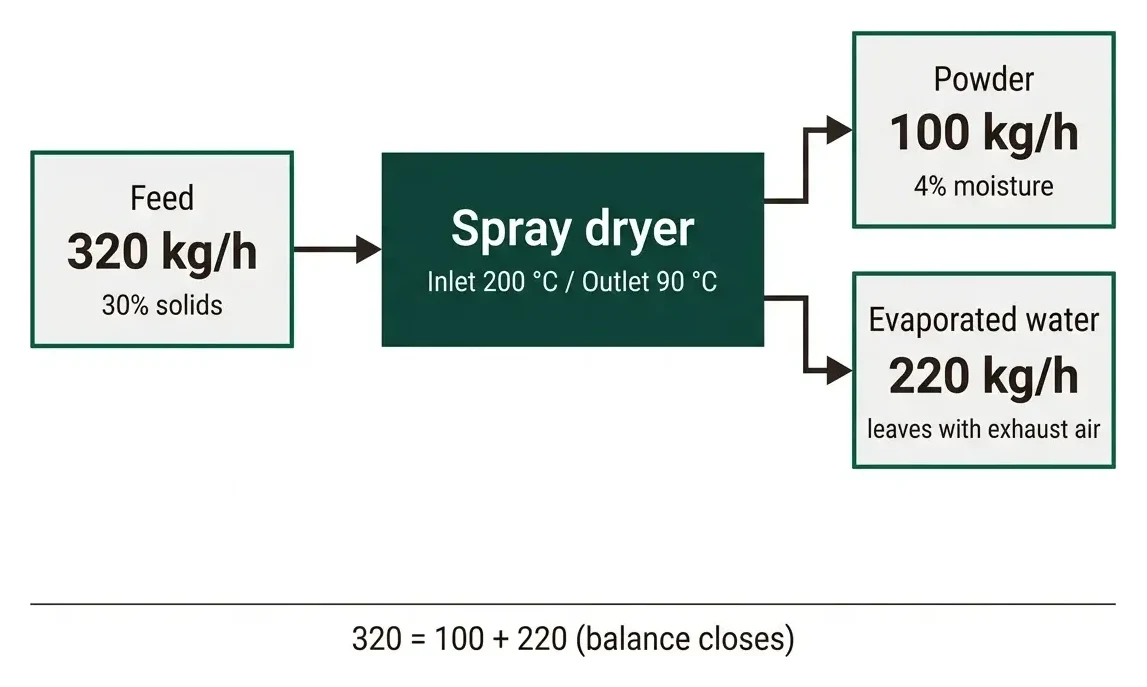
This is the key result: this duty needs a dryer rated for about 220 kg/h of evaporation at your operating temperatures, not a "100 kg/h dryer".
A useful consequence: feed solids content has a large effect. At 20 percent solids the same 96 kg/h of solids needs 480 kg/h of feed and about 380 kg/h of evaporation. Raising solids content from 20 to 30 percent cuts the evaporation load by more than a third, so concentrating the feed before spraying, for example by evaporation, saves dryer size and energy, provided the feed stays pumpable and sprayable.
Step 3: Estimate the heat required
The heat needed has three parts.
- 1.Evaporating the water. Latent heat of water at spray drying conditions is roughly 2,400 kJ/kg (about 2,260 at 100 °C and higher at lower temperatures). For 220 kg/h: 220 × 2,400 = 528,000 kJ/h, about 147 kW.
- 2.Heating the feed to the drying temperature. Assume a specific heat of about 3.5 kJ/kg·K for a 30 percent solids feed, heated from 20 °C to about 50 °C: 320 × 3.5 × 30 = 33,600 kJ/h, about 9 kW.
- 3.Heating the dry powder. 96 kg/h × 1.5 kJ/kg·K × about 60 K = about 8,600 kJ/h, about 2.4 kW.
The useful heat is about 147 + 9 + 2.4 = about 158 kW. Add heat losses from the chamber and ducting. A figure of 10 to 15 percent is typical for an insulated unit, but it should be confirmed for your design, which gives roughly 180 kW that the gas must give up between inlet and outlet.
Step 4: Estimate the airflow
The gas gives up heat as it cools from T_in to T_out. With a specific heat of about 1.05 kJ/kg·K for humid air:
Air mass flow = heat given up ÷ (c_p × (T_in − T_out)) = (180 kW × 3,600 kJ/kW·h) ÷ (1.05 × (200 − 90)) = 648,000 ÷ 115.5 = about 5,600 kg/h of dry air.
At ambient density of about 1.2 kg/m³ that is about 4,700 m³/h at ambient conditions. The fan must handle a larger volume at the hot outlet conditions, so the supplier will size the fan for the actual exhaust volume.
Check the exhaust humidity: 220 kg/h of water into 5,600 kg/h of air adds about 0.04 kg water per kg dry air, well below saturation at 90 °C, so the exhaust is far from condensing.
Step 5: Estimate the heater size
The heater must raise the air from ambient to inlet temperature:
Heater duty = air flow × c_p × (T_in − T_a) = 5,600 × 1.006 × 180 ÷ 3,600 = about 280 kW.
This is larger than the 180 kW the chamber uses, because the exhaust air leaves at 90 °C and carries heat out. That is the reason heat recovery on the exhaust is worth considering at larger scale.
Sanity check against published data. SINOTHERMO's pressure spray dryer lists electric heating of 75, 120 and 150 kW for the YPG-50, YPG-100 and YPG-150, which is about 1.0 to 1.5 kW per kg/h of rated evaporation. Our example needs 280 ÷ 220 = about 1.3 kW per kg/h. The two figures are the same order of magnitude, which is the point of the check. The model data also depends on inlet temperature, so use it as a guide only.
Step 6: Choose a model, with margin
You need about 220 kg/h of evaporation at 200 °C inlet. From the pressure spray dryer range, the next model with enough rated evaporation is the YPG-300 (300 kg/h). Leave a design margin so the dryer is not at its maximum rating every day. Evaporation figures on the product page are maximum values and, for inlet temperatures below 200 °C, depend on actual process requirements. How much margin to keep is a design decision to confirm with the supplier.
If your feed is viscous or abrasive, or you need finer powder, the equivalent choice on the centrifugal line is a model in the LPG-200-2000 range. The atomiser decision comes first; see spray dryer atomization.
Quick reference: what changes the answer
| Change | Effect on sizing |
|---|---|
| Higher feed solids | Lower evaporation, smaller dryer, lower energy |
| Lower powder moisture target | Slightly more evaporation, and may need a higher outlet temperature |
| Higher inlet temperature | Less airflow needed for the same duty, but product limit applies |
| Higher outlet temperature | More heat leaves in the exhaust, so more heater duty for the same evaporation |
| Cold or humid ambient air | More heater duty; humidity lowers drying capacity |
| Heat recovery | Reduces heater duty and running cost |
| Solvent in the feed | Different latent heat and safety design |
For solvent-based feeds, see the closed loop spray dryer guide.
What the calculation does not tell you
This is a first estimate. It does not include the chamber size needed for residence time, which depends on droplet size and drying rate, nor the particle size distribution, the collection efficiency of the cyclone and bag filter, or the behaviour of a sticky feed. Those come from the supplier's design and from trial data.
Common mistakes to avoid
Mixing up powder, feed and water. Confirm in writing which number you mean. Evaporation in kg/h of water is the standard basis.
Using lab throughput to scale. Lab results do not scale linearly. Use pilot data.
Taking the rated evaporation at face value. Rated figures are maxima at stated conditions. At lower inlet temperature or with a difficult feed, the real capacity is lower.
Ignoring the heat source. Electric, steam, gas and hot-air furnace options have different running costs. Heater duty from your calculation lets you compare them. See the spray dryer cost guide and the spray dryer machine guide.
Skipping the trial. The feed solids you can actually spray, and the outlet temperature your powder tolerates, come from testing. Our testing lab runs paid pilot trials and the data feeds directly into this calculation.
Conclusion
Size a spray dryer from the water it must evaporate. Convert powder output through feed solids to evaporation, estimate heat and airflow from your temperatures, and pick a model with margin. Feed solids content is the lever that most changes the result.
Next step: Request a pilot test with your feed to confirm feed solids, outlet temperature and powder properties. Pilot testing is a paid service, and we can then size a production machine on measured data.
Frequently asked questions
How do you size a spray dryer?
Convert your required powder output into the water that must be evaporated, using the feed solids content and the powder moisture. Then estimate the heat and airflow from the inlet and outlet temperatures, and select a model by rated evaporation capacity with some margin.
What is evaporation capacity?
It is the mass of water the dryer can remove per hour, in kg/h. It is the standard sizing basis for spray dryers because it drives heat input, airflow and equipment size.
How do I calculate the water to evaporate?
Feed rate equals dry solids divided by feed solids fraction. Water to evaporate equals feed rate minus powder output. For 100 kg/h of 4 percent moisture powder from a 30 percent solids feed, it is about 220 kg/h.
How much heat does a spray dryer need?
Roughly 2,400 kJ per kilogram of water evaporated for the latent heat, plus feed and product heating and losses. In the worked example, the heater duty is about 280 kW for 220 kg/h of evaporation, or about 1.3 kW per kg/h.
Does feed solids content matter for sizing?
Yes, a great deal. Raising feed solids from 20 to 30 percent cuts the evaporation load by more than a third for the same powder output, as long as the feed can still be pumped and atomised.
Is the calculation exact?
No. It is a first estimate. Residence time, particle size, collection efficiency and feed behaviour are confirmed by a supplier's design and a pilot trial.
Which SINOTHERMO model fits 220 kg/h of evaporation?
From the pressure spray dryer range, the YPG-300 at 300 kg/h maximum evaporation, with margin. The centrifugal LPG-200-2000 range also covers this size. The final choice depends on atomiser, feed and powder specification.

Mark Gu
Passionate about enhancing customer experiences and streamlining operations, Mark focuses on building strong relationships, fostering innovation, and leading teams to achieve exceptional service and efficiency.
Email: mark.gu@sinothermo.com
Phone: +86 18021972660