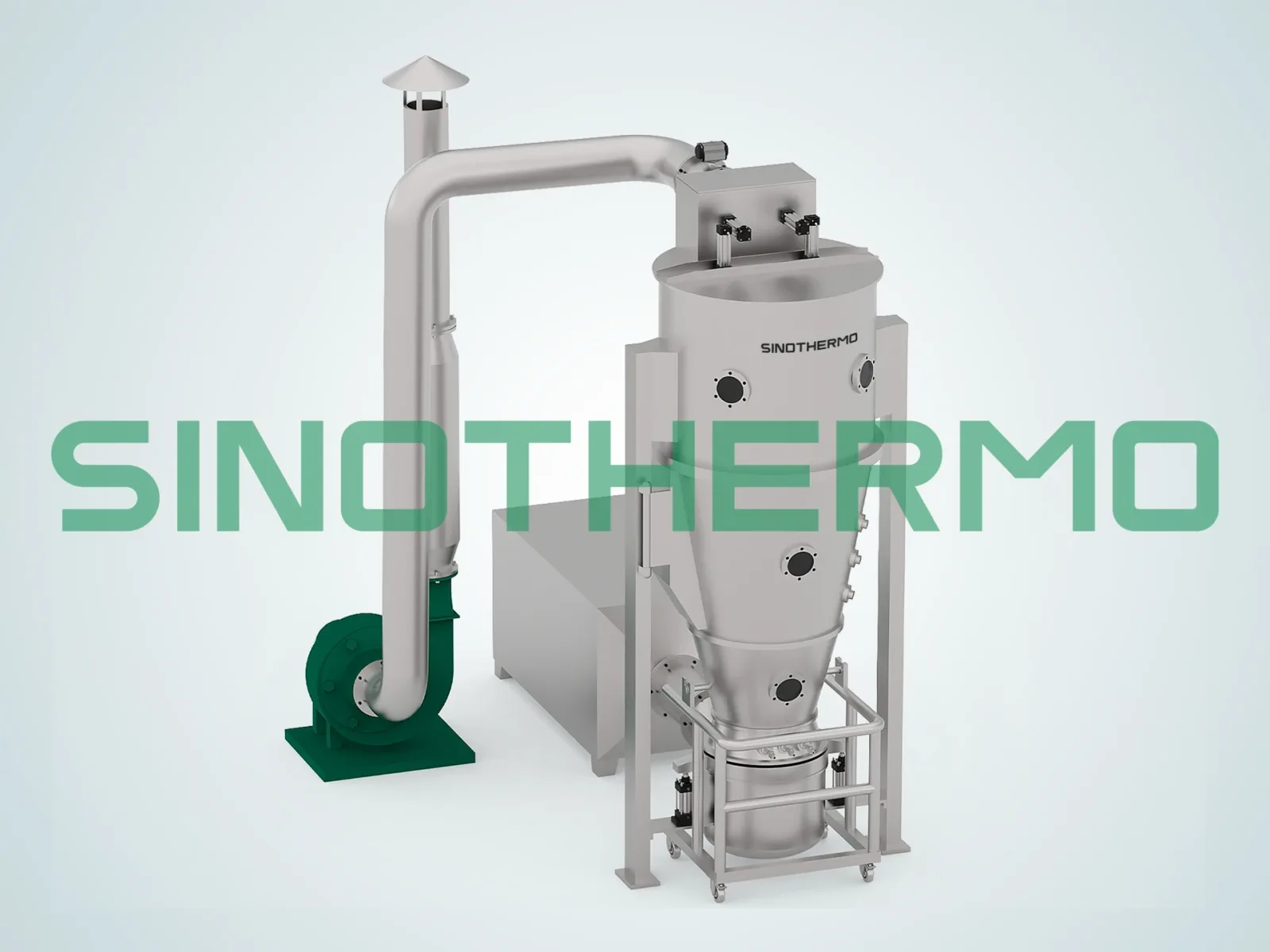
Both machines suspend particles in an upward stream of hot air. The difference is one thing: a granulator sprays liquid binder into the fluidised bed to make small particles stick together into larger granules, while a dryer simply removes moisture. The same vessel can often do both — granulate first, then dry the granules in the same batch — which is why the terms get used interchangeably and why buyers get confused.
The practical question isn't which machine is "better". It's whether your process needs to change particle size or merely to remove water.
Quick context: why the confusion is so persistent
A fluid bed granulator is, mechanically, a fluid bed dryer with a spray system bolted on — which is exactly why the two get conflated in conversation, in RFQs, and sometimes in supplier quotations that don't make clear which capability is actually included. The confusion has a real cost: buyers who need granulation but specify a plain dryer discover the gap only after the machine is on the floor, and buyers who pay for a full granulator when they only ever needed to dry have overspent on a spray system, pumps, and controls they'll never use.
What fluidisation does
Air is blown upward through a perforated distributor plate beneath a bed of particles. Below a critical velocity the bed sits still. At the minimum fluidisation velocity, drag balances particle weight and the bed behaves like a boiling liquid — particles circulate, the bed expands, and every particle is surrounded by hot gas.
Two consequences follow, and they're why fluid beds are so widely used:
- Enormous gas-to-particle contact area — drying is fast and uniform, with no hot spots and no over-dried fraction
- Particles are mobile and individually accessible — which is what makes spraying binder onto them possible
Fluidized bed dryer: removing moisture
Wet particulate material fluidises in heated air; moisture evaporates and leaves with the exhaust.
Suitable for free-flowing granules, crystals and powders that fluidise well, typically in the 50 µm–several mm range. Drying is fast (often minutes, not hours) and gentle, since particles are suspended in gas rather than dragged across metal.
Typical uses: drying pharmaceutical granules before tableting, food powders, fine chemicals, fertilisers, plastic pellets, and battery materials.
The main constraint is that the material must actually fluidise. Very fine cohesive powders channel or form dead zones; very wide particle-size distributions entrain fines while coarse particles sit still; sticky feeds agglomerate uncontrollably. Where that's a problem, a vibrating fluid bed adds mechanical vibration to assist.
Fluid bed granulator: building particles
The vessel and fluidisation are the same. What's added is a binder spray system — nozzles delivering liquid binder into the fluidised bed, plus the controls to manage the spray rate against the drying rate.
The mechanism:
- 1.Fine powder is fluidised
- 2.Binder solution is sprayed as fine droplets onto the moving particles
- 3.Wetted particle surfaces become tacky; colliding particles stick and form bridges
- 4.Simultaneous drying solidifies those bridges into permanent granules
- 5.Granules grow as the cycle continues, until the target size is reached
- 6.Spray stops, and the same air stream dries the granules to final moisture
Why granulate at all? Fine powders flow poorly, segregate, generate dust, and compress inconsistently. Granulation produces free-flowing particles with better handling, uniform composition, controlled bulk density, less dust exposure, and improved dissolution. In tableting it's often essential to hitting weight and content uniformity.
The critical control is the balance between spray rate and evaporation rate. Spray too fast and the bed over-wets, agglomerates uncontrollably, and collapses — a "wet quench", which is the classic failure mode. Spray too slowly and the binder dries before forming bridges, producing fines instead of granules. This balance is why granulation is a genuinely more demanding process than drying.
Side by side
| Fluidized bed dryer | Fluid bed granulator | |
|---|---|---|
| Purpose | Remove moisture | Enlarge particles |
| Binder spray | None | Required |
| Particle size | Unchanged (some attrition) | Increased, controlled |
| Process control | Temperature, airflow, time | + spray rate, atomising pressure, nozzle position |
| Cycle length | Minutes | Longer — growth then drying |
| Difficulty | Straightforward | Requires development work |
| Capital cost | Baseline | Higher — spray system, pumps, controls |
| Output | Dry version of the input | A different, engineered product |
Can one vessel do both?
Yes, and this is the normal arrangement in pharmaceutical and fine-chemical plants. A fluid bed granulator is a fluid bed dryer with a spray system added, so a single batch can granulate and then dry.
Add a Wurster insert (a draft tube with bottom spray) and the same vessel also coats particles — for taste masking, moisture barriers, or controlled release. That gives one machine covering drying, granulation, and coating, which is the fluid bed processor concept.
Choose the drying-only machine when you never need to change particle size. It's cheaper, simpler, and easier to operate and clean.
Choose the granulator when you need to enlarge particles, or expect to. Retrofitting a spray system to a plain dryer is possible but usually more expensive and less well integrated than buying the capability up front.
Top spray, bottom spray, tangential
| Configuration | Nozzle position | Best for |
|---|---|---|
| Top spray | Above the bed, spraying down | Granulation — simplest, most common |
| Bottom spray (Wurster) | In the distributor, spraying up | Coating — uniform film, particles pass the nozzle in an organised path |
| Tangential / rotary | Side of a rotating disc | High-density granules, layering, pellets |
For granulation, top spray is standard. For coating, bottom spray is markedly better, because the draft tube organises particle movement so each one passes the nozzle repeatedly in a consistent path — giving uniform film thickness that random circulation cannot.
What to specify
- Batch size range — and the minimum batch that still fluidises properly (important for R&D and small campaigns)
- Air handling — heating capacity, dehumidification if ambient humidity varies, filtration class
- Distributor plate design matched to your particle size
- Filter system — shaking, pulse-jet, or cartridge, and how it's cleaned without interrupting the batch
- Spray system (granulator) — nozzle type, number, position, atomising air control, peristaltic or mass-flow binder feed
- Spray rate control and feedback — the single most important process control
- Product temperature and exhaust humidity measurement — used to judge endpoint
- Explosion protection — mandatory for organic solvent binders, and worth assessing even for aqueous (dust explosion risk)
- Materials and finish — 316L, documented Ra for pharma
- Cleaning — CIP capability, or removable bowl and demonstrated access
- Containment at discharge for potent products
- Data logging — GMP-compliant batch records
- Trial on your material — whether it fluidises, and the spray/evaporation window, are empirical
Common mistakes to avoid
- Specifying "a fluid bed" without stating whether granulation is needed. The vessel looks similar in a general arrangement drawing; the spray system, controls, and validation scope are not similar in cost.
- Underestimating the process development time granulation requires. Drying is largely a matter of airflow and temperature; granulation requires finding a stable spray-rate window, which takes real development runs.
- Buying full granulation capability for a product that will only ever be dried. The spray system, pumps, and additional controls are a real cost premium — pay for it only when the process actually needs particle enlargement.
- Treating spray rate as a set-and-forget parameter. It needs active control and feedback against evaporation rate; drift in either direction risks wet quench or excess fines.
- Choosing top spray for a coating application because it's cheaper. Coating uniformity depends on the organised particle path a Wurster insert provides — top spray coating is possible but far less uniform, and that gap shows up in release-rate or taste-masking performance.
Where SINOTHERMO fits
We build fluidized bed dryers, fluid bed granulators, and Wurster coating systems, so the recommendation can follow your process rather than our catalogue.
Two questions decide the specification and neither can be answered on paper: does your material fluidise properly, and what spray rate can it absorb without over-wetting. Our pilot lab establishes both — minimum fluidisation velocity, drying curve, granule growth against spray rate, achievable granule size distribution, and the process window with margin. Pilot testing is a paid pre-sales engineering service and you keep the full report, which is exactly the data a production URS needs.
Frequently asked questions
What is the difference between a fluid bed granulator and a fluidized bed dryer?
A fluidized bed dryer only removes moisture from particles suspended in hot air. A fluid bed granulator adds a binder spray system so fine powder sticks together into larger granules, then dries them in the same batch. The vessel and fluidisation are the same; the spray system and its controls are the difference.
Can a fluid bed granulator also dry?
Yes — granulation and drying normally happen in the same batch. Binder is sprayed while the bed is fluidised, granules grow, then the spray stops and the same hot air stream dries them to final moisture. With a Wurster insert added, the same vessel can also coat particles.
Why granulate a powder instead of using it directly?
Fine powders flow poorly, segregate, generate dust, and compress inconsistently. Granulation gives free-flowing particles with uniform composition, controlled bulk density, less dust exposure, and better dissolution — often essential for consistent tablet weight and content uniformity.
What is the most common problem in fluid bed granulation?
Over-wetting. If binder is sprayed faster than the bed can evaporate it, particles become too tacky, agglomerate uncontrollably, and the bed collapses — a wet quench. The opposite error, spraying too slowly, dries binder before bridges form and produces fines instead of granules. Balancing spray rate against evaporation rate is the core control problem.
What is the difference between top spray and bottom spray?
Top spray, with the nozzle above the bed, is the standard configuration for granulation. Bottom spray (Wurster), with nozzles in the distributor plate spraying upward through a draft tube, gives far more uniform coating because particles pass the nozzle repeatedly along an organised path — which is what film uniformity requires.
Whether your powder fluidises, and what spray rate it tolerates, can only be measured.
✉️ mark.gu@sinothermo.com · 📱 WhatsApp: +86 180 2197 2660 · 🌐 www.sinothermo.com · 💬 Request a pilot test
SINOTHERMO — Process Engineering Infrastructure.

Mark Gu
Passionate about enhancing customer experiences and streamlining operations, Mark focuses on building strong relationships, fostering innovation, and leading teams to achieve exceptional service and efficiency.
Email: mark.gu@sinothermo.com
Phone: +86 18021972660