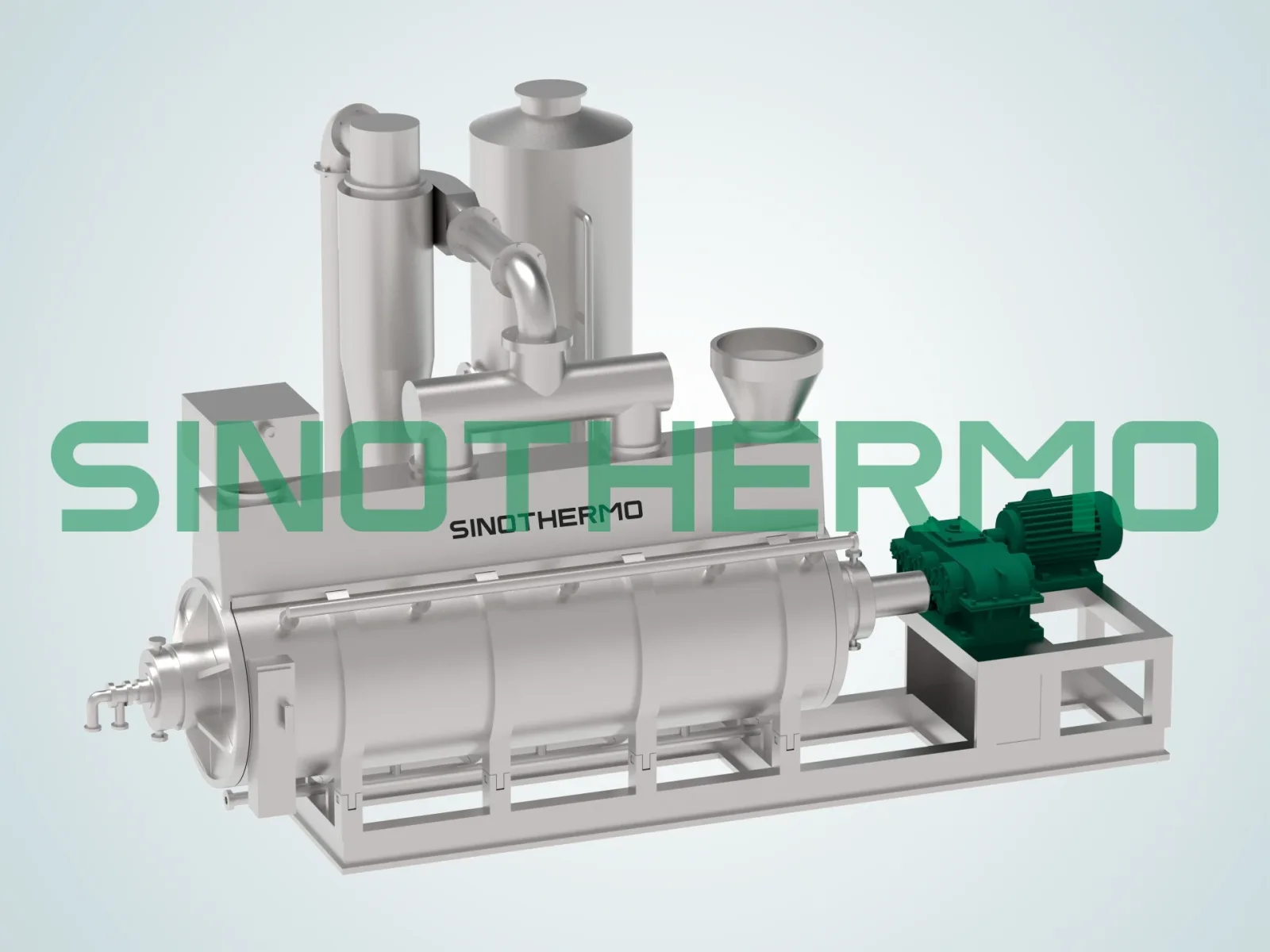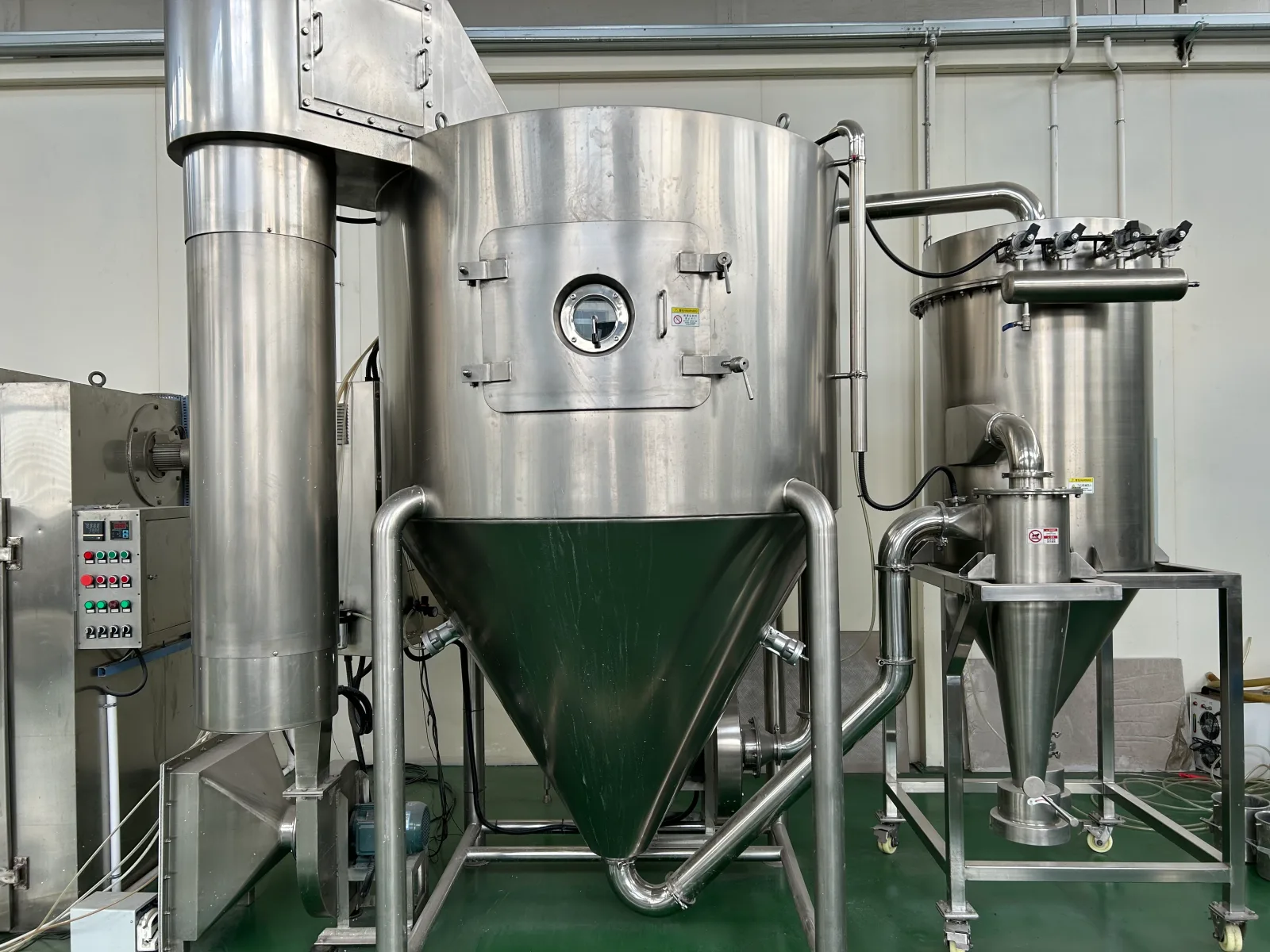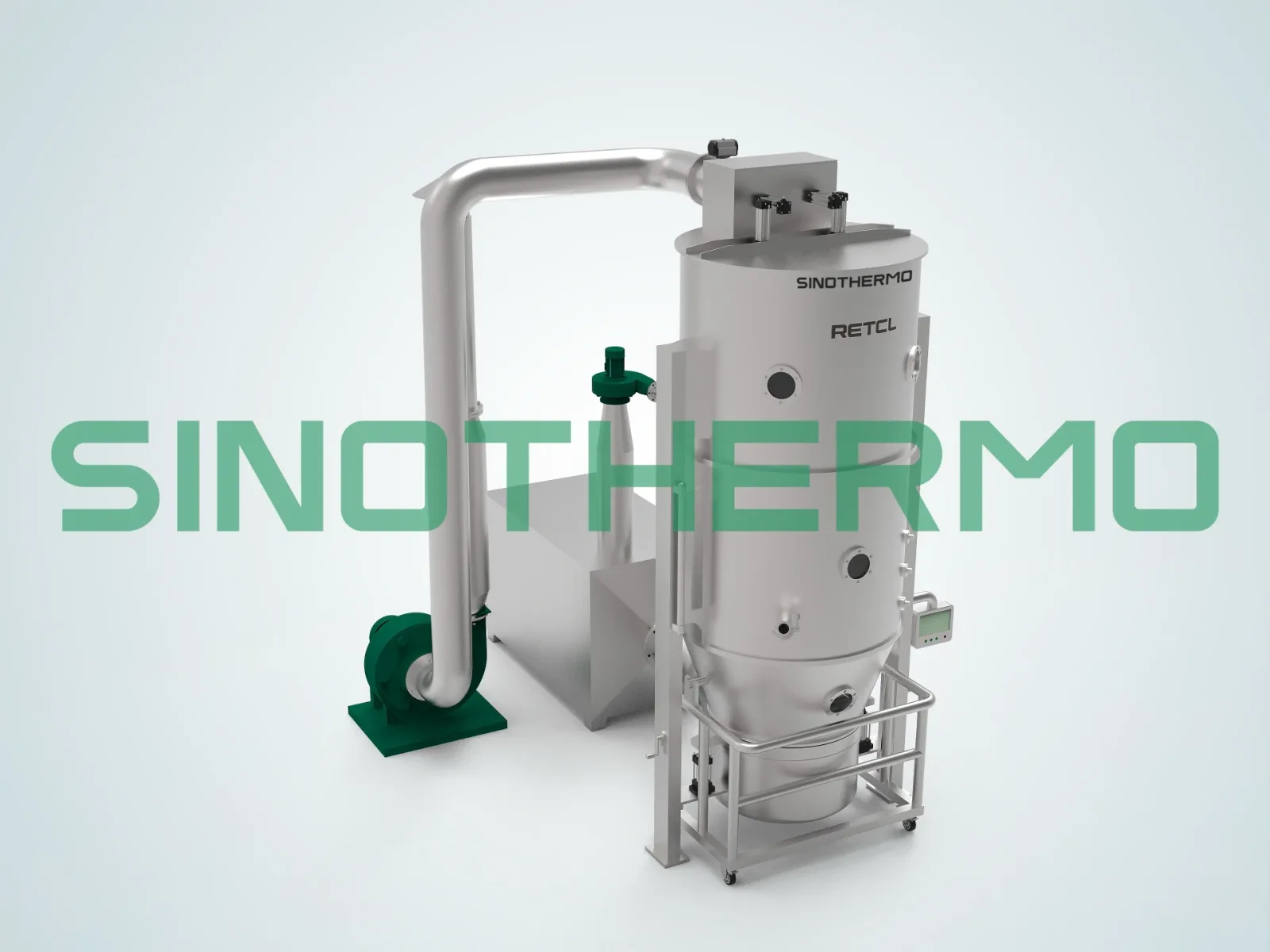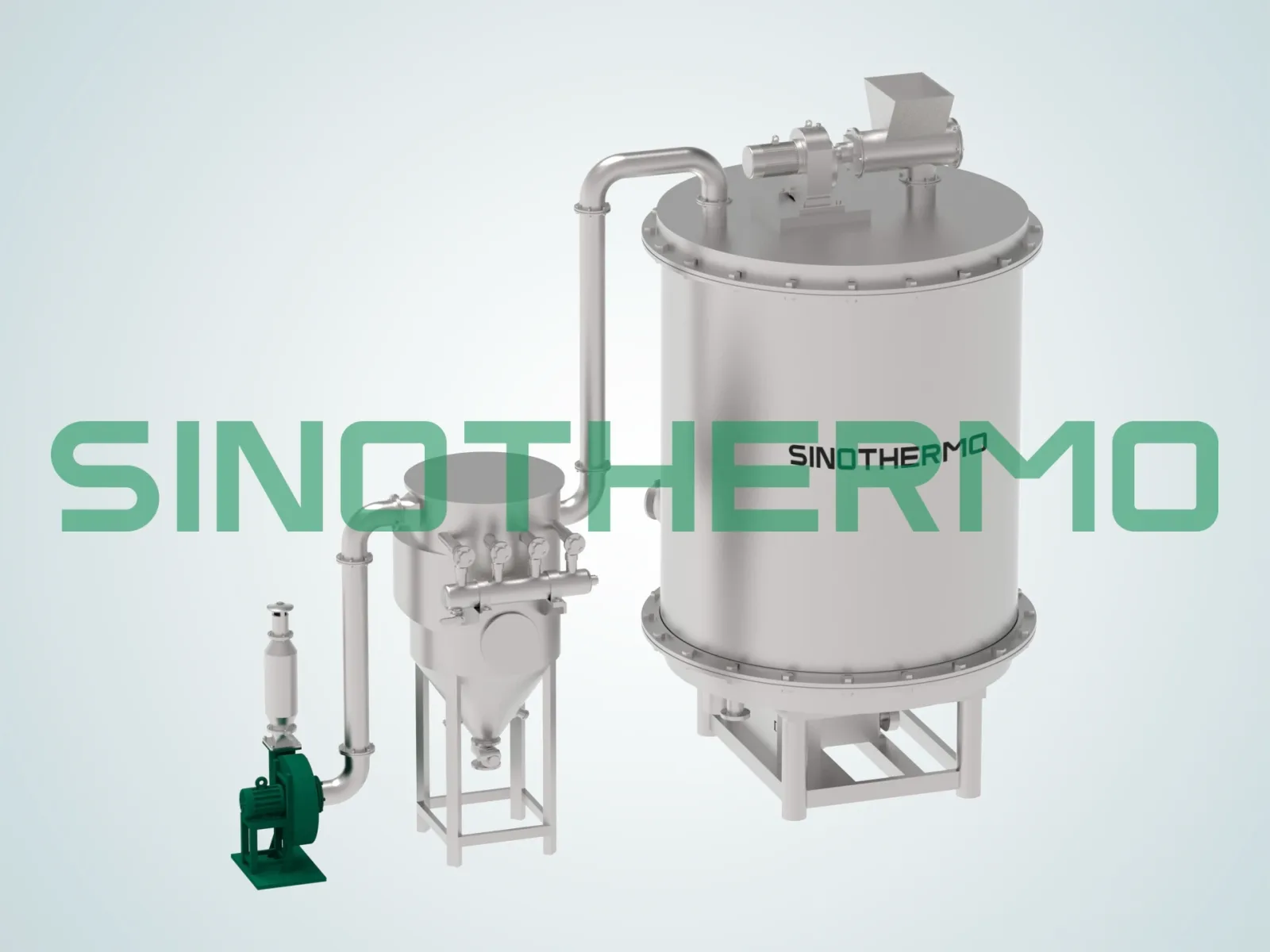
A vacuum plate dryer, in SINOTHERMO's PLG form, is a continuous conduction dryer built from stacked heated plates inside a vacuum shell. Loose powder or granules enter at the top, move plate to plate and leave at 3 to 8 percent moisture, with a heat source below 200 °C. It is a continuous machine, so it suits one product at steady throughput. It is not the same as a vacuum tray dryer, which is a static batch machine.
Quick Context: two machines, one confusing name
Search for "vacuum plate dryer" and you will find two very different machines described under the same words. One is a static batch machine where trays sit on heated shelves, often called a vacuum tray dryer, vacuum shelf dryer or vacuum cabinet dryer. The other is a continuous machine where material moves across a stack of heated plates, called a vertical plate dryer or continuous plate dryer.
SINOTHERMO makes both and keeps them separate:
- The continuous machine is the vacuum vertical plate dryer (PLG series). This article covers it.
- The static machine is the static vacuum cabinet dryer (YZG and FZG series). It is covered in vacuum tray dryer.
If you are not sure which you need, the table in the next section decides it.
Plate dryer or tray dryer: how to choose
| Question | Vacuum vertical plate (PLG) | Static vacuum cabinet (YZG/FZG) |
|---|---|---|
| Operation | Continuous | Batch |
| Feed | Loose powder, granules | Liquids, slurries, pastes, thick materials |
| Product movement | Moves across plates | Static on trays |
| Output | Powder or granules at 3–8% moisture | Lump solids at 3–5% moisture |
| Heat source | Below 200 °C | Below 100 °C |
| Best fit | One product, steady throughput | Many products, small lots, high purity |
If your feed is a wet paste you want to turn into powder, neither is the first choice. A vacuum rake, paddle or disc dryer usually fits better.
How the PLG vacuum vertical plate dryer works
- 1.Feed. Loose powder or granules enter the top of the vacuum shell through a feeder with a vacuum-tight seal.
- 2.Spread and heat. Material falls onto the first heated plate. The product is conveyed across each heated plate and passes down to the next plate in the stack.
- 3.Conduct. Each plate is heated from inside by steam, hot water or thermal oil. Heat conducts through the plate into the thin layer of product.
- 4.Evacuate. The shell is held under vacuum, so moisture or solvent evaporates at a low temperature. Vapour leaves through a condenser and vacuum pump.
- 5.Discharge. Dried product leaves the bottom through a vacuum-tight discharge.
The vertical stack puts a large heating area into a small floor footprint, which matters in plants where space is tight. The product-page figures to remember are:
- Input: loose powder, granules
- Output: powder or granules, 3 to 8 percent moisture
- Heat source temperature: below 200 °C
- Operation: continuous
Why choose a continuous vacuum dryer
Steady throughput and consistent moisture. Because every particle spends roughly the same time on the plates, final moisture is stable. This is hard to match in batch dryers where the last portion of a batch behaves differently from the first.
No batch loading and unloading. For a plant running one product around the clock, labour and idle time fall.
Sealed, low-oxygen environment. Like all vacuum dryers, it suits flammable, explosive, solvent-wet and easily oxidised materials.
Compact footprint. A vertical stack uses less floor area than a horizontal machine with the same heating area.
When a plate dryer is the wrong choice
- Sticky or pasty feeds. The plate dryer is designed for loose solids. A paste will stick to the plates. Use an agitated vacuum dryer or a vacuum drum scraper dryer.
- Many products in small lots. Continuous machines are harder to clean between products. Batch machines such as the double-cone rotary vacuum dryer are easier to change over.
- Very small volumes. A continuous line needs steady feed. Below a certain scale, a batch machine is simpler.
Typical applications
The product page lists these uses for the PLG plate dryer:
- Chemical powders and granules
- Pharmaceutical powders and intermediates that are sensitive to heat
- Pigments and dyes where shade and particle characteristics must be preserved
- Resin and polymer powders
- Bio-based powders and granules
- Food flavours, fragrances and additives
- Salts and inorganic granules
- Laboratory and pilot lines for specialty small-volume production
SINOTHERMO's own delivery news describes a PLG 1500 x 10-layer continuous plate dryer installed at a university in Jiangxi Province for bamboo pulp drying research, an example of the machine in pilot and development use.
How Residence Time and Plate Count Are Set
In a batch dryer you control the drying time by leaving the product in longer. In a continuous plate dryer, drying time comes from the machine geometry and the speed at which material travels through it. Three variables interact:
- Heating area: more plates and larger plate diameter give more area and more evaporation capacity.
- Residence time: a slower conveying speed keeps product on the plates longer, which lowers final moisture but also lowers throughput.
- Heat source temperature: a higher temperature increases the driving force, up to the limit your product can tolerate. The PLG product page gives a heat source below 200 °C.
This is why a catalogue table of plate dryer models is less useful than a drying test. Two powders with the same feed moisture can have very different drying curves, and the curve decides how many plates you need.
A Worked Example
The numbers are illustrative, not customer data.
A chemical producer wants to dry 200 kg/h of crystalline powder from 12 percent moisture to 0.5 percent under vacuum.
- Dry solids per hour: 200 x 0.88 = 176 kg
- Final mass at 0.5 percent moisture: 176 / 0.995 = about 176.9 kg
- Water to remove: 200 - 176.9 = about 23 kg/h
That is a modest evaporation load. The challenge is not the amount of water but the last fraction: removing the final percent of surface-bound and inter-crystalline moisture takes time at low temperature. A test would measure how long the powder needs on a heated surface at a given vacuum to reach 0.5 percent, and that residence time then sets the plate area. This is also a good case for a continuous machine, because the throughput is steady and the evaporation duty is gentle.
The Vacuum System Matters As Much As the Plates
A vacuum plate dryer needs vacuum-tight seals at the feed and discharge, because material enters and leaves continuously while the shell stays under vacuum. This is usually done with rotary valves or lock hoppers. It sets two practical limits:
- The feed must flow reliably. Powders that bridge, cake or ratchet will disturb the vacuum seal and the throughput.
- The vacuum pump has to handle the leak rate of the seals as well as the evaporated vapour. Discuss the pump and condenser with the supplier together with the dryer.
If the product carries a solvent, a condenser upstream of the pump collects the solvent and protects the pump. For aqueous products, a condenser still helps because it reduces the vapour load on the pump.
How the Plate Dryer Compares With Other Continuous Options
| Dryer | Feed | Operation | Heat transfer | Typical use |
|---|---|---|---|---|
| Vacuum vertical plate (PLG) | Loose powder, granules | Continuous, vacuum | Conduction, stacked plates | Heat-sensitive or solvent-wet solids |
| Vacuum drum scraper | Pastes, viscous materials | Continuous | Conduction, heated drum | Thick pastes dried to flakes |
| Belt dryer | Pastes, granules, cuttings | Continuous, hot air | Convection | Larger volumes where vacuum is not needed |
| Spin flash dryer | Filter cakes, loose solids | Continuous, hot air | Convection | Fast drying of non-heat-critical powders |
The plate dryer is the only one on this list that combines continuous operation with vacuum conduction for loose solids. If your product tolerates hot air, a convection dryer is usually simpler and cheaper. If it does not, the plate dryer or a batch vacuum machine is the better route. For the wider choice of technology, see how to choose an industrial dryer.
Specification checklist
When you ask for a quotation, include:
- Material, particle size and bulk density
- Feed moisture and target moisture or residual solvent
- Throughput (kg/h of wet feed)
- Maximum allowable product temperature
- Heat source available
- Solvent type, if any, and whether recovery is needed
- Cleaning and hygiene requirements
Plate count, plate diameter and residence time are set from the throughput and drying curve of your material, so the model is selected after testing, not from a catalogue table.
Common Mistakes to Avoid
- 1.Confusing the plate dryer with the tray dryer. They are different machines with different feeds and different operating modes.
- 2.Using it for pastes. The plate dryer needs flowing solids.
- 3.Not knowing the drying curve. Residence time is set by the material, so test before sizing.
- 4.Forgetting the vacuum-tight feed and discharge. The seals are part of the machine, and they limit what the feed can contain.
- 5.Choosing continuous operation when volume does not justify it.
Test Before You Specify
SINOTHERMO runs paid pilot tests so you can confirm drying time and powder behaviour before choosing a machine. Request a pilot test and the results are yours to use with any supplier. For the wider decision between all nine vacuum and conduction machines, see vacuum drying equipment: how to choose by material, and for the principles see vacuum drying technology.
Frequently Asked Questions
What is a vacuum plate dryer?
A continuous conduction dryer with stacked heated plates inside a vacuum shell. Powder or granules move from plate to plate and dry at low temperature.
Is a vacuum plate dryer the same as a vacuum tray dryer?
No. A plate dryer is continuous and moves loose solids across plates. A tray dryer is a static batch machine where material sits on trays. SINOTHERMO's PLG is the plate dryer. The YZG and FZG series are tray dryers.
What moisture can a vacuum plate dryer reach?
The PLG product page lists 3 to 8 percent final moisture.
What heat source temperature does it use?
Below 200 °C.
Can it dry pastes or slurries?
No. It is designed for loose powder and granules. Pastes and slurries should be dried in a rake, paddle, disc or drum scraper dryer.
Can a plate dryer recover solvent?
Yes. Vapour passes through a condenser under vacuum, so solvent can be collected.
How do I choose between a plate dryer and a double-cone vacuum dryer?
Use the plate dryer for one product at steady throughput. Use the double-cone dryer for batch work, multiple products and easy cleaning.

Mark Gu
Passionate about enhancing customer experiences and streamlining operations, Mark focuses on building strong relationships, fostering innovation, and leading teams to achieve exceptional service and efficiency.
Email: mark.gu@sinothermo.com
Phone: +86 18021972660