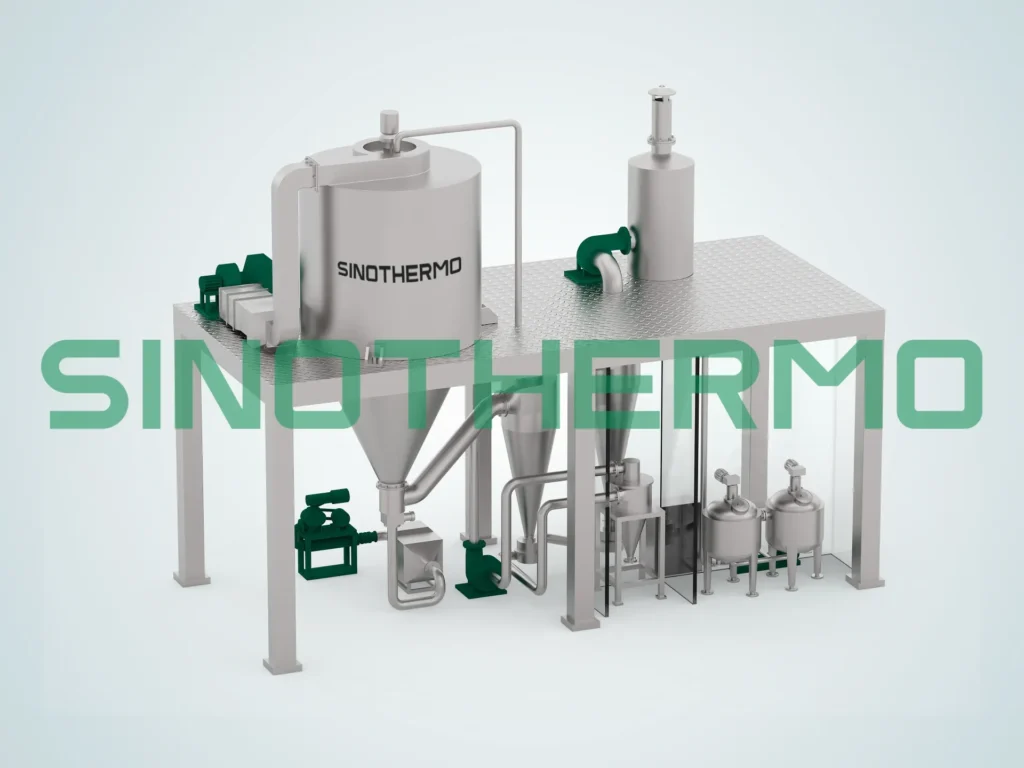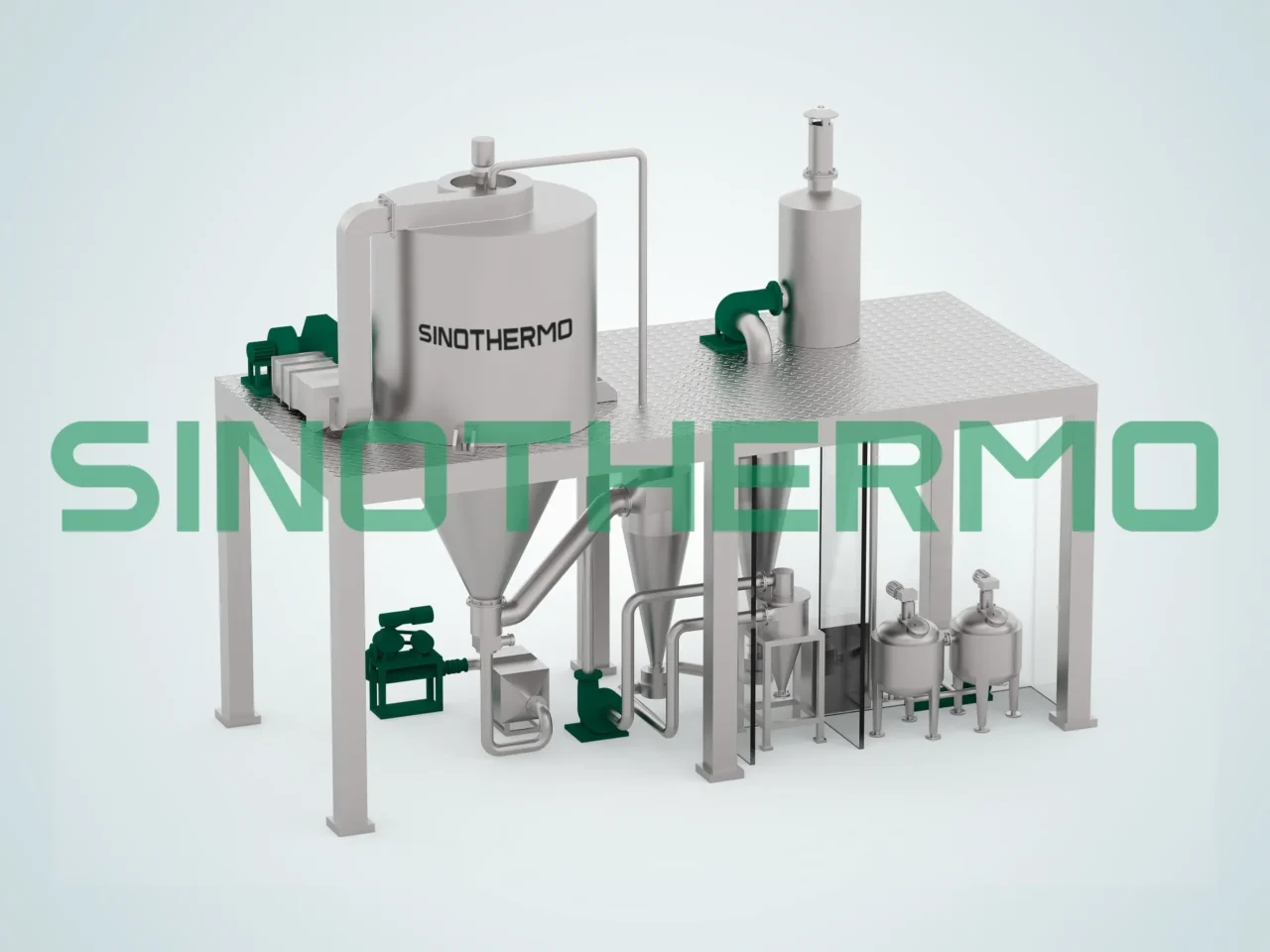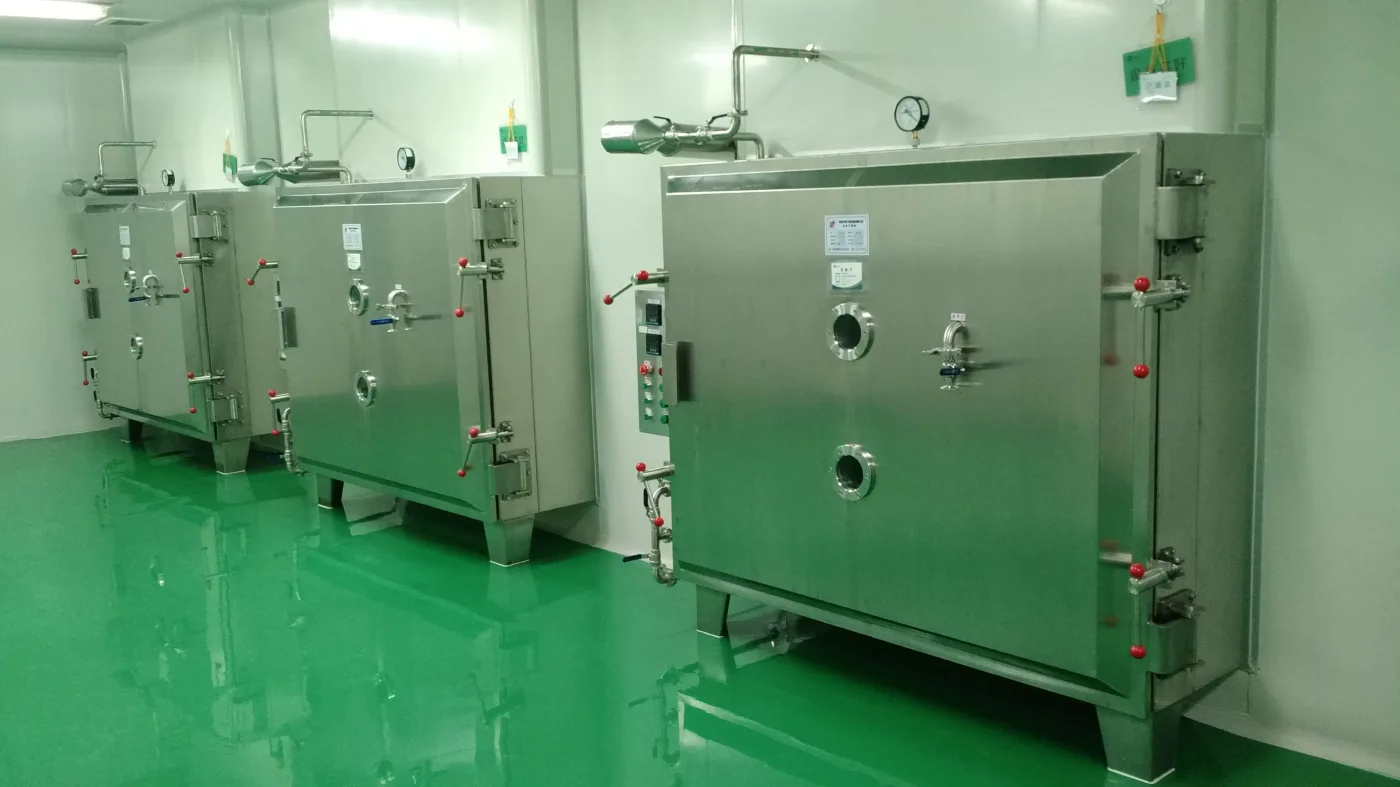
A vacuum tray dryer — also called a static vacuum cabinet dryer or vacuum shelf dryer — holds material in stationary trays on heated shelves inside a sealed chamber under vacuum. Heat conducts from shelf to tray to product while reduced pressure lowers water's boiling point, so drying happens at 40–80 °C with no product movement and no drying gas.
Its defining characteristic is that nothing agitates the material. That is simultaneously its greatest advantage and its main limitation.
Quick context: why buyers still choose the slowest vacuum dryer
Every other machine in the vacuum-drying family agitates the product to speed up heat transfer — tumbling, screwing, paddling. The vacuum tray dryer deliberately does none of that, and it remains one of the most specified vacuum dryers in pharmaceutical and fine-chemical plants anyway. The reason is that some products cannot tolerate any mechanical action at all: fragile crystals that would break under a paddle, potent APIs where every gram must stay in a traceable, individually identifiable tray, or small clinical batches where the cost of a long cycle is trivial next to the cost of losing product to attrition. Where those constraints apply, the slow cycle is the price of admission, not a defect.
How it works
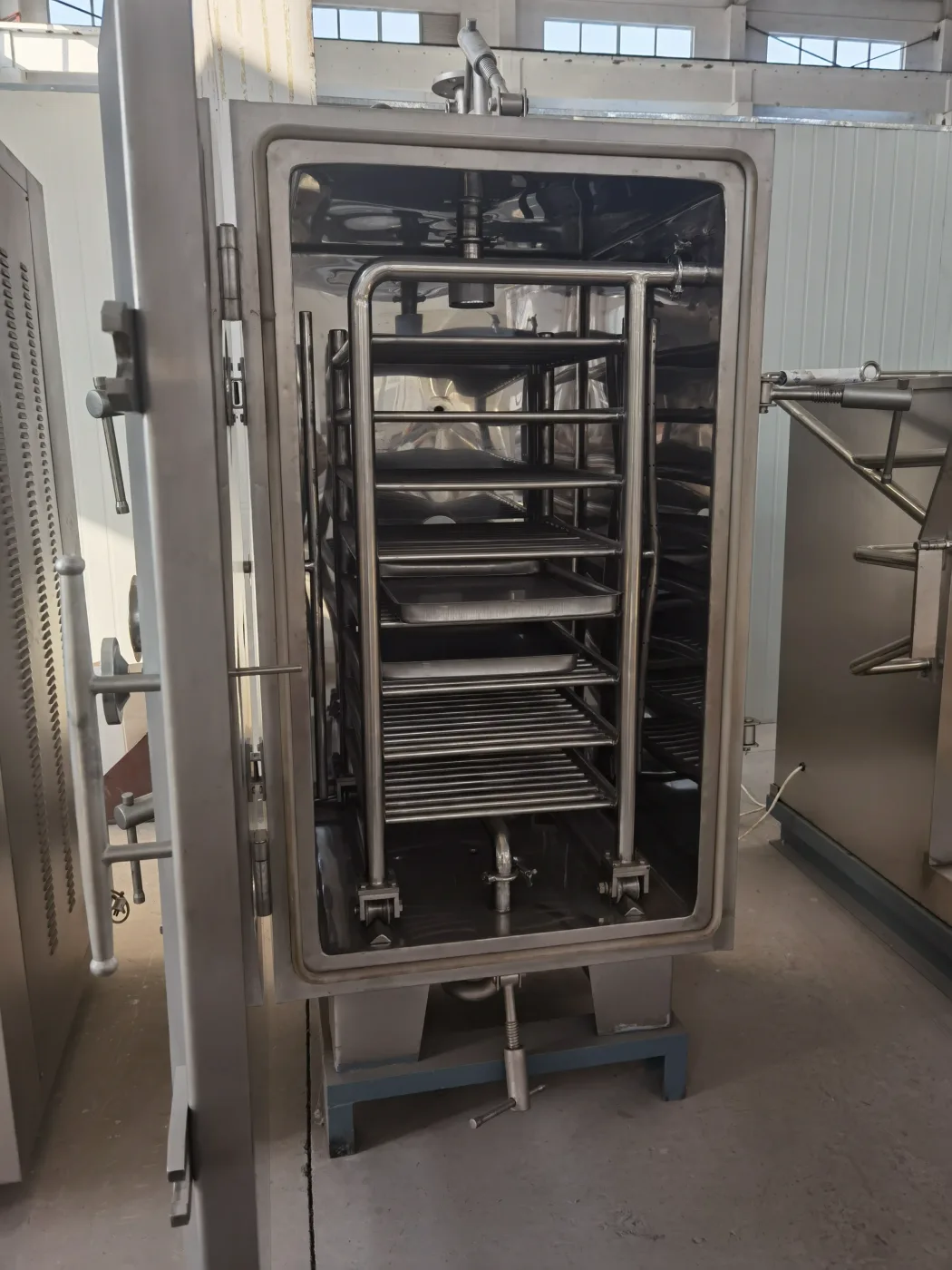
- 1.Loading — material is spread in trays, which sit on hollow shelves inside the chamber.
- 2.Sealing and evacuation — the door closes and a vacuum pump reduces pressure, typically to 10–100 mbar.
- 3.Indirect heating — hot water, steam, or thermal oil circulates through the shelves. Heat passes by conduction: shelf → tray → product.
- 4.Low-temperature evaporation — at 30 mbar water boils near 24 °C; at 100 mbar near 46 °C. Moisture evaporates far below atmospheric boiling point.
- 5.Vapour capture — vapour is drawn to a condenser (essential for solvent recovery) before reaching the pump.
- 6.Cooling and discharge — shelves can be cooled before breaking vacuum, so product doesn't meet ambient air while hot.
Why choose a static tray design?
No mechanical agitation means:
- Fragile crystals and agglomerates survive intact — nothing breaks particle structure
- No attrition, no fines generation — important where particle size distribution is part of the specification
- No moving parts inside the product zone — simple, reliable, easy to clean, nothing to contaminate the batch
- Complete batch traceability — each tray is identifiable, which matters in pharmaceutical and high-value work
Vacuum operation means:
- Low product temperature protects heat-sensitive materials
- Near-absence of oxygen prevents oxidation and discolouration
- Solvent recovery is straightforward — one condenser captures it
- Lower-than-atmospheric boiling point allows drying of materials that would decompose in a hot-air dryer
And the trade-offs
Because material is static, heat transfer is the bottleneck. Only the tray bottom contacts the heated shelf, and dry powder is a poor conductor, so drying times are long — often 8–24 hours, sometimes longer. Bed depth directly controls drying time; doubling the depth more than doubles the time.
| Vacuum tray (static) | Conical/ribbon vacuum | Rotary cone vacuum | Vacuum paddle/rake | |
|---|---|---|---|---|
| Agitation | None | Screw/ribbon | Tumbling | Paddles/rake |
| Particle damage | None | Low–moderate | Low | Moderate |
| Heat transfer | Poor (bottleneck) | Good | Good | Very good |
| Typical cycle | 8–24 h+ | 4–12 h | 4–10 h | 2–8 h |
| Labour | High (manual trays) | Low | Low | Low |
| Batch size | Small–medium | Medium–large | Medium | Medium–large |
| Best for | Fragile, high-value, small batch | General solvent-wet cakes | Free-flowing powders | Pastes, sludges, high-moisture |
Labour is the hidden cost. Loading and unloading trays by hand is slow and, for potent compounds, an exposure risk. When people outgrow vacuum tray dryers, it's usually labour and cycle time that force the change — not drying performance.
Where it's used
- Pharmaceutical — APIs and intermediates, especially solvent-wet cakes; secondary drying after spray drying to meet ICH Q3C residual-solvent limits; small clinical batches
- Fine and speciality chemicals — heat-sensitive intermediates, dyes, pigments where colour matters
- Food and nutraceutical — extracts, botanicals, high-value powders
- Advanced materials — battery precursors and materials requiring oxygen-free drying
- R&D and pilot — low cost per unit and full batch traceability make it the default first choice at small scale
A very common and sensible arrangement: spray dryer or filter/centrifuge upstream → vacuum tray dryer for final solvent removal. The tray dryer isn't doing bulk water removal; it's finishing to a tight residual-solvent specification. For the fuller picture of how this fits into pharmaceutical process trains specifically, see our pharmaceutical spray drying guide.
Why bed depth dominates the drying-time conversation
Heat has to conduct from the tray bottom up through the material, and dry powder is a poor conductor — often close to that of a loose insulating layer. In a static bed, the distance heat has to travel scales with bed depth, but so does the thermal resistance it has to cross, which is why drying time does not scale linearly with depth. A tray running at 20 mm might dry in ten hours; the same material at 40 mm can easily take twenty-five, not twenty. This is also why "increase capacity by loading trays deeper" is usually a false economy — it looks like more throughput per batch, but the cycle stretches out disproportionately, and total daily output can actually fall.
The practical consequence is that a drying-time quote is only meaningful when it states the bed depth it assumes. A supplier quoting "12 hours" without naming the depth is not giving you a number you can compare against anyone else's, and it is not a number you can use to plan production scheduling.
What to specify
- Shelf area and number of trays — quoted against your bed depth, not a nominal figure
- Bed depth assumption used in the drying-time estimate (ask explicitly — it drives everything)
- Heating medium and temperature range — hot water, steam, or thermal oil
- Shelf temperature uniformity across the whole stack, not just the average
- Achievable vacuum level and pump type suited to your vapour load
- Condenser sizing and solvent-recovery efficiency if drying from solvent
- Shelf cooling capability before discharge
- Explosion protection for solvent service
- Materials and surface finish — 316L, documented Ra for pharma
- CIP or manual cleaning access, and tray handling ergonomics
- Instrumentation — product-temperature probes, pressure, data logging for GMP
- Measured drying curve on your material at the intended bed depth
Common mistakes to avoid
- Sizing shelf area without agreeing bed depth. The bed-depth assumption behind a drying-time quote is the single most important number in the specification, and it's easy for a supplier and buyer to be assuming different values without either party noticing.
- Treating average shelf temperature as sufficient. Uniformity across the whole stack — not just the mean — determines whether every tray reaches target moisture at the same time.
- Underestimating labour cost when comparing to agitated designs. A vacuum tray dryer that looks cheaper on paper can cost more in practice once manual tray handling and cycle time are priced in.
- Skipping the condenser conversation for solvent work. Solvent recovery efficiency is a real spec, not a checkbox — ask for the number, not just confirmation that a condenser exists.
- Assuming drying time scales linearly with bed depth. It doesn't — doubling depth more than doubles time, because heat still has to conduct from the bottom up through an increasingly thick, poorly conductive bed.
- Loading trays deeper to chase more throughput per batch. The instinct is understandable, but because cycle time grows faster than depth, total daily output often falls rather than rises — the fix is usually more trays at the original depth, not deeper trays.
Where SINOTHERMO fits
We build vacuum tray dryers (static vacuum cabinet dryers) along with the agitated vacuum dryers that often replace them at larger scale — so we have no incentive to push you toward the tray design if your throughput has outgrown it.
The one number that decides whether a vacuum tray dryer suits you is the drying time at your actual bed depth, and that cannot be calculated reliably from material properties. Our pilot lab measures it: drying curve, achievable residual moisture or solvent, and cycle time at the depth you'd really run. Pilot testing is a paid engineering service and the report is yours to keep — including a frank assessment of whether an agitated design would serve you better.
Frequently asked questions
What is a vacuum tray dryer used for?
Drying heat-sensitive, fragile, or solvent-wet materials in small to medium batches — pharmaceutical APIs and intermediates, fine chemicals, botanical extracts, and battery materials. It's also widely used as a secondary drying step to reach tight residual-solvent limits after spray drying.
Is a static vacuum cabinet dryer the same as a vacuum tray dryer?
Yes — static vacuum cabinet dryer, vacuum tray dryer, vacuum shelf dryer and vacuum cabinet dryer all describe the same machine: stationary trays on heated shelves inside a sealed vacuum chamber, with no agitation of the product.
How long does vacuum tray drying take?
Typically 8–24 hours, and sometimes longer, because heat transfer into a static bed is the limiting factor. Bed depth is the dominant variable — deeper trays increase drying time more than proportionally. The time for your material should be measured, not estimated.
Why is a vacuum tray dryer slower than an agitated vacuum dryer?
Nothing moves the material, so heat only reaches the product by conduction from the tray bottom, and dry powder conducts heat poorly. Agitated designs continually renew the material in contact with the heated surface, which is why their cycles are often two to five times shorter.
Can a vacuum tray dryer recover solvent?
Yes. Because the chamber is closed and vapour passes through a condenser before the vacuum pump, solvent recovery is straightforward and efficient — one of the main reasons the design is used for solvent-wet pharmaceutical cakes.
The only reliable way to know your cycle time is to measure it at your real bed depth. Send us a sample.
✉️ mark.gu@sinothermo.com · 📱 WhatsApp: +86 180 2197 2660 · 🌐 www.sinothermo.com · 💬 Request a pilot test
SINOTHERMO — Process Engineering Infrastructure.

Mark Gu
Passionate about enhancing customer experiences and streamlining operations, Mark focuses on building strong relationships, fostering innovation, and leading teams to achieve exceptional service and efficiency.
Email: mark.gu@sinothermo.com
Phone: +86 18021972660