Once you know which scale you need, the buyer's job shifts from "which one" to "which parameters" — and the parameters that matter are different at each scale, not just smaller versions of the same list. This guide is a specification checklist for whichever scale you have landed on, not a comparison between them.
If you have not yet decided which scale fits your project, our Lab vs Pilot vs Industrial Spray Dryer guide covers that decision — capacity, physics, and cost by scale. This article picks up after that decision, with what to actually specify once you know you are buying a benchtop, lab, or pilot unit. For how spray drying itself works across these scales, see our pilot spray dryer guide.
Benchtop and mini spray dryers: know the boundary before you buy
A benchtop spray dryer is a screening tool: it tells you quickly whether a formulation can be spray dried and roughly what the powder looks like — it does not tell you what a production machine will produce. Understanding that boundary is the difference between a useful instrument and a disappointing purchase.
What benchtop and mini units do well
- Rapid formulation screening — run many candidate formulations quickly with minimal material
- Feasibility answers — can this material be spray dried at all, and does it degrade under heat?
- Very small samples — often the only option when you have milligrams to grams of a novel compound
- Teaching and demonstration — widely used in academic and training settings
- Encapsulation and microparticle R&D — early-stage particle engineering studies
What they cannot do, and where buyers get disappointed
- 1.Predict production powder characteristics. Particle size distribution, bulk density, and morphology at benchtop scale differ meaningfully from production — the chamber is small, residence time is short, and droplet trajectories are entirely different.
- 2.Give reliable production sizing data. Evaporation capacity and thermal behaviour do not scale linearly from a benchtop unit; you need pilot data to size production equipment.
- 3.Achieve production-representative yield. Wall losses are proportionally large at this scale; recovery of 50–70% is common and not indicative of production yield.
- 4.Handle viscous or difficult feeds. Small nozzles and limited feed pumps restrict what can be processed.
- 5.Produce commercial quantities. Throughput is measured in grams per hour, not kilograms.
- 6.Run flammable solvents safely unless specifically supplied with an inert loop — standard benchtop units are aqueous-only.
Most benchtop units use a two-fluid (air-assisted) nozzle, which produces very fine droplets at small scale but consumes substantial compressed air — confirm your lab supply is adequate — and atomizes differently from the centrifugal or pressure-nozzle atomizers typical at production scale. That mismatch is a further reason benchtop particle size does not directly predict production particle size.
Benchtop buying checklist
- Minimum and typical sample volume per run
- Realistic powder recovery rate
- Aqueous only, or inert loop available for solvents?
- Compressed air requirement versus your lab supply
- Adjustable inlet temperature, feed rate, and atomizing air
- Data logging for reproducibility
- Cleaning time between formulations
- Spare parts availability — nozzles block and wear
Lab scale spray dryers: the criteria that actually decide the purchase
In a laboratory the binding constraints are different from production: how little material you can run per trial, whether you can handle organic solvents safely on a bench, and how quickly you can clean between formulations. Throughput barely matters; sample economy and turnaround dominate.
1. Minimum sample volume — usually the deciding factor
In early formulation work, material is scarce and often expensive — novel APIs, specialty ingredients, small synthesis batches. The key question is what is the smallest volume that gives a meaningful, representative run? A unit that needs a litre per trial is unusable if you only have 100 mL of a candidate formulation. Ask suppliers for the realistic minimum working volume, not the theoretical minimum, but the volume at which results are reproducible.
2. Yield recovery at small scale
At laboratory scale, powder losses to the chamber walls and cyclone are proportionally much larger than at production scale. A unit that recovers 40% of a precious sample is a poor research tool. Ask about typical recovery rates and cyclone efficiency for fine powders specifically, not a general specification.
3. Solvent handling and safety
Many R&D formulations are solvent-based. In a lab environment this raises specific requirements: an inert loop (closed-cycle N₂) for flammable organic solvents is essential, not optional; solvent condensation and collection must be built in; oxygen monitoring on the inert loop; and fume extraction integration with the lab's existing systems. Confirm whether the unit is rated for your specific solvents before purchase — retrofitting inert capability afterward is expensive.
4. Cleaning and changeover time
R&D means frequent formulation changes. Time spent cleaning is time not experimenting. Evaluate chamber access, whether the atomizer disassembles without tools, and whether parts are dishwasher- or autoclave-safe where relevant.
5. Bench space and utilities
Physical footprint and height (fume hood clearance if it must sit in one); electrical supply, since some units need more than a standard lab socket; compressed air requirements, as two-fluid nozzles consume substantial air; and cooling water if the condenser needs it.
6. Data quality
A lab dryer's output is data, so instrumentation matters: accurate inlet/outlet temperature measurement, feed rate control, and ideally logging so runs are reproducible and traceable in your lab notebook or LIMS.
Pilot spray dryers: what to specify for real scale-up value
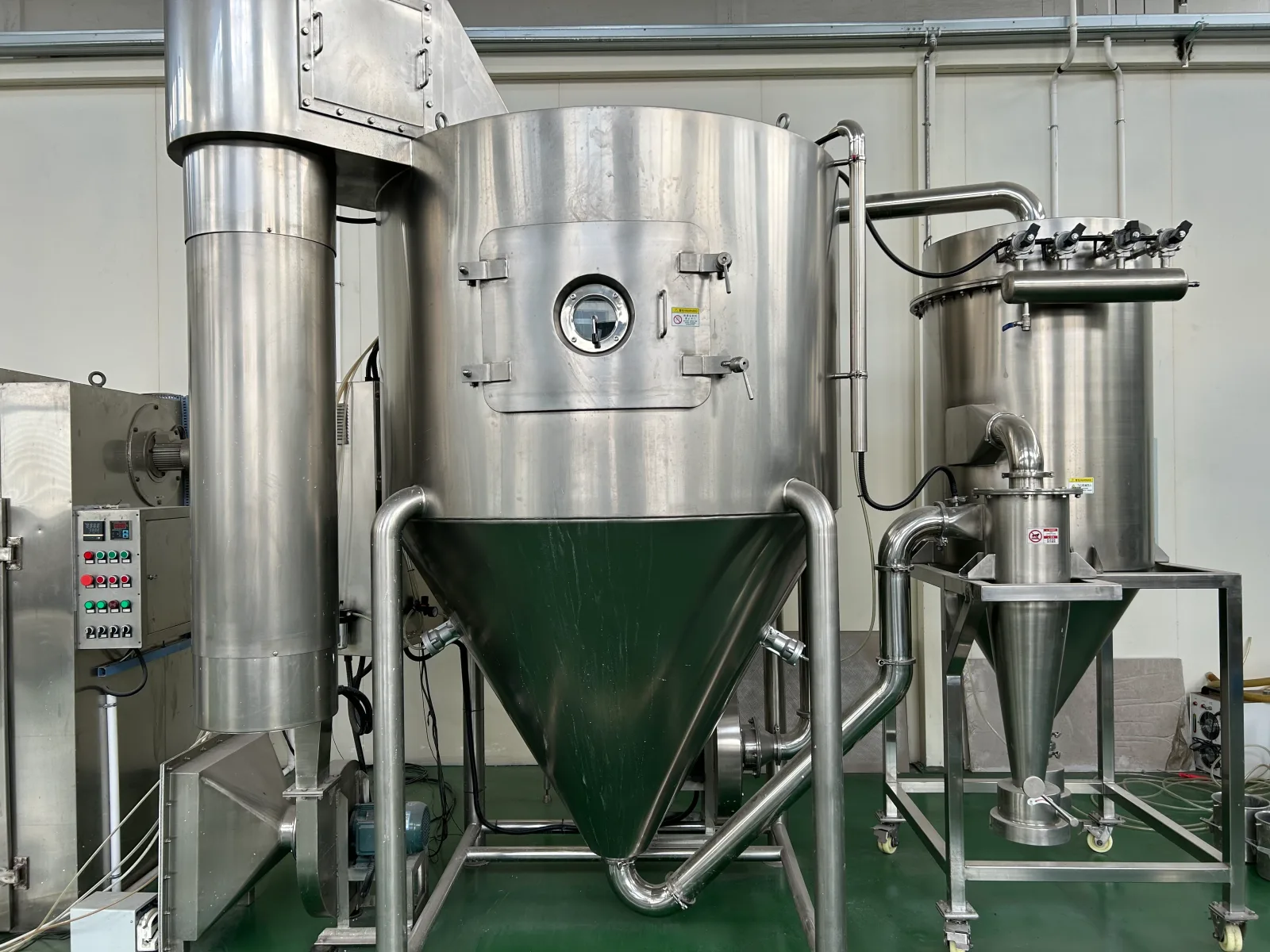
A pilot spray dryer earns its cost by de-risking a production investment — but only if it is specified with enough parameter flexibility to actually map your process window, rather than just producing a sample. The critical requirement is parameter adjustability: a pilot unit that only runs one configuration cannot map a process window.
| Parameter | Why it must be adjustable |
|---|---|
| Inlet temperature | Defines the heat-sensitivity limit for your product |
| Feed rate | Together with temperature, sets outlet temperature and residual moisture |
| Atomizer speed / nozzle pressure | The primary control over particle size |
| Airflow rate | Affects residence time and drying rate |
| Atomizer type (interchangeable) | Ideally the unit accepts both centrifugal and nozzle atomizers, so you can determine which suits your product before buying production equipment |
Also confirm: instrumentation and data logging (you are buying data, so temperature, flow and pressure must be measured and recorded accurately); materials of construction matching your intended production grade (316L if that is what production needs); cleanability, since frequent product changes in R&D make cleaning access a practical daily concern; cycle type — if production will be closed-cycle for solvent or inert duty, the pilot unit must be too, or the data will not transfer; and minimum batch size, which matters when your material is scarce or expensive.
How pilot data translates to production — and where it does not
Scale-up is not simply multiplying capacity.
Transfers well
- Inlet/outlet temperature window — the thermal limits of your product
- Feed concentration and its effect on particle size
- Whether the material is fundamentally sprayable, and what powder characteristics are achievable
- Atomizer type selection
Requires engineering translation
- Residence time — chamber geometry differs; a production chamber has a wider residence-time distribution
- Wall deposit behaviour — a material that runs clean at pilot scale may deposit at production scale, where surface-to-volume ratio and airflow patterns differ
- Droplet trajectory — atomizer-to-wall distance changes with chamber size
- Fines handling — often trivial at pilot scale and a significant engineering problem at production scale
This is why the manufacturer's scale-up experience matters as much as the pilot machine itself. Ask any supplier how they translate pilot outlet temperature and residence time to a production chamber — a substantive answer indicates real process engineering capability, not just a bigger version of the same drawing.
Common mistakes across all three scales
- 1.Specifying benchtop or lab units on throughput. Largely irrelevant below production scale; minimum sample volume and recovery rate matter far more.
- 2.Ignoring solvent requirements until after purchase. Retrofitting an inert loop onto a unit built for aqueous feeds is costly and sometimes not possible at all.
- 3.Buying a pilot unit that cannot vary atomizer type. If you cannot test both centrifugal and nozzle atomization, you have not actually de-risked the atomizer decision — the single biggest driver of production powder quality.
- 4.Underestimating cleaning and changeover time. This is the practical limit on how many experiments you run per week, and it rarely appears on a spec sheet.
- 5.Assuming results scale directly regardless of which unit produced them. Benchtop data establishes feasibility only; lab data establishes feasibility and thermal limits; pilot data is what you size production from. Treating any of them as more than that leads to a mis-sized production machine.
Where SINOTHERMO fits
We would rather you used this checklist to interrogate us than take our word for it. Rather than selling a fixed benchtop or lab product line, SINOTHERMO runs an in-house pilot laboratory where your actual material is trialled under adjustable, instrumented conditions — atomizer type, inlet temperature, feed rate and airflow all confirmed against your feed, with a documented parameter report you can use to size production equipment from us or anyone else. This is backed by 20+ years of experience in industrial drying, so the translation from pilot data to production geometry is handled by engineers who have made that translation before, not read about it. See the facility on the testing lab page.
Scaling up a spray-dried product? Send us your material. Our pilot lab runs it under conditions you specify and documents the parameters a production machine needs.
✉️ mark.gu@sinothermo.com · 📱 WhatsApp: +86 180 2197 2660 · 🌐 www.sinothermo.com · 💬 Request a pilot test
SINOTHERMO — Process Engineering Infrastructure.
Frequently asked questions
What should I look for when buying a lab scale spray dryer?
Minimum workable sample volume, powder recovery rate, solvent handling capability (an inert loop if you use organic solvents), cleaning and changeover speed, bench space and utility requirements, and instrumentation quality for reproducible data. Throughput is rarely the deciding factor at this scale.
Can a benchtop spray dryer predict production results?
No. It indicates feasibility and directional powder characteristics, but particle size, bulk density, yield, and thermal behaviour differ substantially at production scale, partly because most benchtop units use a two-fluid nozzle that production rarely uses. Production sizing should be based on pilot-scale data instead.
What should I look for when buying a pilot spray dryer?
Parameter adjustability above all: inlet temperature, feed rate, atomizer speed or pressure, and airflow must all be variable, ideally with interchangeable atomizer types so you can compare centrifugal against nozzle atomization on your own material. Also confirm accurate instrumentation and data logging, materials matching your intended production grade, and a matching cycle type — open or closed — to what production will actually run.
Does pilot spray dryer data transfer directly to production?
The thermal window, feed concentration effects, and atomizer selection transfer well. Residence time, wall deposit behaviour, and fines handling require engineering translation to production geometry, which is where a manufacturer's scale-up experience — not just the pilot machine itself — determines how reliable your production sizing will be.
Can a lab or benchtop spray dryer handle organic solvents?
Only if it has a closed-cycle inert (nitrogen) loop with solvent condensation and oxygen monitoring. Standard open-cycle lab and benchtop units are built for aqueous feeds, and running flammable solvents on them is unsafe. Confirm solvent compatibility before purchase — retrofitting an inert loop afterward is expensive and sometimes impractical.
How much material do I need for a spray drying trial?
It depends heavily on scale. Benchtop trials can run on milligrams to grams; lab trials typically need a small but meaningful sample, with the exact minimum varying by supplier — ask for the realistic reproducible minimum, not the theoretical one; pilot trials need a moderate quantity, enough to map a process window rather than produce a single data point. If material is scarce or expensive, confirm the minimum working volume before committing to any unit.

Mark Gu
Passionate about enhancing customer experiences and streamlining operations, Mark focuses on building strong relationships, fostering innovation, and leading teams to achieve exceptional service and efficiency.
Email: mark.gu@sinothermo.com
Phone: +86 18021972660