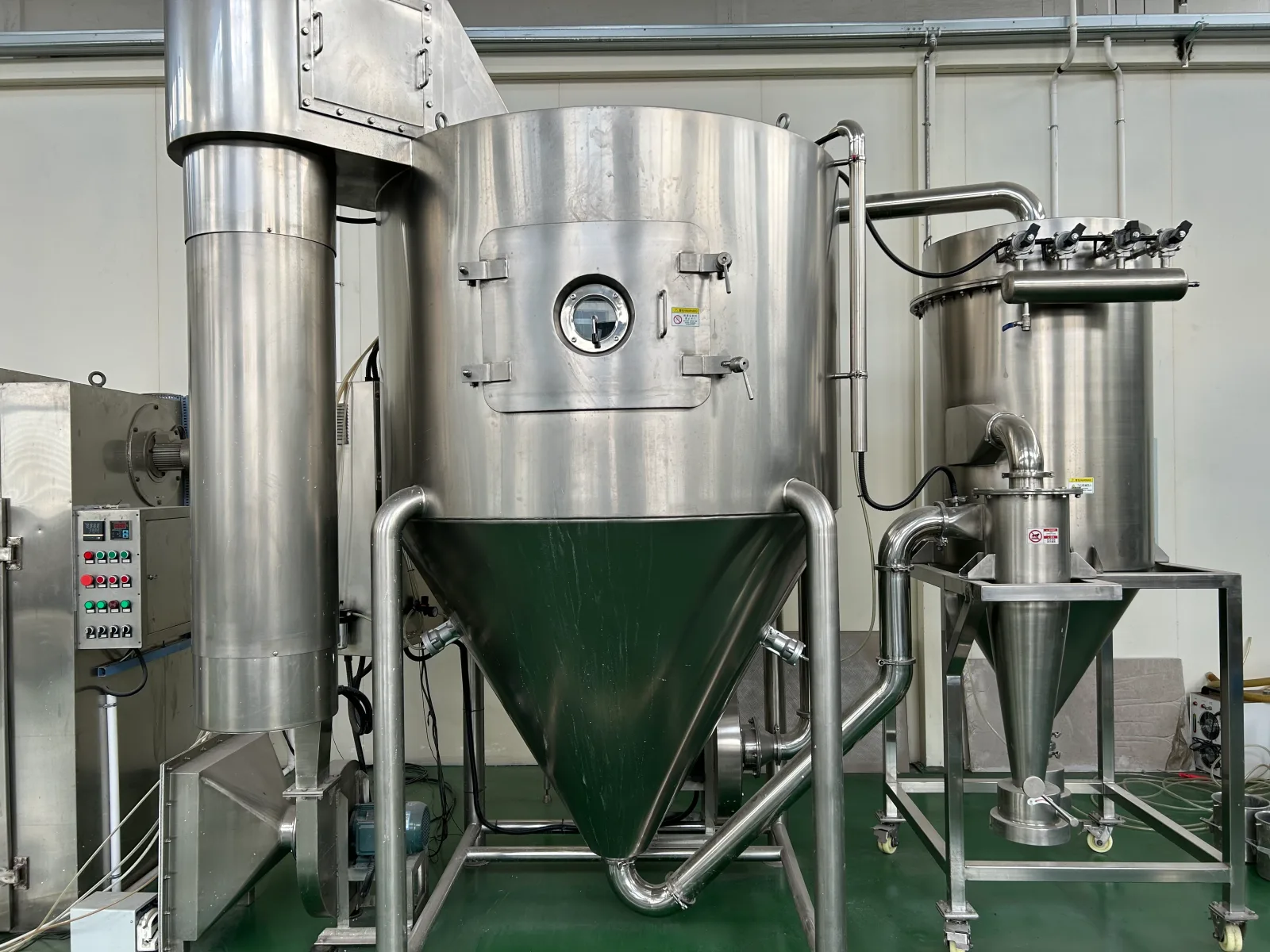
If you are searching for spray drying services, you are really deciding between three routes: pay for a trial run at a testing lab, buy a pilot spray dryer to run your own development, or invest in a production line. The right route depends on how many products you have, how many runs you will do a year, and how well you already know your process. For most projects the lowest-risk sequence is trial first, pilot machine only if you will run it often, and production line once the parameters are proven.
One point first, so nobody wastes time: SINOTHERMO builds and sells spray drying equipment and runs a paid pilot testing laboratory. We do not offer contract drying or toll processing of your product on a continuing basis. If you need a contractor to dry your product for you every month, a toll processor is the right supplier. If you need to prove a process before you buy a machine, or you want to own the equipment, read on.
Quick Context: why this decision matters
Spray drying projects fail at the gap between a promising lab result and a working production line. A formulation that dries well on a benchtop unit can stick, lose activity or give the wrong particle size at scale. The three routes below are three different ways of closing that gap, with different costs and different amounts of control.
Route 1: A paid pilot trial at a testing lab
You send your material, and engineers run it on pilot equipment and report what happened.
What you get: operating parameters (inlet and outlet temperature, feed rate, atomiser setting), powder properties (moisture, particle size, bulk density, flow), yield, observations on sticking or degradation, and a sample of the powder.
Best when:
- You have one or a few products to validate.
- You are choosing between spray drying and another process.
- You need data to specify a production machine, or to support an investment decision.
- You do not yet know whether your material can be spray dried at all.
Limits: a trial gives you data and samples, not ongoing supply. Sample quantities are limited.
SINOTHERMO's testing lab runs pilot trials across spray drying, fluid bed, granulation, mixing and pulverising. Pilot testing is a paid service, and the report is yours to keep whichever supplier you eventually choose.
Route 2: Buy a pilot spray dryer
You own a small unit and run your own trials and small batches.
Best when:
- You develop several products or formulations.
- You expect to run trials frequently through the year.
- You need to produce sample batches for customers on site.
- Confidentiality of formulations means you prefer to keep trials in-house.
What to check: the atomiser type (match it to the production machine so data transfers), materials of construction, evaporation range and whether it can handle solvents if you need that. See the pilot spray dryer guide, our pilot spray dryer packages and the centrifugal spray dryer range.
Limits: a pilot machine needs operators, utilities, space, cleaning time and maintenance. If you will run it a few times a year, the cost per run is high.
Route 3: Invest in a production line
You buy a machine sized to your production volume.
Best when:
- Your process is proven and the parameters are known.
- Volume is high enough to justify the capital.
- You need continuous, repeatable production under your own quality system.
What to check: evaporation capacity, heat source, materials, compliance (CE, GMP, ATEX), automation and after-sales support. See the spray dryer machine guide, the spray dryer cost guide and spray dryer sizing.
Risk: the main risk is buying before the process is proven. Capital is committed against an estimate.
How the three routes compare
| Factor | Paid pilot trial | Own pilot dryer | Production line |
|---|---|---|---|
| Upfront cost | Low, per trial | Moderate | High |
| Time to first result | Days to weeks | Weeks to months (purchase and commissioning) | Months |
| Number of products you can test | Limited by budget per trial | Unlimited once owned | Usually one or a few |
| Control and confidentiality | Shared with the lab | Full | Full |
| Data quality | Pilot-scale, expert-run | Pilot-scale, depends on your team | Production-scale |
| Staffing | None on your side | Operator and process engineer | Production team |
| Risk of wrong equipment choice | Reduces risk | Moderate | Highest if skipped earlier stages |
| Typical user | First project, one product | R&D group, several products | Manufacturer with proven process |
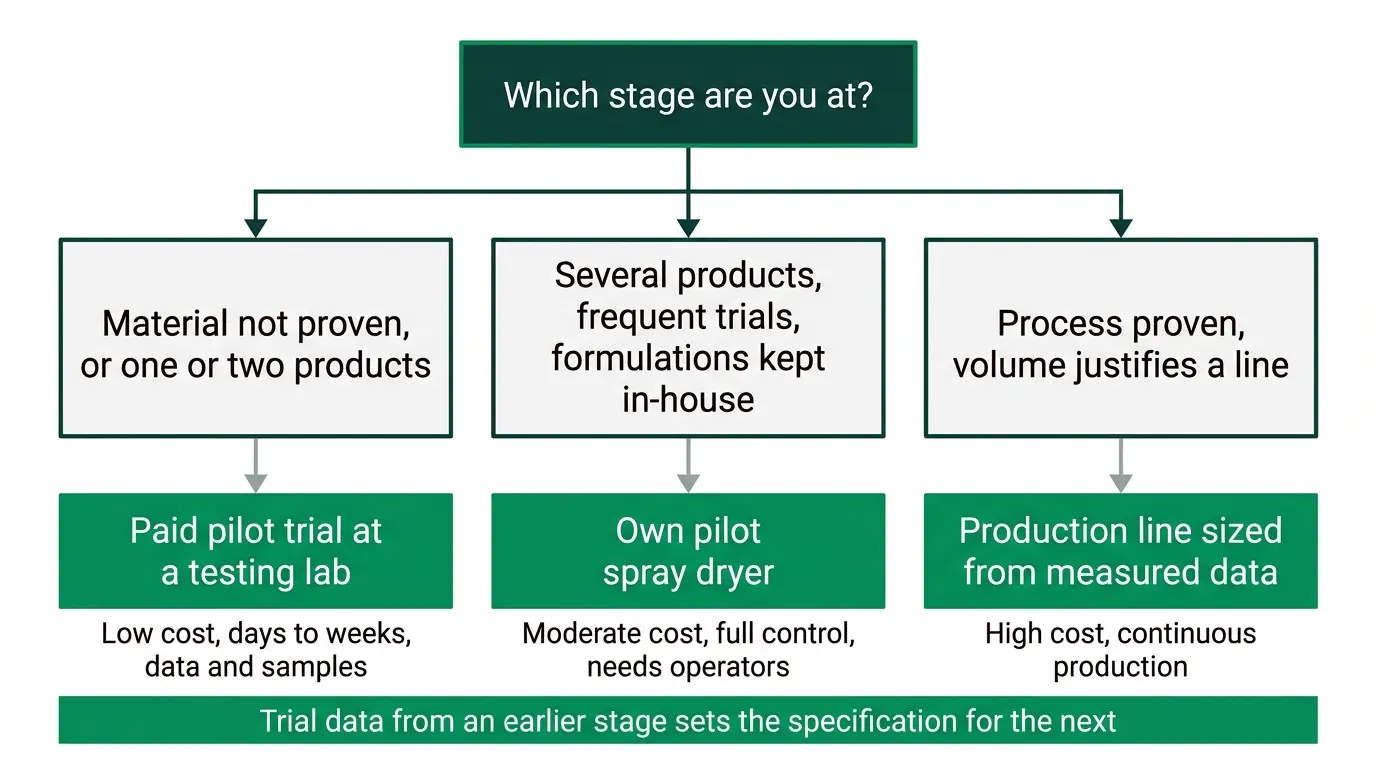
A simple decision path
- 1.Do you know whether your material can be spray dried? If no, run a trial.
- 2.Do you have more than two or three products to develop, and will you run trials regularly? If yes, a pilot dryer may pay back. If no, keep trialling.
- 3.Is the process proven and the volume large enough to justify a line? If yes, specify a production machine from trial data. If no, go back to step 1 or 2.
- 4.Does your feed contain solvents or sticky extracts? Then the dryer design matters from the first trial. See closed loop spray dryer and spray drying herbal and plant extracts.
A worked cost comparison framework
Costs differ by project, so use a framework instead of a number. List each cost under the three routes and put your own figures against them.
| Cost item | Paid trial | Own pilot dryer | Production line |
|---|---|---|---|
| Equipment purchase | None | Pilot dryer, auxiliaries, spares | Full line, installation, commissioning |
| Facility and utilities | None | Space, power, compressed air, cooling, exhaust handling | Plant-scale utilities and building work |
| Staff | None | Operator and process engineer time | Production team |
| Materials | Your sample, shipping | Your feed for every run, including failed runs | Production feed |
| Analysis | Included in the report scope, or extra | Your own lab or outside lab | Quality control lab |
| Maintenance | None | Spares, atomiser wear, calibration | Planned maintenance programme |
| Time cost | Weeks to result | Months to commission, then fast iteration | Months to years |
Then answer two questions. First, how many runs will you need in the next two years? If the answer is a handful, the trial route almost always costs less than owning a machine. If the answer is dozens, the pilot dryer begins to pay back. Second, what is the cost of a wrong production decision? A mis-specified production line is the most expensive error in the whole project, and an inexpensive trial run first is insurance against it.
Information to prepare before contacting any supplier
Whichever route you take, suppliers can respond faster and more accurately when you send complete information. Prepare:
- 1.Product and purpose. What the powder is for and which specification it must meet.
- 2.Feed description. Water-based or solvent-based, solids content, viscosity, pH, particle size of any suspended solids, heat sensitivity, tendency to foam or stick.
- 3.Target powder. Particle size range, bulk density, residual moisture, flowability, and any purity or microbial limits.
- 4.Volume. How much powder per hour, per year, and over what schedule.
- 5.Site and utilities. Available electricity, steam, gas, compressed air and cooling water. Ceiling height and floor space for production machines.
- 6.Standards. CE, GMP, ATEX or food-contact requirements for your market.
- 7.Safety data. For solvents, toxic or potent materials, send the safety data sheet. It changes the dryer design.
- 8.Timeline and budget stage. A feasibility question, a funded development project and an approved capital purchase deserve different responses.
A complete brief shortens the time from first message to a useful answer. It also lets you compare suppliers on equal terms.
What a good trial should deliver
Whichever route you choose, insist on these outputs.
- A written measurement plan before the run. What will be measured, and what counts as success.
- Operating conditions recorded for every run: inlet and outlet temperature, feed rate, atomiser speed or pressure, airflow.
- Powder properties: moisture, particle size distribution, bulk density, flowability, and the quality test that matters for your product.
- Yield and recovery, including how much stuck to the wall.
- A sizing basis for production, such as the evaporation load and temperatures that apply to your material.
- A retained sample you can test independently.
A supplier who cannot provide these has given you a demonstration, not a trial.
How to evaluate a spray dryer supplier
Once you decide to buy, the supplier matters as much as the machine. Our guide to how to evaluate a spray dryer manufacturer gives a seven-question framework: is the company really manufacturing, can it engineer the process, how deep does customisation go, are quotations on one baseline, which materials and standards apply, who owns after-sales, and how will acceptance be proved.
Common mistakes to avoid
Asking for a quotation before a trial. A price based on a guess about your material is a price for a box.
Buying a pilot dryer with a different atomiser from your production machine. The data will not transfer. Match the atomiser type.
Using a toll processor to prove a process you plan to bring in-house. The data may not be in a form that specifies equipment, and you do not learn the process.
Skipping documentation. Insist on recorded parameters and a retained sample.
Treating the trial as a sales exercise. A good trial can show that spray drying is wrong for your product, and that is a useful result.
Conclusion
Choose by stage, not by habit. One product and an open question points to a paid pilot trial. A development programme with many products points to owning a pilot dryer. A proven process and real volume point to a production line sized from measured data.
Next step: Request a pilot test with your own material. Pilot testing is a paid service, and the report gives you the parameters, powder properties and sizing basis to decide your next step.
Frequently asked questions
Does SINOTHERMO offer spray drying services?
We offer paid pilot testing: engineers run your material on pilot spray drying equipment and report parameters, powder properties and yield. We do not provide continuing contract drying or toll processing. We build and sell the equipment.
How much does a spray drying trial cost?
The price depends on the number of runs, the equipment used and the measurements required. Send your material details and objectives through the contact page, and we will scope the trial.
Should I buy a pilot spray dryer or outsource trials?
Outsource if you have one or a few products to validate. Buy a pilot dryer if you develop many products, run trials often, or need to keep formulations in-house.
How do I know the size of the production dryer I need?
Size it by water evaporation. Convert your required powder output to feed and water using the feed solids content, then add margin. A pilot trial gives the measured temperatures and solids that make the calculation reliable.
Can the pilot data be used with another supplier?
Yes. The report from a SINOTHERMO pilot trial is yours to keep, and the parameters and sizing basis are useful when you compare quotations from any supplier.
What should I send for a trial?
A representative sample of the liquid feed with its solids content, viscosity, solvent type and heat sensitivity, plus your target powder specification and any safety data.
What if spray drying turns out to be unsuitable?
Then the trial has done its job. Depending on your material and our pilot equipment, we can also test other drying or granulation processes.

Mark Gu
Passionate about enhancing customer experiences and streamlining operations, Mark focuses on building strong relationships, fostering innovation, and leading teams to achieve exceptional service and efficiency.
Email: mark.gu@sinothermo.com
Phone: +86 18021972660