A pilot spray dryer is a small spray drying system, typically evaporating a few to a few dozen kilograms of water per hour, used to develop a process and generate scale-up data before buying a production machine. It sits between a laboratory unit, which screens formulations on millilitre samples, and an industrial dryer, which runs at hundreds of kilograms per hour.
Whether you are developing a pharmaceutical formulation, scaling up a food ingredient or testing an advanced material, the pilot stage answers questions a lab unit cannot: does the process hold at a realistic feed rate, what powder properties do I get, and what will the full-scale machine need to deliver? This guide covers how lab and pilot units differ, what the process involves, which specifications matter, and how to choose.
Quick Context: why a pilot stage exists
Spray drying results depend on droplet size, residence time, gas temperature and chamber geometry. Change the scale and several of these change at once. A formulation that dries well in a benchtop unit may stick to the wall, give a different particle size, or lose yield in a larger chamber.
A pilot run closes that gap. It gives you measured inlet and outlet temperatures, feed rate, powder moisture, particle size, bulk density and recovery on your own material. Those numbers are the basis for specifying a production dryer. Skipping this stage is the most common reason a full-scale project misses its targets.
What is a pilot spray dryer?
A pilot spray dryer is a complete spray drying line at reduced scale: feed pump, atomiser, heater, drying chamber, cyclone and powder collection. It is used to:
- Develop and test new formulations at realistic conditions
- Establish the operating window for temperature, feed rate and atomisation
- Produce sample batches for customer evaluation and quality testing
- Generate scale-up data for a production dryer
- Run small commercial batches of high-value products
Lab spray dryer vs pilot spray dryer
| Parameter | Lab spray dryer | Pilot spray dryer |
|---|---|---|
| Typical evaporation | Under about 3 kg/h water | About 5 to 50 kg/h water |
| Sample per run | Millilitres to a few litres | Litres to tens of litres |
| Main purpose | Formulation screening, feasibility | Process validation, scale-up data, small batches |
| Atomiser | Two-fluid nozzle (common) | Two-fluid, pressure or centrifugal |
| Particle size | Fine, narrow range | Closer to production behaviour |
| Footprint | Benchtop | Floor-standing |
| Typical users | University and R&D labs | Pilot plants, process development teams |
Use a lab unit while you still have little sample and are still choosing between formulations. Move to a pilot unit when you need data you can scale.
SINOTHERMO pilot-scale models
SINOTHERMO's standard pilot spray dryers are the PSD-5 and PSD-10. Both are co-current, open-cycle, electrically heated units with PLC control, a fully welded polished chamber and cyclone collection. The full specification is on the pilot spray dryer page.
| Item | PSD-5 | PSD-10 |
|---|---|---|
| Water evaporation | About 5 kg/h | Up to 10 kg/h |
| Drying chamber (inner dia. × height) | 1,000 × 2,000 mm | 1,500 × 2,500 mm |
| Atomiser | Centrifugal / pneumatic dual-purpose | Electric centrifugal, 18,000 r.p.m. |
| Product collection | Main chamber + one-stage cyclone | Two-stage cyclone |
| Electric heating power | 18 kW | 27 kW |
| Control | Siemens PLC, touchscreen | Siemens PLC, touchscreen |
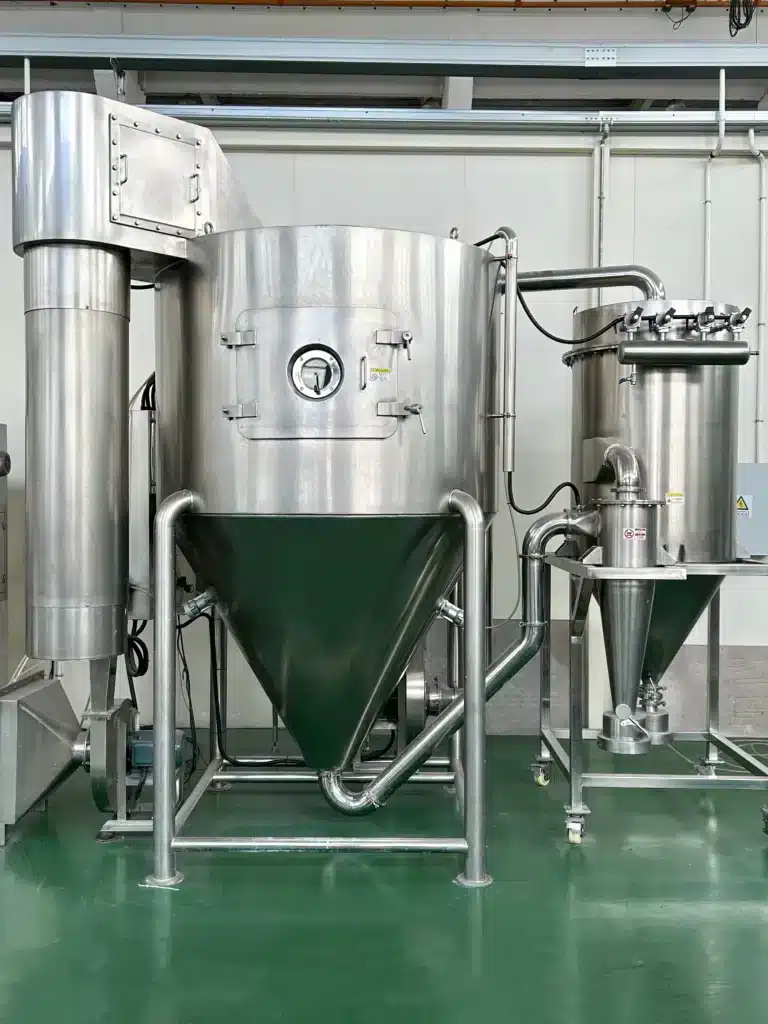
Evaporation capacity depends on material characteristics and on inlet and outlet air temperature, so the figures above are for the standard configurations. Parameters can change as products are updated, so confirm the current specification when you request a quotation. The photo below shows a PSD pilot unit as installed; dust collection options vary, so check the specification for your configuration.
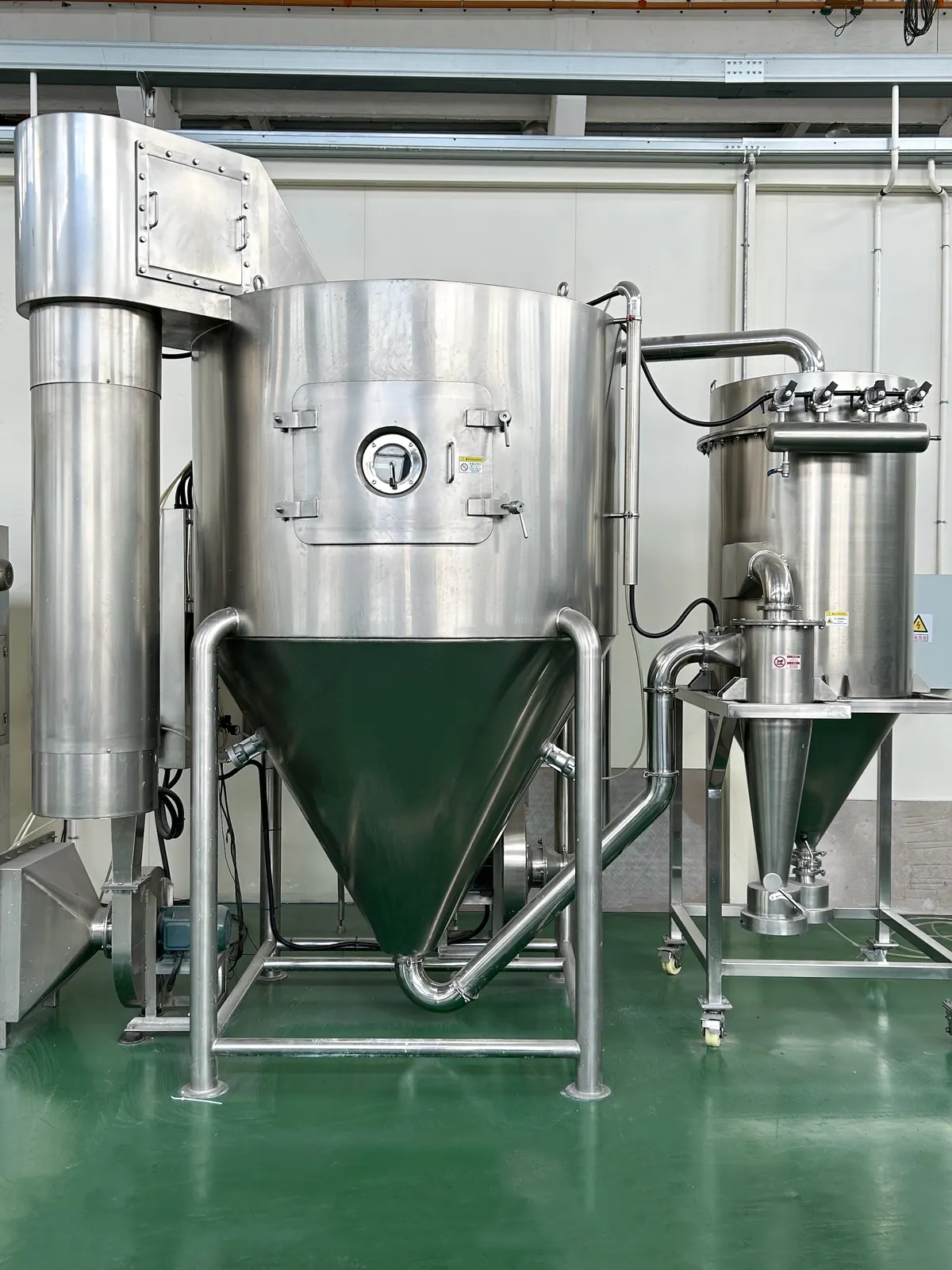
Above PSD-10, the centrifugal spray dryer range starts at LPG-25, which evaporates up to 25 kg/h of water. If your pilot work needs nozzle atomisation for coarser granules, the pressure spray dryer is the nozzle-based alternative, and the closed circulation spray dryer is the option for solvent-based or oxygen-sensitive feeds.
How a spray dryer works
The process has four stages.
- 1.Atomisation. The feed is broken into fine droplets by a nozzle or a spinning disc. Droplet size sets the final particle size.
- 2.Droplet-air contact. Droplets meet hot gas in the chamber. Most pilot and lab systems use co-current flow, in which droplets and gas travel the same way, so the hottest gas meets the wettest droplet. This protects heat-sensitive materials.
- 3.Evaporation. Water leaves the droplet surface and the droplet becomes a dry particle in a few seconds.
- 4.Powder collection. A cyclone, and often a bag filter, separate the powder from the exhaust gas.
For more detail, see how spray drying works and our comparison of atomisation methods in spray dryer atomization.
Key applications of pilot and lab spray dryers
Pharmaceutical. Amorphous solid dispersions to improve solubility, inhalable powders, and encapsulation of active ingredients. See pharmaceutical spray drying.
Food and nutraceutical. Milk, coffee and fruit powders, flavour and oil encapsulation, probiotics. See spray drying in the food industry.
Chemical and advanced materials. Catalysts, pigments, ceramic powders, and battery cathode precursors with controlled particle morphology. See spray processing in lithium battery materials.
For a breakdown by industry, read lab and pilot spray dryer applications by industry.
How to choose a pilot or lab spray dryer
- 1.Material properties. Is the feed aqueous or solvent-based? What are the solids content, viscosity and stickiness? Sticky or heat-sensitive feeds need cooled walls, lower temperatures or different atomisation. For solvent feeds you need an inert gas loop, covered in our guide to the closed loop spray dryer.
- 2.Target particle size. Two-fluid nozzles tend to give fine particles. Centrifugal atomisers give a wider range and handle viscous feeds. Pressure nozzles give coarser granules.
- 3.Production target. Decide the scale you are working towards. Choose a pilot unit whose atomiser type matches the production machine, otherwise the data does not transfer.
- 4.Safety requirements. Flammable solvents require an inert loop. Toxic or potent materials need containment.
- 5.Budget and space. Lab units cost less and fit on a bench. Pilot units need floor space and utilities.
For general selection principles, read the spray dryer machine guide. For scale differences, see lab vs pilot vs industrial spray dryer and what to specify for lab, pilot and benchtop spray dryers.
Buy a pilot unit or test at a lab first?
Many teams do not need to own a pilot dryer at first. If you have one product to validate, a paid pilot trial at a testing lab costs less than buying a machine and gives you the data you need to specify one. Our testing lab runs trials on customer material across spray drying, fluid bed, granulation and other processes, and delivers a report with parameters and powder samples. Buying a pilot dryer makes sense when you will run trials regularly, handle several products, or need to produce sample batches on site.
Common mistakes when selecting a spray dryer
Underestimating feed complexity. Sticky, high-sugar or high-fat materials may need specialised configurations such as cooled walls, dehumidified air or vacuum and cold spray drying.
Ignoring scale-up factors. Lab data does not always translate directly to industrial scale. Use a pilot unit with the same atomiser type as the production machine.
Overlooking powder recovery. Poor collection wastes valuable product. Check the stated recovery rate and what it was measured on.
Neglecting safety compliance. Do not dry organic solvents in open-cycle systems. Use an inert gas loop.
Choosing by capacity alone. Evaporation capacity is only one parameter. Atomiser type, heat source, materials of construction and cleanability matter as much in R&D and pharmaceutical work.
Skipping the data plan. Decide before the trial which measurements you need: moisture, particle size distribution, bulk density, yield and residual solvent. A trial without a measurement plan wastes the sample.
What a pilot trial should measure
A pilot run is only useful if it produces numbers you can act on. Agree the measurement plan with the lab before the trial starts.
- Operating conditions: inlet and outlet temperature, feed rate, atomiser speed or nozzle pressure, and gas flow.
- Powder properties: residual moisture, particle size distribution, bulk and tapped density, flowability, and morphology if it matters for your application.
- Process performance: powder recovery, wall deposits, and any sign of sticking or degradation.
- Product quality: the assay that decides whether the product is acceptable, such as active content, viability, solubility or colour.
With these results you can calculate the evaporation capacity a production dryer needs, choose the atomiser type, and set the operating window. Without them a quotation for a large machine is an estimate, not a specification.
Conclusion
A pilot spray dryer is the step that turns a lab result into a production specification. Pick the scale by your project stage, match the atomiser to your target machine, and measure the properties that matter. If you only have one product to validate, test it at a lab first.
Next step: Request a pilot test with your own material. Pilot testing is a paid service, and you receive a report with operating parameters, powder properties and samples.
FAQ
What is the difference between a lab spray dryer and a pilot spray dryer?
A lab spray dryer is a benchtop unit for feasibility and formulation screening on small samples. A pilot spray dryer evaporates roughly 5 to 50 kg/h of water and is used for process validation, scale-up data and small production runs.
How much does a pilot spray dryer cost?
Price depends on capacity, atomiser type, heat source, materials of construction and options such as an inert gas loop. We do not publish a price range because configurations vary widely. Request a quote with your material and target capacity.
Can a lab spray dryer handle organic solvents?
Only with the right design. Flammable solvents need a sealed inert gas loop, usually nitrogen, with oxygen monitoring and solvent condensation. An open-cycle lab unit is not suitable.
What particle size can a pilot spray dryer produce?
It depends on the atomiser and the process settings. Two-fluid nozzles give the finest particles, centrifugal atomisers a wider range, and pressure nozzles coarser granules. A trial on your material measures the actual particle size distribution.
Does SINOTHERMO offer sample testing?
Yes. SINOTHERMO operates a testing laboratory where engineers run spray drying trials on your material and report parameters, powder properties and samples. Pilot testing is a paid service.
Can spray drying be used for heat-sensitive materials?
Often yes. Droplets stay cooler than the gas while they contain moisture, and drying takes only seconds. Lower inlet temperature, co-current flow and carrier excipients protect probiotics, enzymes and vitamins. A trial confirms the result for your product.
What evaporation capacity do SINOTHERMO's pilot spray dryers have?
The PSD-5 evaporates about 5 kg/h of water and the PSD-10 up to 10 kg/h. For larger capacity, the centrifugal spray dryer range starts at LPG-25, up to 25 kg/h. Capacity depends on the material and on inlet and outlet temperatures.

Mark Gu
Passionate about enhancing customer experiences and streamlining operations, Mark focuses on building strong relationships, fostering innovation, and leading teams to achieve exceptional service and efficiency.
Email: mark.gu@sinothermo.com
Phone: +86 18021972660