There is no single slurry dryer. The right machine depends on how thick the slurry is, whether it sticks as it dries, how heat-sensitive it is and whether a solvent is involved. Free-flowing slurries suit a CD dryer or a vacuum drum scraper dryer. Thick, sticky or solvent-wet slurries suit vacuum paddle, rake or horizontal disc dryers. Slurries that can be atomised into fine droplets are often better handled by a spray dryer. A test on your own material is the way to confirm the choice.
Quick Context: what a "slurry" means in drying
In drying, a slurry is a pumpable mixture of solid particles in liquid. It covers a wide range: a thin chemical slurry that flows like milk, a thick pigment paste that barely pumps, a filter cake that has been re-slurried, and everything in between. Each behaves differently when you take the water away, and the same dryer will not handle all of them.
This article is about process slurries: chemical intermediates, pigments, resins, clays, extracts and other products you want to recover as dry solids. If you are dealing with sludge or waste liquid where the aim is volume reduction and disposal, read our article on choosing slurry drying technology for waste management and the slurry drying application page. The machines overlap, but the selection logic differs.
Four questions that decide the dryer
- 1.How does it flow? Can it be pumped and spread as a film, or is it a stiff paste?
- 2.How does it behave while drying? Does it pass through a sticky stage, form a crust or foam?
- 3.How heat-sensitive is it? What is the maximum allowable product temperature?
- 4.Is there a solvent? Flammable or toxic solvents call for a sealed vacuum system with a condenser.
Answer these and the shortlist is usually two or three machines.
The main slurry dryer options
CD dryer: continuous drying of free-flowing liquids and pastes
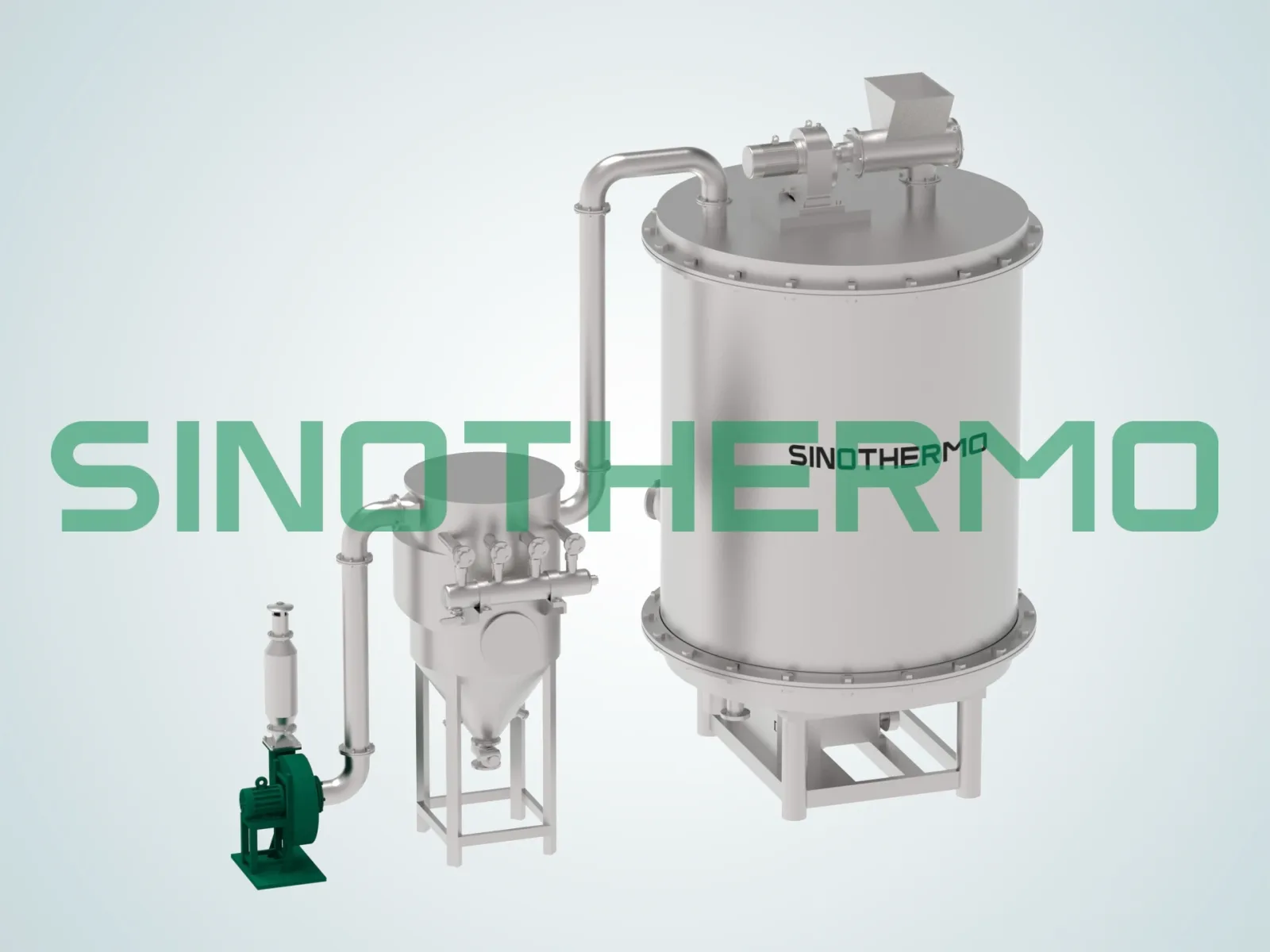
The CD dryer uses indirectly heated hollow discs that rotate through the slurry. A thin layer forms on both faces of each disc and evaporates quickly. The product page lists an overall heat transfer coefficient of 2,300 W/m²K and thermal efficiency of 80 to 85 percent. Heat transfer area runs from 1 to 12 m² on the 900 mm disc models and 12 to 32 m² on the 1,300 mm models. Output is flake or powder depending on the application.
It fits continuous operation on free-flowing liquids and pastes, including china clay, resins and chemical slurries, and it takes much less floor space than a drum dryer with the same heating area. It does not fit very sticky pastes that will not form a thin layer.
Vacuum drum scraper dryer: thick, viscous pastes as flakes
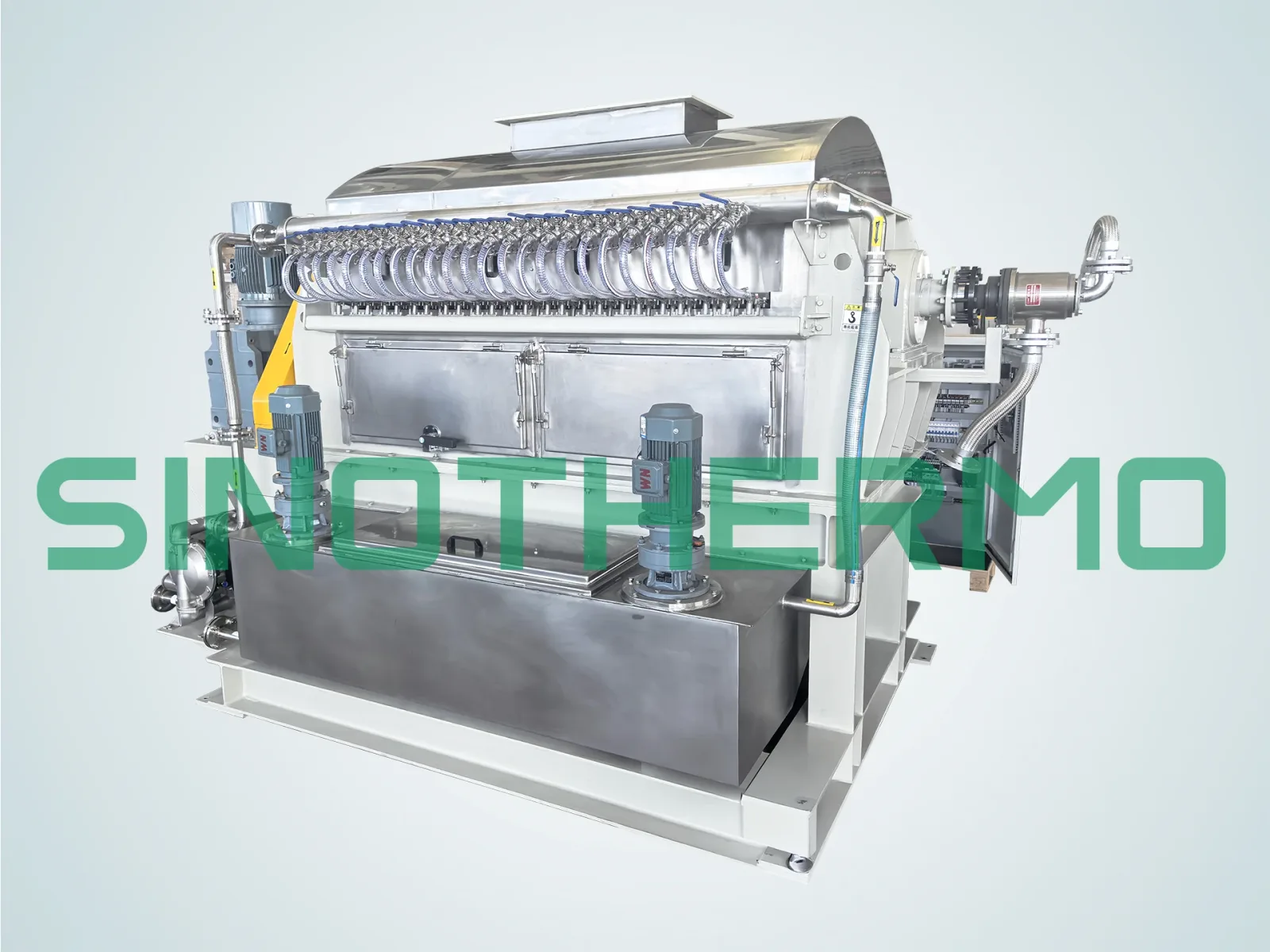
The vacuum drum scraper dryer coats a heated drum with a thin film and scrapes the dried film off as flakes. It is continuous and handles pasty, viscous and thick materials that are difficult in tray, fluid bed or spray equipment, reaching 5 to 8 percent moisture in the flakes. It fits thick pastes where a flake is an acceptable product form. See vacuum drum scraper dryer for the principle.
Vacuum paddle dryer: sticky slurries and pastes needing powder
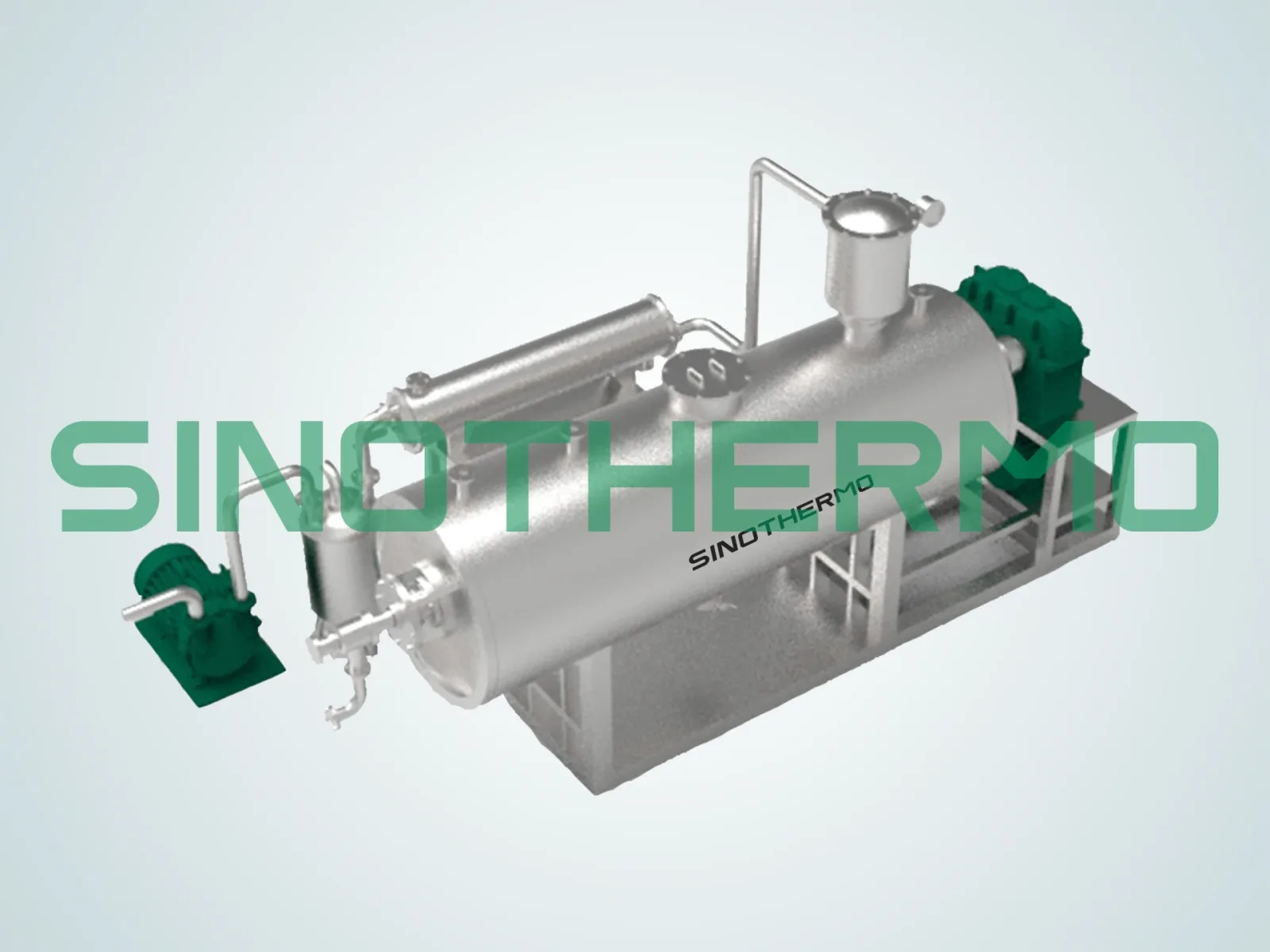
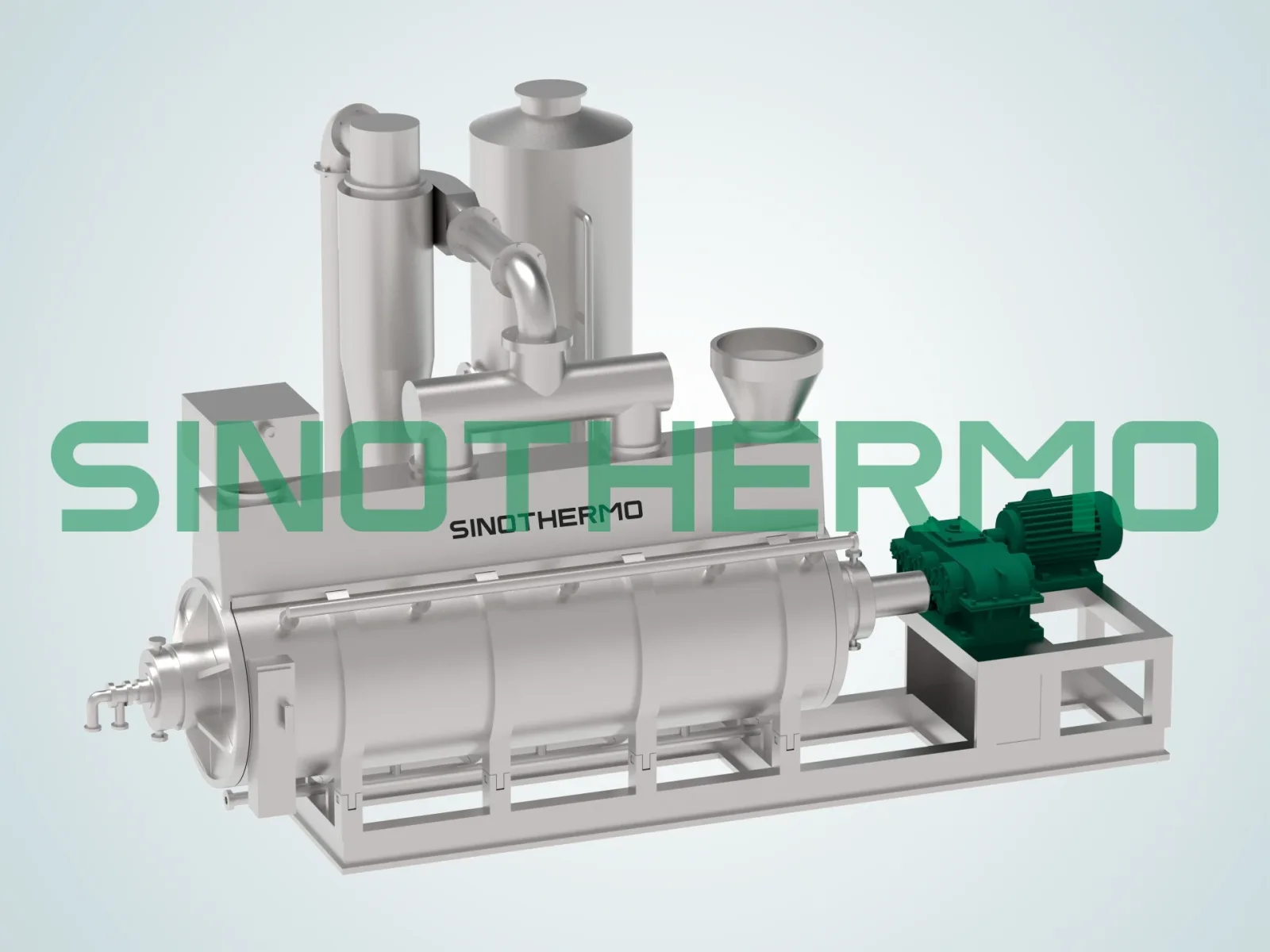
The vacuum paddle dryer uses wedge-shaped hollow paddles that agitate and heat the batch under vacuum. The paddles are self-wiping, which limits build-up. Heat source is 50 to 200 °C and final moisture is 3 to 10 percent. It fits sticky, crusty or solvent-wet slurries made in batches where the end product should be a powder.
Vacuum rake dryer: simple agitated batch drying
The vacuum rake dryer uses a slow rake to turn material against a heated jacket. It is the simplest design and fits slurries that are not too sticky. Working volumes run from 300 to 6,000 L.
Vacuum horizontal disc dryer: large heating area in a compact vessel
The vacuum horizontal disc dryer adds hollow discs on a heated shaft for a large heating surface per litre of vessel. It fits slurries with a large evaporation load. More detail is in our article on the horizontal disc dryer.
Spray dryer: slurries that can be atomised
If the slurry is pumpable and the product should be a fine, free-flowing powder, a spray dryer may be the better route. The slurry is atomised into droplets and dried in seconds. It needs a pumpable feed and enough product value to justify the air handling. For pastes too thick to atomise, use one of the conduction dryers above.
Slurry dryer selection matrix
| Slurry type | Typical behaviour | First choices | Product form |
|---|---|---|---|
| Thin, free-flowing chemical slurry | Pumpable, low viscosity | CD dryer, spray dryer | Flake or powder |
| Clay or mineral slurry | Pumpable, abrasive | CD dryer | Flake or powder |
| Thick pigment paste | Sticky, hard to pump | Vacuum paddle, disc, drum scraper | Powder or flake |
| Resin or polymer slurry | Heat-sensitive, may cure | Vacuum paddle, rake | Powder |
| Plant or herbal extract slurry | Heat- and aroma-sensitive | Vacuum paddle, rake, spray dryer | Powder |
| Solvent-wet slurry | Flammable vapours | Vacuum paddle, rake, disc with condenser | Powder, with solvent recovery |
Treat the table as a starting shortlist. A material's real behaviour, especially its sticky phase, is found only by testing.
How a Slurry Behaves as It Dries
Understanding the drying stages explains why the choice of machine matters so much.
- 1.Free-flowing stage. At high moisture the slurry flows and wets heated surfaces well. Heat transfer is excellent and evaporation is fast. Almost any slurry dryer works here.
- 2.Sticky or plastic stage. As moisture falls, many slurries become thick, tacky and cohesive. They cling to walls, shafts and each other. This is where wrong machine choices fail, because material builds up and heat transfer collapses.
- 3.Crumbly stage. Further drying breaks the mass into lumps and then into powder. The agitator now has to break up agglomerates rather than smear them.
- 4.Dry stage. The last moisture leaves slowly. The product is free-flowing and heat transfer is poorer, so the final percent takes a disproportionate share of the cycle.
Film dryers such as the CD dryer and drum scraper dryer avoid the sticky stage by drying a very thin layer in one pass. Agitated vacuum dryers deal with it by wiping surfaces and mixing the batch through the sticky stage. Spray dryers avoid it by drying droplets so quickly that the particle never sits on a surface. Each approach suits a different slurry, which is why the sticky stage is the first thing to study in a test.
Slurry Dryer Energy and Operating Cost: What Actually Drives It
Buyers often ask which slurry dryer is cheapest to run. The honest answer is that it depends on four things.
- Water to evaporate. Every kilogram of water needs roughly the same latent heat, so a drier feed saves energy in any machine. A mechanical dewatering step ahead of the dryer, such as a filter press or centrifuge, is usually the cheapest energy saving available.
- Heat transfer method. Conduction dryers send heat directly into the product with little exhaust loss. The CD dryer product page lists thermal efficiency of 80 to 85 percent. Hot-air dryers lose heat in the exhaust stream.
- Vacuum system. Vacuum dryers add pump power but let you dry at lower temperature and recover solvent.
- Labour and cleaning. Batch machines need loading and cleaning between lots. Continuous machines need steady feed and attention.
For a fair comparison, ask each supplier to quote on the same basis: the same feed, the same evaporation load and the same final moisture, with heating medium consumption, electrical power and vacuum system included.
A worked example
The numbers are illustrative, not customer data.
A chemical producer has 1,000 kg of pigment slurry per batch at 65 percent moisture. The product darkens above about 90 °C and must leave as a powder.
- Dry solids: 1,000 x 0.35 = 350 kg
- Water to evaporate to 3 percent moisture: 1,000 - (350 / 0.97) = about 639 kg per batch
Because the product is heat-sensitive and must leave as powder, the shortlist is vacuum paddle, rake or disc. Vacuum drops the water boiling point enough to dry below 90 °C product temperature, and the evaporation load of about 640 kg per batch favours a machine with a large heating surface. The next step is a test on a paddle and a disc dryer to compare drying time, crusting and powder quality.
Common Mistakes to Avoid
- 1.Buying by price without knowing the sticky stage. Many slurries pass through a stage that sticks to every surface. A machine that cannot handle it will stall production.
- 2.Treating waste sludge and process slurry as the same problem. The first is about disposal cost, the second about product quality.
- 3.Ignoring solvent. Flammable solvent changes the pump, condenser and electrical design.
- 4.Choosing a dryer that produces the wrong product form. A drum scraper makes flakes, not powder.
- 5.Skipping the test. Two slurries with the same solids content can behave very differently.
- 6.Underestimating the evaporation load. The water to remove is the main driver of dryer size.
What to send with a quotation request
- Slurry composition and solids content
- Viscosity, or a description of how it flows
- Target moisture and product form (powder, flake, granule)
- Maximum allowable product temperature
- Solvent type, if any
- Batch size or hourly throughput
- Heat source available
Test Before You Buy
SINOTHERMO runs paid pilot testing so you can see how your slurry behaves on different dryers before committing. Request a pilot test and the data is yours to use with any supplier. SINOTHERMO builds and sells equipment and does not offer contract drying. For the wider choice between all vacuum and conduction machines, see vacuum drying equipment: how to choose by material.
Frequently Asked Questions
What is the best slurry dryer?
It depends on the slurry. Free-flowing slurries suit a CD dryer. Thick, sticky or solvent-wet slurries suit vacuum paddle, rake or disc dryers. Slurries that can be atomised suit a spray dryer.
Can a slurry be spray dried?
Yes, if it is pumpable and can be atomised. A spray dryer gives a fine, free-flowing powder. Very thick pastes cannot be atomised and need a conduction dryer.
What is the difference between slurry drying and sludge drying?
Slurry drying in process industries is about recovering a dry product. Sludge drying is mostly about reducing volume for disposal. The equipment overlaps, but selection criteria differ.
Can I dry a flammable-solvent slurry?
Yes, in a sealed vacuum dryer with a condenser, which also allows solvent recovery.
Does a drum dryer work for slurries?
Yes, for pasty and viscous slurries. SINOTHERMO's vacuum drum scraper dryer produces flakes at 5 to 8 percent moisture.
How do I know which dryer will not stick?
You find out by testing. The sticky phase is a property of the material, not of the supplier's catalogue.
Does SINOTHERMO dry slurry as a contract service?
No. SINOTHERMO builds and sells drying equipment and offers paid pilot testing.

Mark Gu
Passionate about enhancing customer experiences and streamlining operations, Mark focuses on building strong relationships, fostering innovation, and leading teams to achieve exceptional service and efficiency.
Email: mark.gu@sinothermo.com
Phone: +86 18021972660