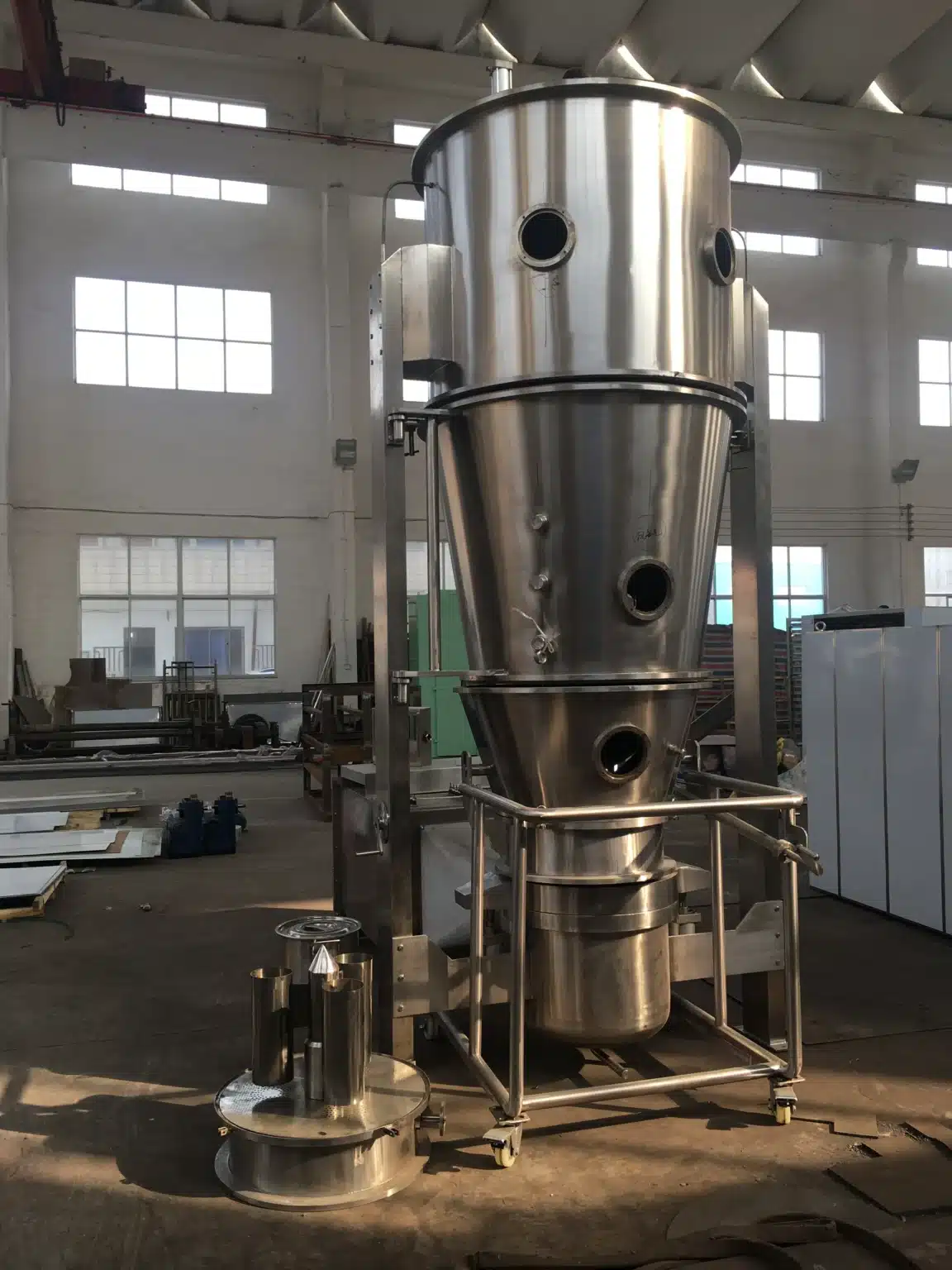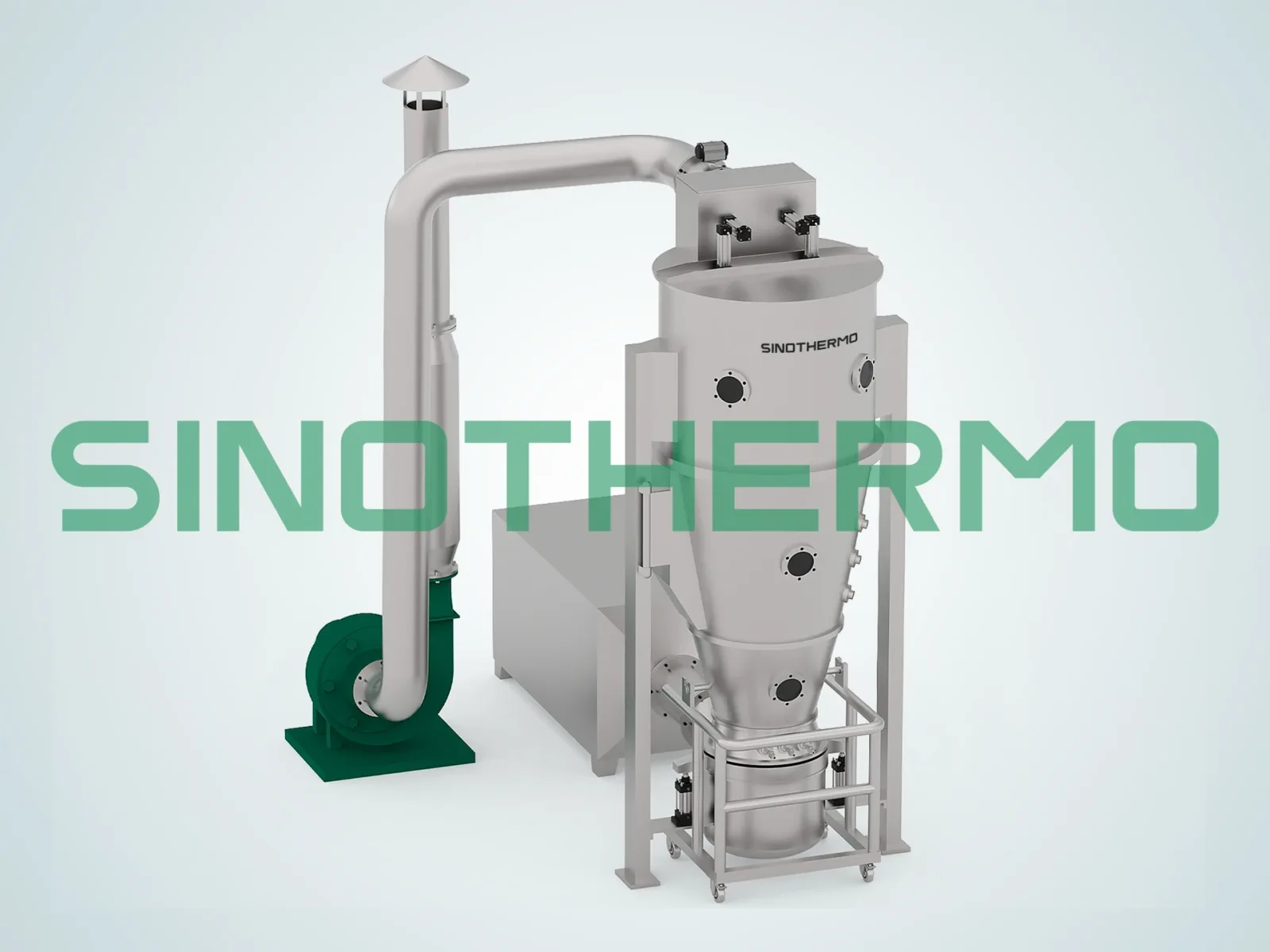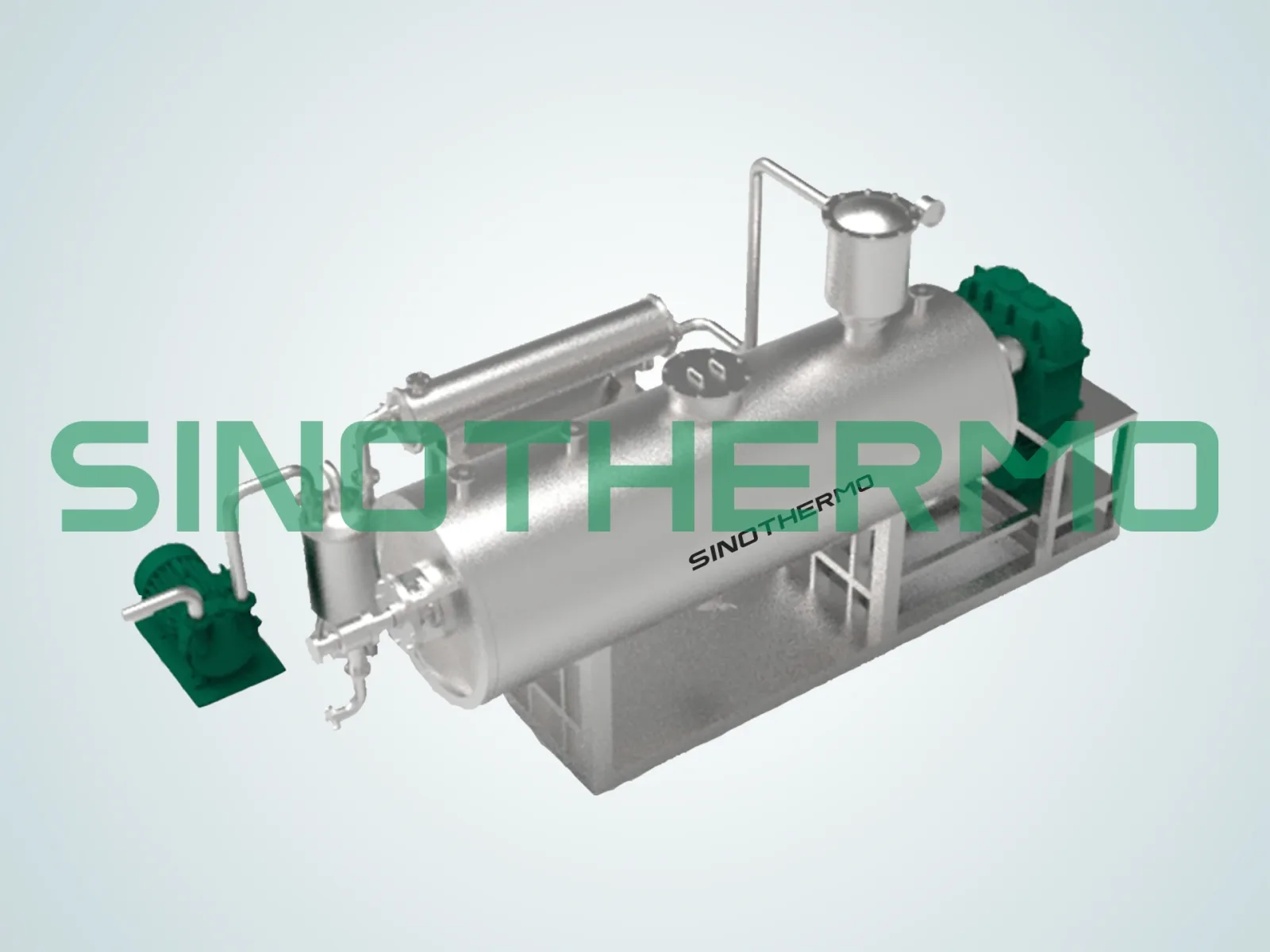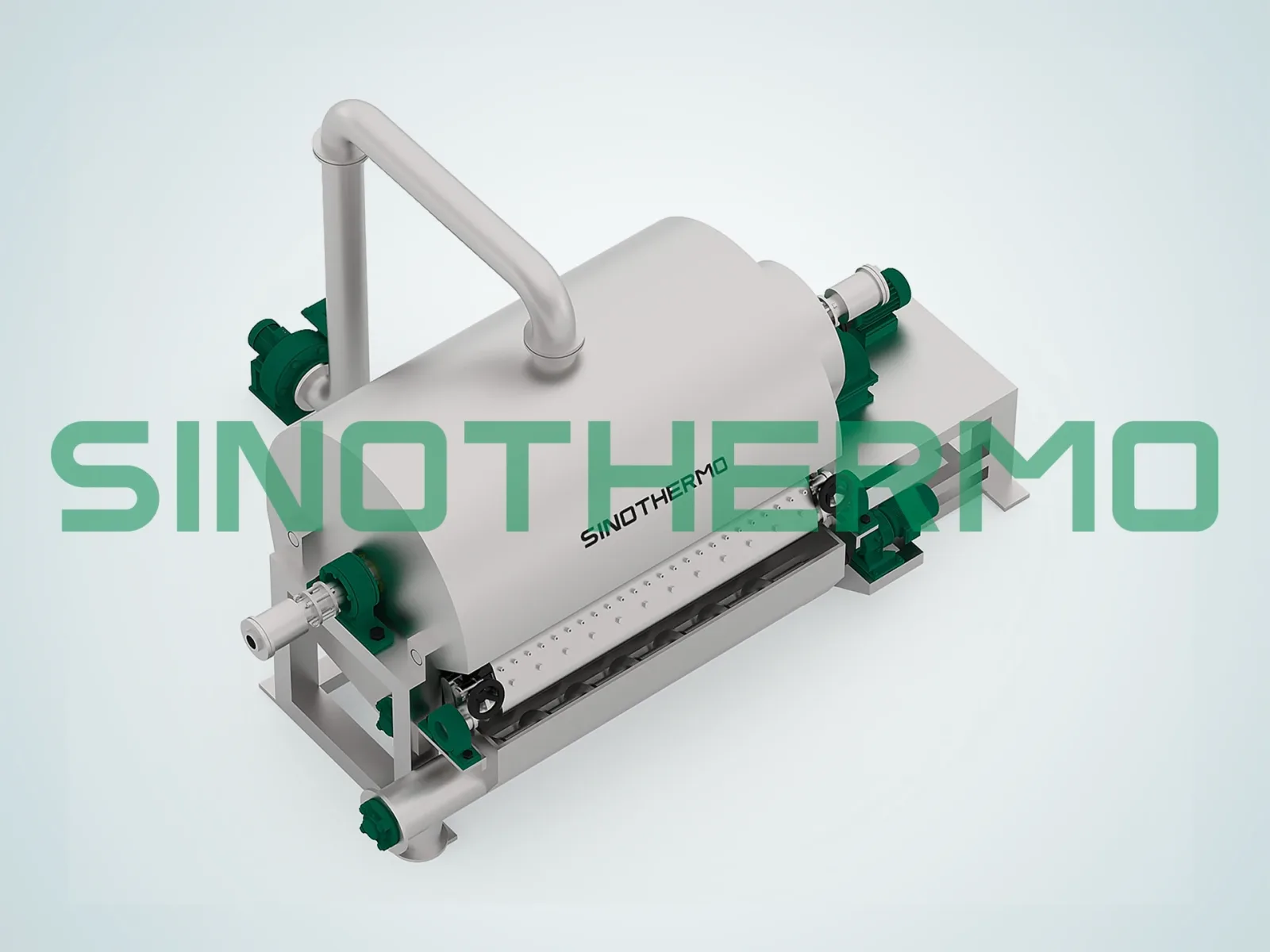
A vacuum drum scraper dryer dries a thin film of liquid on the surface of a heated rotating drum inside a vacuum chamber, then scrapes it off as flakes with a doctor blade. The film dries in a single revolution — seconds to a minute or two — making it the only continuous machine in the vacuum drying family, and the choice when a pumpable feed must become a dry solid at low temperature without batch cycles.
Its value is that it replaces what would otherwise be a multi-step train: pre-breaker, feeder, dryer, and mill. One machine takes a stiff cake in and delivers dry powder out.
Quick context: the gap this machine fills
Most of the vacuum drying family exists to handle material that's already a solid — a cake, a paste, a batch of crystals. The drum scraper dryer sits at the opposite end: it's built for feeds that are still liquid, but too viscous, too heat-sensitive, or too oxidation-prone to spray dry. That combination is more common than it first appears — waste liquors, mother liquors, viscous process streams, and solvent-based solutions all fall into this gap between "pumpable enough to atomise" and "solid enough to handle as a cake."
How it works
- 1.Film application — the drum surface picks up feed by dipping into a trough, or feed is applied by nip rolls or spray. Film thickness, typically a fraction of a millimetre, is set by the applicator.
- 2.Conduction drying — the drum is heated internally by steam, hot water, or thermal oil. Heat passes through the drum wall directly into the thin film. Because the film is thin and in intimate contact with the heated surface, heat transfer is excellent.
- 3.Vacuum operation — the whole assembly sits inside a vacuum chamber, so the liquid boils well below its atmospheric boiling point and the product never sees high temperature.
- 4.Scraping — as the drum completes most of a revolution, a doctor blade removes the dried film as flakes or powder.
- 5.Discharge and vapour handling — flakes fall into a receiver, often through a vacuum lock for truly continuous operation. Vapour goes to a condenser, allowing solvent recovery.
The key variable is residence time, which equals the fraction of a revolution between film application and the blade — typically seconds to a couple of minutes. This extremely short thermal exposure is why heat-sensitive materials survive.
Why residence time in seconds matters
Because dried product leaves within seconds of becoming dry, the material's thermal exposure is minimal despite high inlet air temperatures (often 150–400 °C).
This surprises people: inlet air can be very hot, yet the product stays cool. While free moisture is evaporating, the particle sits near the gas wet-bulb temperature — evaporative cooling holds it there. The particle only approaches gas temperature once it's dry, and by then it's already leaving. So many heat-sensitive materials dry successfully in a spin flash dryer, which is exactly the same principle that lets spray dryers handle heat-sensitive feeds.
The corollary: outlet temperature is the control variable that matters, not inlet. Inlet temperature sets capacity; outlet temperature determines product moisture and thermal exposure.
Compared with the alternatives
| Vacuum drum scraper | Spray dryer | Atmospheric drum dryer | Batch vacuum dryer | |
|---|---|---|---|---|
| Operation | Continuous | Continuous | Continuous | Batch |
| Feed | Slurry, viscous liquid | Must be atomisable | Slurry, viscous | Cake, powder, paste |
| Product form | Flakes | Powder, controllable size | Flakes | Preserves particles |
| Product temperature | Low (vacuum) | Low (evaporative cooling) | High | Low |
| Residence time | Seconds–minutes | Seconds | Seconds–minutes | Hours |
| Solvent recovery | Yes | Needs closed loop | No | Yes |
| Oxygen exclusion | Yes | Needs inert loop | No | Yes |
| Particle size control | No (mill after) | Yes | No | N/A |
Against a spray dryer: choose the drum scraper when the feed is too viscous to atomise, when a flake is acceptable or preferred, or when oxygen exclusion and solvent recovery are needed without the cost of a closed-loop inert-gas spray dryer. Choose the spray dryer when particle size and morphology are specified — see our pharmaceutical spray drying guide for that side of the comparison.
Against an atmospheric drum dryer: the same mechanics, but vacuum lowers product temperature substantially and enables solvent recovery and oxygen exclusion. If the material tolerates atmospheric drum drying, that's cheaper; vacuum is for when it doesn't. Our drum dryer guide covers the atmospheric version in full.
Related: twin flat-plate ("CD") dryers
A closely related indirect-conduction concept replaces the cylindrical drum with two heated flat plates — sometimes called a CD or compact-disc type dryer, after the shape of the discs. Liquid dries on both flat faces instead of a single curved surface, which increases heat-transfer area for a given footprint and makes these units notably compact.
The operating principle is the same family as drum scraper drying: a thin film, conduction from a heated metal surface, mechanical removal of the dried product, and continuous operation at low temperature under vacuum. The applications overlap strongly — concentrating and drying waste liquids, recovering valuable solids from process streams, and reducing disposal volumes.
Note on terminology: "CD dryer" originated as a specific manufacturer's product name and remains associated with it. We describe the flat-plate conduction principle generically; SINOTHERMO's equivalent equipment is offered under our own designation. See our CD dryer product page.
Applications
Chemical — speciality chemicals, catalysts, inorganic salts; concentrating and drying waste liquor to cut disposal cost; recovering solids from mother liquor.
Food — potato and cereal flakes, yeast extracts, flavour concentrates, instant products where a dust-free flake dissolves readily.
Pharmaceutical — heat-sensitive intermediates and excipients from viscous solution; products where short thermal exposure matters more than particle-size control.
Waste and recovery — concentrating industrial effluent, recovering saleable solids, cutting liquid-waste disposal volume. Often justified on disposal-cost savings alone.
Battery and advanced materials — electrolyte and precursor solutions requiring oxygen-free, low-temperature drying.
What to specify
- Drum diameter, width and effective heat-transfer area
- Evaporation rate guaranteed on your feed, at your solids content
- Film thickness control method — dip, nip roll, or spray application
- Drum speed range — this sets residence time; confirm it covers your material
- Heating medium and temperature range; thermal oil if higher surface temperature is needed
- Vacuum level and pump/condenser sizing at peak vapour load
- Doctor blade material, adjustment mechanism and expected service life
- Discharge arrangement — vacuum lock for continuous operation, or batch receiver
- Solvent recovery efficiency if applicable
- Explosion protection for solvent service
- Materials and surface finish; drum surface treatment affects film release
- Cleaning access to drum, trough and blade
- Trial on your feed — film release behaviour is the make-or-break property and cannot be predicted
The specification error to avoid
Quoting on evaporation rate without agreeing the feed consistency. A spin flash dryer's throughput is limited by two different things: the air's capacity to evaporate water, and the rotor's capacity to disintegrate the cake — and in a drum scraper's case, the analogous limits are evaporation capacity versus film-forming behaviour at the applicator. Which one binds depends on how the feed behaves.
Two suppliers can quote the same evaporation rate while assuming quite different feed consistencies — and the one whose assumption is wrong will underperform badly in practice. Always state your feed's solids content and viscosity, and ask which constraint governs at that condition.
Common mistakes to avoid
- Assuming any pumpable liquid will form a usable film. Film release behaviour — whether the dried layer lets go of the drum surface cleanly — is empirical and specific to your material's chemistry and drum surface treatment.
- Sizing on evaporation rate alone, without agreeing feed consistency. The number is meaningless without the solids content and viscosity it assumes.
- Treating the doctor blade as a fit-and-forget component. Blade wear and adjustment directly affect both product quality and drum life; it belongs on the maintenance schedule from day one.
- Expecting particle size control from a machine designed to produce flakes. If particle engineering is the point, this is the wrong technology regardless of how well it dries.
- Underestimating the value of the CD dryer variant for tight footprints. Where floor space is genuinely constrained, the twin flat-plate design's higher heat-transfer area per footprint is worth evaluating before defaulting to a drum.
Where SINOTHERMO fits
We build vacuum drum scraper dryers and related flat-plate conduction dryers, as well as the spray dryers and batch vacuum dryers they compete with — so the comparison can be made on merit for your feed.
One property decides whether this technology works for you: whether the dried film releases cleanly from the heated surface. That is entirely empirical. Our pilot lab runs your feed and reports film release behaviour, achievable moisture, evaporation rate per square metre, flake quality, and the drum speed and temperature window that work. Pilot testing is a paid pre-sales engineering service and you keep the full report — including a straight answer if a spray dryer or batch vacuum dryer would serve you better.
Frequently asked questions
What is a vacuum drum scraper dryer used for?
Continuously drying pumpable slurries, viscous liquids, and solutions into dry flakes at low temperature — speciality chemicals, food flakes and extracts, heat-sensitive pharmaceutical intermediates, and concentrating waste liquids to reduce disposal costs. It suits feeds too viscous to spray dry.
How is a drum scraper dryer different from a spray dryer?
A drum scraper dryer applies a thin film to a heated drum and scrapes off dry flakes; a spray dryer atomises the feed into hot gas and produces powder with controllable particle size. The drum dryer handles viscous feeds that can't be atomised and recovers solvent readily, but you get flakes rather than engineered particles.
What is a CD dryer?
"CD dryer" (compact-disc dryer) refers to a twin flat-plate conduction dryer, where liquid dries on both flat faces of heated plates rather than on a curved drum surface. It works on the same thin-film conduction principle as drum scraper drying and is used for similar duties, particularly concentrating waste liquids in a compact footprint. The term originated as a specific manufacturer's product name.
How thin is the film in a drum dryer?
Typically a fraction of a millimetre. Thin film is what gives the high heat-transfer rate and the very short residence time — usually seconds to a couple of minutes, set by drum speed and the arc between film application and the doctor blade.
Can a vacuum drum dryer produce powder instead of flakes?
The dryer itself produces flakes; if powder is required, flakes are milled afterwards, which is straightforward. If particle size and morphology are specified as part of the product, a spray dryer is the better choice because it forms the particle directly.
Film release behaviour decides whether this technology works for your feed — and it can only be measured.
✉️ mark.gu@sinothermo.com · 📱 WhatsApp: +86 180 2197 2660 · 🌐 www.sinothermo.com · 💬 Request a pilot test
SINOTHERMO — Process Engineering Infrastructure.

Mark Gu
Passionate about enhancing customer experiences and streamlining operations, Mark focuses on building strong relationships, fostering innovation, and leading teams to achieve exceptional service and efficiency.
Email: mark.gu@sinothermo.com
Phone: +86 18021972660