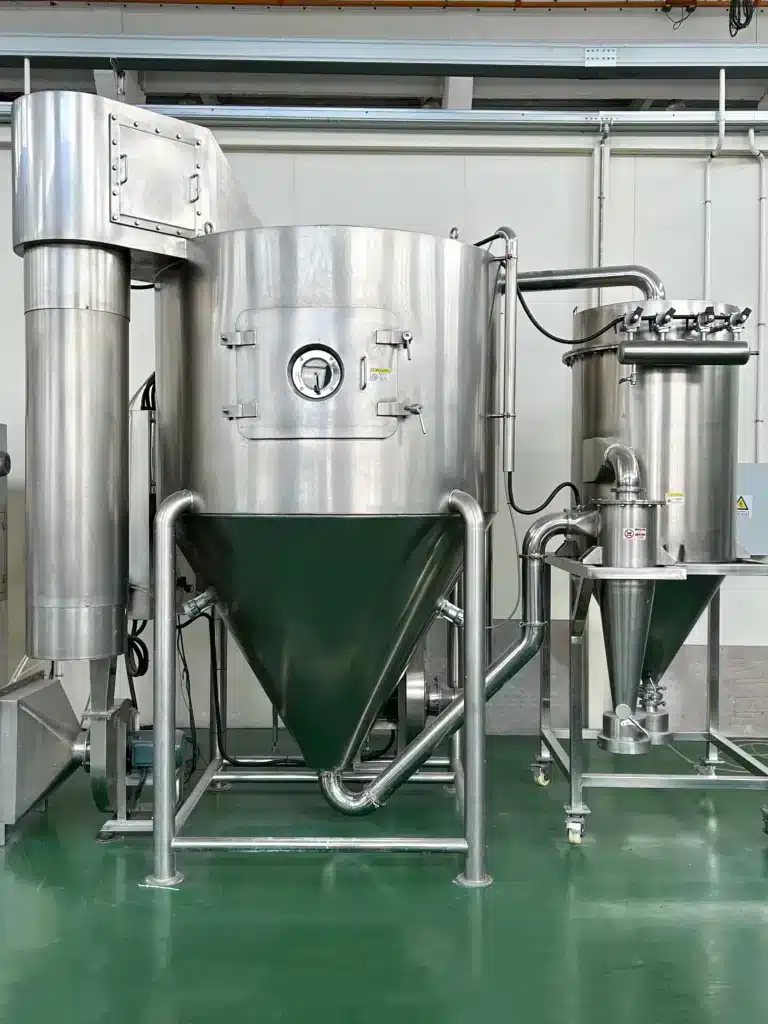
A used spray dryer can be a sound purchase — but only if you verify it can hit your powder spec, because it was engineered around someone else's material and process window. Unlike a pump or a motor, a spray dryer is a process machine: its chamber geometry, atomizer, and airflow were chosen for a specific product. This guide covers how to assess one properly.
The fundamental risk with used spray dryers
A spray dryer's performance is not a fixed nameplate number. Its actual evaporation capacity depends on inlet/outlet temperature, and its ability to produce your particle size depends on atomizer type and chamber geometry suited to your feed.
That means a dryer rated "500 kg/h evaporation" for a low-viscosity dairy feed at high inlet temperature may deliver substantially less on a heat-sensitive product that requires a lower inlet temperature — and may not produce your target particle size at all if the atomizer type is wrong for what you are making.
This is different from buying most other used capital equipment. A used pump either moves the flow rate it is rated for or it does not, largely independent of what it pumped before. A spray dryer's rated capacity is a function of the specific feed it was tuned for — the same chamber can be a strong performer on one material and a poor one on the next, with no visible difference in the machine itself. A visual inspection alone cannot tell you which situation you are in.
Before anything else, confirm: what was it drying, at what temperatures, and with what atomizer? Everything below builds on that answer.
Inspection checklist
The order below is deliberate. Process fit comes first because it is a pass/fail gate — if the machine cannot be made to hit your powder spec, nothing else on this list matters, and there is no point spending inspection budget on a chamber weld survey for a dryer you should not buy at all. Physical condition, documentation and commercial terms only become relevant once process fit has cleared.
Process fit (most important)
- What material was it used for, and at what inlet/outlet temperatures?
- What atomizer type is fitted, and is it right for your target particle size? Our atomizer comparison table covers centrifugal, pressure-nozzle and two-fluid types if you need to check compatibility.
- What evaporation capacity does it achieve at your required temperatures, not the nameplate rating?
- Open or closed cycle — does that match your feed (aqueous vs solvent)?
- Is chamber geometry appropriate for your material's stickiness and heat sensitivity?
Physical condition
- Chamber walls — corrosion, pitting, deposits, previous repairs
- Atomizer — bearing condition, disc or nozzle wear, balance; are spares still available?
- Cyclone and ductwork — erosion, especially if the prior product was abrasive
- Bag filter — housing condition, and whether the media is replaceable to current standards
- Air heater — condition, efficiency, and compatibility with your site utilities
- Instrumentation and controls — obsolete PLCs are a real risk; can the system still be supported and sourced?
Compliance and documentation
- Material compatibility with your product — critical for food/pharma, where prior use matters
- Contact-part material grades documented?
- Original certifications (CE, GMP) — and are they still valid or transferable to a new site?
- Original process data and manuals available?
- Will it meet current safety standards, or does it need upgrading?
Commercial
- Refurbishment cost estimate
- Dismantling, transport, and re-erection cost
- Re-validation cost — significant in pharma and food
- Spare parts availability for the atomizer and controls
- Any warranty, and from whom — the reseller, or the original manufacturer?

The hidden costs that erase the saving
Buyers frequently underestimate six items, and any one of them alone can close most of the gap between a used machine's sticker price and a new one:
- 1.Dismantling and transport. Spray dryers are large; removal and shipping are a substantial line item, not an afterthought.
- 2.Refurbishment. Chamber repair, atomizer rebuild, new filter media, control system replacement — costs that only become clear after inspection, not before.
- 3.Re-validation and documentation. In regulated industries this can approach a significant fraction of new-equipment cost, and it is easy to underestimate until you are mid-process.
- 4.Utility mismatch. A machine built for steam heating at another site may need conversion to match what your facility actually has available.
- 5.Performance shortfall. If it cannot hit your spec after everything above is accounted for, the entire purchase is a loss, refurbishment costs included.
- 6.No process guarantee. With new equipment from a manufacturer, performance can be contractually guaranteed. Used equipment is typically sold as-is, with no one accountable if it underperforms on your material.
When used genuinely makes sense
- Your material is very similar to what the dryer previously processed, at similar temperatures.
- You have in-house process engineering to verify fit and manage refurbishment yourself.
- The application is non-regulated — no GMP or validation burden to carry forward.
- It is for R&D or intermittent use rather than critical continuous production.
- You have had the actual capacity verified at your operating conditions, not just read the nameplate rating.
When to buy new
- Your material is heat-sensitive, solvent-based, or otherwise demanding on the process window.
- You need a guaranteed powder spec and contractual performance behind it.
- You are in a regulated industry where documentation and validation matter and cannot be reconstructed after the fact.
- It is for continuous production, where downtime from an unproven machine is costly.
- The used option would require an atomizer change, cycle conversion, or major refurbishment — at which point the economics usually favour new once every hidden cost above is priced in.
The decisive step either way: test your material
Whether new or used, the question is the same: will this machine produce my powder spec from my feed? A pilot test on your actual material answers it — establishing the required evaporation capacity, atomizer type, and temperature window. With that data you can evaluate a used machine's real fit properly, or specify a new one accurately, without guessing from a nameplate or a supplier's general assurance.
SINOTHERMO's pilot testing is a paid engineering service, and the resulting parameter report is yours to use with any supplier — the used machine you are inspecting, a new one from us, or a new one from anyone else.
Evaluating a used machine, or deciding between new and used? Send us your material and target spec. A pilot test gives you the data to judge either option properly.
✉️ mark.gu@sinothermo.com · 📱 WhatsApp: +86 180 2197 2660 · 🌐 www.sinothermo.com · 💬 Request a pilot test
SINOTHERMO — Process Engineering Infrastructure.
Frequently asked questions
Is buying a used spray dryer a good idea?
It can be, if your material closely matches what the dryer previously processed and you have the engineering capability to verify fit. The main risk is that a spray dryer is engineered around a specific material and process window — it may not achieve your powder spec even if it ran well for its previous owner.
What should I check when buying a used spray dryer?
First, process fit: what material it dried, at what temperatures, which atomizer type, and its actual capacity at your required conditions, not the nameplate rating. Then physical condition — chamber, atomizer, cyclone, filter, heater, controls — compliance documentation, and total refurbishment plus transport cost before you compare it against a new-equipment price.
What hidden costs come with a used spray dryer?
Dismantling and transport, refurbishment, re-validation in regulated industries, utility conversion, and the risk of performance shortfall. Together these frequently erase the apparent saving over new equipment, so price the whole picture before deciding, not just the sale price.
How do I know if a used spray dryer will work for my product?
Test your material to establish the required evaporation capacity, atomizer type, and temperature window, then compare that against the used machine's verified performance at those specific conditions — not its original nameplate rating, which reflects someone else's material and operating point.
When does it make more sense to buy a new spray dryer instead of used?
When your material is heat-sensitive, solvent-based, or otherwise demanding on the process window; when you need a contractually guaranteed powder spec; when you are in a regulated industry with documentation requirements; when the equipment will run continuous production where downtime is costly; or when the used option needs an atomizer change or major refurbishment that erases its price advantage once priced honestly.

Mark Gu
Passionate about enhancing customer experiences and streamlining operations, Mark focuses on building strong relationships, fostering innovation, and leading teams to achieve exceptional service and efficiency.
Email: mark.gu@sinothermo.com
Phone: +86 18021972660