Most disputes between spray dryer buyers and suppliers come down to auxiliary equipment scope — what was assumed included versus what was actually quoted. This guide walks the components of a spray drying system so you can specify scope precisely and compare quotes that are genuinely equivalent.
This article goes part-by-part. For system-level capacity and utility planning, see industrial spray dryer; for evaluating who builds it, see spray dryer manufacturers.
Core components
Atomizer — the component that defines your powder
| Type | Mechanism | Powder result | Considerations |
|---|---|---|---|
| Centrifugal (rotary disc) | High-speed spinning disc | Fine, uniform particles | Tolerant of feed variation; higher capital cost; disc is a wear item |
| Pressure nozzle | High-pressure feed through an orifice | Coarser, free-flowing granules | Lower cost; nozzle orifice wears and must be monitored; more sensitive to feed solids content |
| Two-fluid nozzle | Compressed air assists atomization | Very fine particles, small scale | Common at lab/pilot scale; high compressed-air consumption |
The atomizer sets particle size, so this decision drives product quality more than any other single component. We cover the mechanics and trade-offs of each type in depth in our spray dryer atomization guide — this table stays at the specification level: which type, and why, not how each one works internally.
Air heater
Steam, electric, gas (direct or indirect), or thermal oil. Selection affects both capital and operating cost — see industrial spray dryer for the trade-offs at scale. Confirm the heater's rated output matches the evaporation capacity you are buying, not just the chamber's physical size.
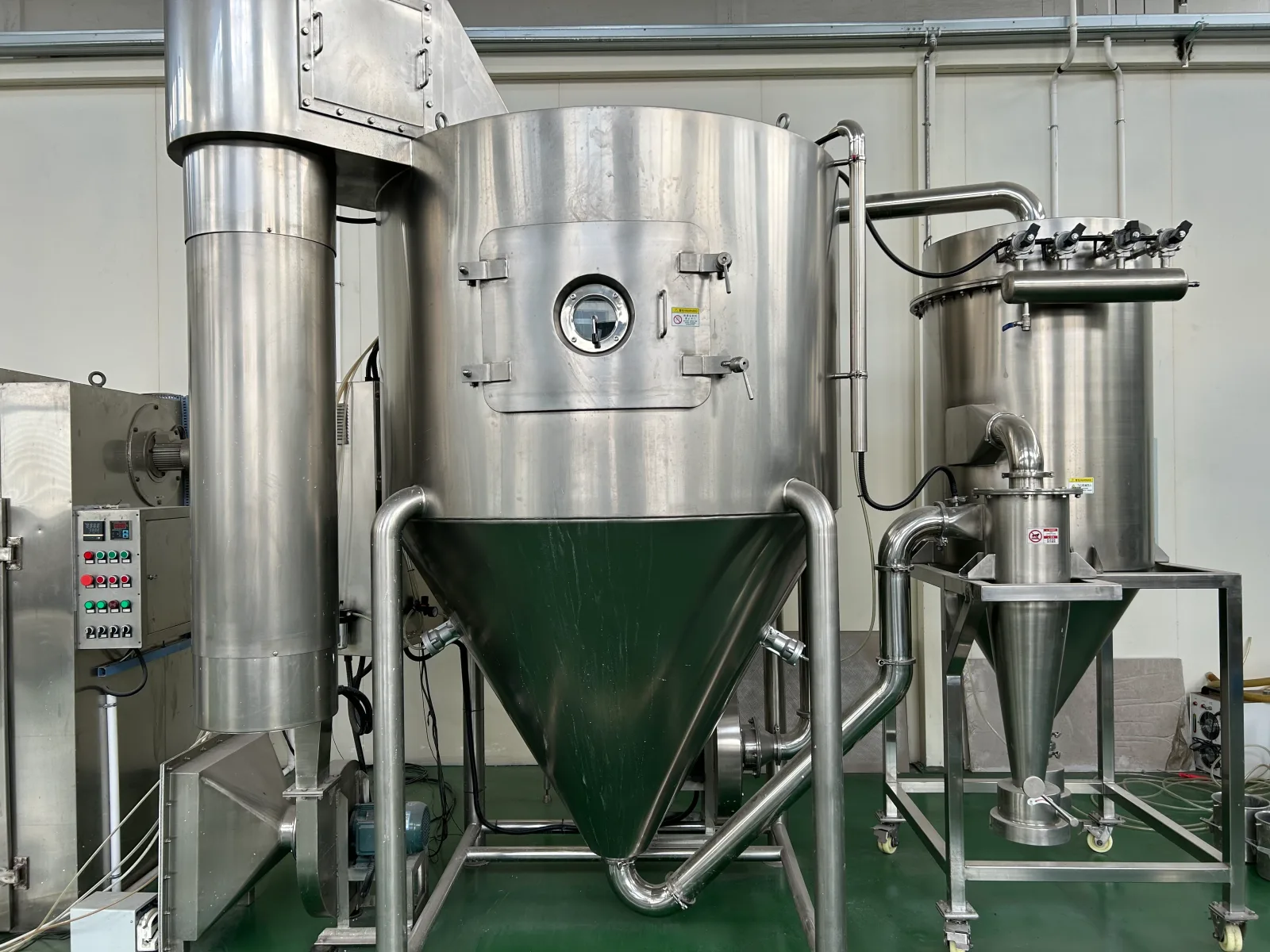
Drying chamber
Chamber geometry (height-to-diameter ratio, cone angle) and airflow pattern (co-current, counter-current, mixed) determine how gently the product is treated and how prone it is to wall deposits. Co-current is standard for heat-sensitive materials, since the hottest air meets the wettest droplets and both cool together as drying proceeds.
Powder separation
- Cyclone — primary separation, standard on virtually all systems
- Bag filter — secondary stage, captures the fines the cyclone misses; determines both product yield and emissions compliance
- Wet scrubber — used where required for emissions control or for solvent-based feeds
Undersized separation is a common cause of yield loss — a filter sized for a lighter dust loading than your material actually produces will blind faster and pass more product to exhaust than a correctly sized one. If yield problems show up after commissioning rather than at first startup, our spray dryer troubleshooting guide covers how to diagnose them.
Auxiliary equipment — the scope items to confirm explicitly
A "spray dryer" quotation and a "spray drying system" quotation can describe two very different scopes at a similar-looking headline price. The gap is almost always in the items below — none of them are optional in the sense of being unnecessary, they are optional in the sense that a supplier can legitimately choose to price them separately, bundle them, or leave them out entirely and let you source them yourself. The problem is not that suppliers do this; it is buyers assuming a line is included when it was never quoted.
These are frequently excluded from a headline quote. Confirm each in writing before you compare prices:
- 1.Feed preparation — mixing/homogenizing tanks, feed pumps, in-line filtration
- 2.Fines recycle system — returns collected fines to the atomization zone for agglomeration; needed where a coarser, more dispersible powder is required
- 3.Integrated fluid bed (two-stage drying) — a second-stage fluid bed under the chamber for gentler final drying and agglomeration
- 4.Powder conveying and packing — pneumatic conveying, big-bag stations, dosing
- 5.CIP (clean-in-place) — essential for food and pharma duty; substantially affects both cost and chamber design
- 6.Explosion protection — venting, suppression, inerting for combustible powders (ATEX/NFPA)
- 7.Solvent recovery / closed-loop N₂ — required for organic-solvent feeds or oxidation-sensitive products
- 8.Control system scope — a basic panel versus full PLC/SCADA with recipe management and data logging for regulatory documentation
- 9.Insulation and cladding — often assumed included, but sometimes quoted as a separate line
- 10.Instrumentation — temperature, humidity, flow and pressure sensors, and their calibration certificates
Open-cycle vs closed-cycle systems
- Open cycle — ambient air is heated, used once, and exhausted. Standard for aqueous feeds.
- Closed cycle (usually N₂) — the drying gas is recirculated, dehumidified, and reused. Required for organic solvents (flammability) and oxidation-sensitive products. Significantly higher cost and complexity, but necessary for solvent-based and many battery/pharma applications.
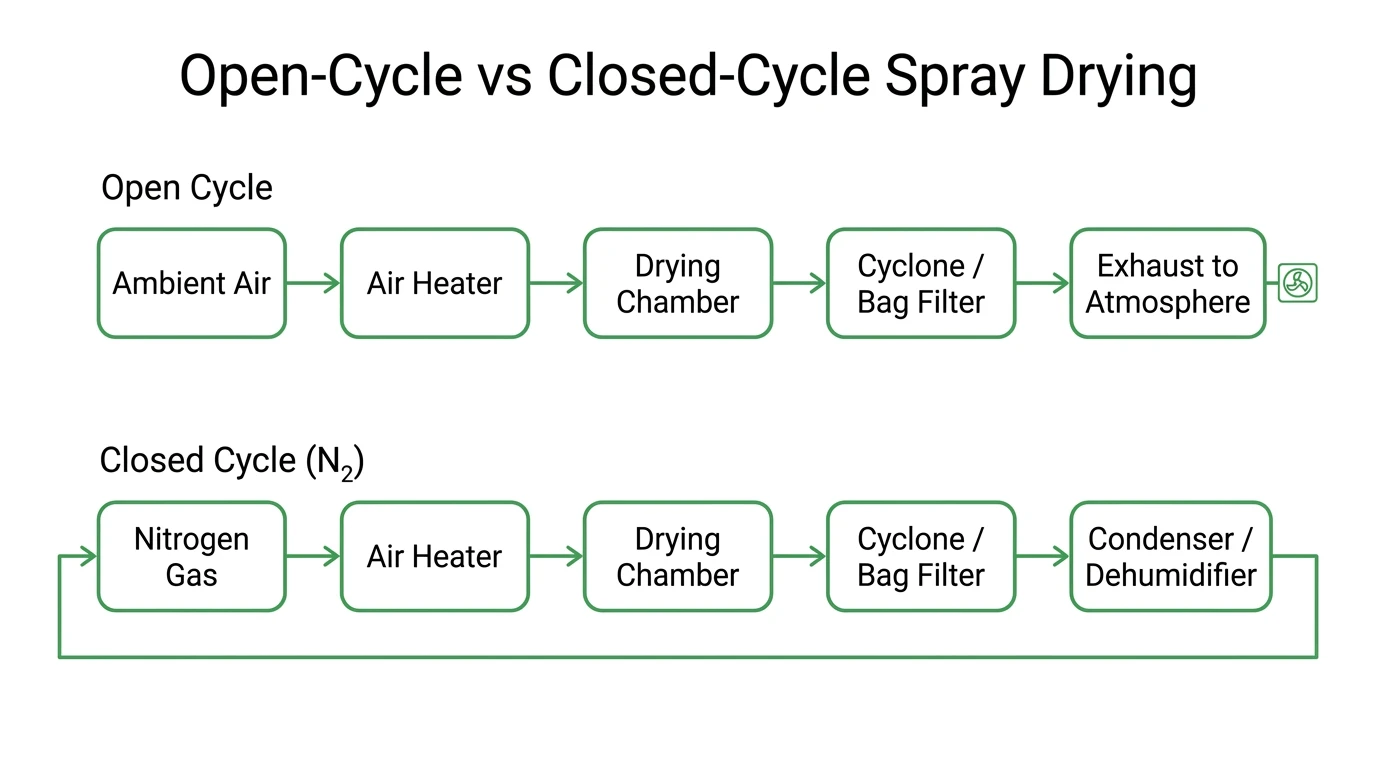
Specifying the wrong cycle type is a fundamental error, not a detail to leave for later — the gas-handling philosophy shapes the chamber, the heater, the instrumentation and the explosion-protection scope all at once. Confirm this before comparing any quotes.
A specification checklist
Before requesting quotes, define:
- Feed: solids %, viscosity, heat sensitivity, aqueous or solvent
- Target powder: particle size, moisture, bulk density, flowability
- Evaporation capacity required (kg water/hour)
- Open or closed cycle
- Atomizer preference (or ask the supplier to recommend with justification)
- Heating source available on site
- Compliance: GMP / CE / ATEX / food-grade
- Auxiliaries required from the list above
- Installation, commissioning, training — in scope or not
Send the same checklist to every supplier on your shortlist, in writing, and ask each to respond line by line rather than with a single bundled price. Two quotations that look close on the bottom line can represent very different scopes once you see which boxes each supplier actually checked — and the gap usually surfaces exactly where this article said it would: in the auxiliaries, not the core machine.
Where SINOTHERMO fits
We would rather you used this checklist against us than took our word for it. SINOTHERMO specifies each of these components and auxiliaries around your material rather than from a fixed configuration, with 20+ years of experience in industrial drying behind the engineering. Our in-house pilot laboratory confirms atomizer choice, cycle type, and separation requirements on your actual feed — a paid engineering service — before any of this scope is frozen into a quotation.
Defining scope before you request quotes? Send us your material and target spec. Our pilot lab confirms the process, and we will specify the full system around it.
✉️ mark.gu@sinothermo.com · 📱 WhatsApp: +86 180 2197 2660 · 🌐 www.sinothermo.com · 💬 Request a pilot test
SINOTHERMO — Process Engineering Infrastructure.
Frequently asked questions
What equipment makes up a spray drying system?
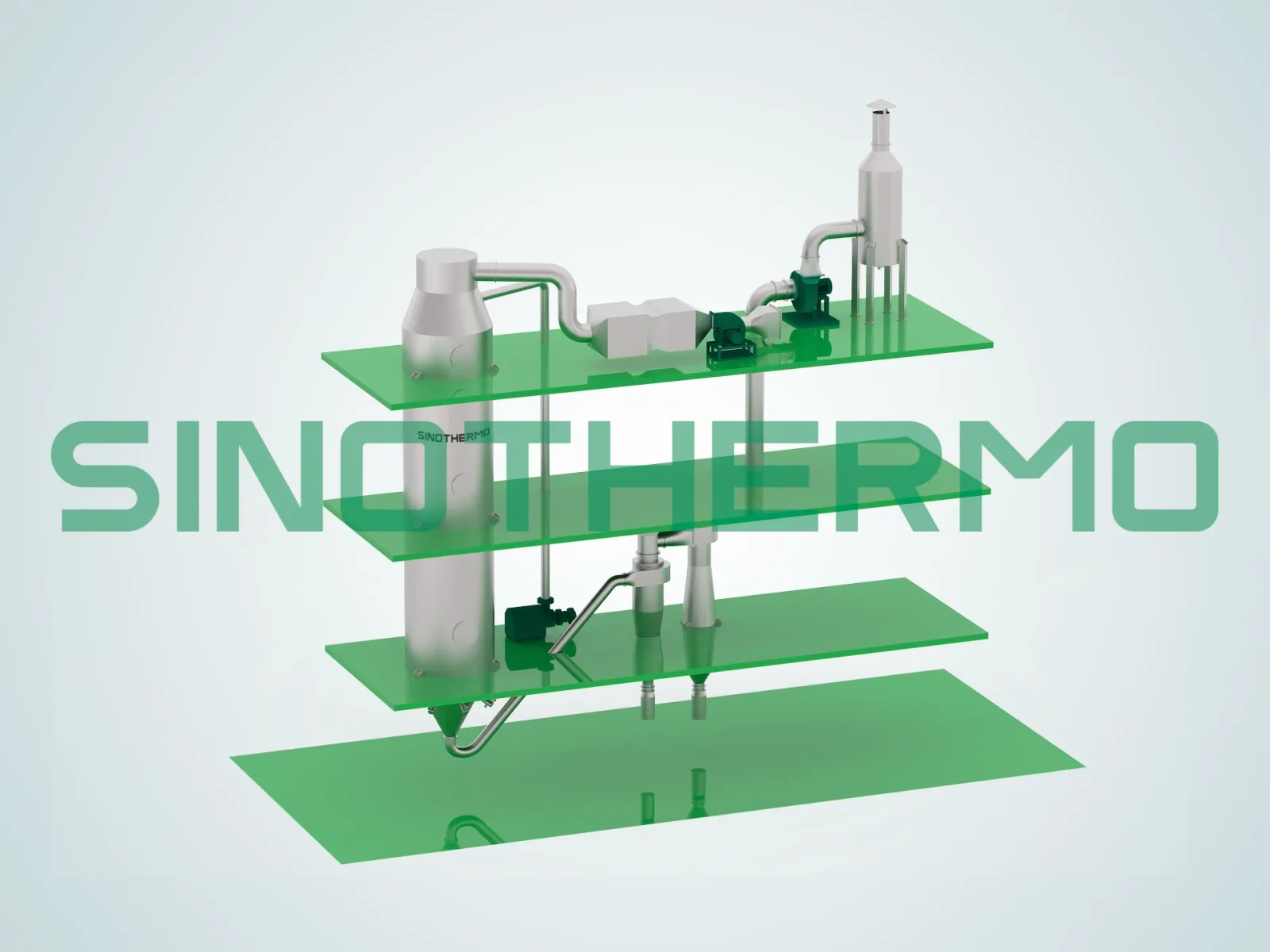
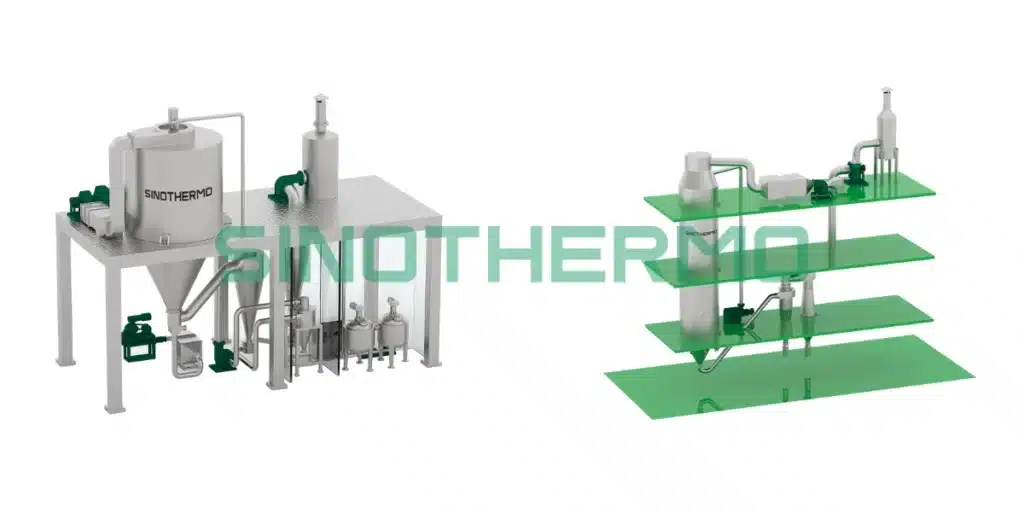
A feed system, atomizer, air heater, drying chamber, powder separation (cyclone and/or bag filter), powder handling, and controls — plus optional auxiliaries such as fines recycle, an integrated fluid bed, CIP, explosion protection, and solvent recovery.
What auxiliary equipment is usually excluded from a spray dryer quote?
Feed preparation, powder conveying and packing, CIP systems, explosion protection, solvent recovery, and sometimes insulation and full control-system scope. Confirm each explicitly in writing before you compare a headline price against another supplier's.
What is the difference between open-cycle and closed-cycle spray drying?
Open cycle heats ambient air, uses it once, and exhausts it — standard for aqueous feeds. Closed cycle recirculates an inert gas, usually nitrogen, which is required for organic-solvent feeds and oxidation-sensitive products. It costs and complicates the system significantly more than open cycle, so specify it deliberately, not by default.
Which atomizer should I choose?
Centrifugal (rotary disc) atomizers produce fine, uniform powder and tolerate feed variation. Pressure nozzles produce coarser, free-flowing granules at lower cost. Two-fluid nozzles suit very fine particles at lab or pilot scale but consume significant compressed air. The right choice depends on your target particle size and feed properties — a pilot test settles it definitively rather than a general rule of thumb.
Do I need CIP on a spray dryer?
It depends on your industry and product. CIP is essential for food and pharmaceutical duty where cross-contamination between batches or products is a regulatory concern, and it substantially affects both cost and chamber design because the geometry has to support drainability and cleaning access. For non-hygienic industrial powders, it is often not required — confirm your compliance framework before assuming either way.

Mark Gu
Passionate about enhancing customer experiences and streamlining operations, Mark focuses on building strong relationships, fostering innovation, and leading teams to achieve exceptional service and efficiency.
Email: mark.gu@sinothermo.com
Phone: +86 18021972660