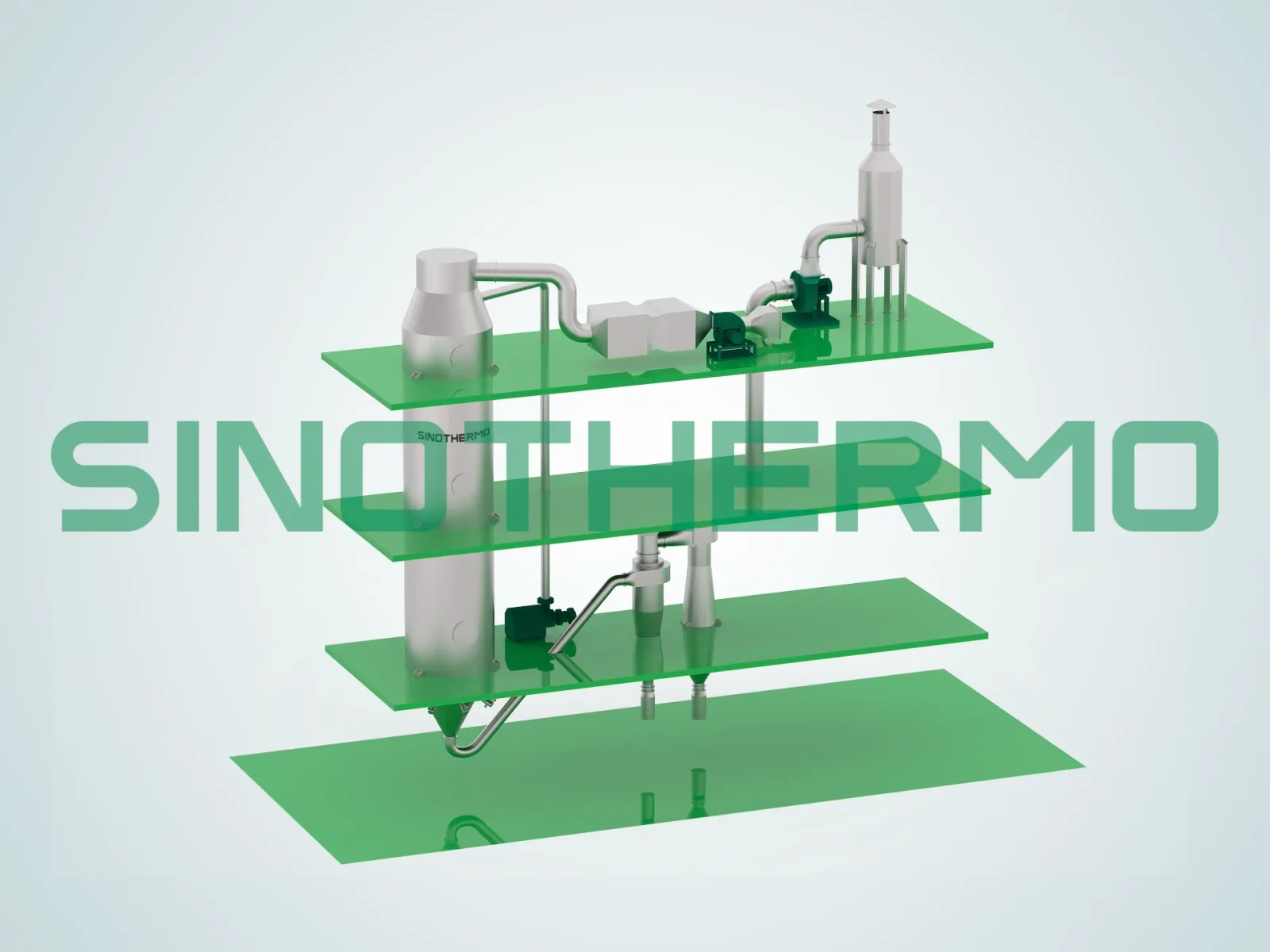
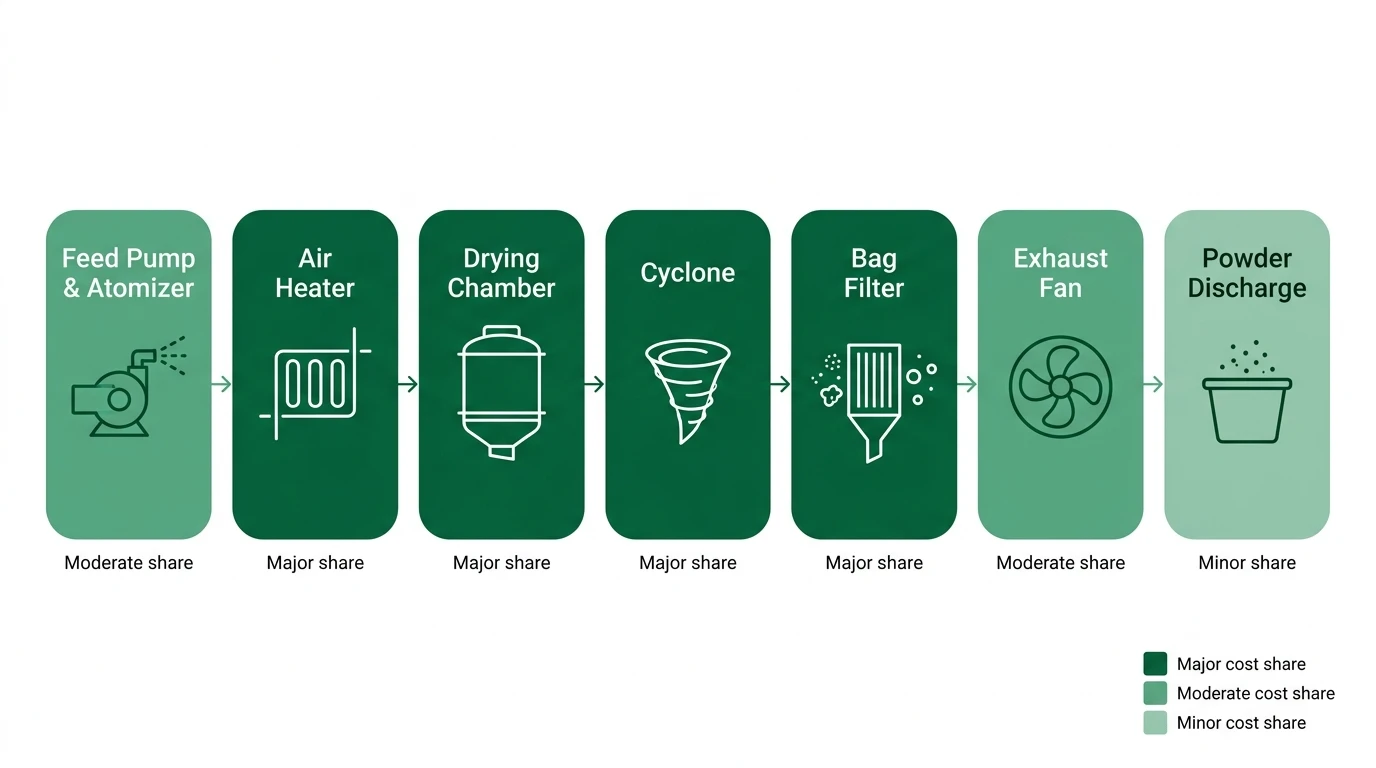
An industrial spray dryer is a complete system, not a single machine — the drying chamber is typically only a moderate share of installed cost once air heating, atomization, powder separation, conveying and controls are included. Understanding the full system before you specify is what prevents budget surprises and undersized utilities when you scale to production.
This article covers system planning. For evaluating who builds the system, see spray dryer manufacturers; for how the machine itself works, see how spray drying works; for budget structure, see spray dryer cost.
What makes up an industrial spray drying system
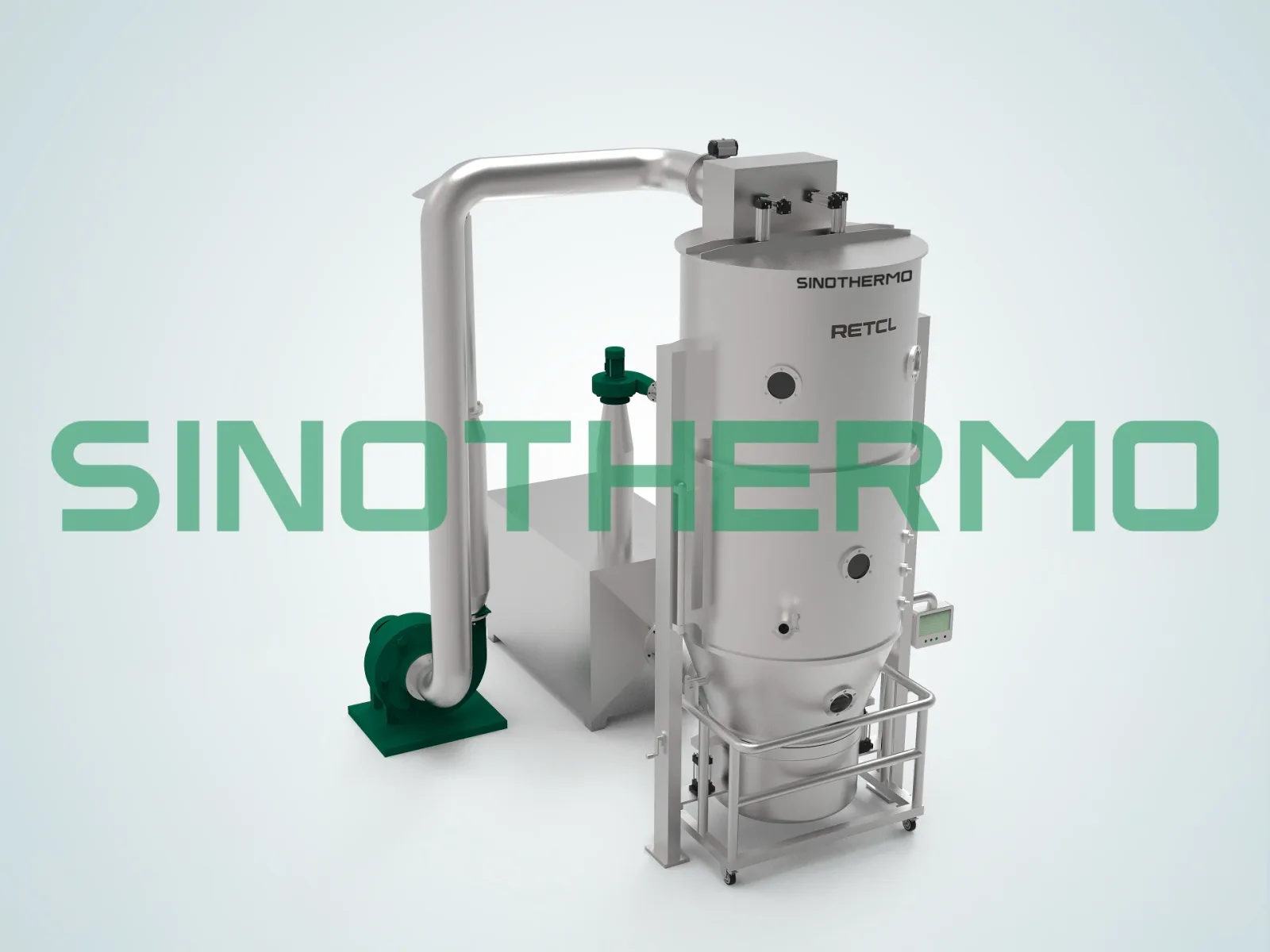
| Component | Function | Why it matters at scale |
|---|---|---|
| Feed system | Pumps and filters the liquid feed | Consistent, pulsation-free feed is essential for uniform particle size |
| Atomizer | Breaks feed into droplets (centrifugal disc or pressure nozzle) | Sets particle size; the main wear/consumable item |
| Air heater | Heats drying air (steam, gas, electric, thermal oil) | Largest energy consumer; heating choice drives operating cost |
| Drying chamber | Where droplets dry | Geometry affects wall deposits and heat-sensitive product handling |
| Powder separation | Cyclone and/or bag filter | Determines yield and emissions compliance |
| Powder handling | Conveying, cooling, packing | Often underspecified; a bottleneck if undersized |
| Control system | PLC, instrumentation, interlocks | Process consistency and regulatory documentation |
This table stays at the planning level — a full component-by-component breakdown, including how each is chosen and sized, is covered in our dedicated spray drying equipment guide.
Capacity planning: get the units right
The single most common specification error is confusing feed rate with evaporation capacity.
- Evaporation capacity = kilograms of water removed per hour. This is how spray dryers are correctly sized.
- Feed rate = kilograms of liquid fed per hour.
If your feed is 20% solids, drying 1,000 kg/h of feed means evaporating roughly 800 kg/h of water — the two numbers describe different things and are not interchangeable in a quotation. Always specify and compare on evaporation capacity, and confirm at what inlet and outlet air temperatures the figure is guaranteed — the same dryer's evaporation capacity changes significantly with those temperatures.
This distinction matters most when a supplier's headline number looks unusually attractive. A quotation stated in feed rate, with no solids content or temperature basis attached, tells you almost nothing about what the machine will actually deliver on your material — it is a number chosen to sound large, not a number you can size a plant around. Ask for the evaporation capacity explicitly, and ask what solids content and temperature profile it assumes, before you compare it against any other quote.
Utilities and plant requirements
Industrial spray dryers have substantial utility demands that need confirming early with your plant engineering team, before layout and civil work are finalised — retrofitting utility capacity after a chamber is already specified is far more expensive than sizing it correctly the first time:
- Thermal energy — steam, gas, or electric heating capacity for the air heater, sized against your evaporation duty and inlet temperature, not the chamber's physical size
- Electrical — main fan, atomizer drive (centrifugal atomizers run at high speed and can be a significant load on their own), feed pumps, conveying
- Compressed air — instrumentation, filter cleaning, and nozzle atomization where applicable; confirm required pressure and flow, not just "compressed air available"
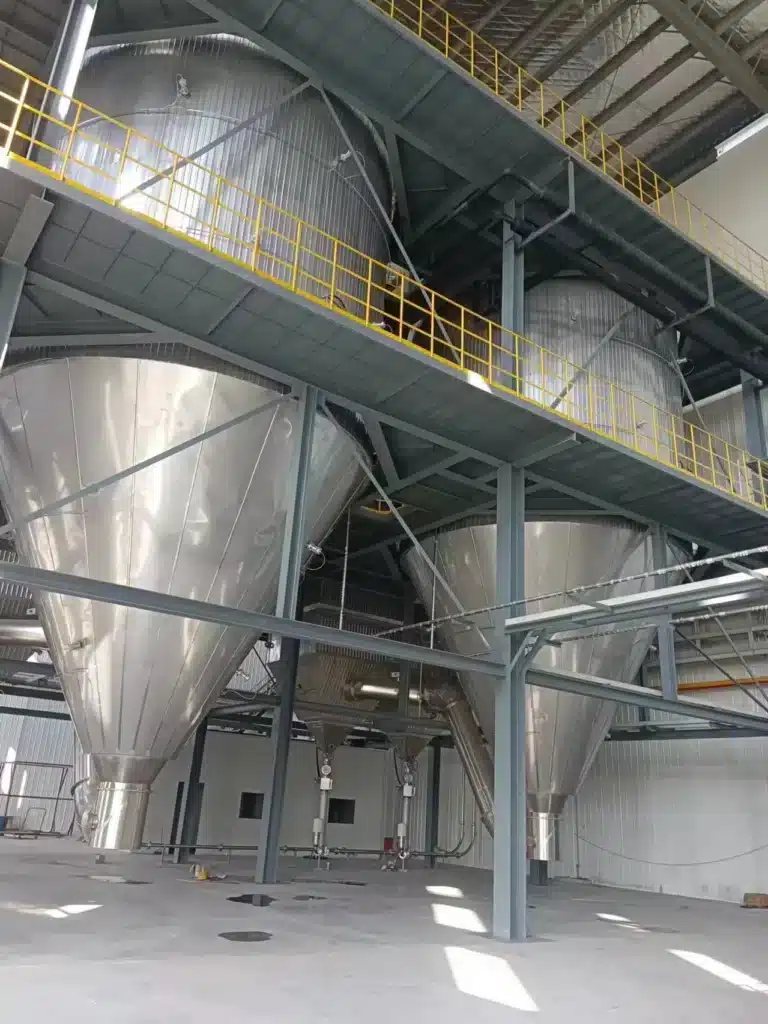
- Building height — drying chambers are tall; verify ceiling clearance and access early, not after the steel is ordered
- Exhaust and emissions — ducting routes and any scrubbing required for compliance at your site
What changes when scaling from pilot to production
Scale-up is not linear. Key differences to plan for:
- Wall deposits behave differently in a larger chamber; a material that ran clean at pilot scale may need parameter adjustment or wall cooling at production scale.
- Residence time distribution widens as chamber size increases, which can affect moisture uniformity across the batch.
- Powder handling becomes a real engineering problem — conveying, cooling, packing — rather than a bucket under the cyclone at pilot scale.
- Fines recovery and recycle may become economically necessary at production volumes, where they were not worth the complexity at pilot scale.
None of these is a reason to distrust pilot testing — they are the reason it exists. A pilot trial is not meant to hand you a finished production design; it is meant to establish how your specific material behaves under heat and airflow, so that the geometry decisions made at production scale are grounded in real data rather than a generic rule of thumb applied to an unfamiliar feed.
This is why pilot data matters: it establishes the process window on your actual material, and an experienced manufacturer translates that window to production geometry rather than re-deriving it from a generic scale-up rule. See our lab, pilot and industrial spray dryer comparison for how the three scales differ, and the pilot spray dryer complete guide for how a pilot trial is structured.
Heating source selection at industrial scale
| Heating | Capital cost | Operating cost | Best for |
|---|---|---|---|
| Electric | Lowest | Highest | Smaller capacities, clean processes, sites without steam |
| Steam | Higher | Lower | Plants with existing steam infrastructure; large continuous production |
| Gas (direct/indirect) | Moderate | Moderate-low | Large capacities where combustion contact is acceptable (direct) or not (indirect) |
| Thermal oil | Higher | Low | High-temperature requirements without steam pressure limits |
At industrial scale, operating cost usually dominates the total cost of ownership over the machine's service life — so the cheapest capital option is frequently the most expensive one once you account for years of operation.
Common specification mistakes at industrial scale
- 1.Specifying by feed rate instead of evaporation capacity. The two numbers are not interchangeable, and a supplier who quotes back your feed rate without asking about solids content has priced the wrong thing. See the units section above.
- 2.Sizing utilities off the drying chamber alone. The atomizer drive, main fan, and air heater between them usually account for more electrical and thermal load than the chamber itself suggests at a glance — confirm the full utility list before civil and electrical design is frozen.
- 3.Assuming pilot parameters scale linearly. They do not, for the reasons covered above. A production quote based only on multiplying pilot throughput by a scale factor, with no re-test, is a guess dressed up as an engineering figure.
- 4.Treating powder handling as an afterthought. Conveying, cooling and packing are real unit operations at production volume, not a bucket under the cyclone — undersizing this stage creates a bottleneck no amount of chamber capacity can fix.
- 5.Choosing a heating source on capital cost alone. As the table above shows, the lowest sticker price is often the highest lifetime cost once operating hours accumulate. Model total cost of ownership before committing.
Where SINOTHERMO fits
SINOTHERMO manufactures centrifugal (LPG), pressure-nozzle (YPG) and extract (ZLPG) spray dryers across lab, pilot and industrial scale, with 20+ years of experience in industrial drying behind the process engineering. Our in-house pilot laboratory establishes the process window on your actual feed — a paid engineering service — and our engineers translate that window into production system sizing, from atomizer selection through powder handling.
Planning a production-scale spray drying line? Send us your feed. Our pilot lab establishes the process window and we size the full system around it.
✉️ mark.gu@sinothermo.com · 📱 WhatsApp: +86 180 2197 2660 · 🌐 www.sinothermo.com · 💬 Request a pilot test
SINOTHERMO — Process Engineering Infrastructure.
Frequently asked questions
How is an industrial spray dryer's capacity measured?
By evaporation capacity — kilograms of water removed per hour — not by feed rate. Always confirm at what inlet and outlet air temperatures the figure is guaranteed, because capacity varies significantly with those temperatures even on the same machine.
What components make up an industrial spray drying system?
Feed system, atomizer, air heater, drying chamber, powder separation (cyclone and/or bag filter), powder handling and conveying, and the control system. The drying chamber is only one part of the installed cost once every other system is included.
What utilities does an industrial spray dryer need?
Thermal energy (steam, gas, electric, or thermal oil) for air heating, substantial electrical supply for the main fan and atomizer drive, compressed air for instrumentation and filter cleaning, plus adequate building height and exhaust routing confirmed early in the project.
Does a process that works at pilot scale transfer directly to production?
Not automatically. Wall deposit behaviour, residence time distribution, and powder handling all change with scale. Pilot data establishes the process window on your actual material, and an experienced manufacturer translates it to production geometry rather than assuming a linear scale-up.
Which heating source is best for an industrial spray dryer?
It depends on your site and volume, not a universal answer. Electric suits smaller capacities and sites without steam infrastructure; steam suits plants that already have it and run large continuous production; gas suits large capacities where combustion contact is or is not acceptable, depending on direct or indirect configuration; thermal oil suits high-temperature requirements beyond steam pressure limits. Operating cost usually dominates total cost of ownership at industrial scale, so weigh it against capital cost rather than choosing on capital cost alone.

Mark Gu
Passionate about enhancing customer experiences and streamlining operations, Mark focuses on building strong relationships, fostering innovation, and leading teams to achieve exceptional service and efficiency.
Email: mark.gu@sinothermo.com
Phone: +86 18021972660