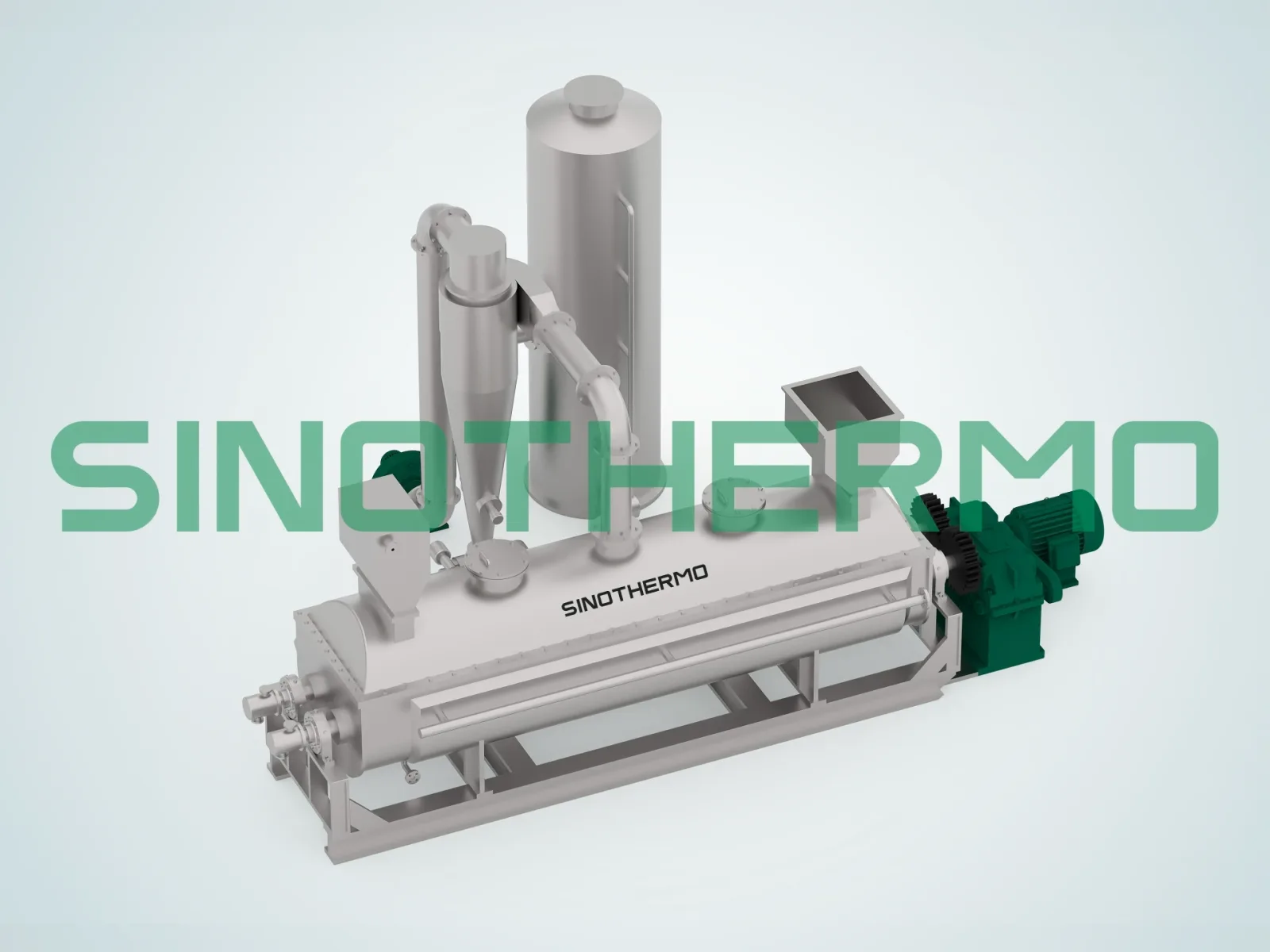
A paddle dryer is bought on heat transfer area — and that area is the easiest number on a quotation to inflate. Two machines can quote the same figure in m² while one keeps most of it above the material bed, where it transfers nothing. Specify four things: the actual heated area, not the geometric one; the heat medium circuit that keeps it working for years; the shaft arrangement that stays clean through the sticky phase; and the operating pressure.
For the engineer drafting the specification and the buyer comparing offers that claim the same duty. It's not a primer on the mechanism — that's covered in our paddle and disc dryer guide. Read that first for the physics.
The heat transfer area on the quote is not the area you get
"Heated surface" has three meanings, and no supplier is obliged to say which one they used.
- Geometric area — all heated metal: jacket, both shafts, every paddle face. The largest number available, and the one most likely to appear unqualified.
- Submerged area — only the fraction buried in material at the operating fill level. This is what actually transfers heat.
- Effective area — submerged area corrected for productivity; a paddle face carrying a baked-on layer contributes far less than its geometry suggests.
That gap is why two comparable-looking quotes behave differently in service: a machine run at a low fill level has a large geometric area and a small submerged one, and a machine that fouls loses effective area through the run while its geometric figure never changes.
So don't ask for the area — ask, in writing:
- 1.Which area is quoted — geometric, submerged or effective?
- 2.At what fill level was it calculated, versus what the machine will actually run at?
- 3.What heat transfer coefficient was assumed, and from where? A trial is engineering; a category assumption is a placeholder.
- 4.What throughput is guaranteed, at what inlet and outlet moisture? Missing either, the figure carries no information.
- 5.What residence time does that imply, and how is it controlled?
On numbers. Areas, fill levels, temperatures, residence times and paddle speeds all depend on your material's rheology. Any figure in a brochure is a typical design target, confirmed on your own material by trial — it describes the machine's envelope, never your duty.
The heat medium circuit is where reliability lives
What makes a hollow paddle dryer compact also makes it demanding: the medium travels down a rotating hollow shaft, out into every paddle, and back. Buyers evaluate area and throughput and rarely this circuit — yet in service the ranking reverses.
- Rotary joint — feeds the turning shaft, wears, stops the machine when it fails. Specify make, service interval, local spares.
- Condensate/oil return — medium that doesn't leave the shafts floods the surface from inside; effective area disappears, mimicking undersizing. Confirm flow across both shafts.
- Shaft seal — holds product on one side and, on vacuum, atmosphere on the other; often the real reason a "working" system quietly leaks.
- Drive torque margin — cohesive materials spike the load in the sticky phase; a drive sized on the average stalls.
None of these appear in a capacity comparison. All appear in the maintenance budget.
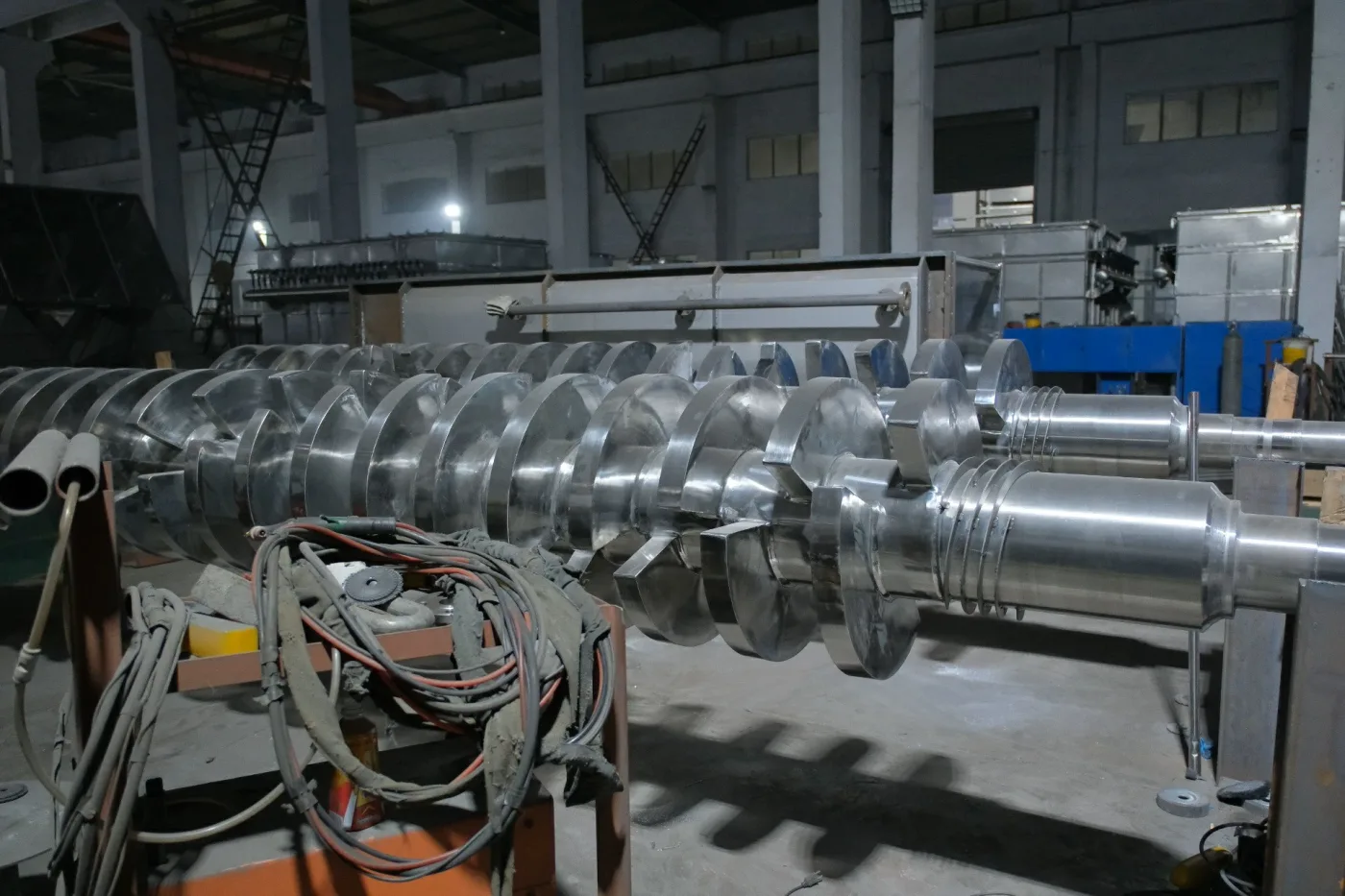
Single shaft or twin shaft: what intermeshing buys
On a twin shaft paddle dryer, paddles on two counter-rotating shafts wipe each other, preventing build-up that would coat the surface and destroy effective area mid-run. A single-shaft machine has no opposing set to be wiped by — cleaning comes only from the wall or breaker bars.
| Selection criterion | Single shaft | Twin shaft |
|---|---|---|
| Heated area per unit length | Lower | Higher |
| Cleaning during the run | Wall/breaker-bar only | Paddles wipe each other continuously |
| Sticky intermediate phase | Build-up risk; area falls | The reason twin shaft exists |
| Footprint | Larger | More compact |
| Complexity/spares | Lower | Two shafts, two seals |
| Capital cost | Lower | Higher |
The rule: does your material pass through a phase plastic enough to adhere to heated metal? If so, twin shaft is close to mandatory. If the feed stays free-flowing throughout, single shaft is a legitimate, cheaper answer.
Wedge paddle angle is also a residence-time control. Set to convey, paddles shorten it; set to hold back, they lengthen it. Where adjustable, a missed residual can be corrected mechanically instead of by cutting throughput.
Atmospheric or vacuum? Don't default to vacuum
Vacuum is the most expensive single decision here — it doesn't stop at the dryer.
| Criterion | Atmospheric | Vacuum |
|---|---|---|
| Why choose it | Vapour is water; may be vented/scrubbed | Product can't tolerate atmospheric boiling temperature, or vapour has recovery value/is regulated |
| Product temperature | Set by medium and boiling point | Falls with pressure — lower is reachable |
| Scope beyond the dryer | Vapour hood, fan, condenser/scrubber | Sealed vessel, filter, condensing train, receiver, vacuum source, vent treatment |
| Seals/flanges | Containment duty | Pressure-boundary duty; small leaks degrade performance invisibly |
| Oxygen in vessel | Present unless inerted | Largely removed by evacuation |
| Typical fit | Sludge, biosolids, water-wet cakes | Heat-sensitive, solvent-wet, oxidation-sensitive products |
| Cost/complexity | Lower | Higher |
Specify vacuum only if: the product degrades or changes crystal form at the atmospheric boiling point of its liquid; the liquid is a solvent you need back, or may not vent; or the product must not see oxygen. Otherwise atmospheric with proper vapour handling is correct.
Where solvent recovery is the driver, the condensing train — not the dryer — usually sets what you get back: see vacuum rotary dryer solvent recovery and the industrial vacuum dryer guide.
Abrasion, scaling and blockage
Abrasive feeds wear paddle edges and the jacket wall silently — clearances open, wiping degrades, effective area falls. Specify hard-facing, a wear allowance, and replaceable tips.
Scaling and crust — some materials bake on a layer wiping cannot remove. Ask for a lump-breaker and realistic cleaning access; intermeshing handles soft build-up well, hard scale poorly.
Blockage at the ends — feed and discharge are where cohesive material bridges. Ask what residual is retained at end of run, and whether CIP supports changeovers.
The specification checklist
Paste this into the enquiry.
| Specification item | State or ask for |
|---|---|
| Shaft arrangement | Single or twin, with the reason |
| Heat transfer area | Geometric, submerged and effective, with fill level used |
| Coefficient basis | Value assumed, and its source |
| Heat medium | Steam, oil or hot water; rated upper limit; site availability |
| Condensate / oil return | How medium leaves the shafts; trap or circulation arrangement |
| Rotary joint | Make, type, service interval, local spares |
| Shaft seal | Type and duty; containment/vacuum requirements |
| Throughput guarantee | At a defined inlet and outlet moisture |
| Residence time | Design value; paddle angle fixed or adjustable |
| Operating pressure | Atmospheric or vacuum, with design pressure |
| Vapour handling | Hood, filter, condenser, scrubber or recovery loop — who supplies it |
| Contact-part materials | All product-contact surfaces, plus wear allowance |
| Drive torque margin | Margin applied, and condition assessed |
| Explosion protection | Required if powder combustible; applicable framework |
| Discharge/residual retention | Discharge type; material left at end of run |
| Cleaning and access | CIP or manual; inspection access |
| Instrumentation | Measurement points; what the loop controls on |
A practical selection path
- 1.Start from behaviour across the whole cycle, not the wet feed. Most cakes are three materials in one run — paste, plastic intermediate, dry powder — and the intermediate eliminates candidates.
- 2.Set the residual against what the process genuinely needs — the last fraction of a percent is always the most expensive.
- 3.Decide atmospheric or vacuum with the three-statement test.
- 4.Choose the shaft from the sticky phase, the paddle arrangement from the residence time needed.
- 5.Size last — the same logic runs across how to choose an industrial dryer.
- 6.Compare the family before committing. The vacuum paddle dryer, vacuum rake dryer and vacuum horizontal disc dryer sit in the same conduction and vacuum dryer family; a small, demanding-residual batch may fit a conical vacuum dryer, and rake geometry suits cakes that harden against the wall.
Common mistakes to avoid
- Comparing quoted areas without asking which area was quoted — geometric and submerged aren't the same quantity.
- Accepting a throughput without both moisture values — alone, meaningless.
- Treating the heat medium circuit as plumbing — the rotary joint, return path and shaft seal decide availability for the machine's life.
- Defaulting to vacuum — it drags a whole condensing train into scope; specify only when the product, solvent or oxygen sensitivity requires it.
- Assuming "self-cleaning" covers hard scale — that's a separate question about breakers and access.
- Scaling from a static tray-oven test — no surface renewal or wall wiping, so it says little about an agitated dryer. See our pilot test checklist.
Frequently asked questions
How do I compare heat transfer area between paddle dryer quotes?
Ask which area was quoted — geometric, submerged or effective — with the fill level used; geometric area includes surface above the bed that transfers nothing. Also ask whether the coefficient came from a trial or a generic assumption.
Should I choose a single shaft or twin shaft paddle dryer?
Decide on whether your material turns plastic enough to stick to heated metal. Twin shaft paddles wipe each other clean — close to mandatory for sludges and cohesive cakes. For feeds that stay free-flowing throughout, single shaft is a legitimate, cheaper choice.
Do I need a vacuum paddle dryer, or is atmospheric enough?
Only if the product degrades at the atmospheric boiling point of its liquid, the liquid is a solvent you need back or may not vent, or the product must not see oxygen. Otherwise atmospheric with proper vapour handling is correct.
What must a paddle dryer specification include?
Shaft arrangement; area as geometric, submerged and effective with fill level; the coefficient basis; heat medium and rated temperature; condensate/oil return; rotary joint serviceability; shaft seal type; throughput at a defined inlet and outlet moisture; residence time and paddle-angle adjustability; operating pressure; vapour handling scope; contact-part materials with wear allowance; drive torque margin; explosion protection where relevant; discharge/residual retention; and cleaning access.
How do I check whether a supplier's throughput figure is real?
Require it at a defined inlet and outlet moisture, then ask how it was derived — measured on your material, or a generic tonnage table. Check the fill level the guarantee implies against the one used for the submerged area — a mismatch means a different machine.
Is a paddle dryer suitable for abrasive or scaling materials?
Both must be specified, not assumed: for abrasive feeds, a wear allowance and hard-facing with replaceable tips; for scaling materials, a lump-breaker and confirmed cleaning access.
Prove the sizing basis before you sign it
The two numbers that decide a paddle dryer project — the heat transfer coefficient your material actually achieves, and the residence time to reach your residual — cannot be read off a datasheet.
That is why SINOTHERMO operates an in-house pilot laboratory: send your sludge, cake or paste, and we run it on agitated conductive equipment — the drying curve, where the material turns plastic, residual against residence time, and torque through the sticky phase. Where the duty needs vacuum, the trial runs under vacuum. Backed by 20+ years of experience, our engineers then specify the shaft arrangement, area, paddle arrangement, seal and heat medium circuit as one coherent machine.
Request a pilot test on your own material: see the testing lab, or talk to an engineer about your duty.
Conclusion
A paddle dryer is a straightforward machine to buy badly. The quoted area invites a comparison it cannot support, and the circuit that determines availability for the next decade rarely enters the evaluation. Specify the area three ways. Choose the shaft from the sticky phase, not the wet feed. Apply the three-statement test before adding vacuum scope. Put the rotary joint, condensate return and shaft seal in the enquiry, not the maintenance budget.
Have a sludge, cake or paste to specify a dryer for? Send us a sample — we'll confirm the coefficient, residence time and achievable residual before the design is frozen.
✉️ mark.gu@sinothermo.com · 📱 WhatsApp: +86 180 2197 2660 · 🌐 www.sinothermo.com
SINOTHERMO — Process Engineering Infrastructure.

Mark Gu
Passionate about enhancing customer experiences and streamlining operations, Mark focuses on building strong relationships, fostering innovation, and leading teams to achieve exceptional service and efficiency.
Email: mark.gu@sinothermo.com
Phone: +86 18021972660