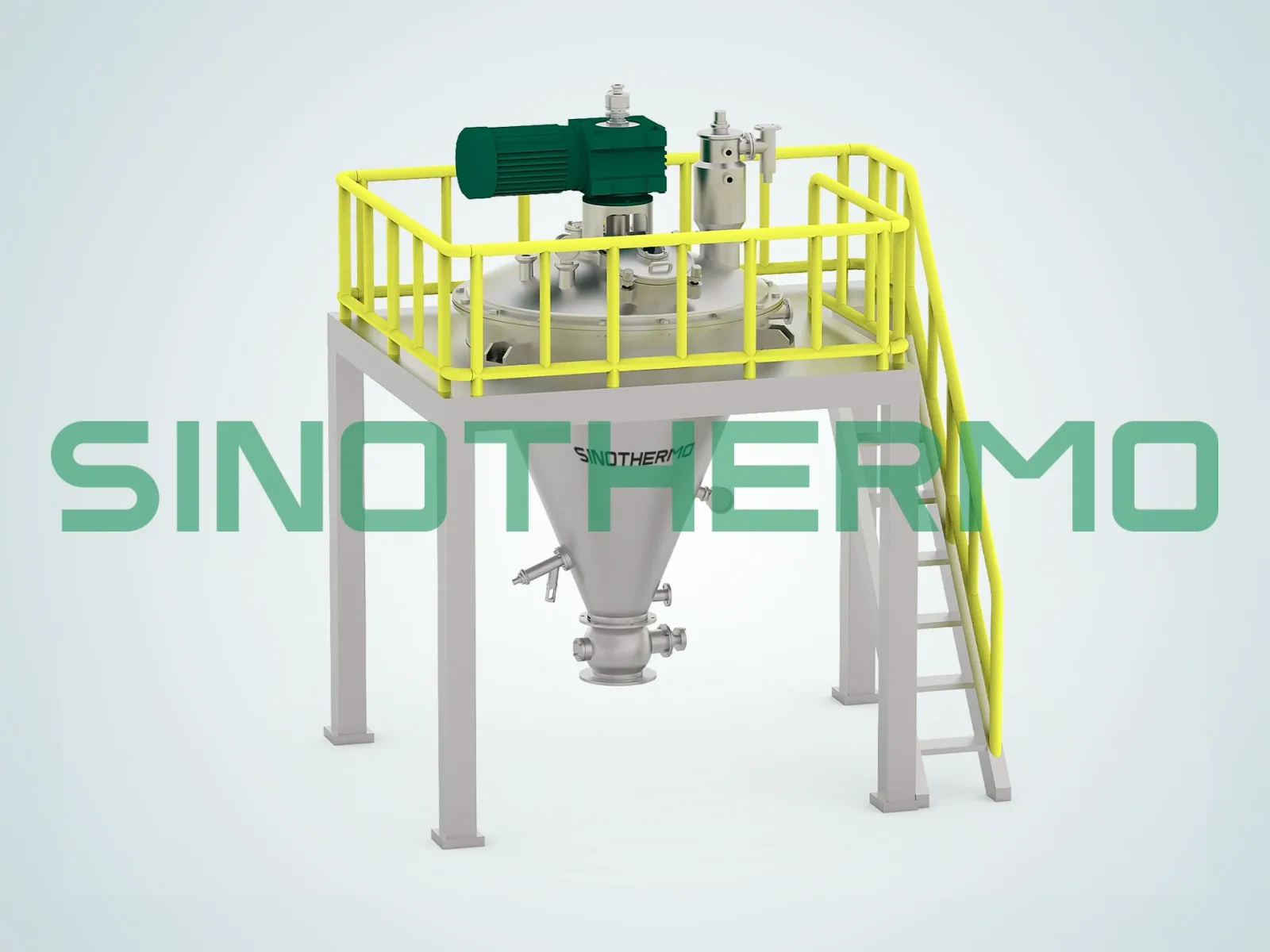
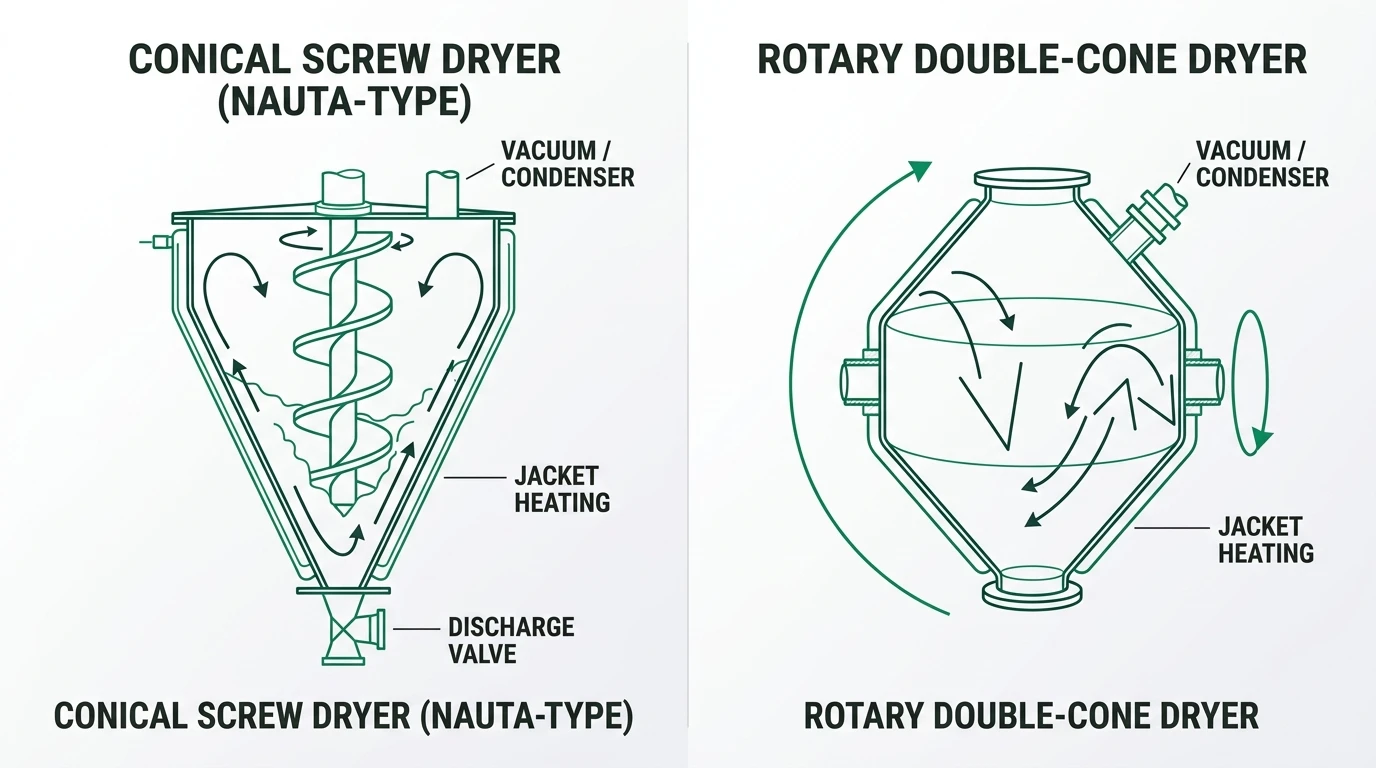
"Conical dryer" is not one machine — it is a shape shared by two unrelated designs. A conical screw vacuum dryer has a stationary cone with an internal screw that spins while orbiting the wall, lifting material and cascading it back to the centre. A rotary cone / double-cone dryer has no internal agitator — the whole vessel rotates and the charge tumbles. Both dry under vacuum at low temperature and both are sold as "conical vacuum dryers", but they are not interchangeable — buyers specify the wrong one often enough that the terminology itself is a selection risk.
A plant orders one for a cohesive cake, receives a rotating double-cone, and finds at commissioning the cake will not tumble — it slumps, rides around with the shell, and dries from the outside in. Nothing is broken; it was the wrong geometry, chosen from a word, not the material.
Why buyers end up with the wrong conical dryer
Three things conspire. Vocabulary is shared — "conical dryer" and "cone dryer" describe both designs. Quotations hide the mechanism — vessel volume, jacket area, heating medium and vacuum read near-identically between the two; the deciding line is often on a drawing, not in the quote. The shape misleads — both get gravity discharge from the cone, so the cone reads as the important feature. It is not: the cone decides how material leaves; agitation decides whether it can be dried.
The defence is one question, asked in writing: does the vessel rotate, or does a screw rotate inside a fixed vessel?
The two designs at a glance
| Conical screw vacuum dryer | Rotary cone / double-cone dryer | |
|---|---|---|
| Vessel | Stationary jacketed cone | Whole vessel rotates on trunnions |
| Material movement | Orbiting screw lifts and cascades material | Gravity tumbling as the shell turns |
| Best suited to | Sticky, cohesive materials; wide batch flexibility | Free-flowing powders, granules, crystals |
| Fragile particles | Screw imparts shear | Gentler; no internal moving parts |
| Partial batches | Effective well below full charge | Needs a reasonable fill to tumble |
| Cleaning | Screw and seal add wetted surfaces | Simpler internals |
| Critical wear item | Agitator shaft seal | Trunnion seals and rotary union |
How a conical screw vacuum dryer works
A screw hung from an orbit arm spins on its own axis while sweeping around the cone wall, lifting material and cascading it back to the centre, scraping off crust before it case-hardens. Under vacuum, reduced pressure lowers the boiling point, and vapour is drawn through a dust filter to a condenser — a circuit common to the whole conduction and vacuum dryer family; solvent recovery is covered in our vacuum rotary dryer solvent recovery guide.
The decisive advantage is mechanical, not thermal: a driven screw can move material that will not move itself.
The sticky phase is what decides the choice
Most filter cakes are three materials in sequence: a wet paste, a cohesive, sticky intermediate that binds into lumps, and a dry, free-flowing powder.
Nearly every disappointing project is about the middle state. A double-cone relies on gravity; a plastic, adhering mass instead slumps and rotates as one lump, collapsing surface renewal exactly when needed most, so cycle time stretches and residuals become hard to reach. A screw dryer meets this state with an agitator that lifts, shears and drags material against the wall regardless — why cohesive pharma, pigment and polymer intermediates land on the screw type. In reverse, for a free-flowing crystal whose habit matters, the screw is unneeded shear, and the double-cone wins because there is nothing inside it.
On numbers: working vacuum, jacket temperature and cycle time vary enormously by material. Any brochure figure is a typical design target, confirmed on your own material by trial — never a specification you can adopt.
Partial-batch capability, and what it is worth
Partial fill is the row buyers under-weight — often the largest value item for a multi-product plant. A double-cone needs a sensible fill to cascade rather than slide, so its batch window is narrow; a screw dryer does not depend on gravity, so it stays effective well below nominal charge, covering a wide range on one vessel. Against that, the screw and seal add wetted surfaces; where changeover is frequent, the double-cone wins instead. A trade, not a ranking.
Seals: the screw type's double duty
The shaft seal does two jobs at once. Vacuum integrity: a leaking system does not fail loudly — it pulls a plausible pressure while non-condensable air blankets the condenser and kills heat transfer; plants have re-sized condensers for months over a worn seal. Containment: for potent or valuable powders, the same seal holds a dry powder against a pressure differential.
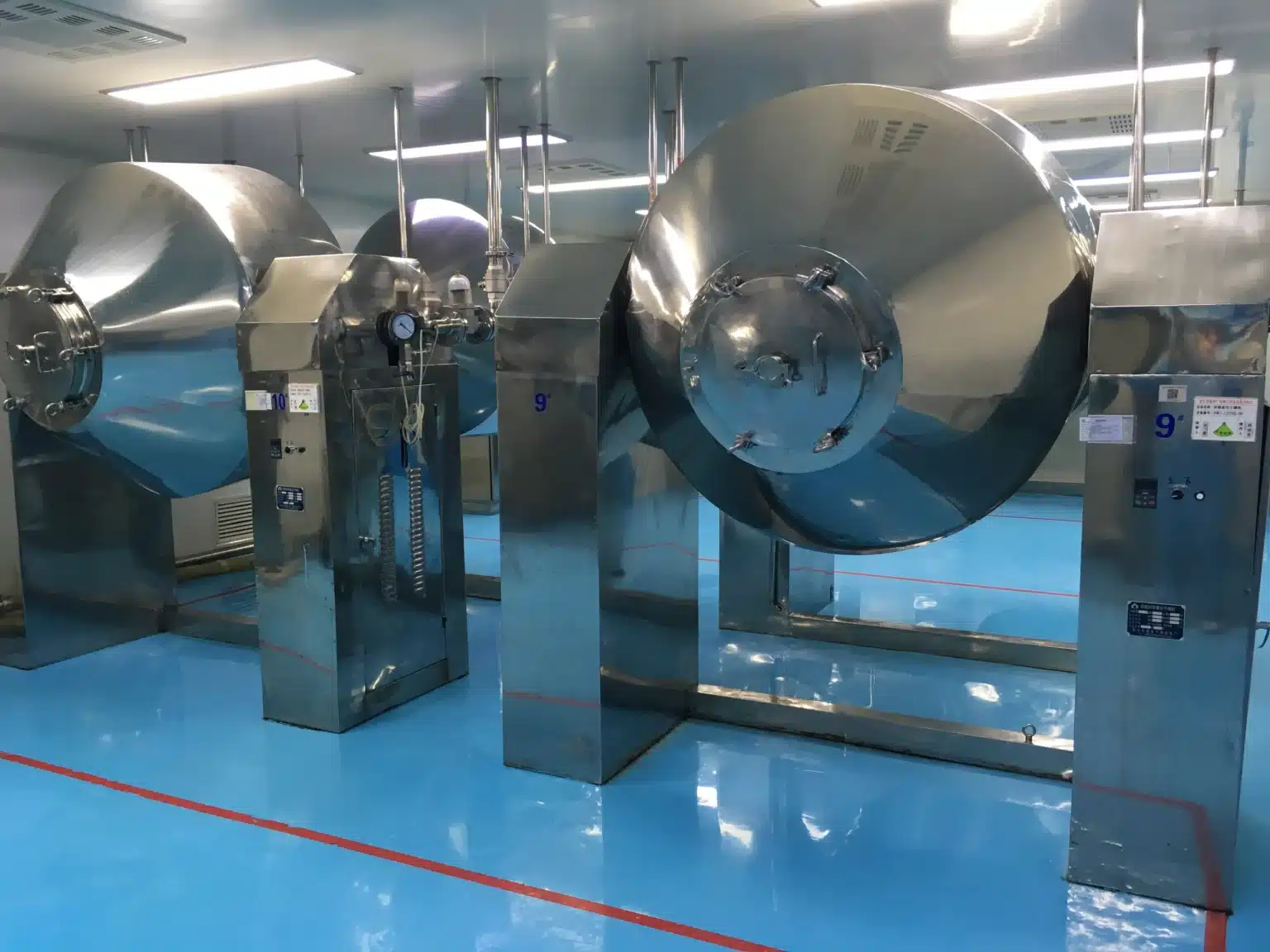
Specify: sealing principle for dry powder duty; purged/barrier fluid if used; how it is inspected and changed; service interval on your material. The double-cone moves this to trunnion seals and a rotary union, where consequences are narrower.
Shared advantages of conical vacuum drying
Both bring low-temperature drying; strongly reduced oxygen (a real inert case still needs N₂ purging, O₂ interlocks, nitrogen vacuum-break); solvent recovery by condensation from a small, concentrated vapour stream; low achievable residual; and closed handling with gravity discharge.
Typical applications
- Pharmaceutical — APIs and solvent-wet cakes; screw for adhering cakes, double-cone for crystal habit/validation.
- Fine chemicals, dyes and pigments — cohesive cakes needing colour and particle survival.
- Polymers and resins — sticky intermediates with a plastic phase.
- Food and nutraceutical powders — heat-sensitive, closed, low-temperature handling.
See rotary cone vacuum dryer and paddle dryer selection for the tumbling and horizontal alternatives. Wider context: industrial vacuum dryer guide and how to choose an industrial dryer.
Specification checklist
Use this when two "conical vacuum dryer" quotations arrive. Row 1 prevents the whole problem this article describes.
| # | Item to establish | Why it matters |
|---|---|---|
| 1 | Mechanism, stated explicitly | Settles which machine you are buying |
| 2 | Working vs geometric volume, min. fill | Real batch range, not headline size |
| 3 | Screw geometry, jacket medium/range | Cycle time and shear |
| 4 | Vacuum, pump, condenser duty vs peak load | Temperature regime; averages undershoot |
| 5 | Dust filtration, contact materials, finish | Purity, compatibility, GMP |
| 6 | Seal design — integrity and containment | The screw type's critical item |
| 7 | Discharge valve, residual retention | Yield, changeover, contamination |
| 8 | Inerting — N₂ purge, O₂ interlocks, vacuum-break gas | Flammable solvents, sensitive product |
| 9 | CIP/GMP, hazardous-area classification | Simpler internals win; motor/instrument selection |
Common mistakes to avoid
- Specifying from "conical" instead of the mechanism. Agitation is the real decision.
- Choosing geometry from the wet feed alone. A paste often turns cohesive mid-cycle and stalls a machine sized for the wet state.
- Assuming the double-cone is safe because it is gentler. That is exactly what makes it wrong for an adhering cake.
- Treating partial fill as a nice-to-have. For a high-mix plant it can mean one dryer instead of two.
- Leaving the shaft seal as a vendor-standard item. It is the vacuum and containment boundary at once.
- Scaling from a static lab vacuum oven. No surface renewal or scraping predicts little about production.
FAQ
What is a conical vacuum dryer?
A conical vacuum dryer is a vacuum dryer with a cone-shaped vessel, covering two different machines. In a conical screw dryer the cone is stationary and an internal screw rotates on its own axis while orbiting the wall, lifting and mixing the material. In a rotary cone or double-cone dryer there is no internal agitator — the whole vessel rotates so the charge tumbles. Both are correctly called conical vacuum dryers, so the mechanism must be confirmed explicitly rather than inferred from the name.
What is the difference between a conical screw dryer and a rotary cone dryer?
The conical screw dryer uses a driven orbiting screw to lift, shear and break up material that would not move on its own — suited to sticky cakes and partial charge. The rotary cone dryer rotates the entire vessel and relies on gravity — gentler on fragile particles, simpler to validate, but needing a reasonable fill to cascade rather than slump.
Which conical dryer is best for sticky materials?
The conical screw design. Its mechanical agitation moves pasty, cohesive material that would not tumble freely in a rotating vessel, and scrapes the heated wall so a crust cannot case-harden. In a double-cone the same material tends to slump into one plastic mass and travel with the shell, collapsing surface renewal exactly where the cycle needs it most.
Why dry under vacuum in a conical dryer?
Reduced pressure lowers the boiling point of the water or solvent, so it evaporates at a tolerable temperature — protecting heat-sensitive materials from degradation, discolouration or a crystal-form change. Evacuation also removes most of the oxygen, helping oxidation-sensitive products, and yields a small, concentrated vapour stream that is cheap to condense, so solvent is recovered as reusable liquid instead of vented.
Can a conical vacuum dryer run partial batches?
The conical screw design can, and this is one of its main advantages: because mixing is screw-driven rather than gravity-cascaded, it stays effective well below nominal charge, so one vessel covers a wide batch range. A rotary double-cone needs a reasonable fill fraction — too small a charge slides instead of tumbling, too large leaves no headroom for the motion.
How do I tell which design a supplier is actually quoting?
Ask in writing whether the vessel rotates or a screw rotates inside a fixed vessel, and require the answer in the quotation itself, not only on a drawing — vessel volume, jacket area, heating medium and vacuum read near-identically between the two designs. Also ask for the minimum practical fill and the seal arrangement; both reveal the mechanism even where the description is vague.
Prove it on your material before you specify
Cycle time to your residual spec, and whether the material stays workable through its cohesive phase, cannot be read off a datasheet — properties of your cake, not the machine.
SINOTHERMO runs an in-house pilot laboratory: bring your wet cake, paste or powder and we run it under vacuum, tracking the drying curve and how it behaves from paste through the sticky intermediate to powder — the observation that settles screw versus rotating cone. Flammable or sensitive trials run inerted. See our pilot test checklist.
Backed by 20+ years of experience, our engineers specify the vessel, agitator, heated area, seal, filter and condensing train as one system — a ribbon conical vacuum dryer, a double cone rotary vacuum dryer, or a vacuum paddle dryer when the material is too viscous for either cone. See our testing lab, or talk to an engineer.
Conclusion
Two different machines share the name "conical vacuum dryer" — the shape is the least important thing about them. Establish the mechanism explicitly, choose it from how your cake behaves through its cohesive phase, and give the shaft seal the attention its double duty deserves.
Not sure whether your material needs a screw or a rotating cone? Send us a sample — our pilot lab confirms the vacuum window, the temperature limit, the cycle time and, most importantly, how the material behaves through its sticky phase, before you commit to a machine. Request a pilot test.
✉️ mark.gu@sinothermo.com · 📱 WhatsApp: +86 180 2197 2660 · 🌐 www.sinothermo.com
SINOTHERMO — Process Engineering Infrastructure.

Mark Gu
Passionate about enhancing customer experiences and streamlining operations, Mark focuses on building strong relationships, fostering innovation, and leading teams to achieve exceptional service and efficiency.
Email: mark.gu@sinothermo.com
Phone: +86 18021972660