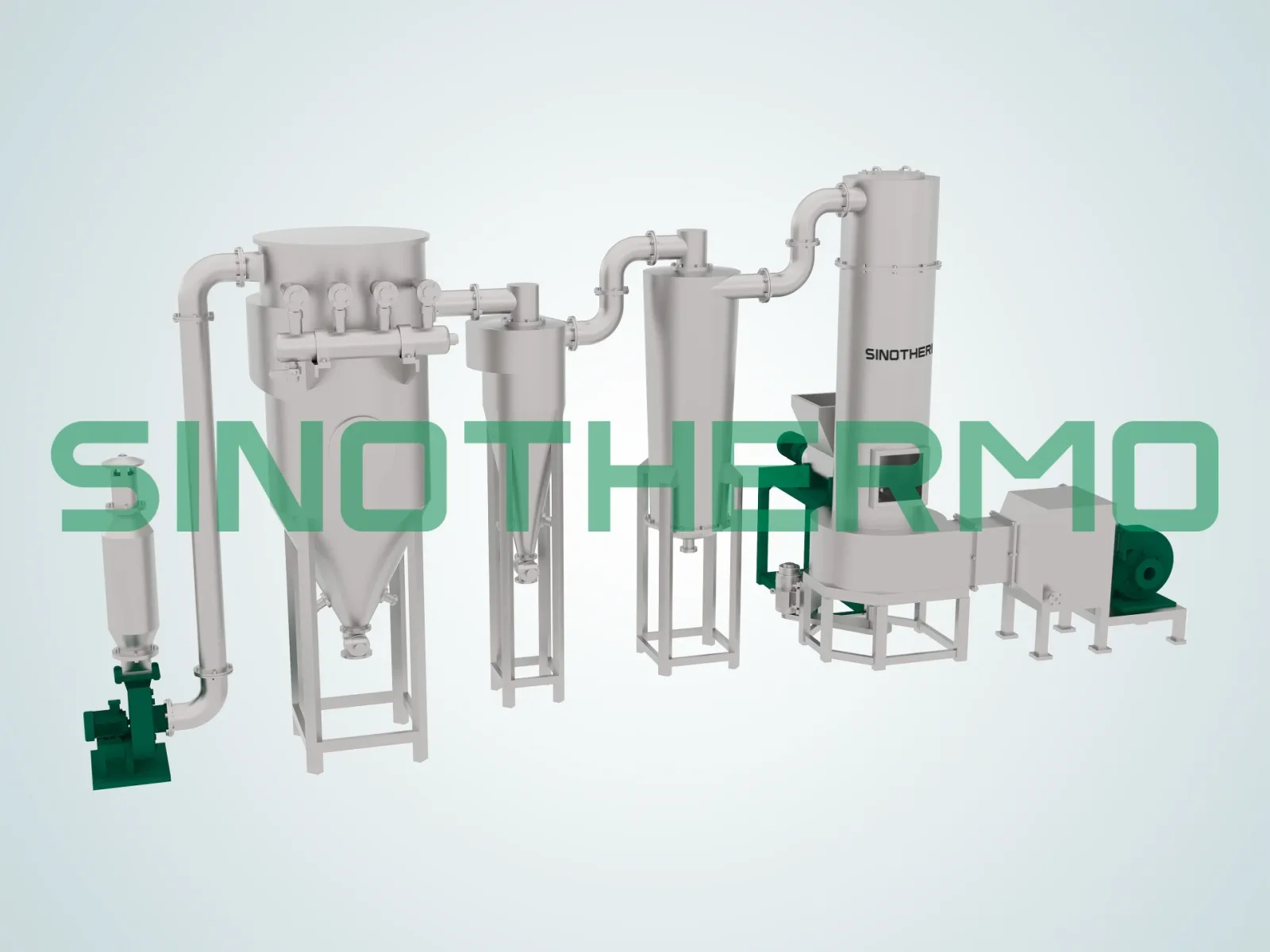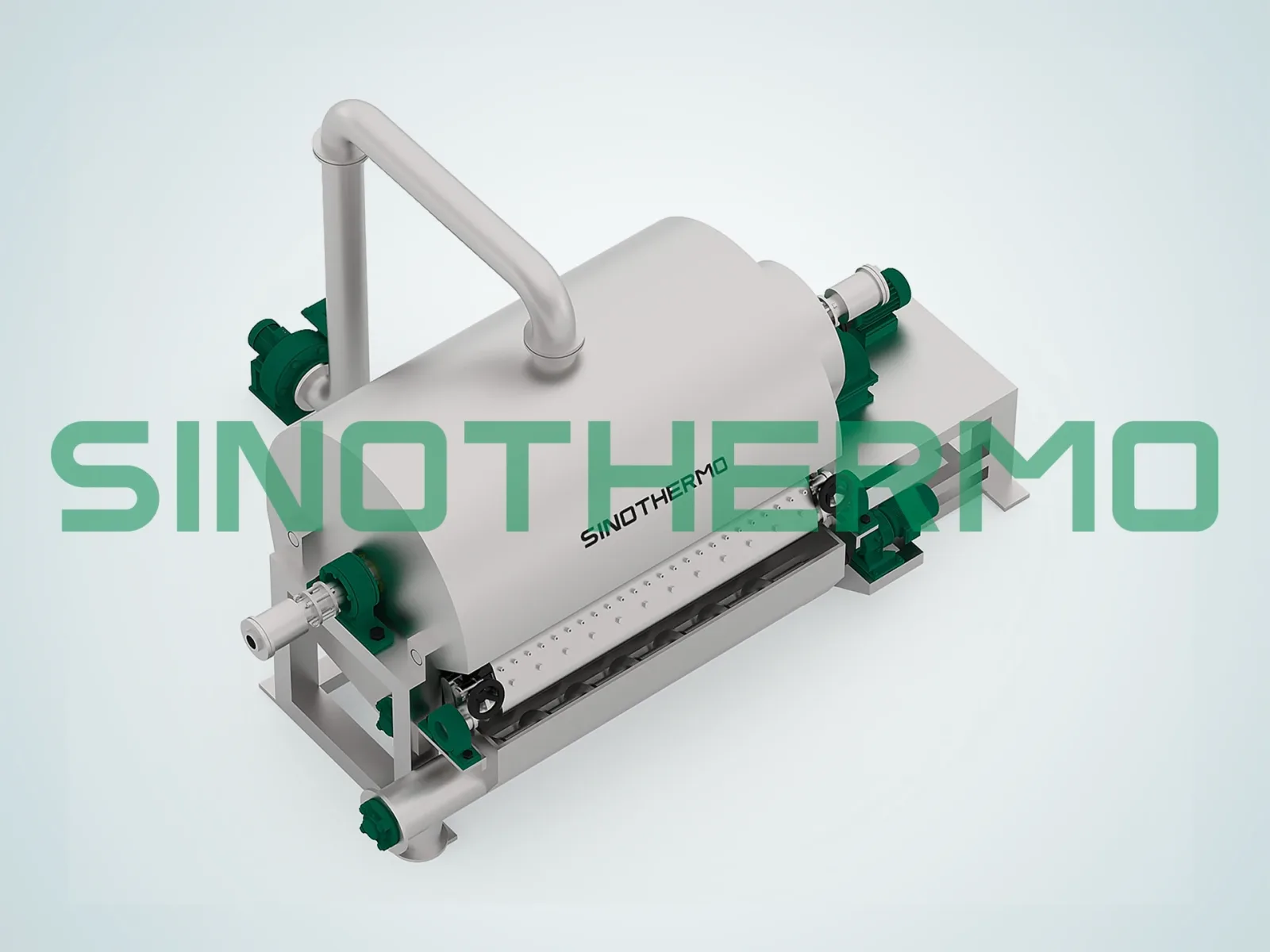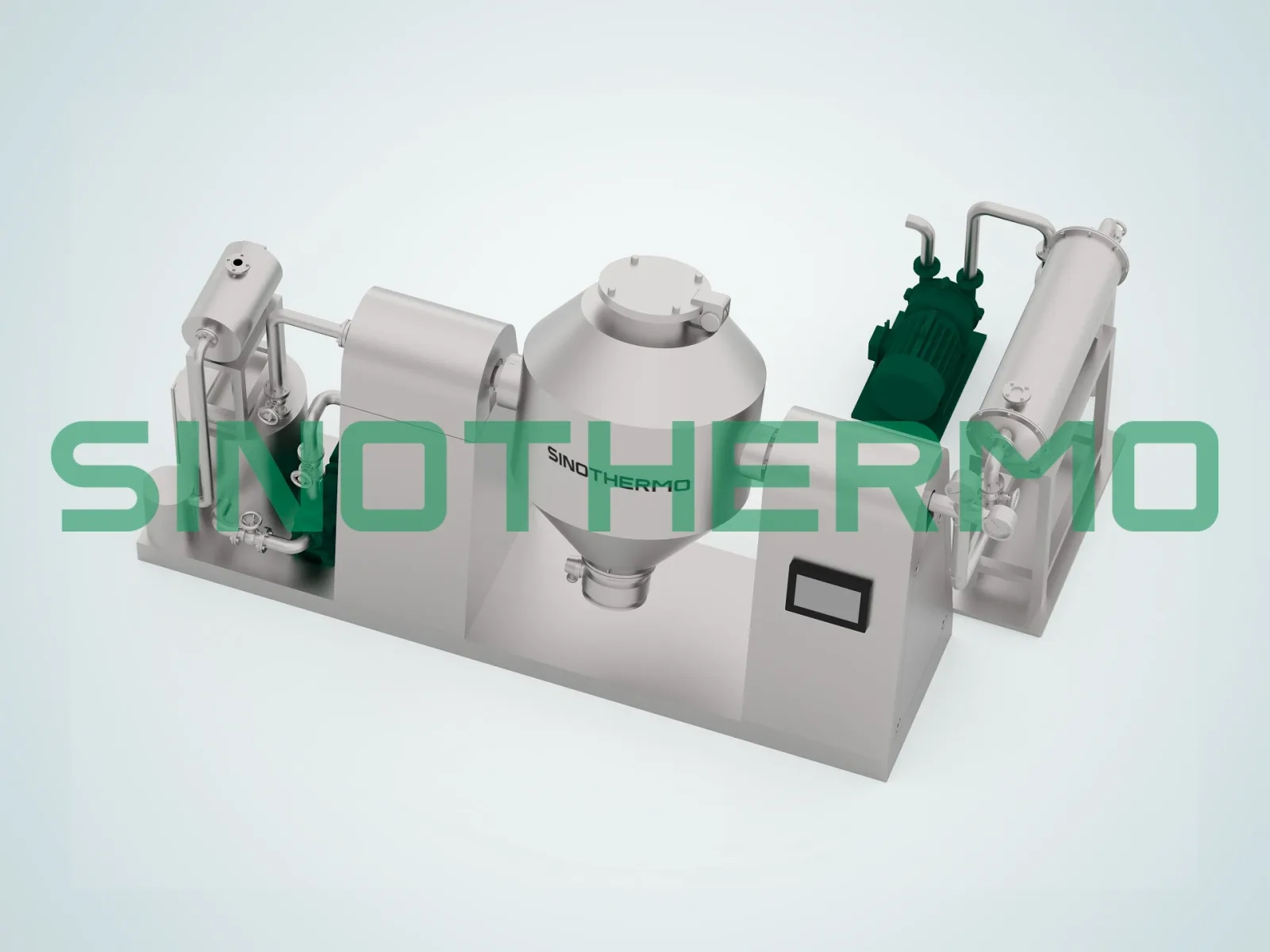
A rotary cone vacuum dryer (RCVD) dries by conduction, not convection: the double-cone vessel rotates slowly under vacuum while heat passes through its jacketed wall, so the charge tumbles against a heated surface at a boiling point you have lowered deliberately. That is why it is the default batch dryer for heat-sensitive, oxidation-prone and solvent-wet materials. But the item you are quoting is not one machine — it is a dryer, a dust filter, a condensing train, a receiver and a vacuum end, and two quotations are comparable only when all five appear in both.
Written for the shortlisting stage.
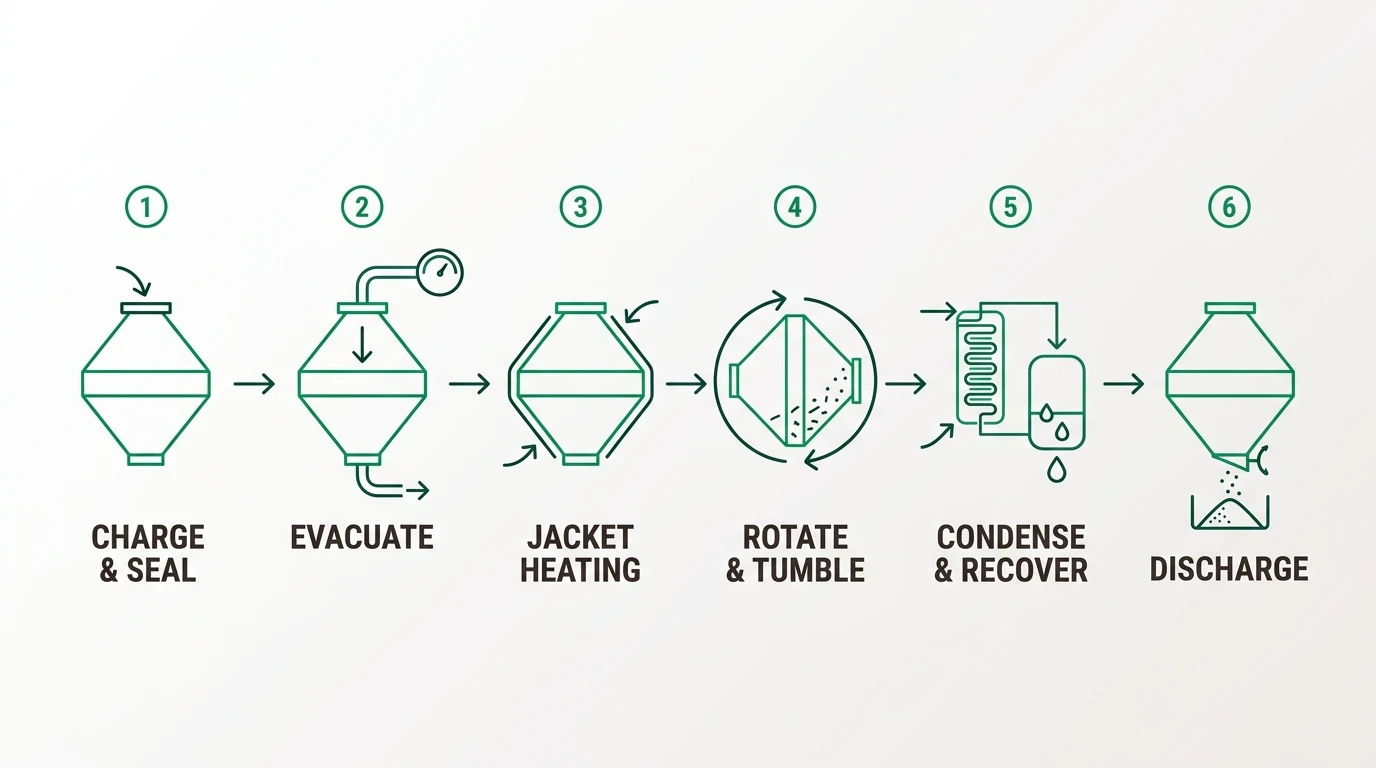
What actually happens in an RCVD cycle
- 1.Charge and seal. Wet cake, crystals or powder enters through a sealed connection — on flammable duties an open manway admits air to a vessel about to hold solvent vapour.
- 2.Evacuate. The vacuum system pulls the vessel down, lowering the boiling point of the solvent — why the product never needs a damaging jacket temperature.
- 3.Heat through the jacket. Hot water, steam or thermal oil conducts heat through the wall; no hot gas touches the product.
- 4.Rotate and tumble. The vessel turns slowly enough that the charge cascades rather than rides the wall — renewing material at the heated wall, breaking the crust that would case-harden it.
- 5.Condense. Vapour leaves through a dust filter, condenses, and drains to a receiver, where the solvent becomes an asset rather than an emission (full loop).
- 6.Discharge. The cone drains through the bottom valve with little retention — why this geometry suits high-value products.
Step 4 is the technical case for the machine; steps 5 and 6 are where quotation prices differ.
Why tumbling under vacuum beats a static vacuum oven
Most buyers reach an RCVD after a static vacuum oven failed on residual specification.
| Static vacuum oven / tray | Rotary cone vacuum dryer | |
|---|---|---|
| Heat transfer | Tray contact only; poor through a static bed | Continuously renewed at the heated wall |
| Uniformity | Over-dried surface, wet core — the normal failure | Uniform across the whole charge |
| Case hardening | Common on filter cakes | Broken up mechanically by tumbling |
| Cycle time | Long; falling-rate period stretches badly | Substantially shorter, same charge |
| Discharge | Manual tray handling | Near-complete gravity discharge |
| Scale-up value | Poor — no surface renewal to scale from | Good, if trialled in a tumbling unit |
A tray-oven trial cannot predict an RCVD cycle time — the mechanism that makes it fast, surface renewal, doesn't exist in an oven.
On numbers. Vacuum level, jacket temperature, cycle time and achievable residual vary enormously with the material. Every brochure figure — including ours — is a typical design target, confirmed on your own material by trial.
Fill ratio and working volume: where "capacity" gets overstated
This is the most common way an RCVD quotation misleads a buyer — usually a units problem, not dishonesty.
A double cone cannot be filled. Tumbling needs room to cascade; overfill it and the material rotates as a plug, surface renewal stops, and you have bought a rotating vacuum oven. The usable fraction is a design target confirmed by trial, not read off a table. That leaves three numbers quotations routinely mix: geometric volume (the largest number, and the one likely to appear as a headline capacity), working volume (geometric volume × achievable fill ratio — the only volume you can actually load), and batch mass (working volume × the bulk density of your wet feed, not the dried product).
Write the check into the enquiry: confirm the geometric volume, the fill ratio assumed, the resulting working volume, and the wet-feed bulk density used for the quoted batch mass. With those four items, comparing quotations becomes arithmetic — the first place to check if one machine looks unexpectedly cheap per kilogram.
Verifying the other parameters a supplier quotes
Achievable vacuum is rated dry and leak-free; your vessel holds a wet, vapour-generating charge and real seals. Ask what pressure holds at the vessel, with the charge in it — a leaking system doesn't fail loudly, it quietly kills the condenser's heat transfer.
Heat transfer area is fixed by geometry, but the wetted area falls as the bed slumps — ask how a quoted cycle time accounts for that.
Condenser duty peaks early in the cycle; sizing on the average leaves it undersized exactly when the load arrives.
Residual specification: confirm the cycle time is stated to your limit, not a generic "dry".
The condenser and vacuum end are not accessories
A recurring tender pattern: one quotation is cheaper because it priced a bare dryer with the vacuum and condensing package as an option. That is not a saving — this package sets your recovery rate, emissions position and cycle time. Specify it in the same scope as the dryer: the dust filter before the condenser; condenser duty, sized on peak vapour load; the receiver, emptied without breaking vacuum mid-cycle; the vacuum pump type, each carrying different cross-contamination risk; and the vacuum-break medium — nitrogen, not air, since air into a hot vessel holding solvent vapour and dry powder recreates the ignition conditions the design exists to prevent.
See inert gas drying for battery materials, the conduction and vacuum dryer category, and the industrial vacuum dryer guide.
Specification checklist
Every row here has changed a scope or price after award, when left out at tender.
| Item to confirm | Why it decides the outcome |
|---|---|
| Geometric / fill ratio / working volume | Only one number is actually loadable |
| Wet-feed bulk density for batch mass | Dry-basis density inflates the quoted batch |
| Vacuum held at the vessel, with charge | Sets the boiling point, so the thermal regime |
| System leak test on handover | A quiet leak kills the condenser, not the gauge |
| Condenser duty basis — peak or average | Average sizing fails in the constant-rate period |
| Dust filter type and cleaning method | Decides whether recovered solvent is reusable |
| Vacuum pump type and vent destination | Cross-contamination and emissions live here |
| Contact parts — 316L or specialty alloy | Corrosive duties rule out standard grades |
| Internal agitator / lump-breaker: yes/no | Strong agglomerators won't break by tumbling |
| Cycle time stated to your residual limit | Otherwise you compare different endpoints |
Common mistakes to avoid
- Comparing geometric volume against working volume. The most expensive error in this equipment class.
- Treating vacuum and condensing as options. They are the machine — priced separately, they shift the recovery shortfall to you.
- Sizing the condenser on average evaporation rate. Vapour load peaks early, exactly where average sizing leaves you short.
- Scaling from a static tray-oven trial. No surface renewal means a different mechanism — our pilot test checklist covers what to bring instead.
- Assuming vacuum alone makes a flammable duty safe. Charging, discharge and vacuum-breaking all admit air; nitrogen purge and hazardous-area classification stay in scope regardless.
- Ignoring mid-cycle behaviour. Cakes often pass through a sticky phase between paste and powder that decides whether you need a lump-breaker, or a different geometry entirely.
Where an RCVD fits — and where it does not
Good fit: pharmaceutical APIs and solvent-wet filter cakes; fine chemicals such as dyes and catalysts; food/nutraceutical powders intolerant of hot-gas contact; battery materials needing oxygen-excluded drying. Throughput gains are covered in production efficiency with double cone dryers — the better read if your question is output, not specification.
Look elsewhere when: you need continuous operation (how to choose an industrial dryer); or the material stays a high-viscosity paste (vacuum horizontal disc dryer).
Model range and discharge options are on the double cone rotary vacuum dryer product page.
Frequently asked questions
What is a rotary cone vacuum dryer used for?
Drying heat-sensitive, oxidation-prone and solvent-wet materials at low temperature — most commonly pharmaceutical APIs, fine chemicals, and high-value powders needing solvent recovery and closed handling.
How does a rotary cone vacuum dryer work?
The double-cone vessel rotates slowly while its jacket is heated and the interior held under vacuum. Vacuum lowers the boiling point so moisture or solvent evaporates at low temperature, while tumbling continuously renews contact with the heated wall, keeping drying uniform and preventing case-hardening. No hot gas contacts the product.
What is the advantage of a rotary cone vacuum dryer over a vacuum oven?
Tumbling renews the heat-transfer surface continuously — far more uniform drying, no case hardening, a shorter cycle, and near-complete gravity discharge. A static oven relies on conduction through an undisturbed bed, so the surface over-dries while the core stays wet, and trays must be handled manually.
How do I work out the real batch size of a rotary cone vacuum dryer?
Resolve three numbers. Geometric volume is the vessel's internal volume. Working volume is geometric volume × fill ratio, because a double cone must be charged well below full for the material to tumble rather than rotate as a plug. Batch mass is working volume × the bulk density of your wet feed, not the dried product. Ask a supplier for all four items — otherwise you may compare a geometric volume in one quotation against a working volume in another.
Can a rotary cone vacuum dryer recover solvent?
Yes — a primary reason it is chosen for solvent-wet filter cakes. Vapour leaves the sealed vessel through a dust filter, condenses, and collects in a receiver for reuse instead of being vented. The recovery rate is set by the whole loop, not the dryer: condenser duty sized on peak rather than average vapour load, coolant suited to the lightest solvent, and no air in-leakage.
Does a rotary cone vacuum dryer need an internal agitator?
It depends on the material. Free-flowing crystals and moderately cohesive cakes tumble adequately on the vessel's own rotation. Materials that agglomerate strongly, or pass through a pronounced sticky phase, can form lumps tumbling alone won't break, and need an agitator or lump-breaker — decided by trial, not assumed at the design stage.
Prove the cycle before you sign the order
The two numbers that decide an RCVD project — cycle time to your residual specification, and the batch mass you can genuinely load — are properties of your material, not the vessel.
SINOTHERMO operates an in-house pilot laboratory with tumbling vacuum units for customer trials. We run the drying curve under vacuum, measure residual against cycle time, and confirm the vapour load so the condensing train is sized on measured data. Flammable or oxidation-sensitive trials run inerted. Backed by 20+ years of experience, our engineers specify the vessel, filter, condenser duty and vacuum end as one system. See our testing lab, or talk to an engineer.
Request a pilot test — bring your actual wet cake or powder and we will measure the cycle, not estimate it.
Conclusion
An RCVD earns its place by lowering the boiling point so the product never overheats, and tumbling the charge so the heated surface stays continuously renewed instead of blocked by a case-hardened crust.
The commercial case is decided elsewhere: resolve every quoted capacity into a working volume and a wet-feed bulk density, keep the filter, condenser, receiver and vacuum end in the same scope as the dryer, and treat every brochure figure as a design target confirmed by trial.
Specifying a rotary cone vacuum dryer, or checking a quotation you already have? Send us your material — our pilot lab will confirm the working volume, the vacuum and temperature window, the cycle time and the vapour load, before the design is frozen.
✉️ mark.gu@sinothermo.com · 📱 WhatsApp: +86 180 2197 2660 · 🌐 www.sinothermo.com
SINOTHERMO — Process Engineering Infrastructure.

Mark Gu
Passionate about enhancing customer experiences and streamlining operations, Mark focuses on building strong relationships, fostering innovation, and leading teams to achieve exceptional service and efficiency.
Email: mark.gu@sinothermo.com
Phone: +86 18021972660