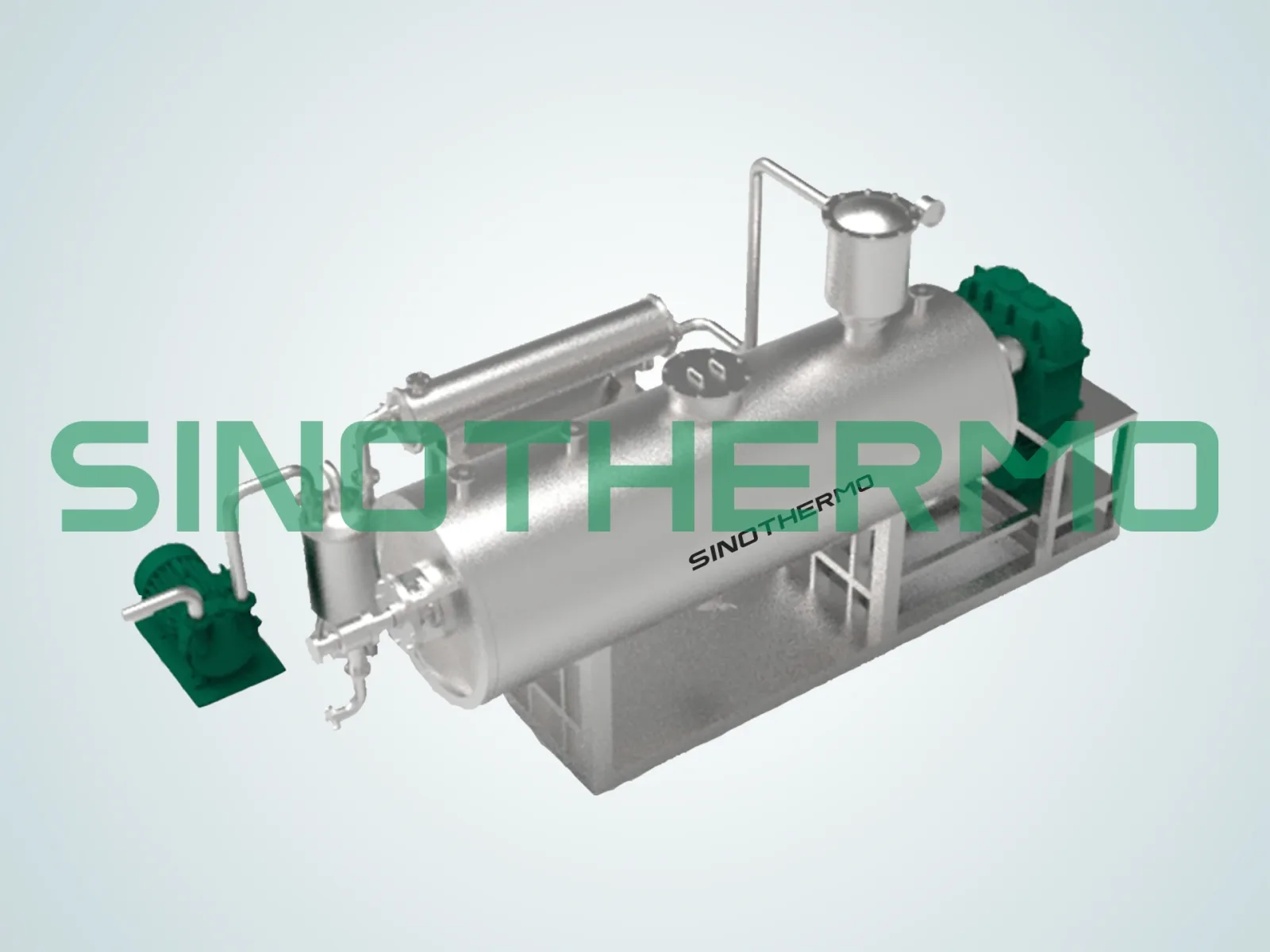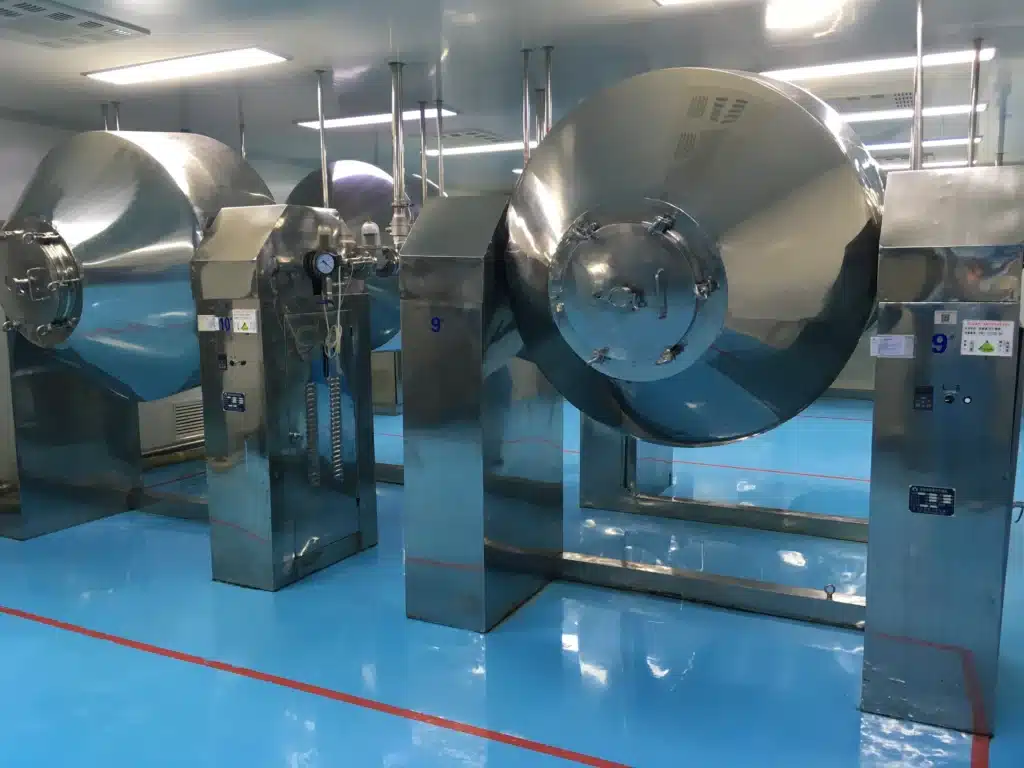
A double cone dryer — also called a rotary cone vacuum dryer — is a batch dryer whose entire double-cone-shaped vessel rotates under vacuum. Tumbling continuously renews material against the heated wall, giving far better heat transfer than a static dryer while causing very little particle damage. It suits free-flowing powders and crystals, particularly solvent-wet pharmaceutical and fine-chemical products.
How does a double cone dryer work?
The vessel is charged, sealed, and evacuated. A jacket heated by hot water, steam, or thermal oil warms the wall while the vessel rotates slowly, tumbling the material. Under vacuum, moisture or solvent boils well below its atmospheric boiling point, which lets sensitive products dry at low temperature without thermal degradation. Vapour is drawn off to a condenser for recovery — important when the solvent is flammable, valuable, or environmentally regulated. Because the whole shell turns rather than an internal agitator, every part of the charge is exposed to the heated wall in turn, so the batch dries evenly instead of forming hot or dead zones. Once drying is complete, the cone geometry discharges the batch almost completely through a bottom valve.
What is a double cone dryer used for?
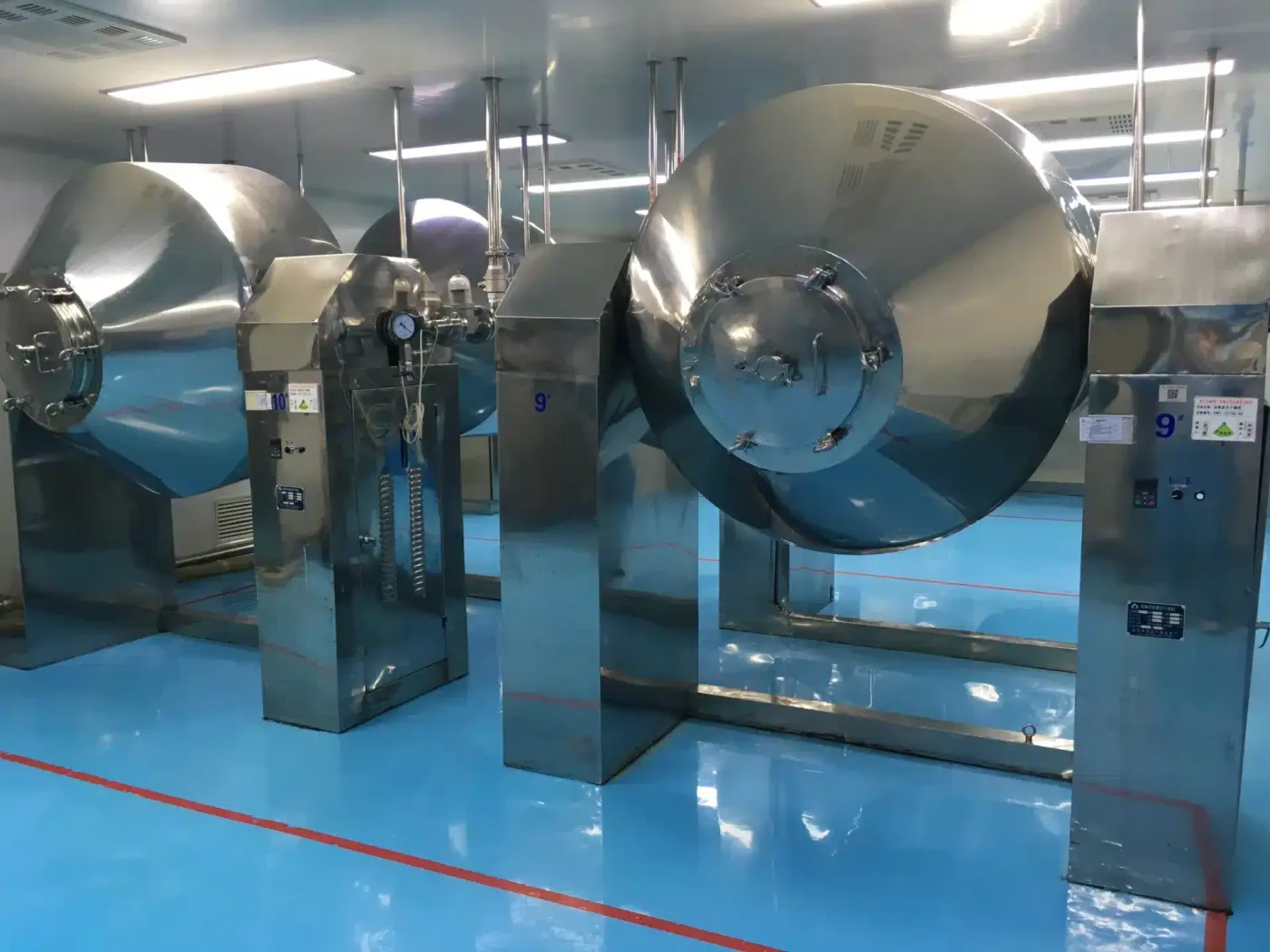
Double cone dryers are chosen for drying free-flowing powders, crystals, and granules under vacuum. Typical applications include solvent-wet pharmaceutical APIs and intermediates, fine chemicals and pigments, dyes, and battery materials that need low-oxygen or low-moisture handling. It's the right shape wherever particle integrity, easy cleaning, and near-complete discharge matter more than raw throughput — which is why it turns up as often in pharmaceutical GMP suites as in fine-chemical and specialty-materials plants. For the full range of options across static, screw, and paddle designs, see our vacuum dryer selection guide.
Double cone dryer vs other vacuum dryers
A double cone dryer is one of several vacuum batch-drying geometries, and the right choice depends on how the material behaves as it dries — not just on chamber size. The table below compares it against the alternatives.
| Double cone (rotary cone) | Vacuum tray (static) | Conical screw | Vacuum paddle | |
|---|---|---|---|---|
| Agitation | Whole vessel tumbles | None | Internal screw | Paddles |
| Moving parts in product | None | None | Screw + seal | Paddles + seal |
| Particle damage | Very low | None | Low–moderate | Moderate |
| Heat transfer | Good | Poor | Good | Very good |
| Typical cycle | 4–10 h | 8–24 h+ | 4–12 h | 2–8 h |
| Discharge | Near-complete, self-emptying | Manual trays | Good | Good |
| Cleaning | Easy — no internals | Easy | Shaft/seal access | More geometry |
| Best feed | Free-flowing powders, crystals | Fragile, small batch | General wet cakes | Pastes, sludges |
| Struggles with | Sticky material, wall caking | Everything, slowly | — | Fragile particles |
Why having no moving parts in the product zone matters
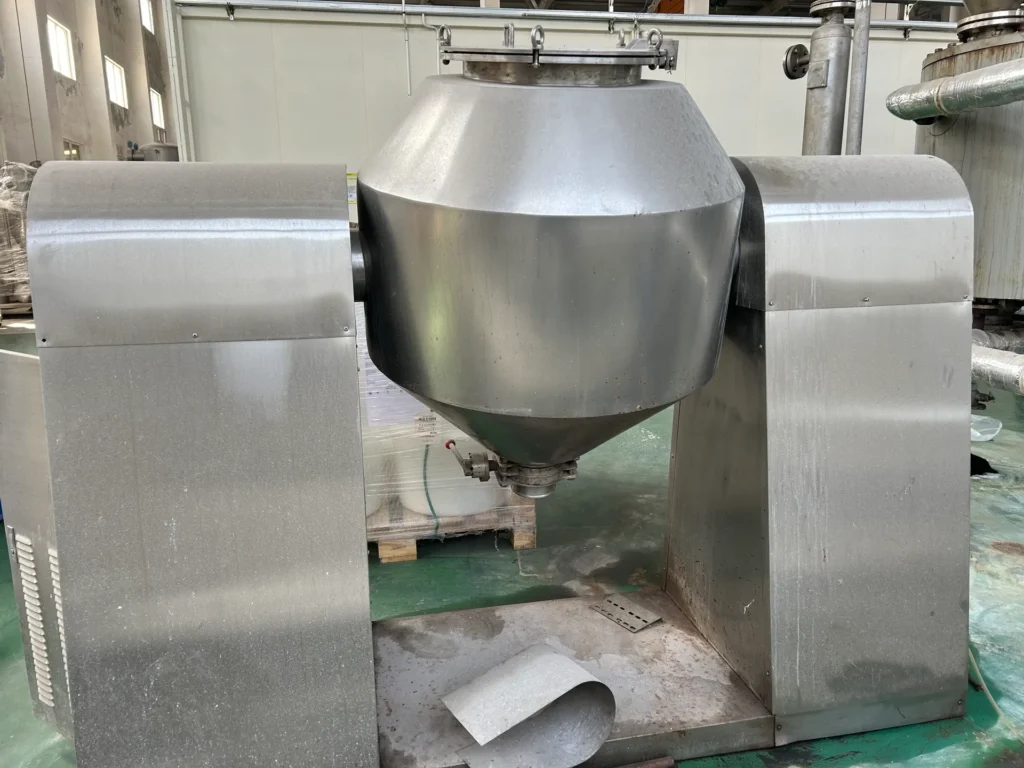
The double cone's genuine differentiator is that it has no moving parts inside the product zone. Heat transfer comes from rotating the whole vessel, not from an internal agitator.
- No shaft seal in contact with product — the usual contamination route and maintenance weak point is simply absent
- Nothing to disassemble for cleaning; the interior is a smooth vessel
- Very low attrition, so particle size distribution is preserved
- The cone geometry empties itself almost completely, which matters for potent or expensive product
This is why it's favoured for GMP pharmaceutical work: cleaning validation is much simpler when there's no agitator, no product-contact seal, and no dead space.
Where a double cone dryer struggles
If material sticks to the vessel wall rather than tumbling freely, the double cone loses its entire advantage: the wall coating insulates, heat transfer collapses, and the batch stalls. Material that passes through a sticky or dough-like phase during drying needs an agitated design — conical screw, paddle, or rake — that mechanically scrapes the wall. So the selection rule is simple: free-flowing throughout, choose a double cone; sticky phase at any point, choose an agitated design.
Double cone vs conical screw: how to choose
"Conical dryer" covers two unrelated machines, and buyers specify the wrong one often enough that the name itself is a selection risk. A double cone has no internal agitator — the whole vessel rotates. A conical screw vacuum dryer keeps the vessel static and uses an internal orbiting screw to lift and cascade the material. The double cone is gentler and far easier to clean, but it depends on the material staying free-flowing; a screw design mechanically works sticky or caking material that would defeat a double cone. See our conical vacuum dryer comparison for the full breakdown of screw versus rotary-cone geometry, including partial-batch handling and seal design.
Specification checklist: what to ask a supplier
- Vessel volume and typical batch fill level — cone dryers are usually specified at 50–70% fill, not full capacity
- Jacket heating medium and achievable temperature range (hot water, steam, or thermal oil)
- Vacuum level and condenser sizing for the actual solvent load, not just water
- Rotary seal design at the vessel drive shaft, and its rated vacuum and temperature limits
- Materials of construction and surface finish (316L and mirror-polish are common for pharmaceutical and fine-chemical duty)
- Discharge valve type and whether it supports contained, dust-tight unloading
- Explosion-proof rating and nitrogen inerting if solvent recovery is involved
- Cleaning validation documentation package, if the application is GMP-regulated
Frequently asked questions
What is a double cone dryer?
A batch vacuum dryer whose entire double-cone-shaped vessel rotates, tumbling material against the heated wall. Rotation continuously renews the material in contact with the heated surface, giving good heat transfer with very little particle damage and no moving parts inside the product zone.
How does a double cone dryer work?
The vessel is charged, sealed, and evacuated. A jacket heated by hot water, steam, or thermal oil warms the wall while the vessel rotates slowly, tumbling the material. Under vacuum, moisture or solvent boils well below its atmospheric boiling point, and vapour is drawn to a condenser for recovery. The cone geometry then discharges the batch almost completely.
What is the difference between a double cone dryer and a conical screw dryer?
A double cone dryer rotates the whole vessel and has no internals; a conical screw dryer keeps the vessel static and moves material with an internal screw. The double cone is gentler and far easier to clean, but material that sticks to the wall defeats it — that's where the screw design's mechanical scraping is needed.
What is a double cone dryer used for?
Drying free-flowing powders, crystals, and granules under vacuum — especially solvent-wet pharmaceutical APIs and intermediates, fine chemicals, dyes, and battery materials needing oxygen exclusion. It's chosen where particle integrity, easy cleaning, and complete discharge matter.
How long does a double cone dryer cycle take?
Typically 4–10 hours, depending on batch size, initial moisture, the liquid being removed, and jacket temperature. That's substantially faster than a static vacuum tray dryer (8–24 hours) because tumbling continuously renews the material against the heated wall, but slower than an agitated paddle or rake dryer on high-moisture feeds.
Not sure whether your material will tumble freely or pass through a sticky phase? That's exactly what our in-house pilot laboratory is for — we trial your actual material under vacuum and instrumented conditions before you commit to a design.
✉️ mark.gu@sinothermo.com · 📱 WhatsApp: +86 180 2197 2660 · 🌐 www.sinothermo.com · 💬 Request a pilot test
SINOTHERMO — Process Engineering Infrastructure.

Mark Gu
Passionate about enhancing customer experiences and streamlining operations, Mark focuses on building strong relationships, fostering innovation, and leading teams to achieve exceptional service and efficiency.
Email: mark.gu@sinothermo.com
Phone: +86 18021972660