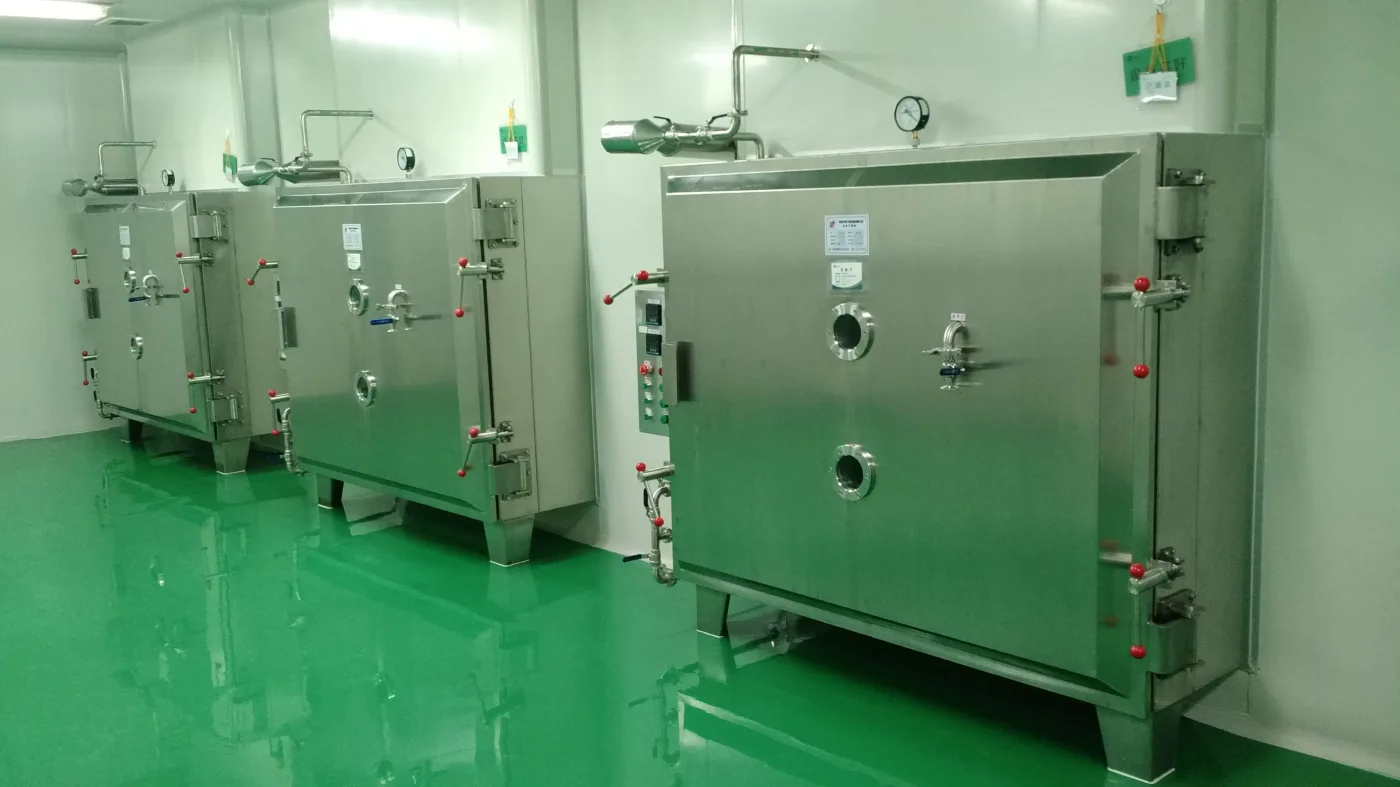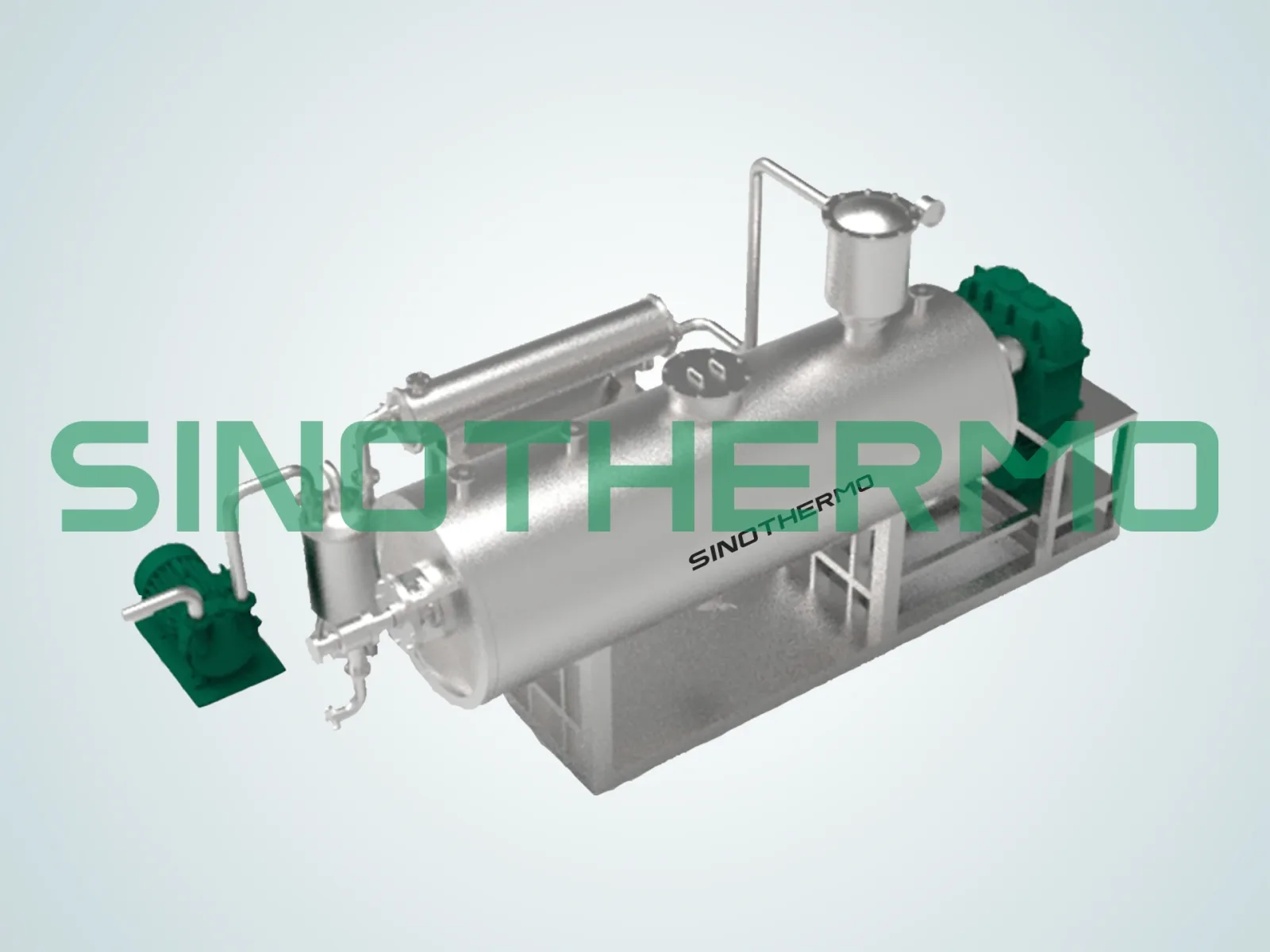
Both machines dry material under vacuum by sweeping it against a heated wall, and both are chosen for the difficult feeds that static and tumbling dryers cannot handle. The difference is the agitator: rake arms lift and turn material with minimal shear, while paddles shear and fold it. That makes the rake better for sticky, crusting cakes, and the paddle better for pastes and sludges that pass through a plastic phase.
If your material is free-flowing, neither is the right answer — a rotary cone or conical screw vacuum dryer will be cheaper and simpler. These two exist specifically for material that gives other dryers trouble.
Quick context: why two agitator designs exist for the same job
It would be simpler if one agitated vacuum dryer handled every difficult feed. It doesn't, because "difficult" splits into two genuinely different failure modes. Some cakes crust and cling to the wall as they lose moisture — a rigid, adherent layer that a gentle sweep needs to break mechanically. Other materials pass through a soft, dough-like phase where they want to ball up and roll rather than break apart — something a stiff scraper can stall on. Rake and paddle designs exist because no single agitator geometry handles both failure modes well, and misreading which one your material will do costs real money in an underperforming machine.
Why both exist
In any indirectly heated dryer, heat has to cross from the heated wall into the material. Dry powder is a poor conductor, so the layer touching the wall dries and then insulates everything behind it. Drying rate collapses.
Agitated vacuum dryers solve this by continuously scraping that layer away and replacing it with wet material. The heat-transfer coefficient stays high through the whole cycle, which is why these machines achieve 2–8 hour cycles where a static vacuum tray dryer would need 8–24 hours on the same material.
Where the two designs diverge is how they move the material — and different problem feeds need different handling.
Vacuum rake dryer
A horizontal cylindrical vessel with a shaft carrying rake or harrow arms that sweep close to the jacketed wall, lifting and turning material.
Best for:
- Sticky, cohesive materials that adhere to surfaces
- Cakes that crust or form a hard shell — the rake breaks it up mechanically
- Materials that change consistency dramatically during drying, starting very sticky and ending as free powder
- Fragile crystals where paddle shear would create too many fines
Characteristics:
- Lower shear than paddles, so less particle attrition
- Rake geometry scrapes the wall aggressively, resisting buildup
- Often includes reversible rotation to help break up caking
- Slightly less intensive bulk mixing, so temperature uniformity depends more on the sweep pattern
Vacuum paddle dryer
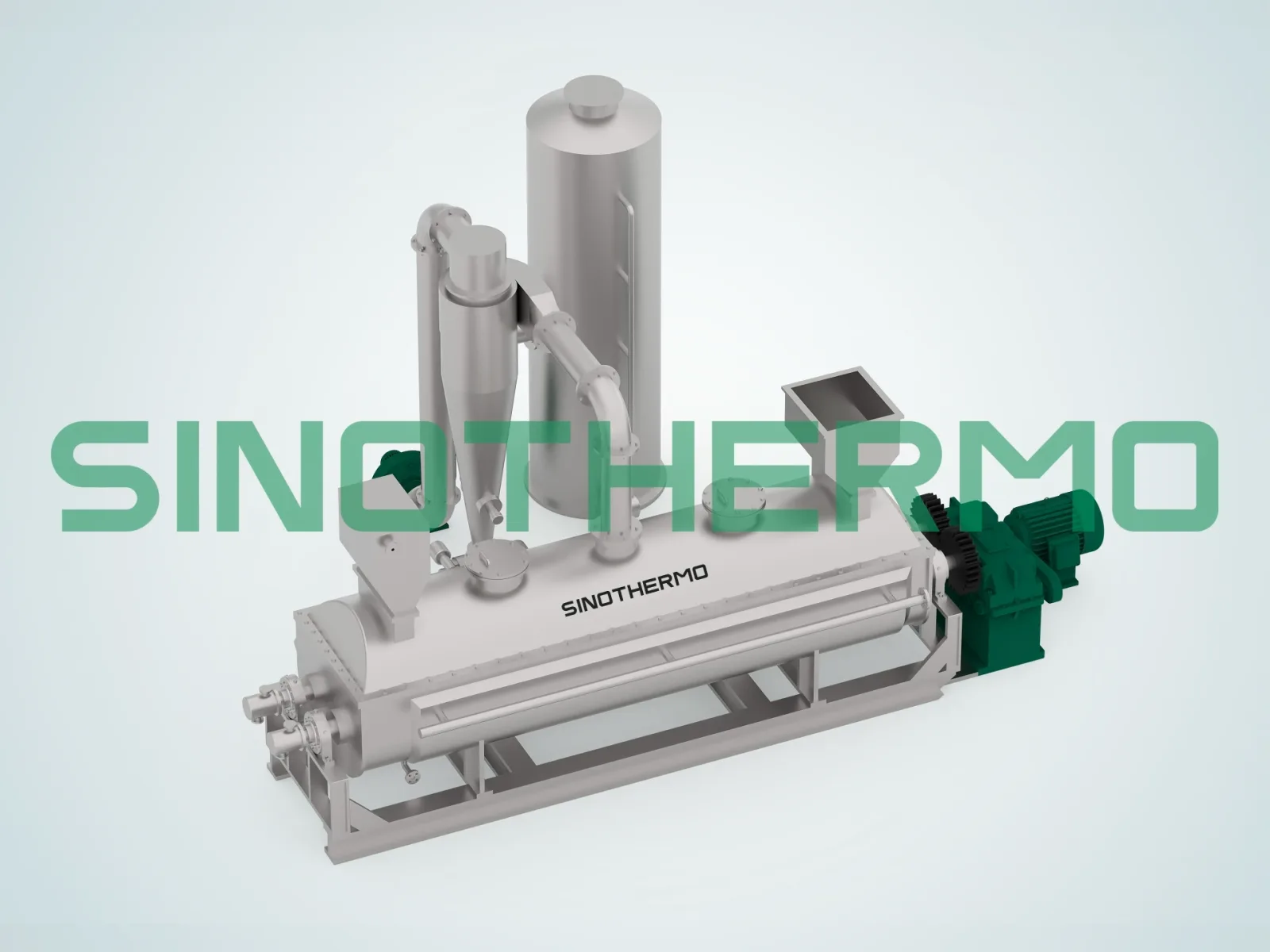
A horizontal vessel — often trough-shaped — with paddles on one or two shafts. Twin-shaft designs interlace for intensive mixing. Paddles and sometimes the shafts themselves are hollow and heated, which adds significant heat-transfer area beyond the jacket.
Best for:
- Pastes and sludges with high initial moisture
- Materials passing through a plastic or dough-like phase — paddles knead through it, where a rake can stall or ball up the material
- Cases where maximum heat-transfer area is needed in a given footprint (heated shafts and paddles can add 50–100% over jacket area alone)
- Feeds needing intensive mixing for uniform drying or in-process blending
Characteristics:
- Highest heat-transfer rates in the batch vacuum family
- More shear, so more particle breakage — good if you want a finer product, bad if particle integrity is specified
- Twin-shaft self-cleaning geometry reduces buildup
- Higher installed power and torque; drive and seals are the maintenance focus
Side by side
| Vacuum rake dryer | Vacuum paddle dryer | |
|---|---|---|
| Agitator | Rake / harrow arms | Paddles, single or twin shaft |
| Shear on product | Low | Moderate–high |
| Particle attrition | Low | Moderate |
| Handles sticky/crusting | Excellent | Good |
| Handles paste/plastic phase | Moderate — can stall | Excellent |
| Heat-transfer area | Jacket (+ arms) | Jacket + hollow shafts + paddles |
| Mixing intensity | Moderate | High |
| Typical cycle | 2–8 h | 2–8 h (often shorter at high moisture) |
| Installed power | Lower | Higher |
| Cleaning | Good access; arms are simple | Twin-shaft self-wiping, but more geometry |
| Capital cost | Lower | Higher |
The selection rule
What does your material do at its worst point?
Nearly every difficult drying job has a moisture range where the material is at its most awkward — sticky, doughy, or prone to balling. That window, not the start or end condition, decides the machine.
- Goes hard and crusty, adheres to the wall → rake. Its arms mechanically break the crust; a paddle may smear it.
- Goes plastic and dough-like, balls up → paddle. It kneads through; a rake can stall or wrap material around the arms.
- Stays free-flowing throughout → neither. Use a rotary cone or conical screw vacuum dryer and save the cost.
- Very high initial moisture (a pumpable sludge) → paddle, for the extra heat-transfer area from heated shafts and paddles.
- Fragile crystal, particle size specified → rake, for lower attrition.
This is exactly the question a pilot trial answers definitively. Predicting a material's plastic phase from composition is unreliable — two chemically similar filter cakes can behave completely differently.
Common applications
Vacuum rake dryer — pharmaceutical intermediates and APIs from solvent-wet cakes; dyes and pigments; speciality chemicals that crust; battery precursor materials requiring oxygen exclusion.
Vacuum paddle dryer — chemical sludges and high-moisture pastes; wastewater and industrial sludge where volume reduction is the goal; food pastes; materials needing simultaneous mixing and drying; solvent-wet cakes at larger batch sizes.
What to specify for either
- Total heat-transfer area broken out: jacket, shafts, paddles/arms separately
- Guaranteed cycle time at your inlet and outlet moisture, on your material
- Installed drive power and peak torque — material often peaks in torque at the sticky phase, and an undersized drive stalls there
- Shaft seal design — the main maintenance item and a contamination route; ask what type and expected service interval
- Reversible rotation for breaking up caking
- Achievable vacuum under peak vapour load, not just ultimate vacuum at idle
- Condenser and solvent recovery sizing
- Explosion protection to your zone classification
- Discharge design and residual heel — how much stays in the vessel
- Cleaning access to the shaft, seals, and paddle/arm roots
- Torque trending instrumentation — useful as an in-process dryness indicator
Common mistakes to avoid
- Guessing the plastic-phase behaviour from a data sheet. Two chemically similar filter cakes can behave completely differently as they dry — this has to be observed, not inferred from composition.
- Sizing the drive on average torque instead of peak torque. Material typically peaks in torque resistance right at the sticky phase; an undersized drive stalls exactly when you need it most.
- Treating shaft seal design as a minor spec line. It's the main maintenance item on both designs and a real contamination route — ask for the type and expected service interval explicitly.
- Choosing paddle for particle-sensitive product without checking attrition. Higher shear means more breakage; if particle size distribution is part of the specification, that trade-off needs to be made consciously, not discovered after commissioning.
- Comparing rake and paddle on heat-transfer area alone. A paddle's larger heat-transfer area doesn't help if your material's failure mode is crusting rather than sticking — the agitator geometry matching the failure mode matters more than raw surface area.
Where SINOTHERMO fits
We build both types, along with the rest of the vacuum range, so there's no need for the recommendation to be predetermined. In practice, which one suits a given cake is settled by a trial rather than an argument.
Our pilot lab runs your material and reports the drying curve, the torque profile through the sticky phase (which is what reveals whether rake or paddle is right), achievable final moisture or residual solvent, and the effect on particle size. Pilot testing is a paid pre-sales engineering service and the report is yours to keep — including the data needed to compare any supplier's quotation on equal terms.
Frequently asked questions
What is the difference between a vacuum rake dryer and a vacuum paddle dryer?
Both sweep material against a heated wall under vacuum, but rake arms lift and turn material with low shear, suiting sticky and crusting cakes, while paddles shear and knead, suiting pastes and sludges that pass through a plastic phase. Paddle designs also add heat-transfer area through hollow heated shafts and paddles.
What is a vacuum paddle dryer used for?
Drying high-moisture pastes, sludges, and solvent-wet cakes where intensive mixing and maximum heat-transfer area are needed — chemical sludges, industrial wastewater solids, food pastes, and larger-batch pharmaceutical intermediates. It handles materials that become dough-like during drying.
What is a vacuum rake dryer used for?
Drying sticky, cohesive, or crusting materials under vacuum at low temperature — pharmaceutical intermediates from solvent-wet cakes, dyes and pigments, speciality chemicals, and battery precursors needing oxygen exclusion. Its low-shear action also suits fragile crystals where particle size must be preserved.
Which is faster, a rake or a paddle dryer?
They overlap, with both typically in the 2–8 hour range, but a paddle dryer often wins at high initial moisture because heated shafts and paddles add substantial heat-transfer area. For a sticky, crusting material the rake can be faster in practice, because a paddle may smear material onto the wall and lose heat transfer.
How do I know which one my material needs?
Identify what the material does at its stickiest point during drying — crusting and adhering points to a rake, dough-like balling points to a paddle. Because this behaviour can't be reliably predicted from composition, a pilot trial that records the torque profile through the sticky phase is the dependable way to decide.
The torque profile through your material's sticky phase is what decides rake or paddle. We'll measure it.
✉️ mark.gu@sinothermo.com · 📱 WhatsApp: +86 180 2197 2660 · 🌐 www.sinothermo.com · 💬 Request a pilot test
SINOTHERMO — Process Engineering Infrastructure.

Mark Gu
Passionate about enhancing customer experiences and streamlining operations, Mark focuses on building strong relationships, fostering innovation, and leading teams to achieve exceptional service and efficiency.
Email: mark.gu@sinothermo.com
Phone: +86 18021972660