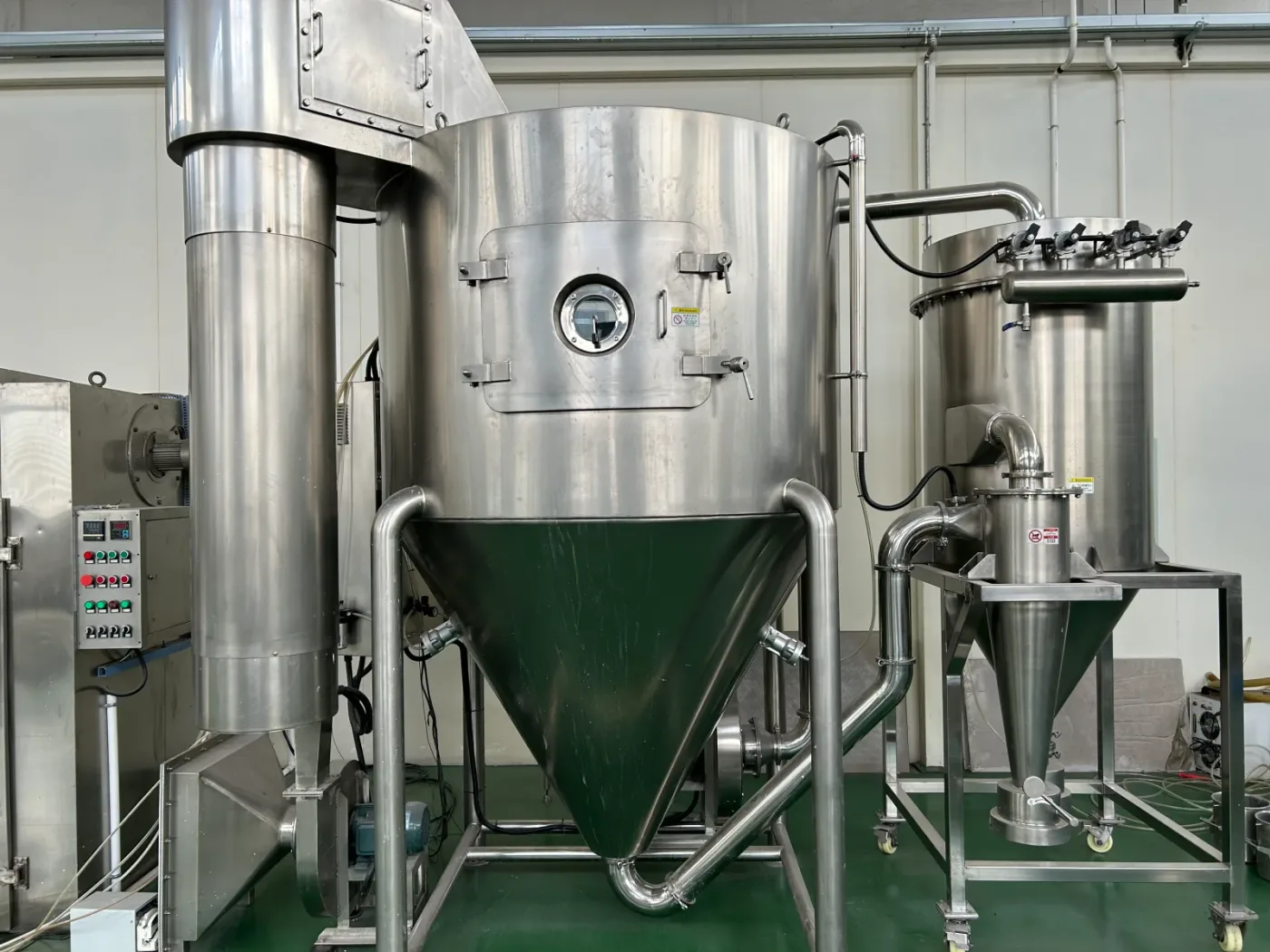
A drying pilot test answers the one question no datasheet can: how does your material behave when it is actually dried? Running one well takes seven steps — define what the trial must prove, prepare a representative sample, supply the material and safety data, agree the test plan and acceptance criteria, run the parameter sweep, read the results, and convert them into an equipment specification. This checklist walks through all seven so the trial you book produces data you can actually buy equipment with.
Most drying projects go wrong long before the machine arrives. They go wrong at the moment someone reads a generic drying curve for "a similar material" and treats it as a design basis. Two feeds with the same moisture content, the same solids loading, and a nearly identical composition can dry completely differently — one flows out of the chamber as free-flowing powder, the other coats the wall and blocks the discharge within twenty minutes. That difference is not in any catalogue. It is a property of your material, and the only reliable way to find it is to dry some.
This guide is written for the process or R&D engineer who is preparing to send material for a drying trial. Use it as a preparation checklist before shipping, and as a review checklist afterwards to confirm you received everything a trial should produce.
Why a trial beats a datasheet
A dryer datasheet describes what a machine can do under stated conditions. It cannot tell you which conditions your material tolerates, and that is the number that decides the size, the configuration, and ultimately the price of the plant.
Three things are almost impossible to predict from composition alone:
- The drying rate curve. Where the material leaves the constant-rate period and enters the falling-rate period determines how much residence time you need. Get this wrong and you buy a chamber that is either half-empty or hopelessly undersized.
- The sticky point. Many food, chemical, and biological materials pass through a temperature and moisture band where they become adhesive. That band defines the boundary of your operating window — and it is a measurement, not a lookup.
- The behaviour of the powder after drying. Bulk density, flowability, dust generation, agglomeration, and moisture re-pickup determine your separation, conveying, and packing design, not just the dryer itself.
A trial also produces something commercially useful: a defensible basis for a firm quotation. Sizing built on measured evaporation and residence time is far more accurate than sizing built on assumption, which is why trial data usually narrows a price range rather than widening it. If you are working through budget approval in parallel, our breakdown of what drives spray dryer cost shows which of these variables actually move the number.
The 7-step pilot test checklist at a glance
| Step | What it covers | Who owns it |
|---|---|---|
| 1 | Define what the trial must prove | You |
| 2 | Prepare and ship a representative sample | You |
| 3 | Supply the material and safety data package | You |
| 4 | Agree the test plan and acceptance criteria | Both |
| 5 | Run the trial and sweep the parameters | Us |
| 6 | Analyse the product and issue the data package | Us |
| 7 | Convert trial data into an equipment specification | Both |
Step 1: Define what the trial must prove
A trial without a written question produces a folder of numbers that nobody can act on. Before anything ships, write down four things.
The output specification that actually matters. Not "dry powder" — a number, with the method attached. Final moisture, and whether that is loss-on-drying at a stated temperature and time or Karl Fischer. Particle size distribution and the measurement technique. Bulk and tapped density. Flowability. Solubility or dispersibility if the product is reconstituted. Residual solvent if one is present. Colour, if colour is a quality attribute.
The constraint that worries you. Heat sensitivity, stickiness, oxidation, abrasiveness, dust explosion risk, solvent recovery, or a hygroscopic product that reabsorbs moisture before packing. Naming it upfront changes the test plan; discovering it on trial day wastes the sample.
The throughput you are heading for. Evaporation rate and product rate at production scale, batch or continuous, and the operating hours per year. A trial is only useful if the scale-up target is known while the data is being taken.
The decision the trial should unlock. There are three common ones, and they call for different test plans: choosing between two dryer families, confirming a single family already chosen, or establishing a scale-up basis for a firm quotation. Say which one you are in.
Step 2: Prepare and ship a representative sample
This is the step that most often quietly ruins a trial. The single most common failure is not the quantity — it is representativeness.
Send the material in the state it will actually enter the dryer. If production will feed wet cake straight off a filter press or centrifuge, send wet cake at that moisture, not a dried reference sample that someone re-wetted in the lab. A re-slurried powder has a different particle structure, a different bound-moisture profile, and often dries far more easily than the real feed. The trial will look excellent and the plant will not reproduce it.
Typical sample quantities
| Trial type | Typical sample range | Notes |
|---|---|---|
| Spray drying trial (liquid feed) | Roughly 5–20 L of feed at production solids | Or enough solids plus solvent to prepare it on site; more feed allows more parameter sets |
| Fluid bed or flash drying trial | Roughly 5–20 kg of the actual wet solid | Must represent the real wet-cake or granule state, not a dried reference |
| Vacuum, paddle, disc, or rotary trial | Roughly 5–20 kg of paste, cake, or sludge | Keep sealed so the as-received moisture is the real moisture |
| Multi-family comparison | Upper end of the ranges above, or a repeat shipment | Each family consumes its own material; one small batch cannot serve three trials |
These are typical ranges, offered as guidance only. The correct quantity for your material and test scope should be confirmed with our engineers before you ship — some materials need less, comparison trials and difficult feeds usually need more.
Packaging and shipping requirements
- Seal against moisture exchange. Sealed HDPE drums or jerricans, minimal headspace, double-bagged where practical. An unsealed pail arriving three weeks later no longer carries the moisture content you measured.
- Label every container with material name, batch, date sampled, as-sampled moisture or solids content, and your reference number.
- Declare hazards on the outside of the package, and match the paperwork to the contents. Flammable, corrosive, toxic, or dust-explosive materials need a correct dangerous-goods declaration or the shipment will be delayed or refused.
- Protect unstable material. If the feed ferments, separates, settles, or degrades, say so and state its usable window; chilled or frozen shipment may be appropriate. If a preservative was added, that is process-relevant information, not a detail.
- Allow margin for repeats. The most valuable trials are the ones where an unexpected result justifies a second run at adjusted conditions. Material is usually the limiting factor.
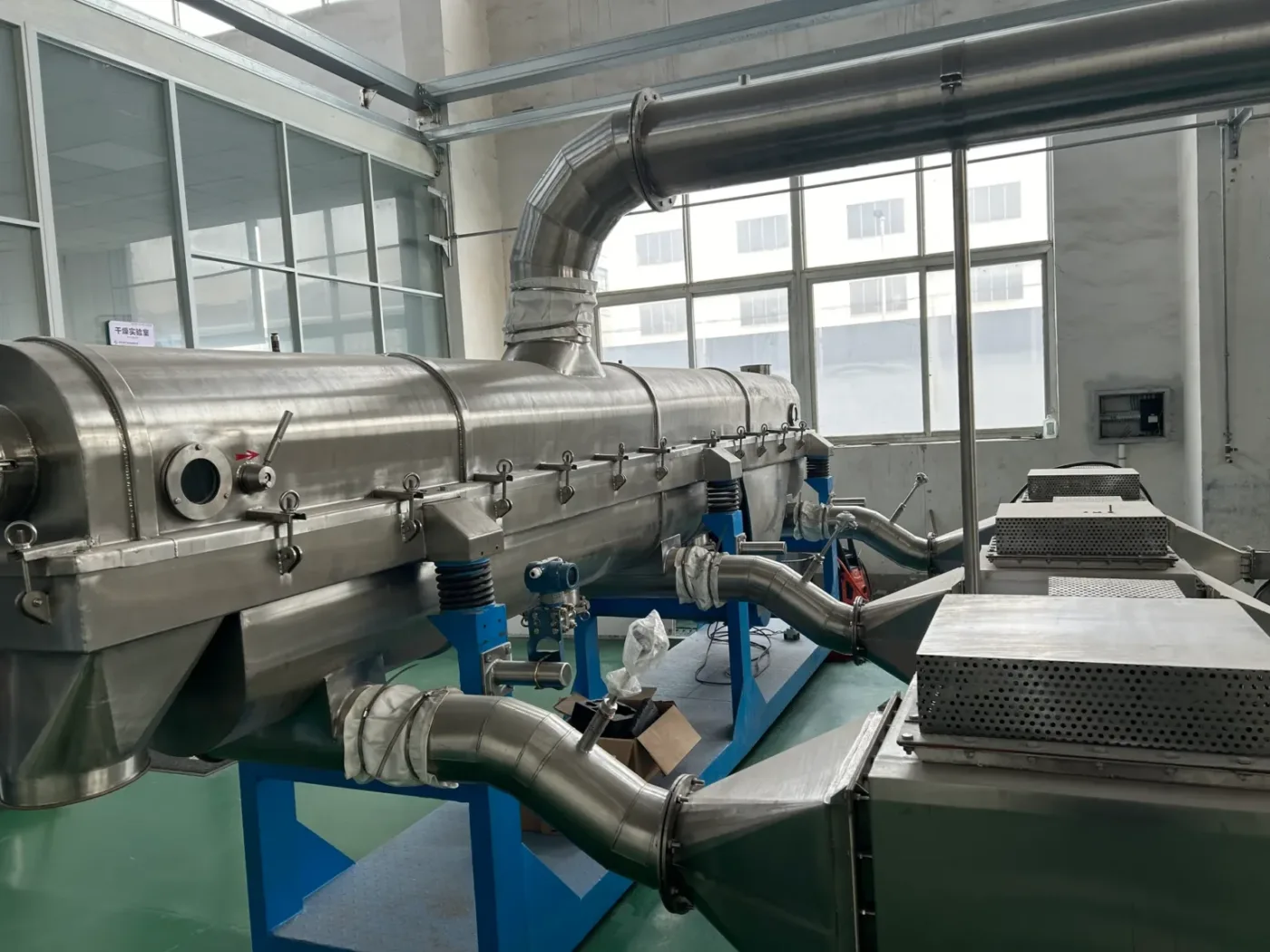
Step 3: Supply the material information package
The sample tells us how the material dries. The information package tells us what we are allowed to do to it, and what the result has to look like. Send it with the sample, not after.
- 1.Feed characteristics — solids content, viscosity and how it behaves under shear, density, pH, particle size if solid, presence of fibres or agglomerates, and abrasiveness. A shear-thinning feed and a shear-thickening feed of identical viscosity behave very differently at an atomiser.
- 2.Heat sensitivity — the maximum safe product temperature, known degradation, melting or glass-transition points, and the threshold at which colour or activity starts to change. If the limit is uncertain, say that too; establishing it can be part of the trial.
- 3.Target output specification — with measurement methods, as set out in Step 1. "Below 5% moisture" means two different things depending on whether it is measured by loss-on-drying or Karl Fischer, and the gap between them is often larger than the tolerance.
- 4.Throughput target — evaporation rate and product rate, batch or continuous operation, and expected annual running hours.
- 5.Atmosphere and safety requirements — inert gas needs and oxygen limits, dust explosion data such as Kst and minimum ignition energy where available, solvent identity and whether it must be recovered, and any classified-area constraints.
- 6.Regulatory and materials context — GMP, food-grade, or pharmaceutical requirements, contact-material restrictions, and the cleaning regime the machine has to survive. These change materials of construction, surface finish, and access design, and they are far cheaper to design in than to retrofit.
- 7.Upstream and downstream context — what dewaters the material before the dryer, and what happens after it: milling, blending, cooling, conveying, packing. Drying is one step in a train, and the best drying result is not always the best plant result.
- 8.Site utilities — available steam pressure, gas, electrical capacity, chilled water, and compressed air. These shape the heating method long before they shape the quotation.
An SDS or equivalent safety data sheet is required for any hazardous, flammable, corrosive, toxic, or dust-explosive material. Without it, the trial cannot be planned or run safely, and it will not be run at all.
Step 4: Agree the test plan and acceptance criteria
Before the equipment is booked, both sides should agree in writing on:
- Which dryer family or families will be trialled, and why those.
- How many parameter sets will be run, and which variables are being swept.
- What will be measured, by which method, and where — in-house during the trial, or in your own laboratory afterwards on returned samples.
- The acceptance criteria — the numeric result that would count as success, written before the data exists rather than negotiated after it.
- Confidentiality, sample handling, retention, and disposal or return of unused material.
Agreeing acceptance criteria in advance is what separates a trial from a demonstration. A demonstration shows that the machine runs. A trial establishes whether your material meets a specification you defined, and — just as usefully — where it stops meeting it.
Step 5: What happens during the trial
A well-run pilot trial has a predictable shape.
- 1.Check-in and safety review. The sample is verified against the declared description, the SDS is reviewed, and handling, containment, and cleaning are confirmed before any material is charged.
- 2.Baseline run. A conservative first condition establishes that the material feeds, dries, and discharges at all, and produces a reference point for everything after it.
- 3.Parameter sweep. Depending on the family, this means inlet and outlet temperature, feed rate, atomiser speed or nozzle pressure, gas velocity, residence time, jacket temperature, vacuum level, and agitator speed. Conditions are varied deliberately, one dimension at a time where possible, so the effect of each is attributable.
- 4.In-run observation. This is the data that never appears on a datasheet and is often the most valuable output of the whole exercise: wall build-up, stickiness, agglomeration, fines carryover into the separation stage, discolouration, discharge behaviour, and how hard the machine is to clean afterwards.
- 5.Sampling and labelling. Product is taken at every condition, labelled against its parameter set, and retained so results can be traced back to the settings that produced them.
The conditions that fail are as informative as the ones that succeed. The temperature at which the product turns sticky, or the feed rate at which the outlet moisture stops meeting spec, is precisely the boundary of your operating window — and knowing where the edge is prevents a plant that runs perfectly on paper and unpredictably in reality.
Step 6: What you receive
A pilot test should hand you a package, not a verbal opinion. Expect all of the following.
- Processed product samples from each condition, labelled and traceable, for your own quality evaluation and downstream testing.
- A parameter report listing the exact settings behind every sample: temperatures, feed rate, residence time, atomiser settings, gas flow, and vacuum or jacket conditions as applicable.
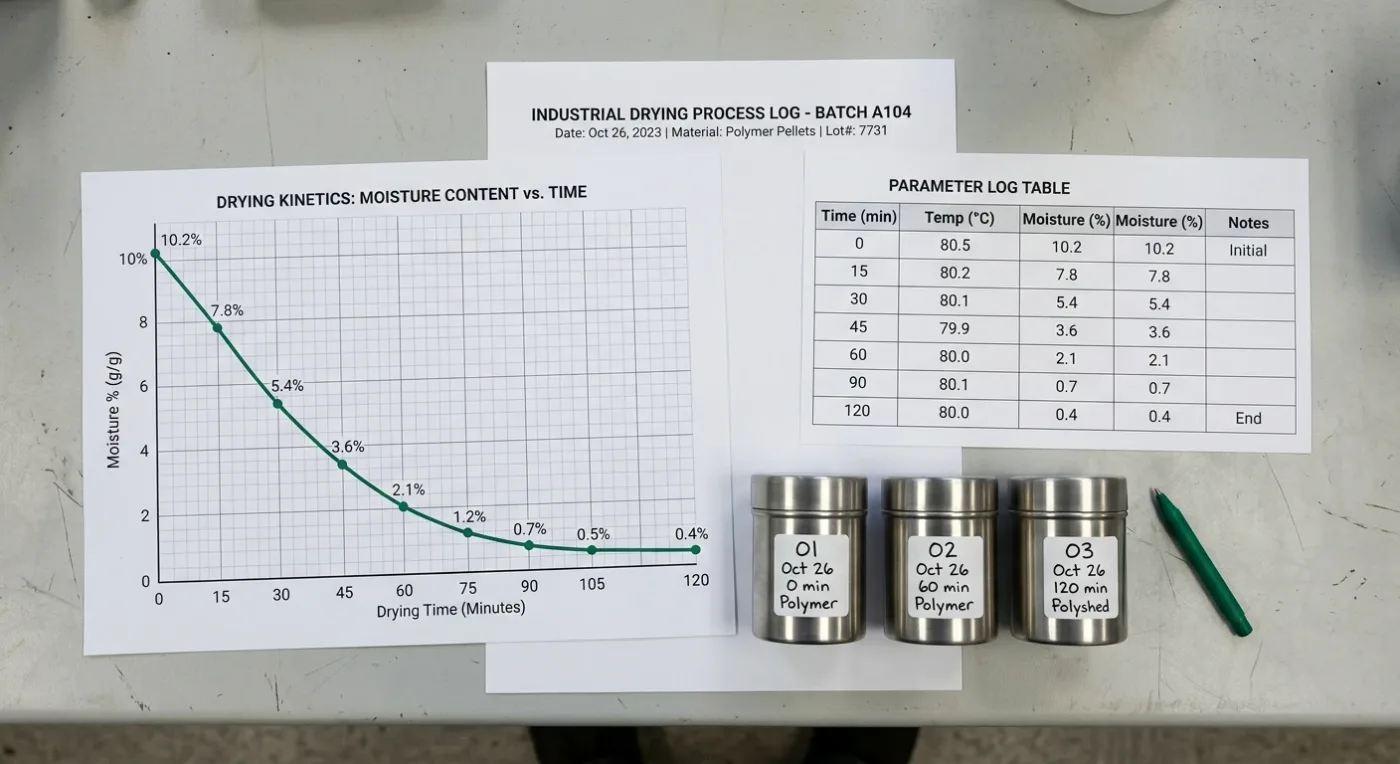
- Drying behaviour data specific to your material — the drying curve or equivalent process data, and the evaporation rate achieved.
- Product analysis covering the attributes agreed in Step 4: moisture, particle size distribution, bulk density, and the physical quality of the output.
- Operability observations — build-up, stickiness, fouling, dust behaviour, cleanability, and anything that surprised the engineers running it.
- An equipment recommendation and sizing basis for your target throughput, with the reasoning visible, so it can be reviewed rather than simply accepted.
That last item is the deliverable that matters commercially. It converts the trial into a quotation you can compare against alternatives on equal terms.
Step 7: From trial data to equipment specification
Trial data does not become a machine by itself. Scale-up is where the value is realised — or lost.
Know what scales and what does not. Evaporation rate, residence time, gas velocity, atomiser tip speed, and heat transfer area scale predictably. Wall effects, heat-loss-to-throughput ratio, and the ratio of surface to volume do not. A pilot chamber loses proportionally more heat than a production chamber, so raw pilot energy figures are not production energy figures.
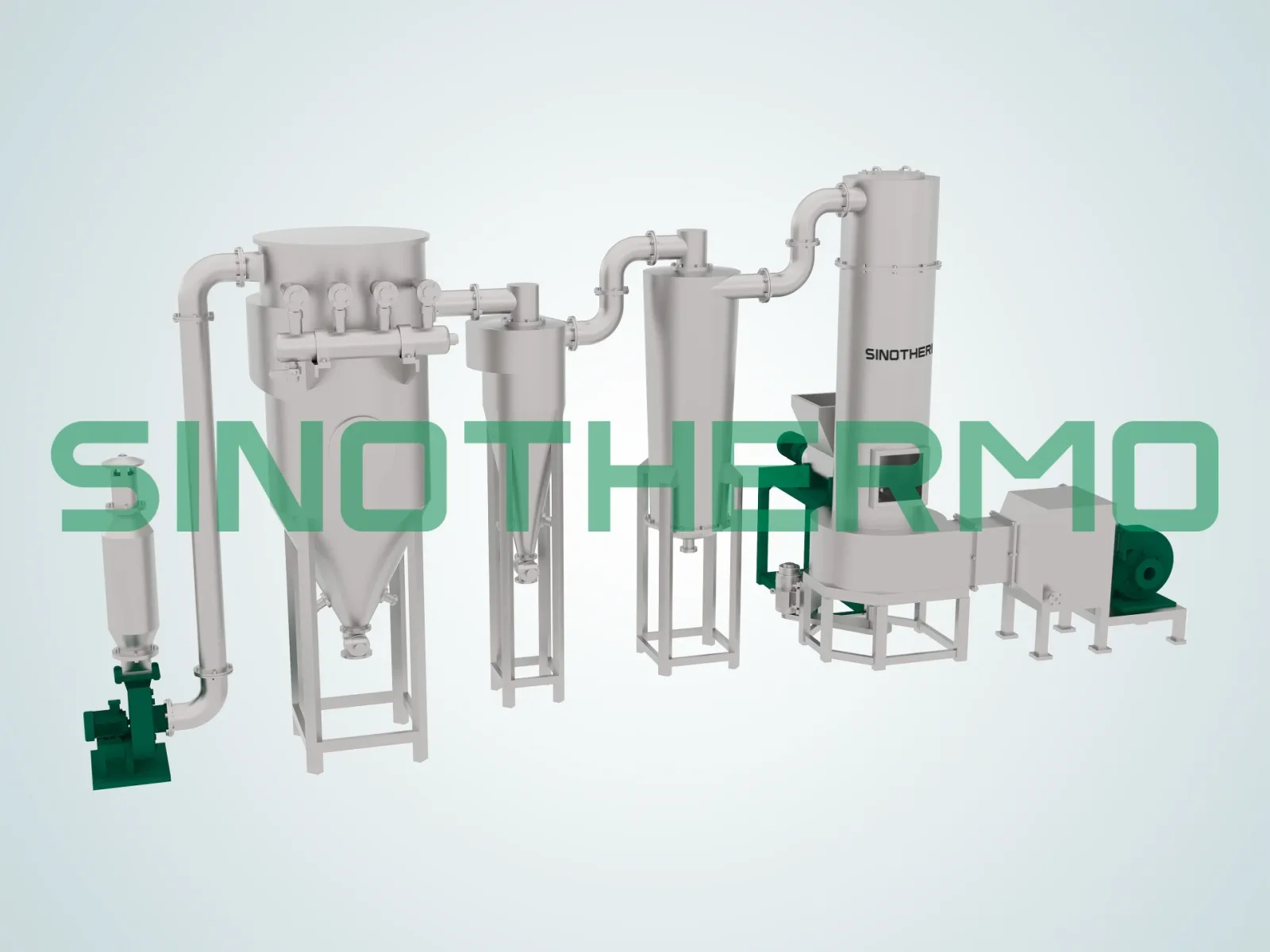
Design the whole train, not just the dryer. The trial usually reveals the auxiliaries: how much fines the cyclone will have to catch, whether a bag filter or scrubber is needed, whether the product needs cooling and inert conveying before packing, whether solvent recovery is required. Underspecifying the separation train is one of the most common ways a correctly sized dryer still fails to deliver a correctly performing plant.
Carry the constraints into materials of construction. Corrosivity, abrasiveness, hygiene class, and cleaning regime observed during the trial should appear in the specification, not in a change order after commissioning.
Apply a deliberate margin. Feed variability, seasonal changes, and future capacity all deserve an explicit allowance rather than an optimistic assumption. Decide the margin consciously and record why.
If you want the wider selection logic that sits around this data, our guide on how to choose an industrial dryer covers how material properties map to dryer families before a trial narrows the field. Our engineering services team can then take the trial data through to a full process and layout design.
Which dryer families a trial usually compares
A pilot programme is most useful when it is allowed to test more than one route. Depending on your feed, the shortlist usually comes from these families:
- Spray drying for pumpable liquids, slurries, and solutions where a defined particle size and solubility matter — see the spray dryer machine guide, and for trial-scale work specifically, the pilot spray dryer complete guide and the comparison of lab, pilot, and industrial spray dryers.
- Fluid bed drying for free-flowing granules and crystals needing gentle, uniform treatment — see the fluid bed dryer guide.
- Flash drying for surface-moisture-dominated filter cakes with very short drying times — see the flash dryer guide.
- Rotary drum drying for robust bulk solids and abrasive materials at high tonnage — see the rotary drum dryer guide.
- Paddle and disc drying for pastes, sludges, and indirect-heated duties where gas volume must stay low — see the paddle and disc dryer guide.
- Vacuum drying for heat-sensitive or solvent-wet material where boiling point reduction and solvent recovery matter — see the industrial vacuum dryer guide.
Common mistakes to avoid
- Sending a dried reference sample instead of the real wet feed. It is the easiest sample to ship and the least useful one to test. Bound moisture, particle structure, and stickiness all change when a powder is re-wetted, and the trial result will not survive scale-up.
- Sending too little material. A single small batch cannot support a parameter sweep, a repeat run, and a comparison between dryer families. Under-sending usually costs a second shipment and a second slot, which is far more expensive than sending more the first time.
- Stating a target spec without stating the measurement method. Moisture by loss-on-drying and moisture by Karl Fischer are different numbers for the same material. A trial optimised against the wrong method can pass in the lab and fail at your incoming inspection.
- Withholding the awkward facts. Corrosivity, solvent content, a previous failed trial elsewhere, an odour problem, a variable upstream process — these are exactly the details that change the test plan. Disclosing them makes the trial useful; withholding them makes it decorative.
- Treating the trial as a demonstration. If the goal is to watch a machine run successfully, the operating envelope never gets mapped. Push the conditions until something fails; the failure point is the specification boundary you are paying to discover.
- Scaling from the dryer alone. A correctly sized dryer bolted to an undersized separation, cooling, or conveying train still produces an underperforming plant. Read the trial data for what it says about the whole line.
Why run the trial in SINOTHERMO's pilot laboratory
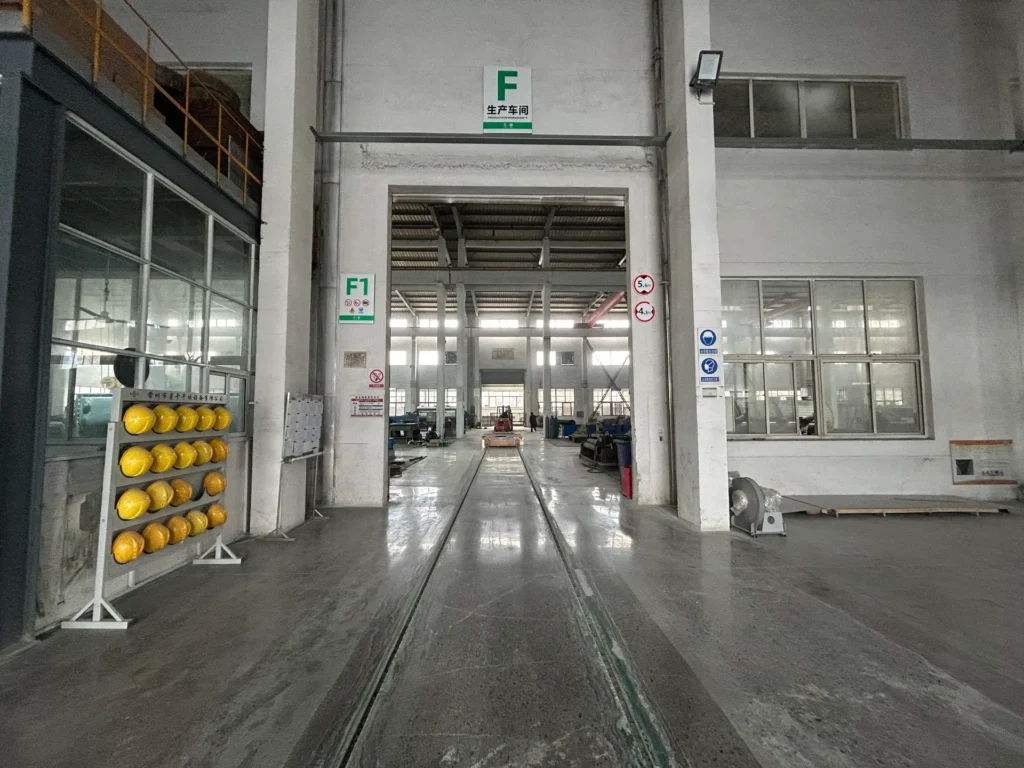
The reason SINOTHERMO maintains an in-house pilot laboratory is simple: we would rather find out how a material behaves before it is designed into a plant than afterwards.
Several dryer families sit under one roof, which means a genuine comparison is possible without shipping your sample to three different vendors and receiving three sets of data taken under three different conventions. Trials can be run with controlled atmosphere where oxidation or dust explosion risk is a factor. And the engineers who run the trial are the same people who size and customise the resulting machine — with 20+ years of experience in industrial drying and a business built on deep customisation rather than catalogue configurations, the trial data goes directly into the design instead of being handed across a gap.
Practically, that means the parameter set you approve in the pilot laboratory is the parameter set the production machine is built to reproduce.
Ready to send a sample? Tell us your material, its current state, and your target specification through our testing lab page or contact us directly, and we will confirm the sample quantity, packaging, and test scope for your specific case before you ship anything.
SINOTHERMO — Process Engineering Infrastructure. We solve the process problem, not just sell a machine.
Conclusion
A pilot test is not a formality before a purchase order — it is the cheapest engineering you will do on the whole project. The seven steps in this checklist exist to make sure the trial produces a specification rather than an impression: a defined question, a representative sample, a complete information package, an agreed plan with acceptance criteria, a deliberate parameter sweep, a data package you can act on, and a disciplined scale-up.
Get those right and the machine that arrives on site behaves the way the trial said it would. Skip them, and you find out what your material really does after the foundations are poured.
Have a material you are unsure how to dry? Send it to our pilot laboratory and let the data decide the equipment.
✉️ mark.gu@sinothermo.com · 📱 WhatsApp: +86 180 2197 2660 · 🌐 www.sinothermo.com
SINOTHERMO — Process Engineering Infrastructure.
FAQ
How much sample do I need to send for a drying pilot test?
As a typical guide, spray drying trials use roughly 5–20 L of liquid feed, while fluid bed, flash, vacuum, paddle, or rotary trials use roughly 5–20 kg of the actual wet solid. Comparison trials across several dryer families need more, because each family consumes its own material. The correct quantity depends on your material and test scope and should be confirmed with the engineering team before you ship.
What information do I need to provide with the sample?
Feed characteristics such as solids content, viscosity and pH; heat sensitivity and any known degradation temperature; the target output specification including the measurement method; the throughput you are scaling to; atmosphere and safety requirements; regulatory or materials-of-construction constraints; the upstream and downstream steps; and the utilities available at your site.
Do I need to send a safety data sheet with my sample?
Yes. An SDS or equivalent safety data sheet is required for any hazardous, flammable, corrosive, toxic, or dust-explosive material so the trial can be planned, handled, and run safely. Hazards must also be declared correctly on the shipping paperwork.
What do I get back after a pilot drying test?
Labelled product samples from each test condition, a parameter report listing the exact settings behind every sample, drying behaviour data specific to your material such as the drying curve and achieved evaporation rate, product analysis against the agreed attributes, operability observations, and an equipment recommendation with the sizing basis for your target throughput.
Why can't I just size a dryer from a datasheet?
A datasheet describes what a machine can do under stated conditions, not which conditions your material tolerates. Drying rate behaviour, the sticky point, and post-drying powder properties vary between materials of nearly identical composition, and those are the properties that set the size, configuration, and cost of the plant.
Can one pilot trial compare more than one dryer type?
Yes, and it is often the most valuable way to run one — but each dryer family consumes its own material and its own test time, so the sample quantity and the test scope need to be planned for that from the start rather than added later.
How long does a pilot test take?
It depends on the material, the number of parameter sets, and the analysis required, so a specific timeline should be agreed for your test scope rather than assumed. Ask for a schedule commitment upfront, covering both the trial itself and the written report that follows it.

Mark Gu
Passionate about enhancing customer experiences and streamlining operations, Mark focuses on building strong relationships, fostering innovation, and leading teams to achieve exceptional service and efficiency.
Email: mark.gu@sinothermo.com
Phone: +86 18021972660