A paddle dryer — and its close relative the disc dryer — dries sticky, pasty, sludge-like materials by conduction: heat passes through hollow, steam-heated paddles or discs that continuously stir the material, instead of through a large volume of hot air. That single design decision is what makes the paddle dryer the workhorse for sewage sludge, chemical filter cakes, and other difficult wet solids that would blind, clog, or blow apart in a convective dryer.
If a material passes through a sticky "glue phase" as it dries, an indirect dryer is usually the honest answer — and this guide explains why, where it fits, and where its limits lie.
How a paddle dryer works
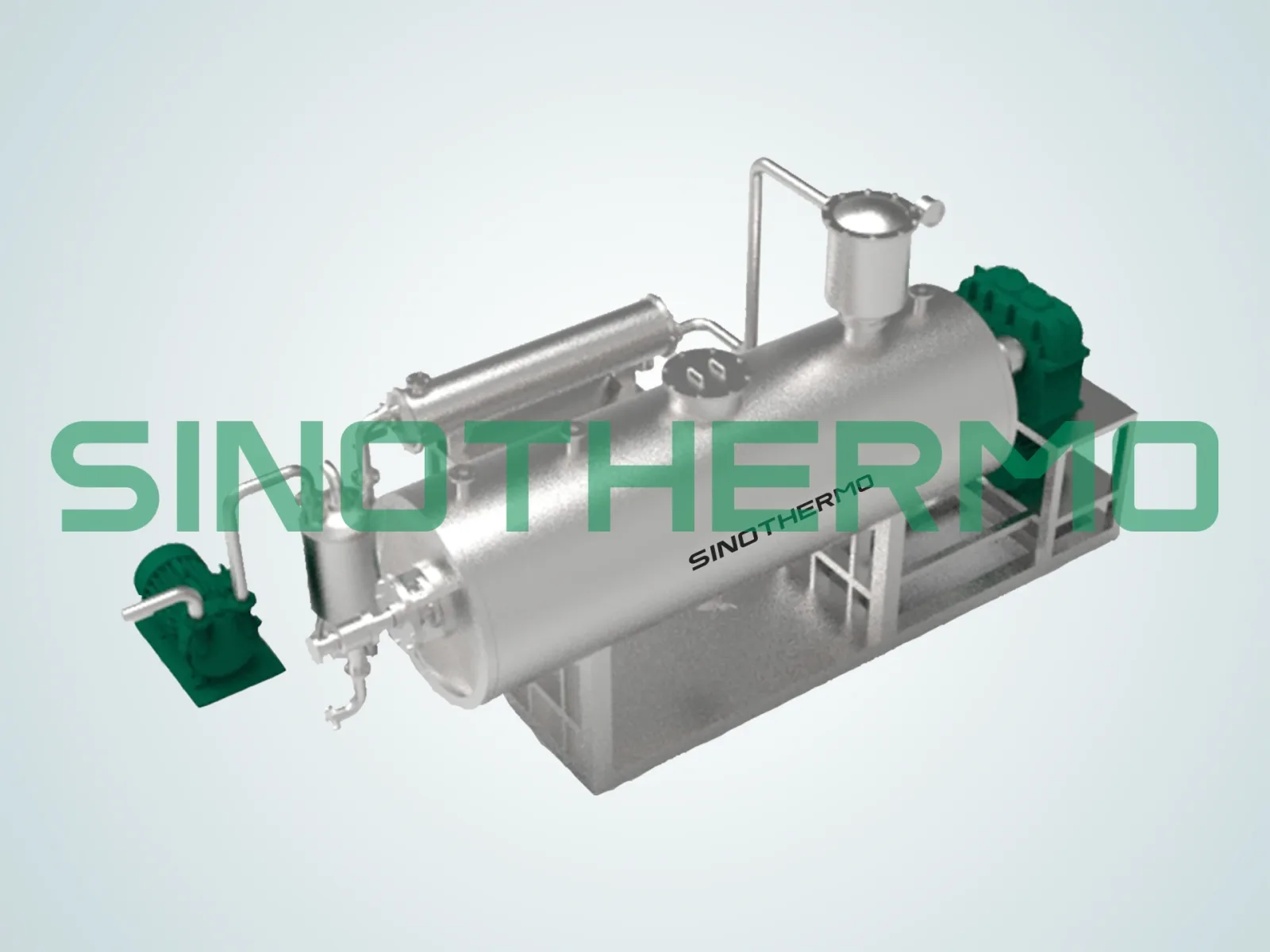
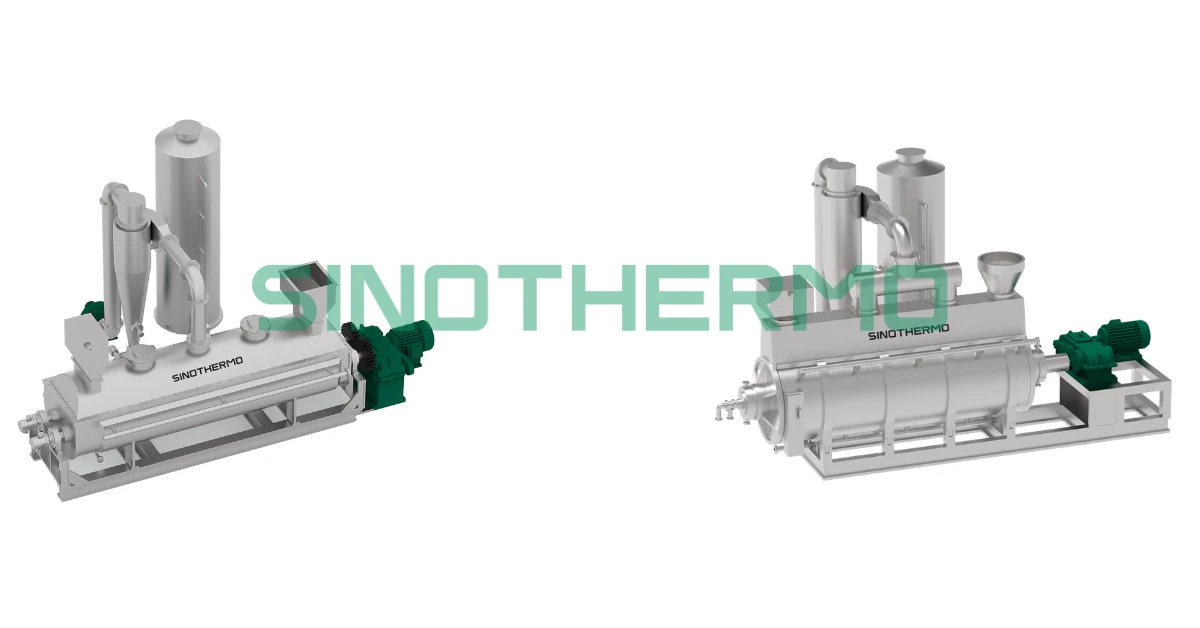
A paddle dryer is built around a horizontal, jacketed trough containing one or two slowly rotating shafts. Fitted to each shaft are hollow, wedge-shaped paddles. Both the shafts and the paddles are heated internally, so nearly every surface the material touches is a heat-transfer surface. The drying sequence has four stages:
- 1.Feeding — Wet sludge or paste enters the elevated end of the jacketed trough. Feed is typically a dewatered cake or a thick slurry that would be impossible to fluidize or spray.
- 2.Indirect heating — Steam or thermal oil flows through the hollow shafts, the hollow paddles, and the surrounding jacket. Heat conducts through every wetted metal surface directly into the material. The gas phase carries almost no heat — it only carries away vapor.
- 3.Mixing and conveying — As the shafts turn, the wedge paddles knead and turn the material, constantly renewing the film in contact with the hot surface, breaking up lumps, and slowly pushing the solids toward the outlet.
- 4.Vapor removal — A small sweep-gas or inert-gas stream draws off the evaporated moisture, which is then condensed. Because the vapor is concentrated, solvent recovery and clean, low-volume exhaust are straightforward.
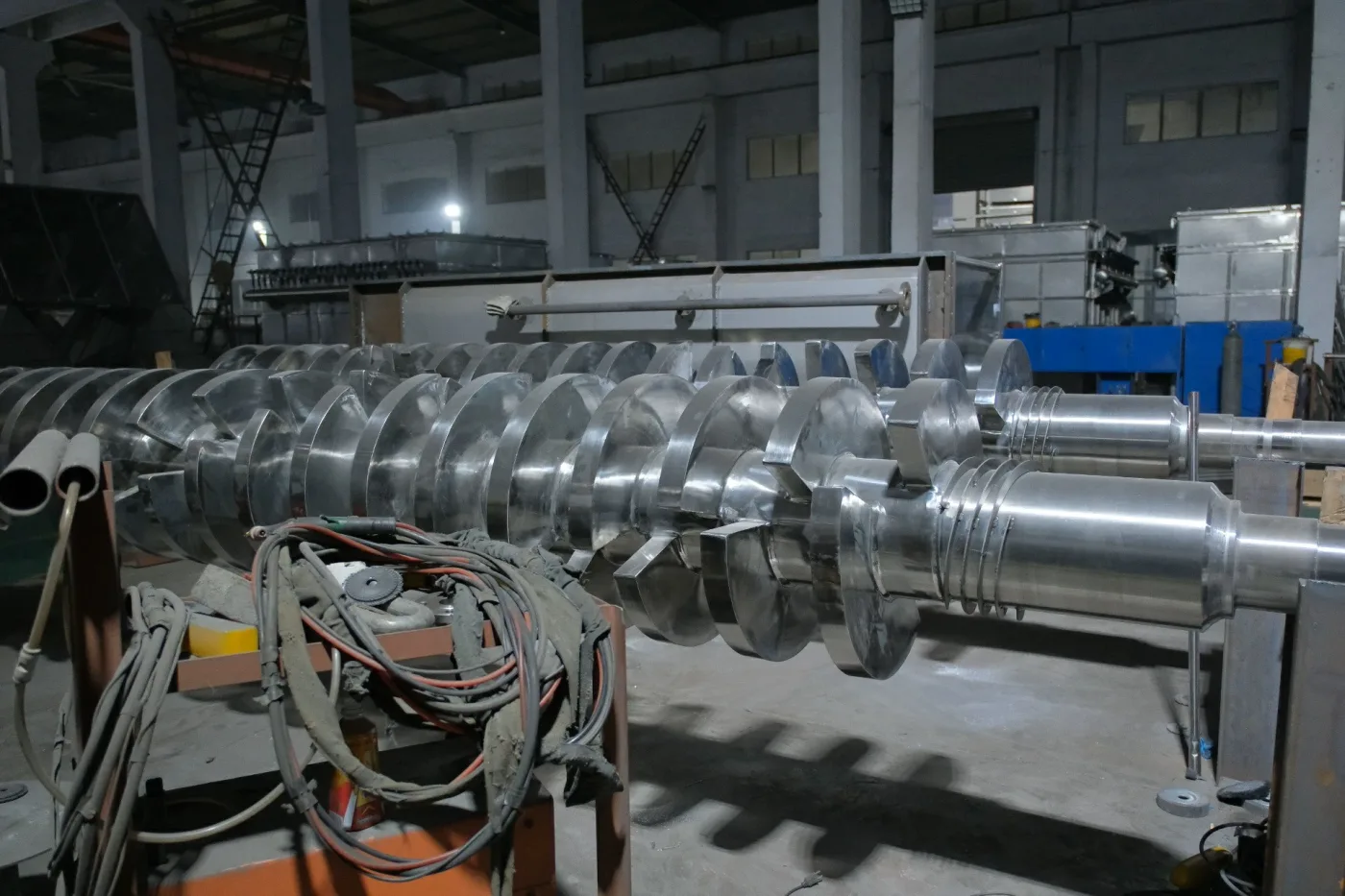
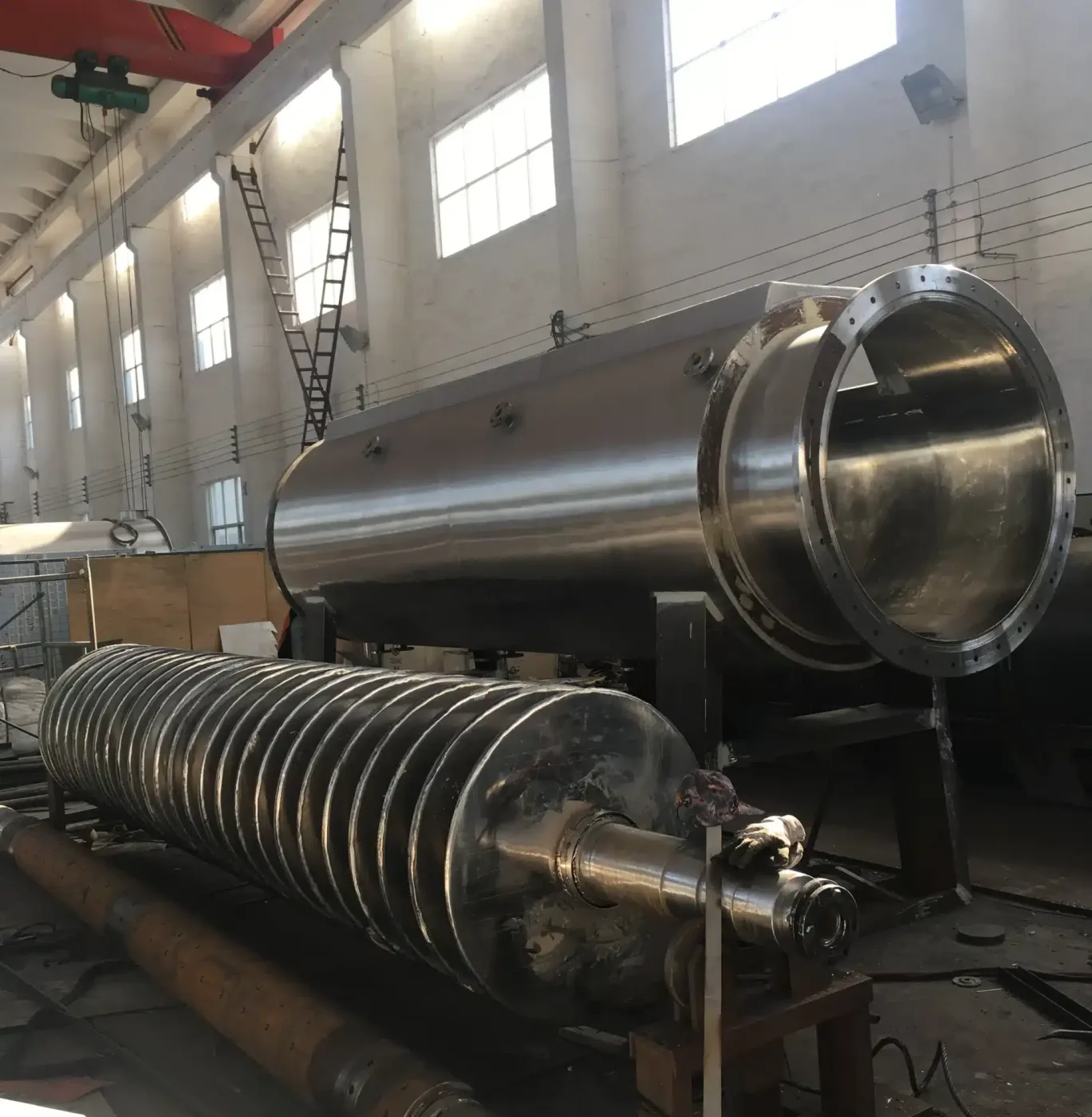
The disc dryer uses the same indirect principle but replaces the paddles with closely spaced hollow discs mounted on a central shaft. Packing many discs along the length maximizes heat-transfer area per unit of machine length, which is why disc dryers are favored for high-capacity sludge duties where footprint matters.
Why indirect, conductive drying wins for sludge and pastes
The reason a paddle dryer or disc dryer beats a hot-air dryer on these feeds comes down to four physical advantages:
- Very low gas volume. Only the evaporated vapor leaves the machine. There is no large hot-air stream to filter, so odor, dust, and emission control are dramatically simpler and cheaper.
- High thermal efficiency. Heat goes into the material through metal, not into a river of air that you then have to reheat. Energy per kilogram of water removed is low compared with convective drying.
- Solvent and vapor recovery. Because the off-vapor is concentrated rather than diluted in air, it condenses easily — enabling closed-loop solvent recovery and inert-gas operation for flammable or toxic volatiles.
- Compact footprint. A large heat-transfer area is packed into a small, enclosed machine, so a paddle or disc dryer occupies far less plot space than a direct dryer of comparable duty.
These are not marketing claims; they follow directly from moving the heat through surfaces instead of through air. The trade-off is mechanical, which we cover under limitations.
7 proven uses for paddle and disc dryers
Across 20+ years of experience, the same indirect dryer keeps solving the same class of problem — sticky, wet, hard-to-handle solids. Seven of the most common proven applications:
| Application | Typical feed | Why indirect fits |
|---|---|---|
| Municipal sewage sludge | Dewatered biosolids | Sticky glue-phase; low-emission exhaust required |
| Industrial wastewater sludge | Chemical/biological sludge | Solvent/odor capture, compact plant footprint |
| Chemical filter cakes | Pigments, salts, fine chemicals | Solvent-wet cakes needing recovery |
| Fine chemical & pigment pastes | Oxidation-sensitive powders | Gentle, low-air, controlled atmosphere |
| Food & feed byproducts | Spent grains, stillage concentrates | Thick pastes that jam convective dryers |
| Mineral concentrates & tailings | Fine ore concentrates | High heat-transfer area, dust contained |
| Distillery & fermentation residues | Byproduct pastes and syrups | High moisture, sticky, energy-sensitive |
For free-flowing granular materials at very high tonnage, a different tool fits better — see the rotary drum dryer guide. For heat- or oxidation-sensitive solids that need vacuum, the industrial vacuum dryer guide covers the paddle dryer's vacuum-capable cousins.
Advantages and limitations
Advantages. The paddle dryer handles sticky, glue-phase materials that jam almost everything else; the self-wiping paddle geometry continually renews the heat surface and breaks lumps so the machine does not blind. Gas volume is minimal, thermal efficiency is high, and emission control and solvent recovery are simple. Operation can be fully enclosed and, if needed, inerted.
Limitations. Indirect dryers are mechanically more complex than a bare rotating drum: heated rotating shafts, internal steam joints, and shaft seals all need maintenance. Throughput per single unit is generally lower than a very large direct rotary dryer, so paddle and disc dryers are best matched to medium capacities with genuinely difficult feeds — not to bulk free-flowing granular products where a convective dryer is cheaper per ton.
Paddle/disc dryer vs. rotary dryer
The clearest way to place the paddle dryer is against the direct rotary dryer, its convective opposite:
| Factor | Paddle / disc dryer | Rotary dryer |
|---|---|---|
| Heat transfer | Indirect / conductive | Direct / convective |
| Gas volume | Very low | High |
| Ideal feed | Sludge, cakes, sticky pastes | Free-flowing granular solids |
| Emission control | Simple (small vapor stream) | More complex (large exhaust) |
| Capacity ceiling | Medium | Very high tonnage |
| Solvent recovery | Easy | Difficult |
If you are still mapping the whole landscape of technologies, start with the industrial drying equipment guide, then come back to the paddle dryer once you know your feed is sludge-like.
Common mistakes to avoid
- Specifying by capacity alone. The right question is not "how many tons per hour" but "how does this specific material behave through the glue phase." Two sludges at the same throughput can need very different residence times and torque.
- Ignoring torque and the glue phase. As pasty material passes peak stickiness, motor torque spikes. Undersizing the drive is a classic field failure. Paddle geometry must be matched to the feed's rheology.
- Forgetting vapor handling. The dryer is only half the system. The condenser, sweep-gas loop, and (where volatiles are present) inert-gas circuit must be designed together, or you lose the emission and recovery advantages that justified the indirect choice.
- Confusing "disc" and "paddle" as interchangeable. They share the indirect principle but not the economics. Disc dryers give more area per length for high-capacity sludge; paddle dryers give more aggressive self-cleaning agitation for the stickiest cakes.
- Skipping the trial. Sludge and cake behavior is notoriously hard to predict from a spec sheet. Sizing from a generic table risks an oversized or underperforming machine.
Prove it in the pilot lab before you specify
The honest way to size a paddle dryer is to run the actual material, not a datasheet approximation. Bring your sludge, filter cake, or sticky paste to the SINOTHERMO pilot laboratory and trial it before you specify: we measure the drying curve, confirm the real heat load and throughput, watch how the material moves through its glue phase, and check torque and fouling behavior. That trial-first discipline is backed by 20+ years of experience.
SINOTHERMO — Process Engineering Infrastructure. We solve the process problem, not just sell a machine. When you need a vacuum-capable variant for heat-sensitive or solvent-laden material, we point you to the right configuration — for example the Vacuum Paddle Dryer or the Vacuum Horizontal Disc Dryer — rather than forcing one machine onto every job. You can also browse the full Conduction and Vacuum Dryer category to compare indirect options.
Conclusion
A paddle dryer, and the closely related disc dryer, is the indirect, conductive answer for sludge, filter cakes, and sticky pastes — low gas volume, high thermal efficiency, easy emission control, and self-cleaning agitation through the glue phase. Match it to medium-capacity, genuinely difficult feeds, size it on real material rather than a table, and design the vapor system as part of the machine.
Have a sludge, cake, or sticky paste that jams every other dryer? Yes — an indirect paddle or disc dryer, proven on your own sample in our pilot lab, is almost certainly the right tool.
✉️ mark.gu@sinothermo.com · 📱 WhatsApp: +86 180 2197 2660 · 🌐 www.sinothermo.com
SINOTHERMO — Process Engineering Infrastructure.
FAQ
What is a paddle dryer used for?
A paddle dryer is used to dry sticky, pasty, and sludge-like materials — sewage sludge, chemical filter cakes, pigment and fine-chemical pastes, and food/feed byproducts. It uses indirect conduction, so only a small vapor stream leaves the machine and emission control stays simple.
What is the difference between a disc dryer and a paddle dryer?
Both are indirect, conductive dryers. A paddle dryer uses hollow, wedge-shaped paddles on one or two shafts, giving aggressive self-cleaning agitation for the stickiest cakes. A disc dryer uses closely spaced hollow discs on a central shaft, packing more heat-transfer area per unit length for high-capacity sludge.
Why use indirect drying instead of hot air?
Indirect drying heats the material through steam- or oil-heated metal surfaces, so only concentrated vapor leaves the machine. That means high thermal efficiency, simple odor and emission control, easy solvent recovery, and a compact footprint — advantages a convective hot-air dryer cannot match on sticky feeds.
Can a paddle dryer handle the sticky "glue phase"?
Yes. The self-cleaning wedge-paddle geometry continually renews the heat-transfer surface and breaks up lumps, so the machine keeps working through the glue phase where many dryers blind or clog. Drive torque must be sized for the peak, which is one reason a pilot trial matters.
How do I size a paddle or disc dryer?
Size is set by feed rate, initial and target moisture, and how the specific material behaves through its glue phase. Rather than estimate from a table, SINOTHERMO runs a pilot-lab test on your actual sludge or cake to confirm the drying curve, heat load, residence time, and torque before scale-up.
Is a paddle dryer better than a rotary dryer?
Neither is universally better — they solve different problems. A paddle or disc dryer is best for sludge, cakes, and sticky pastes at medium capacity with easy emission control. A rotary dryer is best for free-flowing granular solids at very high tonnage. Match the dryer to the feed.
Can a paddle dryer recover solvents or run under vacuum?
Yes. Because the off-vapor is concentrated, it condenses easily for closed-loop solvent recovery, and the enclosed design can be inerted for flammable or toxic volatiles. For heat-sensitive or solvent-laden material, a vacuum-capable variant such as the Vacuum Paddle Dryer or Vacuum Horizontal Disc Dryer is used.

Mark Gu
Passionate about enhancing customer experiences and streamlining operations, Mark focuses on building strong relationships, fostering innovation, and leading teams to achieve exceptional service and efficiency.
Email: mark.gu@sinothermo.com
Phone: +86 18021972660