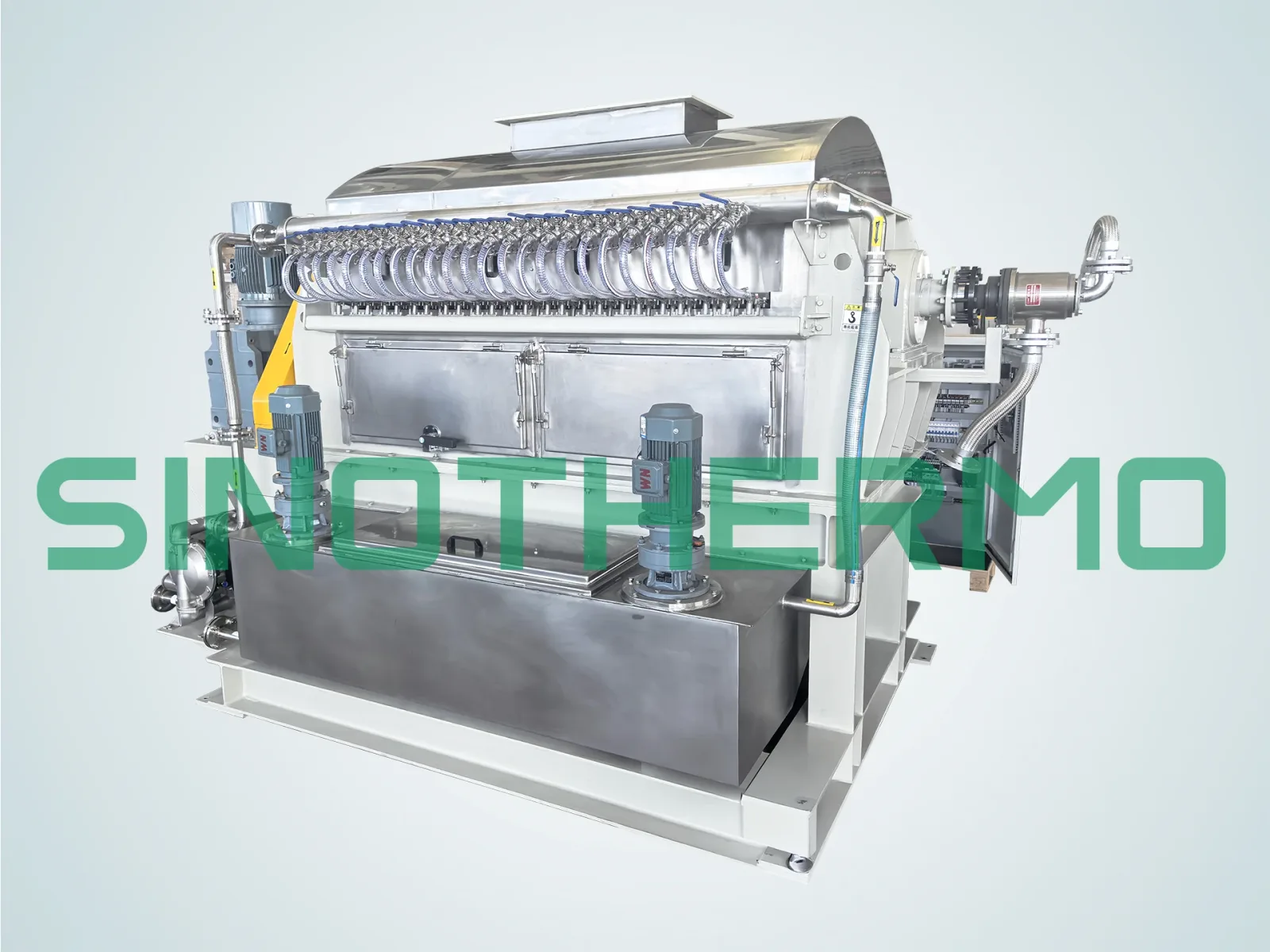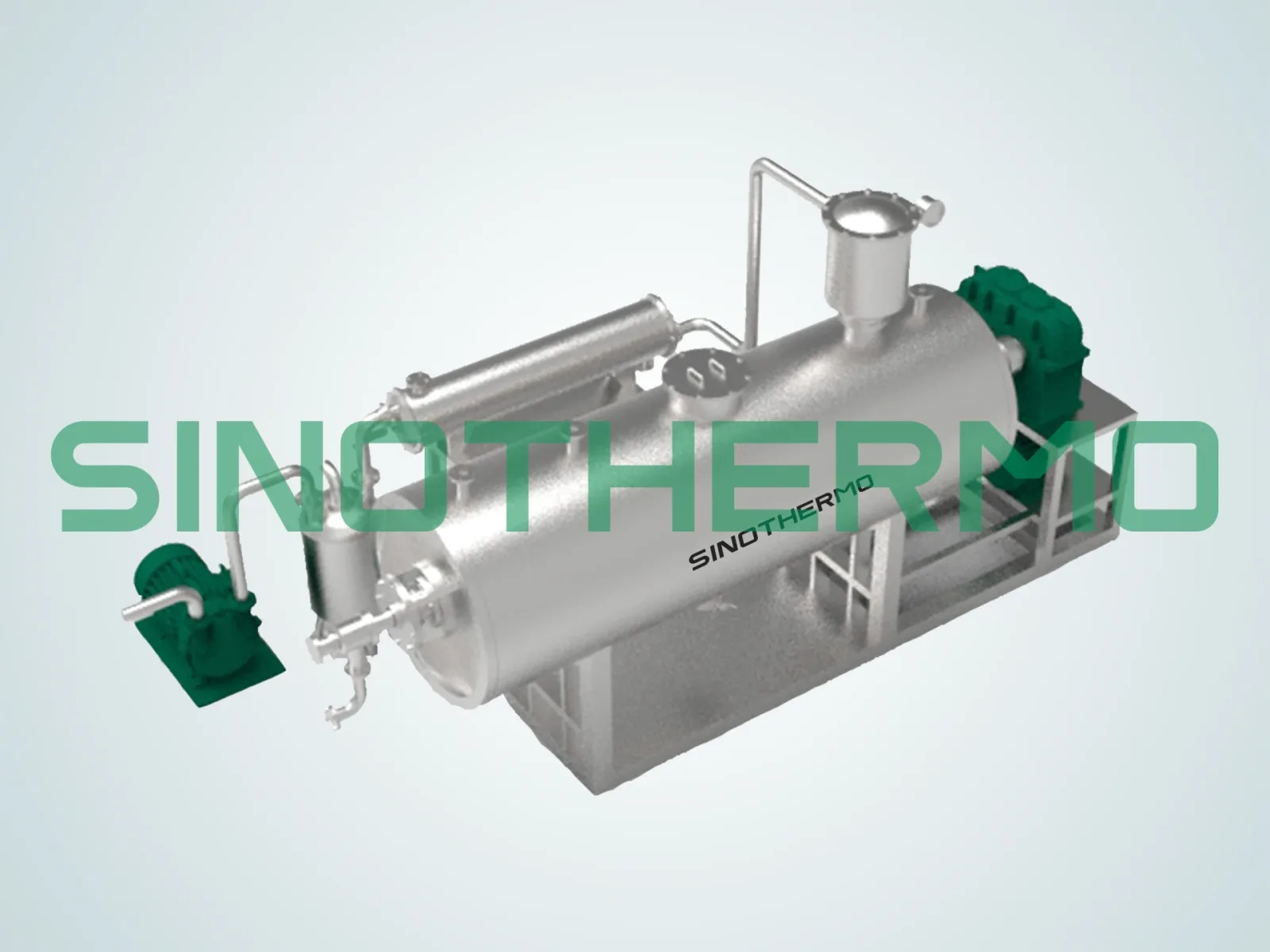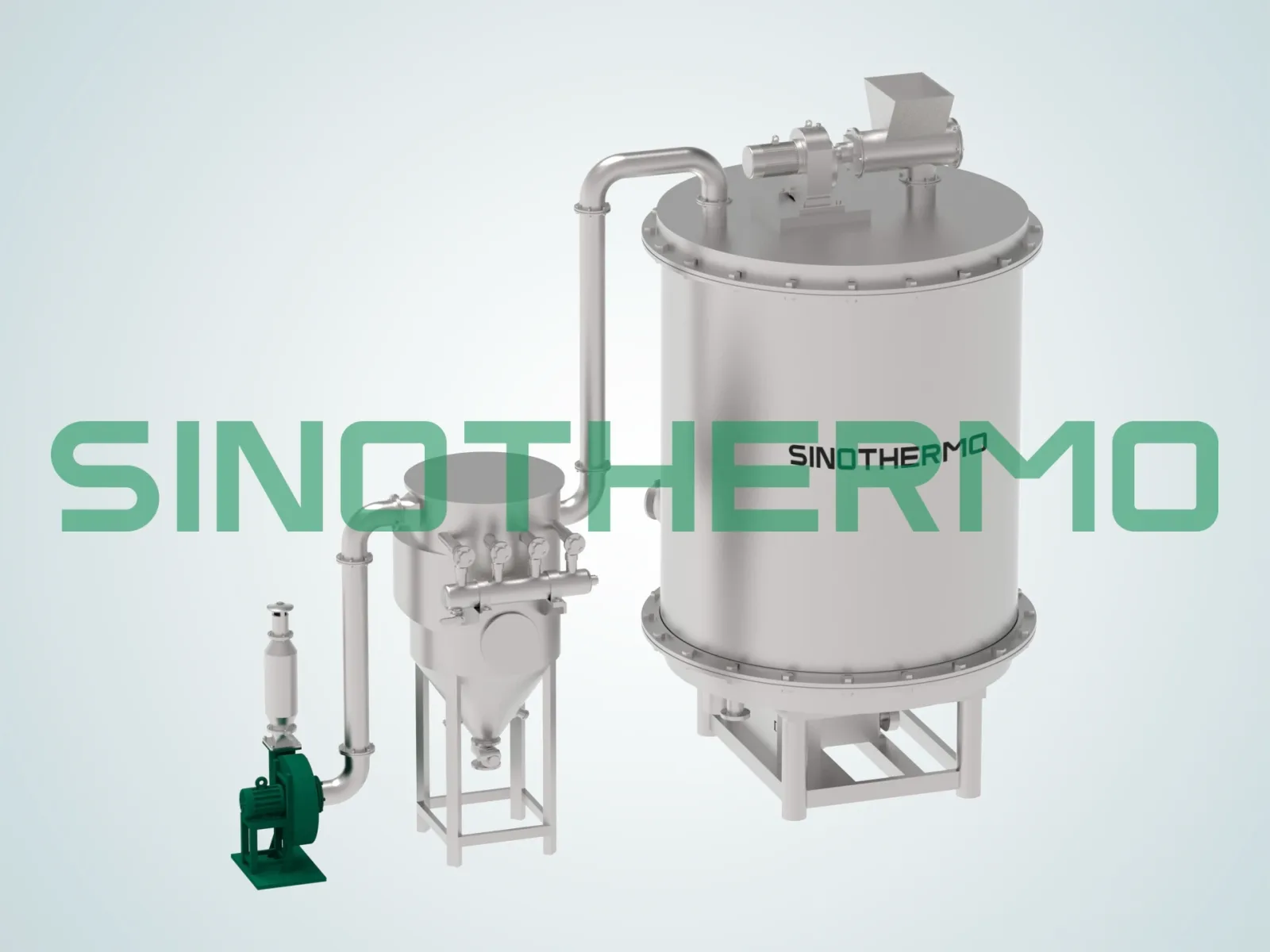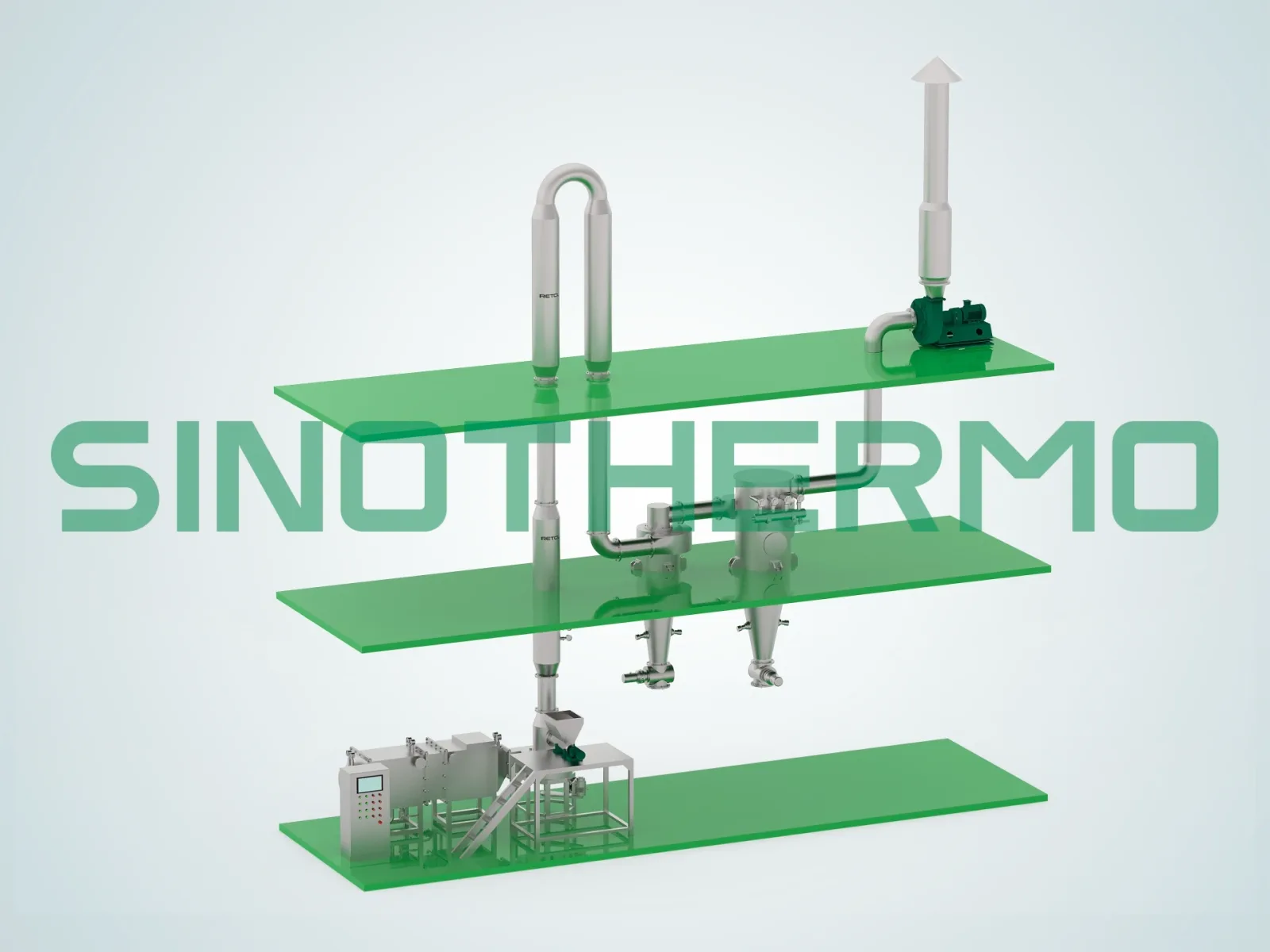
Pneumatic, ring and spin flash dryers all dry by suspending wet solids in a fast stream of hot air for a few seconds. They differ in how they handle the feed. A pneumatic dryer carries loose, non-viscous solids through a long duct. A ring dryer adds a classifier ring that holds oversize particles back until they are dry. A spin flash dryer adds a rotor that breaks up wet cakes and pastes, so it handles sticky filter cakes the other two struggle with. SINOTHERMO supplies the first two through its pneumatic dryer and the third as its spin flash dryer.
Quick Context: the flash dryer family
"Flash drying" describes any process that dries a wet solid in seconds by dispersing it into a hot gas stream. Heat and mass transfer are very fast because the particles are small and surrounded by air. Residence times are typically a few seconds, so even heat-sensitive materials can be dried at high air temperatures because the product itself stays cool while water is evaporating.
Within that family, three designs are widely used. This article compares them. For the broader family and when to use flash drying instead of another dryer, see flash dryer guide and flash dryers vs spray dryers.
What a pneumatic dryer is
A pneumatic dryer conveys loose, non-viscous solid material through a stream of hot air, drying it as it travels through the drying line. SINOTHERMO's product page lists these characteristics:
- Input: non-viscous, loose solid materials
- Output: powder or granules at 3 to 6 percent moisture
- Inlet air temperature: below 200 °C
- Modular design: drying and grinding stages can be added
Because transit time is short, exposure to heat is brief, and the design suits temperature-sensitive materials that are free-flowing. It is not designed for pastes or slurries, because they would stick in the duct and block the airflow.
What a ring dryer is
A ring dryer is a pneumatic dryer with a recirculation loop. Wet feed is dispersed in the hot air stream, and the stream passes through a classifier that separates dry fine particles from wet or oversize ones. The wet fraction is returned to the drying loop until it is dry enough to leave. This gives a narrower range of final moisture than a plain pneumatic dryer and makes it useful where particle size varies.
In SINOTHERMO's range, this ring-type configuration is delivered through the pneumatic dryer platform, whose modular design lets drying and grinding stages be added to suit the material. We do not sell it as a separate product called a "ring dryer"; on the product list it is a pneumatic dryer built to your duty. Tell us the feed and the target moisture, and we will configure it for your material.
What a spin flash dryer is
A spin flash dryer combines fluidising, pneumatic conveying and grinding in one unit. Hot air enters at the bottom and swirls the material while a rotor breaks lumps apart. The product page lists:
- Input: loose, granular or filter-cake solids
- Output: powder
- Temperature: 140 to 220 °C standard, and below 140 °C for heat-sensitive materials
- Additional feature: grinding
The rotor and swirling airflow disperse pasty, cohesive filter cakes that would clog a plain pneumatic dryer. It dries and de-lumps in one step, which removes the need for a separate mill for many materials. The XSG series covers evaporation capacities from 10 to 20 kg/h (XSG-200) up to 150 to 1,300 kg/h (XSG-1200) and beyond on the product page. See spin flash dryer for more.
How Flash Drying Works: The Physics in Brief
Flash drying is fast because of surface area and air velocity. When a wet solid is broken into small particles and carried in hot air, each particle is surrounded by gas and loses surface moisture within seconds. The evaporating water cools the particle, so the product temperature stays close to the wet-bulb temperature of the air while surface moisture remains. That is why hot air at 140 to 220 °C can dry a product that would be damaged by the same temperature in an oven.
This works well for surface and loosely bound moisture. Once the surface is dry, the particle temperature rises toward the air temperature and the remaining internal moisture leaves slowly. For this reason, flash dryers are best where the water is mostly on the surface or in the pore spaces of a cake, and less suited to materials where water is chemically bound or deep inside large particles.
Particle size matters in two ways. Smaller particles dry faster, and they also stay in the air stream. Larger lumps drop out or recirculate. The spin flash dryer solves this with a rotor that breaks lumps into fine particles, and the ring dryer solves it with a classifier that sends wet oversize particles back for more drying.
System Components You Should Include in the Quotation
A flash dryer is a system, not a single vessel. A complete quotation normally covers:
- Feeder: a screw feeder or similar device that meters wet material into the air stream. For filter cakes, feeder design is critical because sticky cake can bridge.
- Air heater: steam, thermal oil, gas or electric heating to reach the inlet temperature.
- Drying chamber or duct: where the drying happens.
- Cyclone and bag filter: to separate the dry product from the air and capture fine dust.
- Fan: sized for the air volume and the pressure drop across the system.
- Control system: inlet and outlet temperature control to hold the final moisture.
Exhaust air volume, dust loading and product value decide how much to spend on the collection system. Fine, valuable powders justify a high-efficiency bag filter.
Side-by-side comparison
| Feature | Pneumatic dryer | Ring dryer | Spin flash dryer |
|---|---|---|---|
| Feed | Loose, non-viscous solids | Loose or crumbly solids, variable size | Filter cakes, pastes, granular solids |
| Handles sticky cake | No | Limited | Yes |
| Grinding | Optional stage | Via classifier recirculation | Built-in rotor |
| Final moisture control | Basic | Narrower range | Good for fine powder |
| Inlet air temperature | Below 200 °C | Design-dependent | 140–220 °C (below 140 °C for sensitive) |
| SINOTHERMO product page | Pneumatic dryer | Built on the pneumatic dryer platform | Spin flash dryer |
| Typical use | Free-flowing chemicals, foods, agri products | Materials with variable particle size | Starch, pigments, chemical filter cakes |
Choosing between them
Follow this order of questions:
- 1.Is the feed a wet cake or paste? If yes, choose a spin flash dryer. A pneumatic dryer will not handle it.
- 2.Is it loose, free-flowing and non-sticky? A pneumatic dryer is the simpler, lower-cost choice.
- 3.Does particle size vary widely, and do you need uniform final moisture? A ring dryer configuration may help, or a spin flash dryer with a suitable classifier.
- 4.Do you need fine powder directly from the dryer? A spin flash dryer, because it grinds while it dries.
- 5.Is the product so heat-sensitive that even seconds at high air temperature is a problem? Use the below-140 °C mode of the spin flash dryer, or consider a vacuum dryer instead.
A worked example
The numbers are illustrative, not customer data.
A producer has a filter cake at 40 percent moisture and wants 500 kg of dry product per hour at 2 percent moisture.
- Dry solids per hour: 500 x 0.98 = 490 kg
- Feed rate: 490 / 0.60 = about 817 kg/h of wet cake
- Water to evaporate: 817 - 500 = about 317 kg/h
A filter cake needs a machine that can break the lumps apart, so the pneumatic dryer is out. A spin flash dryer in the range of a mid-size XSG model (for example, evaporation capacity 60 to 600 kg/h on the XSG-800) would be the first candidate. The next step is to test the cake: stickiness, particle size after drying and final moisture decide the model and air temperature.
Where each dryer is used
- Pneumatic dryer: free-flowing chemical solids, loose dried foods, agricultural solids, loose pigment solids and resin particles that are sensitive to extended heat.
- Ring dryer configurations: powders with a wide particle size distribution where uniform final moisture matters.
- Spin flash dryer: starch, pigments, chemical filter cakes and mineral products. Our article on flash dryer vs spin flash dryer for starch drying shows a real application.
Common Mistakes to Avoid
- 1.Using a pneumatic dryer for a sticky cake. The material builds up in the duct and the dryer stops.
- 2.Assuming a flash dryer can dry any moisture level. Flash dryers remove surface and loosely bound moisture quickly, but they are less effective for deep internal moisture.
- 3.Ignoring the product's temperature limits. High air temperature is acceptable only because exposure is brief.
- 4.Leaving out the dust collection. Bag filters and cyclones are part of the system and affect the pressure drop and cost.
- 5.Choosing by headline evaporation rate. Evaporation capacity depends on the inlet air temperature and the feed moisture, so a figure on a table is not a guarantee for your product.
Test Before You Buy
SINOTHERMO runs paid pilot tests to confirm whether a flash dryer is the right choice for your material. Request a pilot test and the data is yours to use with any supplier. SINOTHERMO builds and sells equipment and does not offer contract drying.
Frequently Asked Questions
What is the difference between a pneumatic dryer and a ring dryer?
A ring dryer is a pneumatic dryer with a classifier and recirculation loop that returns wet or oversize particles for more drying. It gives more uniform final moisture on materials with variable particle size.
Is a spin flash dryer better than a pneumatic dryer?
It handles more feeds, including sticky filter cakes, and grinds while drying. A pneumatic dryer is simpler and lower in cost for loose, free-flowing solids.
What moisture can a pneumatic dryer reach?
SINOTHERMO's pneumatic dryer reaches 3 to 6 percent moisture with inlet air below 200 °C.
Can SINOTHERMO supply a ring-type dryer?
Yes, in the sense that a ring-type configuration is built on our pneumatic dryer platform. On our product list it appears as the pneumatic dryer, not under a separate ring dryer name.
Can a flash dryer dry heat-sensitive materials?
Often yes, because residence time is only seconds. The spin flash dryer also has a mode below 140 °C. Very sensitive products may still need a vacuum dryer.
Can a spin flash dryer dry a paste?
It handles filter cakes and cohesive wet solids. A true pumpable paste is better handled by a spray dryer or conduction dryer.
How do I choose the size?
From the water to evaporate per hour and the inlet air temperature. A test gives the real drying rate for your material.

Mark Gu
Passionate about enhancing customer experiences and streamlining operations, Mark focuses on building strong relationships, fostering innovation, and leading teams to achieve exceptional service and efficiency.
Email: mark.gu@sinothermo.com
Phone: +86 18021972660