Walk down any supermarket coffee aisle and most of the jars of instant coffee you see started as a liquid. Spray dried coffee is what makes that possible: a process that takes brewed, concentrated coffee extract and turns it into a dry, free-flowing, soluble powder in a matter of seconds — fast enough to run continuously at industrial volumes, and controlled enough to keep most of the flavour intact.
For producers and process engineers, spray drying sits at the heart of the instant coffee manufacturing process. Get it right and you have a powder that dissolves cleanly, flows without clumping, and holds its aroma. Get the atomization, airflow or temperature wrong and you lose yield, solubility or flavour. This article walks through how spray dried coffee is made, where spray drying fits in the wider production line, how it compares with freeze drying, and what to look for in the equipment behind it.
What Is Spray Dried Coffee?
Spray dried coffee is instant coffee produced by atomizing concentrated coffee extract into a stream of hot air, where each droplet dries into a fine powder particle almost instantly. The water evaporates in seconds; the dried coffee solids fall to the base of the tower and are collected as powder.
It is the most common form of instant coffee worldwide because the method is fast, continuous and lower-cost per kilogram than the alternatives. The trade-off — covered in detail below — is that high-temperature drying drives off some of the volatile compounds that carry coffee aroma, which is why premium products often use freeze drying or add captured aroma back into the powder.
The Instant Coffee Manufacturing Process
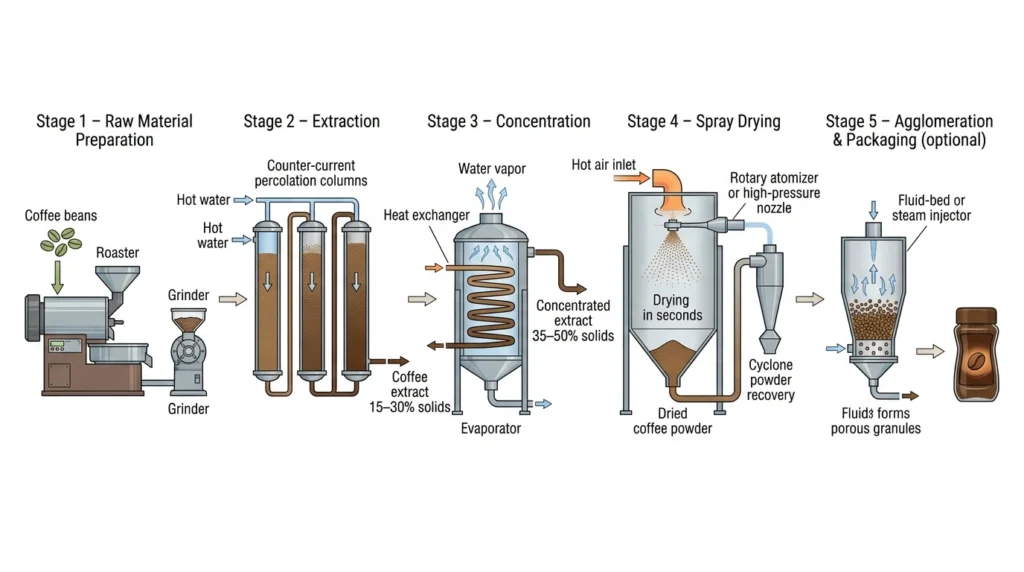
Spray drying is the final transformation, but the quality of the powder is largely decided in the steps before it. The full instant coffee manufacturing process runs like this:
- Roasting and grinding. Green beans are roasted and ground, much as they are for regular coffee. Roast profile and grind size influence the flavour and the extraction yield downstream.
- Extraction. Ground coffee is brewed with hot water under pressure in a series of percolation columns to pull out the soluble solids. Counter-current extraction lets fresh water meet the most spent coffee, maximising yield.
- Concentration. The extract leaving extraction is often only 15–30% solids. Before drying, it is concentrated — by evaporation or freeze concentration — typically to the 35–50% solids range, so the dryer has far less water to remove and the line runs more efficiently.
- Spray drying. The concentrate is atomized into a tower of hot air, where it dries into powder almost instantly. This is the step that defines particle size, bulk density and solubility.
- Agglomeration (optional). Fine powder is re-wetted with steam so particles clump into larger, porous granules that dissolve faster and look more premium on shelf.
Why Spray Drying Is Used for Instant Coffee
Coffee extract is a liquid that has to become a free-flowing, soluble powder — at large scale, consistently, and at a price the mass market accepts. Spray drying fits that brief better than any other industrial method:
- Speed. Each droplet dries in seconds, so the line runs continuously rather than in long batches.
- Scale and cost. Spray drying has a markedly lower operating cost per kilogram than freeze drying, which is why it dominates mass-market instant coffee.
- Solubility you can dial in. Particle size, bulk density and agglomeration can be tuned so the powder dissolves quickly in hot — or even cold — water.
- Consistency. Once airflow, atomization and temperatures are stable, a well-designed spray dryer produces a uniform powder batch after batch, which matters for blending and packaging.
The honest trade-off is aroma. Hot drying air strips off some of the volatile aromatic compounds that give coffee its smell. Producers manage this two ways: by capturing aroma earlier in the process and dosing it back into the finished powder, or by reserving freeze drying for premium lines where flavour retention justifies the higher cost.
Spray Dried vs Freeze Dried Coffee
Both methods turn coffee extract into instant powder; they differ in how they remove the water and what that does to flavour, appearance and cost.
| Spray dried coffee | Freeze dried coffee | |
|---|---|---|
| Drying principle | Atomized into hot air, dries in seconds | Frozen, then water removed by vacuum sublimation over hours |
| Process time | Seconds, continuous | Many hours, batch |
| Aroma retention | Lower (volatiles lost to hot air) | Higher (low-temperature process) |
| Appearance | Fine, rounded powder | Larger, crystalline granules |
| Operating cost | Lower | Higher |
| Energy use per kg | Lower | Higher |
| Typical use | Mass-market instant coffee | Premium instant coffee |
Neither is simply “better.” Spray drying wins on cost, speed and throughput; freeze drying wins on flavour retention and the premium look of crystalline granules. Many producers run both — spray drying for everyday lines, freeze drying for premium SKUs — which is why an equipment partner who understands the whole drying portfolio is more useful than one who sells a single machine.
Equipment Considerations for Coffee Spray Drying
Coffee is one of the more demanding products to spray dry. The concentrate is sticky and thermoplastic, the target powder has to dissolve cleanly, and aroma is fragile. That places specific demands on the dryer:
- Tall drying towers. Coffee spray dryers use tall chambers so each droplet has enough residence time to dry fully before it reaches a wall — otherwise sticky semi-dry particles foul the chamber and lower yield.
- Atomization matched to the concentrate. Whether you use a high-pressure nozzle or a rotary atomizer, it must be sized for the concentrate’s viscosity and the target particle size. This single choice drives solubility, bulk density and fines generation.
- Inlet / outlet temperature control. Inlet air must be hot enough to dry quickly, but the outlet temperature has to stay low enough to protect flavour and avoid scorching. Tight control here is the difference between aromatic powder and a flat, baked taste.
- Powder recovery and handling. Cyclones and bag filters recover fine particles so product isn’t lost to the exhaust; conveying and storage must keep the hygroscopic powder dry.
- Optional agglomeration / fluid-bed finishing. An integrated or external fluid bed can agglomerate fines into instant-dissolving granules and cool the powder before packing.
- Hygienic, food-grade design. Stainless-steel contact parts, CIP (clean-in-place) capability and compliance with food-safety standards are non-negotiable for a consumables line.
At SINOTHERMO, we engineer industrial spray drying systems — towers, atomization, heat supply, powder recovery and fluid-bed finishing — as a single integrated line rather than a one-size box. Our team configures the chamber height, atomizer type and temperature profile around your extract solids, throughput target and the flavour profile you want to protect.
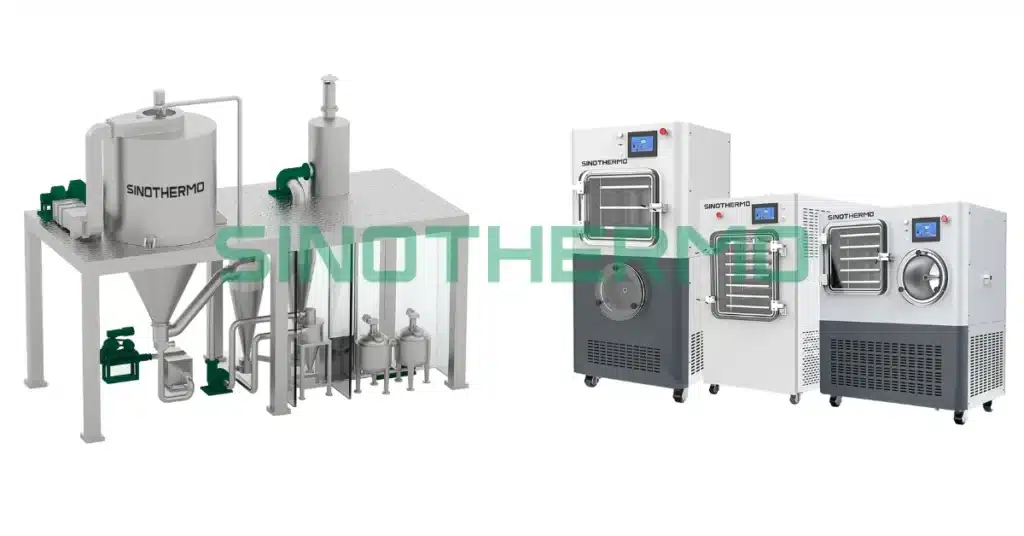
| SINOTHERMO system | How it fits coffee | Atomization | Inlet air temperature | Output |
|---|---|---|---|---|
| 원심분무건조기 | The standard route for coffee — a high-speed centrifugal (rotary) atomizer turns concentrated extract into very fine droplets that dry in seconds. Best when particle size, moisture, bulk density and shape must hit precise targets. | High-speed centrifugal atomizer at the tower top | 150–500°C (rated range; coffee runs in the lower part to protect aroma) | Powder, 3–5% moisture |
| Cabinet / Pilot Freeze Dryer | For premium freeze-dried coffee tiers where maximum aroma retention and crystalline granules justify the higher cost. | — (sublimation, no atomization) | −50 to −80°C (shelf/condenser) | Freeze-dried granules |
This is why an equipment partner who builds both spray dryers and freeze dryers is more useful than one selling a single machine: we can size a centrifugal or extract spray dryer for your everyday lines and a freeze dryer for premium SKUs from the same conversation.
Common Mistakes When Spray Drying Coffee
A short checklist of the errors that most often hurt yield or quality:
- Under-concentrating the extract. Feeding too much water into the dryer wastes energy and cuts throughput. Concentrate to the right solids first.
- Wrong atomizer sizing. Mismatched atomization gives inconsistent particle size, poor solubility and excessive fines.
- Outlet temperature too high. Faster drying at the cost of aroma — a common shortcut that shows up as a flat, “cooked” taste.
- Ignoring stickiness. Coffee’s thermoplastic behaviour fouls undersized chambers; tower geometry and wall management matter.
- No aroma strategy. If you don’t capture and re-dose aroma (or choose freeze drying), expect to lose some of the cup quality buyers notice.
결론
Spray dried coffee remains the workhorse of the instant coffee industry because it converts liquid extract into a soluble, shelf-stable powder faster and more cheaply than any alternative. The technology is mature — but the gap between an average powder and an excellent one comes down to engineering: the right tower height, atomization, temperature profile and powder handling for your specific extract and product goals.
If you are planning a new instant coffee line, scaling up, or trying to improve solubility, yield or flavour retention on an existing one, SINOTHERMO can help you specify the right spray drying system — and, where premium lines call for it, the freeze drying equipment alongside it.
자주 묻는 질문
What is spray dried coffee?
Spray dried coffee is instant coffee made by atomizing concentrated coffee extract into hot air, where each droplet dries into a soluble powder particle within seconds. It is the most common form of instant coffee because the process is fast, continuous and low-cost.
How is spray dried coffee made?
Brewed coffee extract is concentrated (typically to around 35–50% solids), then atomized into a tower of hot air where the droplets dry into powder within seconds. The powder is collected by cyclones and filters and is often agglomerated to dissolve faster.
Is instant coffee spray dried or freeze dried?
Both methods are used. Most mass-market instant coffee is spray dried because it is cheaper and faster; premium instant coffee is often freeze dried to retain more aroma and produce crystalline granules.
Does spray drying affect coffee flavour?
Yes, somewhat. Some volatile aroma compounds are lost to the hot drying air. Producers offset this by capturing aroma earlier and adding it back, or by using freeze drying for premium products.
What equipment is used to spray dry coffee? A spray dryer with a tall drying tower, atomization (nozzle or rotary) sized for the concentrate’s viscosity and target particle size, precise inlet/outlet temperature control, cyclones/filters for powder recovery, and an optional fluid bed for agglomeration and cooling. For coffee specifically, a centrifugal spray dryer is the standard choice, while premium freeze-dried lines use a freeze dryer instead.
Why is the spray drying tower so tall?
Height gives each atomized droplet enough residence time in the hot air to dry fully before reaching a chamber wall. Coffee concentrate is sticky, so insufficient height leads to wall fouling, lost yield and inconsistent powder.