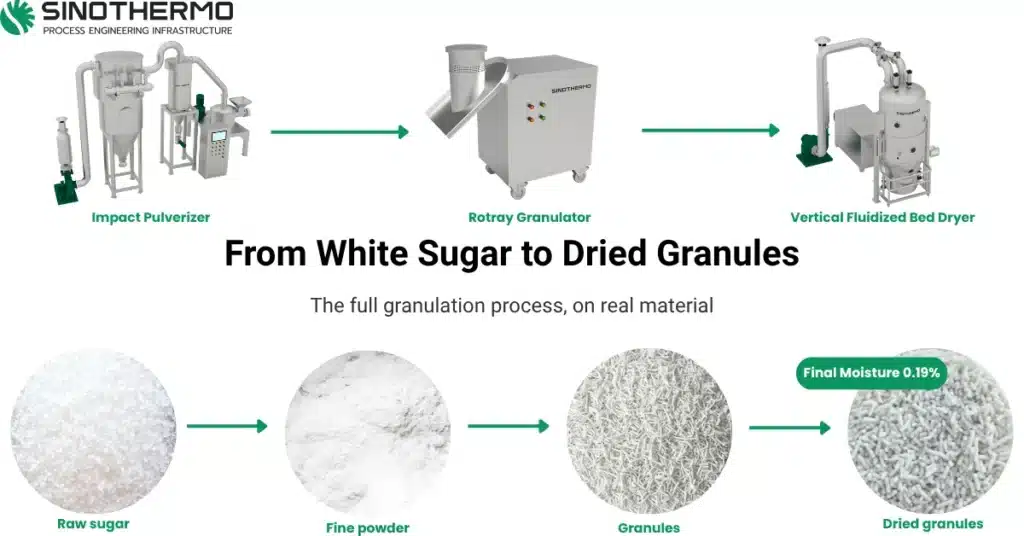
We recently ran a single, integrated material trial in the SINOTHERMO testing lab that shows the entire granulation process end to end — starting from ordinary white sugar and finishing with dried, uniform granules verified by moisture analysis. It is a simple material to follow, but it demonstrates exactly what a powder-to-granule line has to accomplish for far more demanding products: control particle size, build uniform granules, drive out moisture, and prove the result with instrument data.
This article walks through that trial one stage at a time — why each step exists, what the equipment does, and how the pieces connect into one repeatable line. If you are evaluating a granulation or drying line for food, pharmaceutical, chemical or fine-powder production, this is the process you are really buying, seen on real material rather than a spec sheet.
Why the granulation process follows this order
Fine powder is difficult to handle. It flows poorly, generates dust, segregates during transfer, doses inconsistently, and can cake or dissolve unevenly. The granulation process solves this by converting loose powder into larger, uniform, free-flowing granules — but the sequence of steps matters as much as the steps themselves.
The logic of the chain is straightforward:
- Pulverize first to create a consistent fine powder — a uniform feedstock is what makes even granulation possible.
- Granulate to convert that fine, dusty powder into uniform, free-flowing granules with better flow, dosing and dissolution, and far less dust.
- Dry to remove the moisture introduced during granulation, so the granules are stable, storable and ready for packaging without caking.
- Verify the final moisture with an instrument, so the result is proven rather than assumed.
Size reduction → granulation → drying → QC. Skip or reorder a step and the problem reappears downstream as uneven granules, high moisture, or a batch that fails at packaging. Here is how each stage played out in the trial.
Stage 1 — Pulverizing: building a uniform feedstock
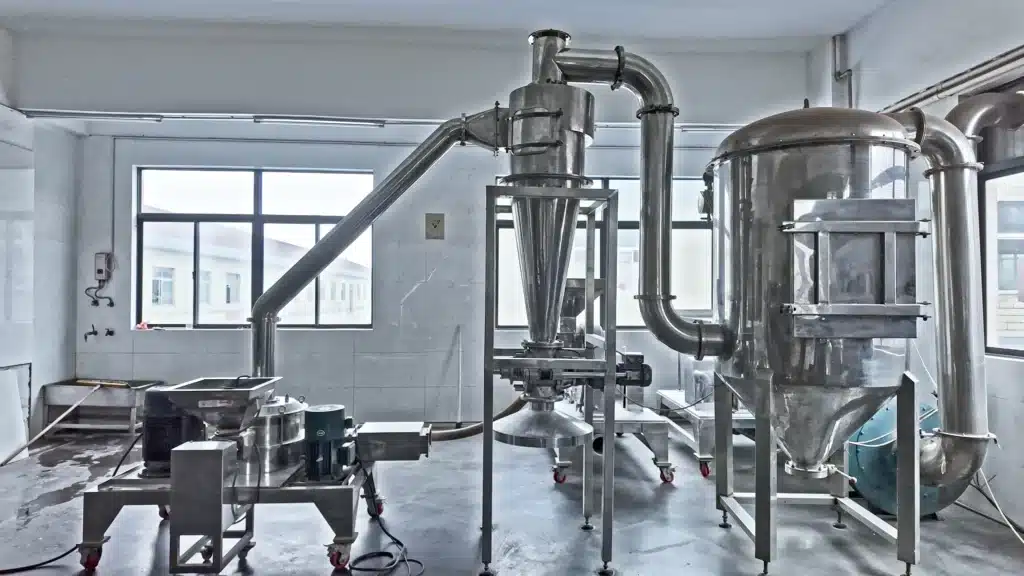
The trial begins with raw granulated white sugar fed into a WFJ Impact Pulverizer. Coarse crystals up to 10 mm enter the chamber, where high-speed impact grinding fractures them and the particles are classified to a controlled fineness. The output is a fine, even powder in the 80–450 mesh range — capable of 400 mesh or finer — and the mill runs cleanly with cyclone or bag-type dust collection.
This step is about consistency, not just fineness. Particle size reduction to a uniform distribution is what allows the next stage to build granules of even size and density. Feed inconsistent powder into a granulator and you get inconsistent granules; a controlled feedstock is the foundation of the whole line.
Stage 2 — Granulation: from fine powder to uniform granules
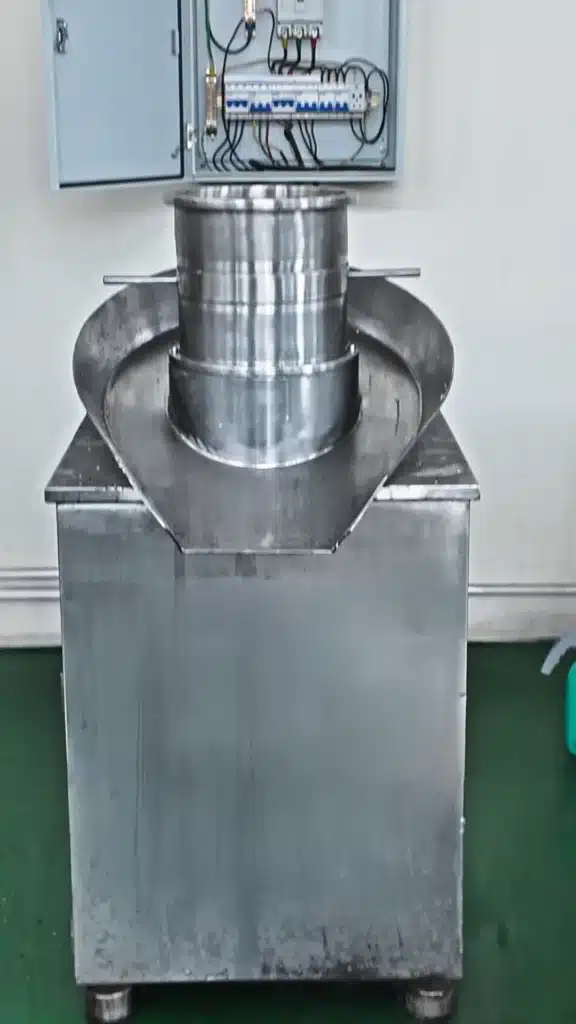
The fine powder then moves to a ZLB rotary granulator (also called a basket granulator). Inside, a rotating impeller presses the material against a precision cylindrical screen — the “basket” — and extrudes it through the perforations into consistently sized, dense, cylindrical granules. This is the heart of the sugar granulation step: it turns a fine, dusty powder into free-flowing granules that handle, dose, dissolve and package far more predictably.
At this point the granules are still high in moisture — they are wet granules, which is exactly why a drying stage has to follow. Note that “rotary granulator” and “basket granulator” describe the same rotary-impeller-plus-basket-screen machine; it should not be confused with an oscillating granulator, which is a different design.
Equipment note: exact screen aperture and throughput for the ZLB unit are configured to the target granule size.
Stage 3 — Fluidized bed drying: locking in stability
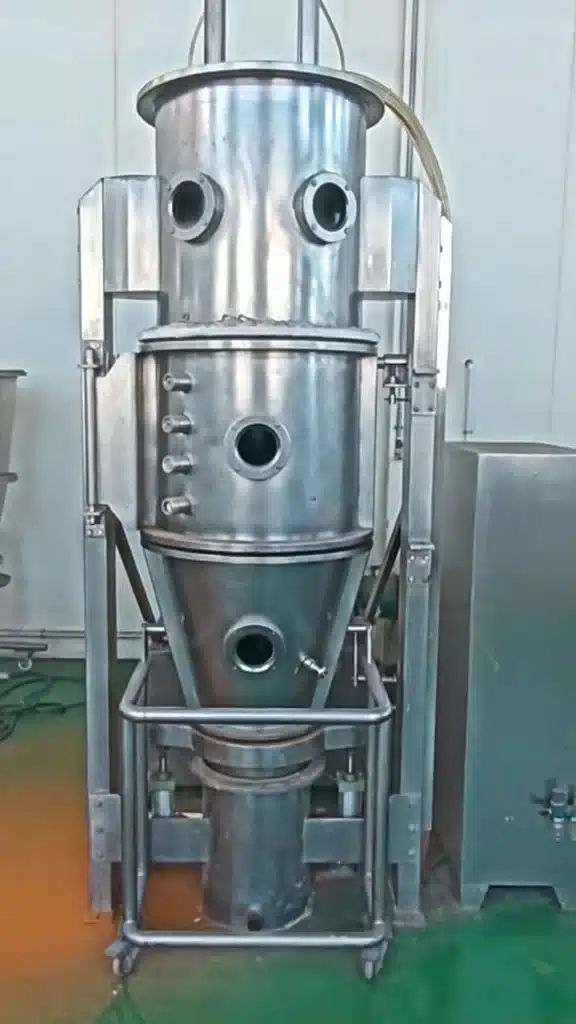
The wet granules are dried in an FG Vertical Fluidized Bed Dryer. Hot air — with an inlet temperature under 100 °C — suspends and fluidizes the granules, creating intimate particle-to-air contact so drying is fast and uniform. The dryer accepts material with moisture under 20% and, by its nominal specification, brings it down to a 3–5% moisture content.
Fluidized bed drying is the right tool here for two reasons: fluidization dries every granule evenly rather than crusting the outside, and the vertical design maximizes bed height and floor-space efficiency in batch operation (the same platform can even be converted to a spray fluidized bed granulator). This is the step that makes the granules stable and storable — dried enough to resist caking and spoilage, ready for packaging.
Stage 4 — Quality verification: proving the result
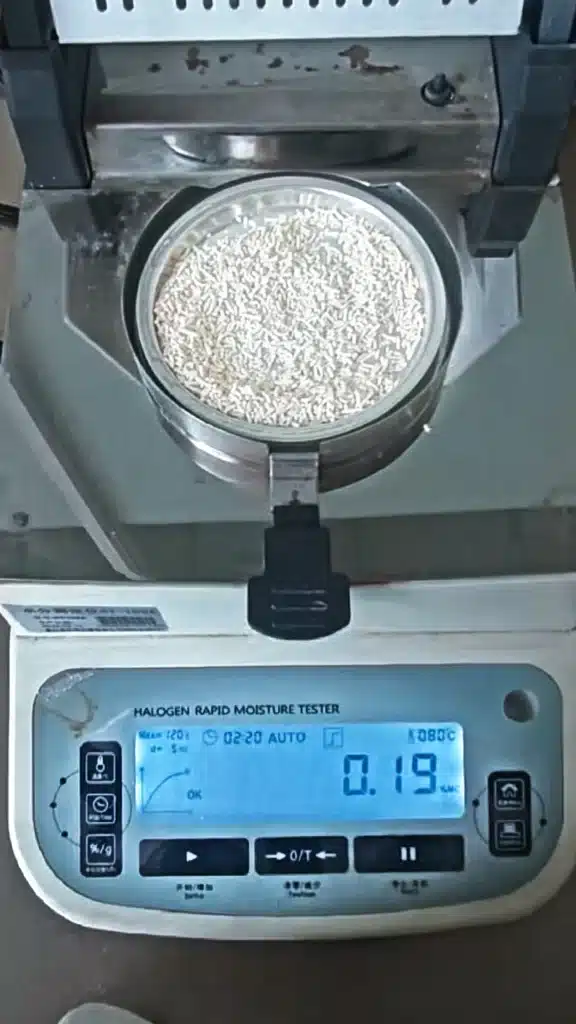
The trial closes with quality control on a Halogen Rapid Moisture Analyzer. A sample is weighed and rapidly heated by halogen; the analyzer computes the moisture loss and reports the final figure.
In this run, the dried granules measured 0.19% final moisture — thoroughly dried. It is worth being precise about what that number means: the dryer’s nominal output spec is 3–5%, so 0.19% is the result of this particular run, not a fixed guarantee. It demonstrates strong drying capability and, just as importantly, shows the value of verifying with an instrument rather than relying on feel. You do not know a batch has hit target until you measure it.
One integrated line, one continuous logic
Read as a whole, the trial is a compact demonstration of what a well-designed granulation process delivers:
| Stage | Equipment | Input | Output |
|---|---|---|---|
| 1 · Pulverize | WFJ Impact Pulverizer | White sugar, ≤10 mm | Fine powder, 80–450 mesh |
| 2 · Granulate | ZLB Rotary (Basket) Granulator | Fine sugar powder | Uniform wet granules |
| 3 · Dry | FG Vertical Fluidized Bed Dryer | Wet granules, <20% moisture | Dried granules, 3–5% (spec) |
| 4 · Verify | Halogen Moisture Analyzer | Dried granule sample | 0.19% moisture (this run) |
Each stage hands a defined output to the next: uniform powder enables uniform granules; uniform granules dry evenly; even drying delivers a stable product; the analyzer proves it. That hand-off discipline — not any single machine — is what separates a reliable line from one that fights you at scale.
Why this matters beyond sugar
Sugar is an easy material to watch, but the same powder → granule → dry → verify chain applies directly to:
- Alimentación — sugar, flavors, instant and soluble products
- Farmacéutica — APIs and excipients
- Chemical and pigments
- Cosméticos
- Agriculture and fertilizer
- Fine chemicals
Across all of them the benefits are the same: uniform particle size, controlled moisture, better flowability and solubility, reduced dust, and a process that scales and repeats. If your product is heat- or moisture-sensitive, the same line adapts — and choosing between drying and granulation routes is a decision worth testing first (see our guide on wet vs dry granulation and our fluid bed dryer guide).
A process-engineering view: prove it on your own material
A spec sheet tells you what a machine can do; a trial tells you what your material actually does. Two powders that look similar can pulverize, granulate and dry very differently — particle shape, binder behavior, moisture uptake and heat sensitivity all shift the result. The dependable way to de-risk a scale-up and confirm equipment selection is to run your material through the full chain and measure the output at each step.
That is exactly what this trial exists to do. As a process-engineering manufacturer with 20+ years of experience, ISO 9001:2015 certification, and a track record across 300+ industries and 5,000+ delivered projects, SINOTHERMO doesn’t just supply the pulverizer, granulator and dryer — we run your material through them in our in-house testing lab, verify particle size and moisture, and then engineer the production line around your validated process rather than an off-the-shelf model.
Common mistakes to avoid
- Granulating inconsistent powder. Uneven feedstock produces uneven granules. Get particle size reduction right first.
- Under-sizing or skipping the drying stage. Granulation adds moisture; if the dryer can’t remove it evenly, granules cake or fail at packaging. Size drying to the wettest granules, not the average.
- Trusting feel instead of measurement. “Looks dry” is not a moisture spec. Verify with an analyzer on every batch.
- Reading a single trial result as a fixed spec. A 0.19% moisture result shows capability; your target moisture should be set to the product’s requirement and confirmed on your own material.
- Confusing granulator types. A rotary (basket) granulator is not an oscillating granulator — the mechanism and granule result differ. Specify the right one for your granule target.
Conclusión
This trial compresses an entire production philosophy into four steps and one easy-to-follow material: pulverize to a uniform powder, granulate into free-flowing granules, dry to a stable moisture, and verify the result with data. The white sugar hit 0.19% moisture — but the real takeaway is the discipline of the chain, and the fact that it was proven on real material before any talk of scale-up.
Have a powder you need turned into uniform, dried granules? Bring it to our testing lab. We’ll run the full granulation process on your material, share the moisture and particle-size data, and spec a line around the result.
 mark.gu@sinothermo.com ·
  WhatsApp: +86 180 2197 2660 ·
  www.sinothermo.com
SINOTHERMO — Process Engineering Infrastructure.
PREGUNTAS FRECUENTES
What is the granulation process?
The granulation process converts fine powder into larger, uniform, free-flowing granules to improve flow, dosing, dissolution and dust control. In a full line it typically runs as pulverizing (to create a uniform powder feedstock), granulation (to build the granules), drying (to remove the moisture added during granulation), and a final moisture check to verify the result.
Why do you granulate powder and then dry it?
Granulation often introduces moisture — either from a binder or from the material itself — so the resulting wet granules must be dried to become stable and storable. Drying removes that moisture, preventing caking and spoilage and preparing the granules for packaging.
What is fluidized bed drying and why use it for granules?
Fluidized bed drying suspends granules in an upward stream of hot air so every particle contacts the air directly. This gives fast, uniform moisture removal without crusting the surface, which is why it suits wet granules. In this trial the FG vertical fluidized bed dryer ran with inlet air under 100 °C.
What moisture level do dried granules reach?
It depends on the material and target. The fluidized bed dryer used here has a nominal output of 3–5% moisture; in this specific trial the dried sugar granules measured 0.19% on a halogen moisture analyzer — a result that shows strong drying capability rather than a fixed guarantee.
Is a rotary granulator the same as a basket granulator?
Yes. "Rotary granulator" and "basket granulator" describe the same machine — a rotating impeller that presses material through a precision cylindrical (basket) screen into uniform granules. It is different from an oscillating granulator, which uses an oscillating rotor and produces granules by a different mechanism.
Can I test my own material on this line?
Yes. SINOTHERMO's in-house testing lab runs your material through the full pulverize → granulate → dry → verify chain, measures particle size and final moisture, and uses the data to de-risk scale-up and confirm equipment selection before any line is built.