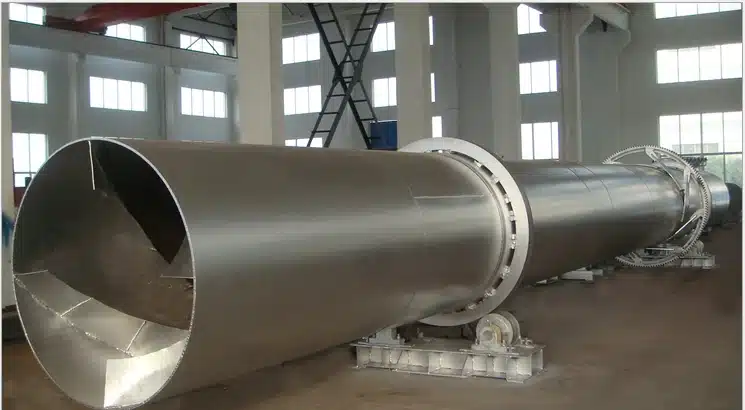
A rotary dryer is a large, long-life capital asset, so the manufacturer's sizing methodology matters more than almost any other factor — a drum sized wrong either misses your moisture target or wastes energy for the rest of its service life. This guide covers how to assess a rotary dryer supplier's engineering capability, verifiably, before you sign.
This article stays on the supplier-evaluation layer. For the equipment itself, see the rotary drum dryer guide; for the wider selection framework across dryer types, see how to choose an industrial dryer.
The core question: how do they size the dryer?
Rotary dryer sizing depends on feed rate, initial and target moisture, particle characteristics, and heat-transfer behaviour — not on tonnage alone. Ask directly: what is your sizing basis?
Ask for: their sizing basis in writing — ideally a drying-curve test on your actual feed, plus feed rate, moisture in/out, particle properties and heat sensitivity — and an explanation of how those inputs set drum diameter, length, slope and rotation speed.
A passing answer walks from your material's behaviour to the drum geometry, and is willing to test rather than assume.
Slow down if the supplier sizes from a rule-of-thumb table or matches a drum to a tonnage figure with no discussion of your material's drying behaviour. Two feeds with identical moisture content can need very different residence times; sizing from tonnage alone is how oversized (wasteful) or undersized (underperforming) dryers happen.
What to evaluate in a rotary dryer manufacturer
1. Direct and indirect capability
Direct-fired suits high-tonnage, robust materials that tolerate contact with combustion gas. Indirect (steam, thermal oil, or electric) suits fine, dusty, oxidation-sensitive or contamination-sensitive materials where combustion gas contact is unacceptable. A supplier who only builds one type will steer you toward it regardless of fit — ask which they have actually delivered for a material like yours, not just which they list.
2. Flight (lifter) design
Flights control how material showers through the gas stream and therefore heat-transfer efficiency. Ask how the flight profile is chosen for your material's flowability and stickiness, and whether it is adjustable or fixed.
3. Airflow configuration
Co-current airflow is gentler on heat-sensitive feeds; counter-current achieves lower final moisture. Ask which the supplier recommends for your material and why — the answer should follow your material's heat sensitivity, not a default configuration.
4. Materials of construction for abrasive or corrosive feeds
Minerals and some chemicals wear drums and flights. Ask about wear allowance built into the shell and flight thickness, liner options, and expected replacement intervals in operating terms rather than a vague "long life" assurance.
5. Drive and support systems
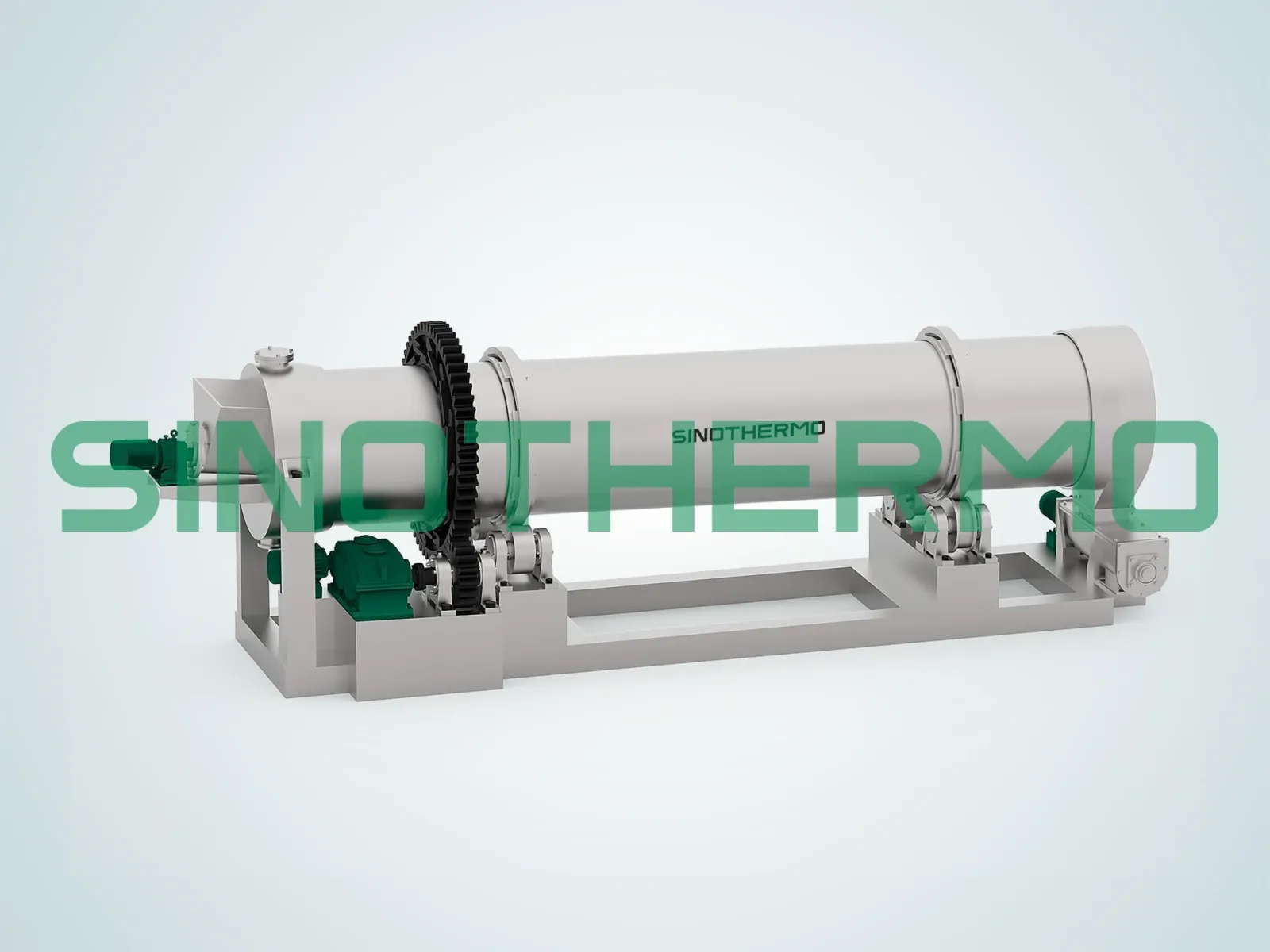
Trunnion/riding-ring design, drive type, and alignment tolerance affect service life and maintenance burden on equipment this size. Ask how alignment is verified at commissioning and what the recommended re-alignment interval is.
6. Air handling and emissions
Cyclones, bag filters, scrubbers — on a large rotary dryer this is a significant part of both capital cost and regulatory compliance. Confirm what stage(s) are included and what the supplier's basis is for the equipment sizing (dust loading, particle size distribution of the fines).
7. Installation and commissioning
Rotary dryers are large, field-erected installations, not a machine that arrives assembled and gets bolted to the floor. Confirm who provides foundation drawings, who supervises erection, and whether commissioning support is included in the quoted price or billed separately once the equipment lands on site.
Ask for: a named commissioning engineer or team, the expected number of days on site, and what "commissioning complete" means in the contract — a running dryer, or a dryer that has demonstrated your target throughput and outlet moisture. Those are different milestones, and the gap between them is where disputes happen.
Slow down if installation support is described only as "available on request" with no scope or day-rate attached, or if the supplier has never commissioned a unit at your site's scale before.
Rotary dryer vs rotary kiln — make sure you're buying the right thing
These terms are often used interchangeably, but they are not the same machine.
- Rotary dryer removes moisture, typically at temperatures below roughly 300°C.
- Rotary kiln / calciner performs high-temperature heat treatment — often 500–1000°C or higher — that drives a chemical or phase transformation, not just moisture removal.
If your process requires calcination rather than drying, you need a kiln, and the supplier evaluation shifts toward temperature control, atmosphere control, and refractory/materials capability. See our rotary kiln page for what that evaluation adds; for a real calcination process chain, see LFP precursor drying and calcination.
Bring every quotation onto one baseline
Rotary dryer quotations are hard to compare because scope boundaries genuinely differ between suppliers — some quote the drum and drive only, some quote the full air-handling train. Issue a one-page scope sheet and require every supplier to mark each line included / optional / excluded:
- Guaranteed throughput at a stated outlet moisture — not a bare tonnage figure
- Heating type and energy source, direct or indirect
- Flight design basis for your material
- Wear allowance and liner specification for abrasive/corrosive duty
- Drive type, trunnion/riding-ring design, alignment tolerance
- Air handling and emissions equipment: cyclone, bag filter, scrubber — which stages, and how many
- Control system: panel, PLC, instrumentation, data logging
- Foundation drawings and utility requirements
- Erection supervision and commissioning support
- Spare parts kit, itemised
A bottom-line number only means something once every supplier has answered the same lines.
Red flags to watch for
None of these means a supplier is untrustworthy. Each means you need one more answer before proceeding.
- 1.Sizing from tonnage alone, with no interest in your material's drying behaviour.
- 2.Only one heating type offered, regardless of what your material needs.
- 3.Throughput guaranteed with no outlet moisture stated. A tonnage figure without a moisture target is not a guarantee you can hold anyone to.
- 4.Air handling excluded from the quote and revealed later as a major add-on.
- 5.No erection or commissioning support on a machine of this scale.
Supplier evaluation checklist
| Area | Ask for | Passes when | Watch for |
|---|---|---|---|
| Sizing basis | Drying-curve test on your material; feed rate, moisture in/out | Explains how inputs set drum geometry | Sizing from a tonnage table alone |
| Direct/indirect capability | Units actually delivered for a comparable material | Specific references named | Only one heating type, sold regardless of fit |
| Flight design | Basis for profile selection; adjustable or fixed | Tied to your material's flow behaviour | Standard flight regardless of material |
| Materials/wear | Wear allowance, liner options, replacement interval | Stated in operating terms | Vague "long life" with no numbers |
| Drive/support | Alignment verification method, re-alignment interval | Procedure named | No commissioning alignment check mentioned |
| Air handling | Stages included, sizing basis (dust loading) | Itemised and explained | Bundled as "standard" with no detail |
| Quotation scope | Every line marked included / optional / excluded | All suppliers answer the same lines | Price compared before scope aligned |
Where SINOTHERMO fits
We would rather you applied this checklist to us than took our word for it. SINOTHERMO builds direct and indirect rotary dryers, and rotary kilns for calcination duty, sized from pilot-lab testing on your actual material rather than a generic tonnage table — with 20+ years of experience in industrial drying behind the design. Pilot testing is a paid engineering service that returns the drying curve, residence time and gas-temperature data used to size the drum correctly. See the facility on the testing lab page.
Sizing a rotary dryer? Send us your material. Our pilot lab tests it and produces the drying data you need to size it correctly, ours included.
✉️ mark.gu@sinothermo.com · 📱 WhatsApp: +86 180 2197 2660 · 🌐 www.sinothermo.com · 💬 Request a pilot test
SINOTHERMO — Process Engineering Infrastructure.
Frequently asked questions
How should a rotary dryer manufacturer size my dryer?
From your material's actual drying behaviour — feed rate, moisture in and out, particle properties, and heat sensitivity — ideally confirmed by a test on your feed. Sizing from tonnage alone risks an oversized, wasteful dryer or an undersized, underperforming one.
What is the difference between a rotary dryer and a rotary kiln?
A rotary dryer removes moisture at relatively low temperature, typically below roughly 300°C. A rotary kiln performs high-temperature heat treatment, often 500–1000°C or higher, that drives a chemical or crystalline transformation rather than just moisture removal. Confirm you are specifying the right one for your process before you request quotes.
Should I choose a direct or indirect rotary dryer?
Direct-fired suits high-tonnage, robust materials that tolerate contact with combustion gas. Indirect suits fine, dusty, oxidation-sensitive, or contamination-sensitive materials where combustion gas contact is unacceptable. The answer should follow your material's properties, not a supplier's default configuration.
What should be included in a rotary dryer quote?
The drum and drive, air handling and emissions equipment (cyclone, bag filter, or scrubber as applicable), control system, foundation and utility specifications, and erection/commissioning support. Confirm each explicitly and in writing — scope varies widely between suppliers, and a low headline price often means a narrower scope, not a better deal.
How do I compare rotary dryer quotations that are scoped differently?
Issue a one-page scope sheet and require each supplier to mark every line included, optional or excluded: guaranteed throughput at a stated outlet moisture, heating type, flight design basis, wear allowance, drive and alignment approach, air-handling stages, control system, foundation requirements, and installation/commissioning support. Compare bottom-line prices only once every supplier has answered the same lines.
What wear allowance should a rotary dryer have for abrasive material?
There is no universal figure — it depends on your material's abrasiveness and the target service life you are specifying for. Ask the supplier to state the wear allowance in shell and flight thickness, the liner options available, and the expected replacement interval in operating hours or years, rather than accepting a general "built to last" assurance with no numbers attached.

Mark Gu
Passionate about enhancing customer experiences and streamlining operations, Mark focuses on building strong relationships, fostering innovation, and leading teams to achieve exceptional service and efficiency.
Email: mark.gu@sinothermo.com
Phone: +86 18021972660