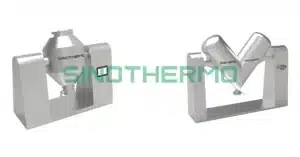
Choosing an industrial mixer looks simple until you watch two machines handle the same batch and get two completely different results. A ribbon blender can homogenize a free-flowing powder blend in minutes; run the same fragile granule through it and you may find the particles broken down and the specification ruined. A ploughshare mixer treats that fragile material more gently — but it moves differently, adds liquid differently, and suits a different class of material altogether. The two are not interchangeable, and picking the wrong one is one of the most common and expensive mixing mistakes buyers make.
This guide compares the ribbon blender against the ploughshare mixer the way a process engineer would — by mixing action, speed, shear, liquid addition and attrition risk — so you can match the machine to your material rather than to a brochure.
Why the mixer choice matters
Mixing sits at the heart of almost every powder, granule and paste process, and the agitator you choose decides three things at once: how uniform the blend is, how fast you reach it, and what the material looks like when you are done. Get it right and you hit blend uniformity quickly with no damage to the product. Get it wrong and the consequences are subtle but costly — segregation on discharge, dead zones that never blend, over-shearing that fractures granules, or a mixer that simply cannot fold in a liquid additive without forming lumps.
The core distinction is mixing action and shear. A ribbon agitator drives fast, high-convection movement that excels with robust, free-flowing powders. A ploughshare action lifts and throws material into a mechanically fluidized zone, mixing thoroughly while protecting fragile or cohesive materials and handling liquid addition and wet, sticky masses far better. Everything downstream — throughput, particle integrity, cleaning, energy — follows from that first decision.
What a Ribbon Blender does
에이 ribbon blender is the workhorse of dry powder mixing. Inside a horizontal U-shaped trough, a central shaft carries a double helical ribbon agitator: an outer ribbon moves material in one direction while an inner ribbon moves it in the opposite direction. This counter-current action creates fast, turbulent convective mixing — material is constantly displaced axially and radially — and typically homogenizes a free-flowing batch in 10 to 20 minutes.
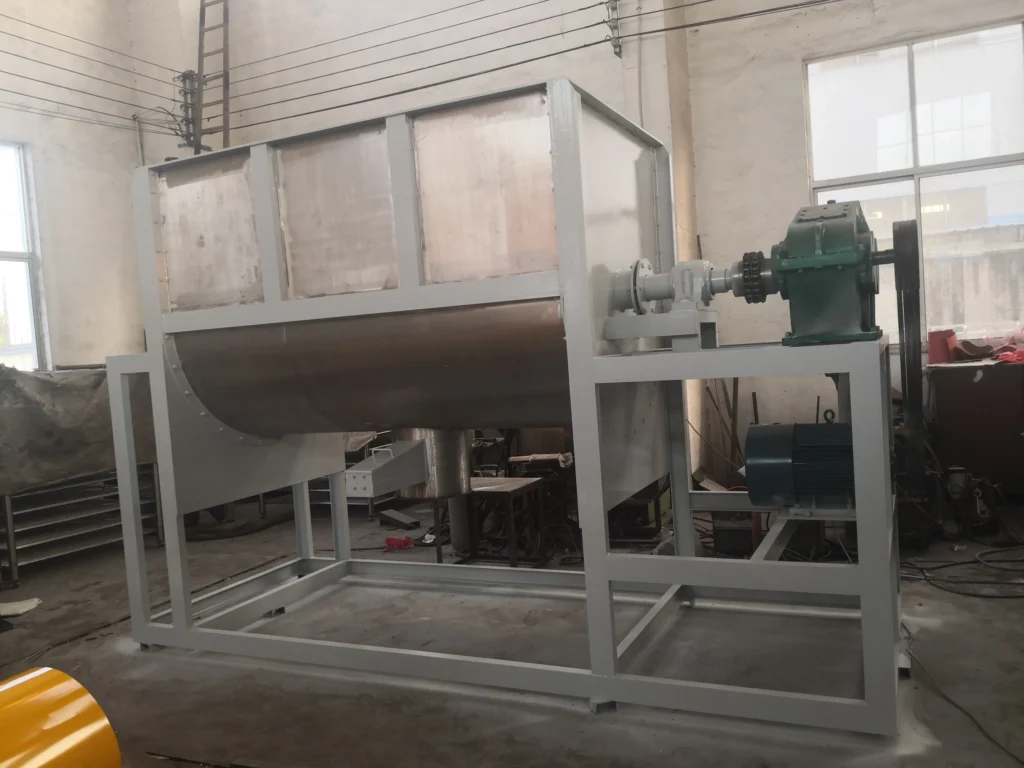
That speed comes from relatively high mechanical energy and higher shear at the ribbon tips, which makes the ribbon blender ideal for robust powders but demanding on fragile ones. A Horizontal Ribbon Mixer is the natural choice when you are blending dry powders and granules of similar density and particle size, when you want the shortest cycle time, and when the materials can withstand the shear without breaking down. It handles minor liquid additions through spray bars, but liquid addition is not its strength — heavy wetting tends to build up on the ribbons and trough wall.
A ribbon blender suits you when the batch is free-flowing dry powder or robust granules, you need fast, high-convection homogenization, the ingredients are reasonably matched in density and size, and particle integrity is not fragile. Be cautious when the material is friable, shear-sensitive, cohesive and sticky, or requires significant liquid addition — these are exactly the conditions where the ribbon’s higher shear becomes a liability.
What a Ploughshare Mixer does
Ploughshare mixers work on a different principle: mechanical fluidization. Instead of a continuous helical ribbon, plough-shaped tools are mounted along a horizontal shaft inside a cylindrical drum. As the shaft turns, the ploughs move material axially along the drum wall and throw it into an open, mechanically fluidized zone where it mixes in three dimensions. The action is thorough yet gentler and lower-shear than a ribbon, which protects fragile particles and works far better with cohesive, wet or sticky materials.
High-speed flying blades (an optional chopper) can be added to break up lumps and agglomerates, and the open space around the ploughs lets liquids fold in evenly without smearing — making the ploughshare the better choice when a liquid binder or additive is part of the recipe.
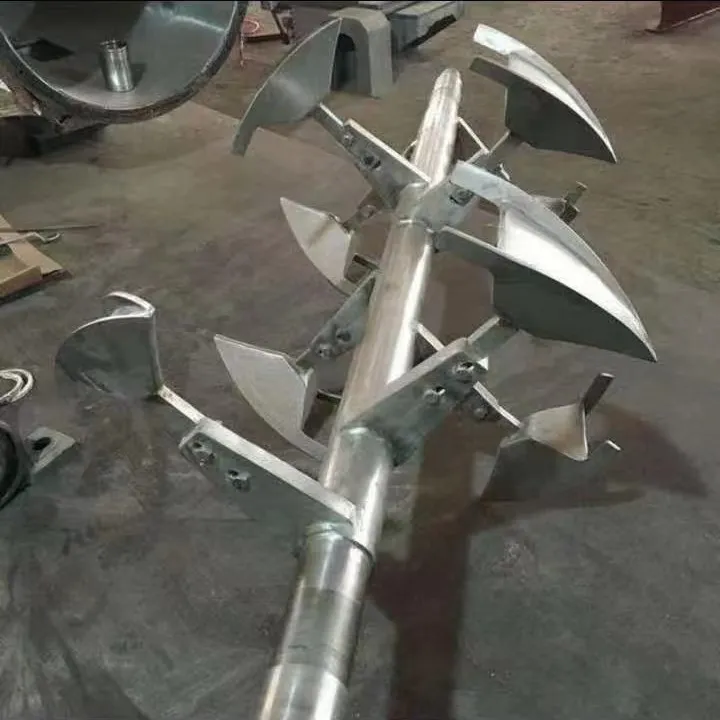
At SINOTHERMO, our gentler-action mixer is the 쟁기 믹서. Its ploughs move material along the drum wall while high-speed flying blades disperse and break up lumps when needed, giving thorough but gentle mixing. This makes it well suited to fragile granules that must not be crushed, cohesive powders that cake in a ribbon, wet or paste-like masses, and any recipe that involves adding a small amount of liquid.
A ploughshare mixer suits you when the material is fragile or shear-sensitive, cohesive or sticky, prone to lumping, or when the process requires light liquid addition. Be cautious when you simply need the fastest possible blend of a robust free-flowing powder — for that, a ribbon blender is usually faster and more economical. When a formulation instead needs very high shear and intensive liquid dispersion, a 고속 믹서 can be the right tool rather than either a ribbon or a ploughshare machine.
Ribbon blender vs Ploughshare Mixer — side by side
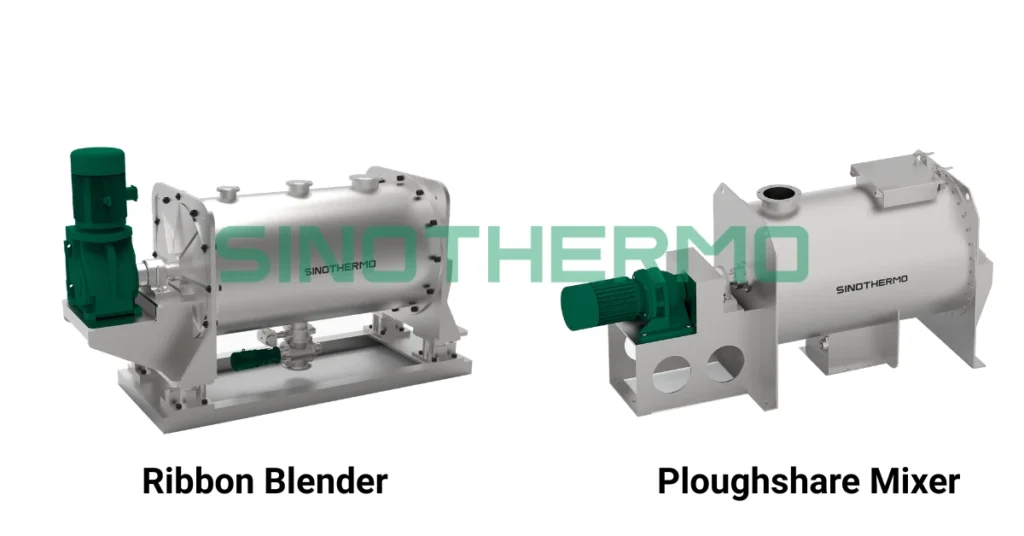
| 리본 블렌더 | 쟁기 믹서 | |
|---|---|---|
| Mixing action | Counter-current convection via double helical ribbon | Mechanical fluidization via plough-shaped tools |
| Speed to uniformity | Fast (typically 10–20 min) | Moderate — gentler, controlled |
| Best material | Free-flowing dry powders, robust granules | Fragile, cohesive, wet or sticky materials |
| Shear level | Higher (shear at ribbon tips) | Lower / gentle (optional chopper for lumps) |
| Liquid addition | Limited (spray bars only) | Good — folds liquids in evenly |
| Attrition risk | Higher — can fracture fragile particles | Low — protects particle integrity |
| Typical equipment | Horizontal Ribbon Mixer | 쟁기 믹서 |
For a fuller look at what a ribbon agitator is and how it homogenizes a batch, see our companion article on what is a ribbon blender. If you want the working principle of the ploughshare in detail, see our guide to the ploughshare mixer. And if you are weighing mixer types across your whole line, our industrial mixer buying guide walks through the full selection framework.
How to decide: a quick checklist
Run your batch through these questions before you specify anything:
- What state is the material in — dry, cohesive, or wet? Free-flowing dry powder points to a ribbon blender; cohesive, sticky or wet material points to a ploughshare mixer.
- Are the particles fragile? If granules or crystals must survive intact, the lower attrition of a ploughshare protects them; a ribbon’s higher shear risks breaking them down.
- Do you need to add liquid? Light liquid addition favors a ploughshare; a ribbon blender handles only light spray additions well.
- How fast do you need uniformity? For the shortest cycle on a robust powder, the ribbon wins on speed and cost.
- Do you have lumps or agglomerates to break? A ploughshare with a high-speed chopper handles lump-prone material a ribbon would smear or leave intact.
- Are ingredients matched in density and particle size? Well-matched free-flowing powders blend readily in a ribbon; widely mismatched or segregation-prone blends may need the gentler folding of a ploughshare.
A process-engineering view: prove it before you specify
A specification sheet rarely settles the ribbon-versus-ploughshare question. Two powders that look identical on paper can behave very differently once an agitator is turning — one blends cleanly in a ribbon while the other cakes, segregates or fractures, and only trials reveal which. The dependable way to choose is to run your own material and measure what you get: blend uniformity, cycle time, particle size before and after mixing, and how cleanly a liquid additive folds in.
This is the step most buyers skip and later regret. As a process-engineering manufacturer with 20+ years of experience, SINOTHERMO doesn’t just supply the machine — we help you prove the mixing action. Bring your powder to our in-house pilot laboratory, trial it on both ribbon and ploughshare agitators, and select the mixer on evidence rather than assumption. Every system we build is then engineered around your validated process, not adapted from an off-the-shelf model.
Common mistakes to avoid
- Choosing on throughput alone. A ribbon blender is faster, but speed is worthless if it fractures fragile granules or cannot fold in your liquid binder. Match the action to the material first.
- Ignoring particle attrition. Shear-sensitive crystals and granules can be quietly degraded by a ribbon’s higher shear — check particle size before and after mixing, not just final uniformity.
- Underestimating liquid addition. If your recipe needs meaningful liquid, a standard ribbon blender will disappoint. Specify a ploughshare action — with a chopper if lumps are a risk.
- Overlooking discharge and dead zones. Ask how the mixer discharges and whether its geometry leaves unmixed pockets; segregation on discharge can undo a perfect blend.
- Skipping pilot trials. A spec sheet cannot predict how your specific powder behaves under a given agitator. Trial first, then specify.
결론
The ribbon-versus-ploughshare decision comes down to one question above all: what state is your material in, and how fragile is it? If you are blending free-flowing dry powders or robust granules and want the fastest, most economical homogenization, a ribbon blender’s high-convection action is usually the answer. If your material is fragile, cohesive, wet or sticky, or your recipe needs light liquid addition, a ploughshare mixer protects particle integrity and folds liquids in evenly. The comparison table narrows the field, but pilot testing with your own material is what confirms the choice.
Not sure whether a ribbon blender or a paddle mixer fits your material? Talk to our process engineers and book a trial in our pilot lab — we’ll help you decide on data, not assumptions.
자주 묻는 질문
What is the main difference between a ribbon blender and a ploughshare mixer?
A ribbon blender uses a double helical ribbon to drive fast, high-convection mixing with higher shear, ideal for free-flowing dry powders. A ploughshare mixer uses plough-shaped tools to throw material into a mechanically fluidized zone, mixing more gently at lower shear — which suits fragile, cohesive or wet materials and handles liquid addition far better. The choice is driven mainly by material state and fragility.
Which mixer is faster, a ribbon blender or a ploughshare mixer?
A ribbon blender is generally faster, homogenizing a free-flowing batch in roughly 10 to 20 minutes thanks to its counter-current convective action. A ploughshare mixer is gentler and more controlled, trading some speed for lower particle attrition and better handling of difficult materials.
Which mixer is better for fragile or shear-sensitive materials?
A ploughshare mixer is better for fragile materials because its lift-and-throw action runs at lower shear and produces less particle attrition. A ribbon blender’s higher shear at the ribbon tips can fracture friable granules and crystals, so it is best reserved for robust, free-flowing powders.
Can a ribbon blender handle liquid addition?
A ribbon blender handles only light liquid additions through spray bars. Significant wetting tends to build up on the ribbons and trough wall and can cause caking, so recipes that require meaningful liquid addition are better suited to a ploughshare mixer, which folds liquids in evenly.
What is a ploughshare mixer best used for?
A ploughshare mixer is best for fragile, cohesive, wet or lump-prone materials, and for recipes that need light liquid addition. Its plough-shaped tools mix by mechanical fluidization at lower shear, and an optional high-speed chopper breaks up agglomerates — making it a versatile choice where a ribbon blender would over-shear or cake the material.
How do I decide which industrial mixer is right for my product?
Start with the material state and fragility: free-flowing robust powders favor a ribbon blender; fragile, cohesive, wet or lump-prone materials favor a ploughshare mixer. Then weigh speed, shear tolerance, liquid addition and attrition risk. Because powders behave unpredictably, the dependable final step is a pilot trial with your own material to measure uniformity, cycle time and particle integrity before specifying a machine.