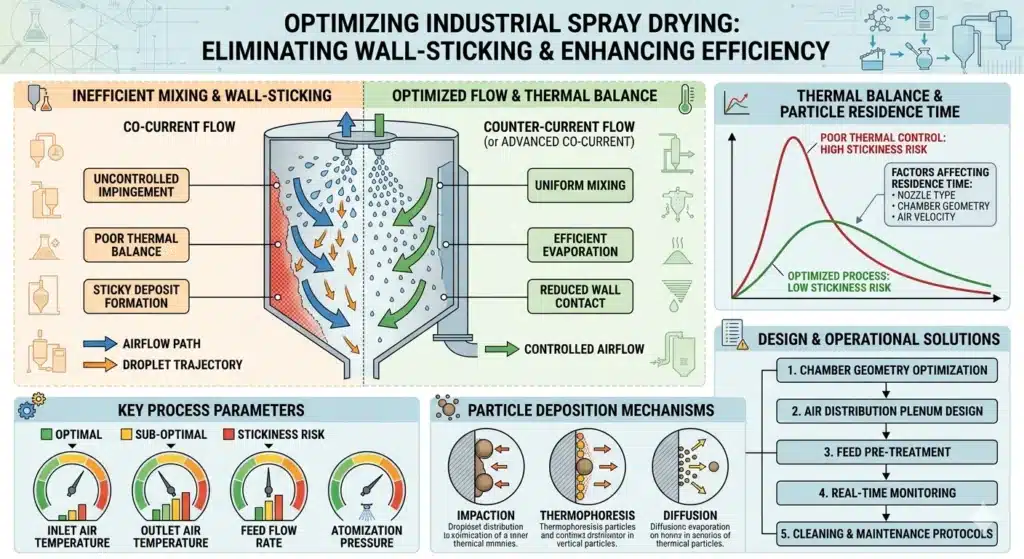
Spray drying process optimization is critical for industrial manufacturers seeking to eliminate wall-sticking problems and improve product yield. The spray drying process remains one of the most challenging operations in industrial manufacturing. However, the “wall-sticking” crisis—where semi-wet or thermoplastic particles adhere to the internal surfaces of the drying chamber—remains a primary bottleneck for spray drying equipment operational efficiency, resulting in yield loss, product degradation, and safety hazards like localized scorching. Solving this challenge requires a sophisticated engineering approach that balances the thermodynamics of the Glass Transition Temperature ( ) with optimized airflow dynamics. At SINOTHERMO, we address these complexities through the integration of jacketed cooling systems to maintain wall temperatures below the “sticky point” (
 ) and rotating air broom technology to continuously remediate fine powder accumulation. By synchronizing tower geometry, surface metallurgy, and dynamic thermal tuning, industrial operators can achieve continuous production cycles even with highly viscous or heat-sensitive materials such as pharmaceutical extracts and lithium-ion battery precursors.
The Thermodynamic Foundation: Glass Transition Temperature in Spray Drying Process Optimization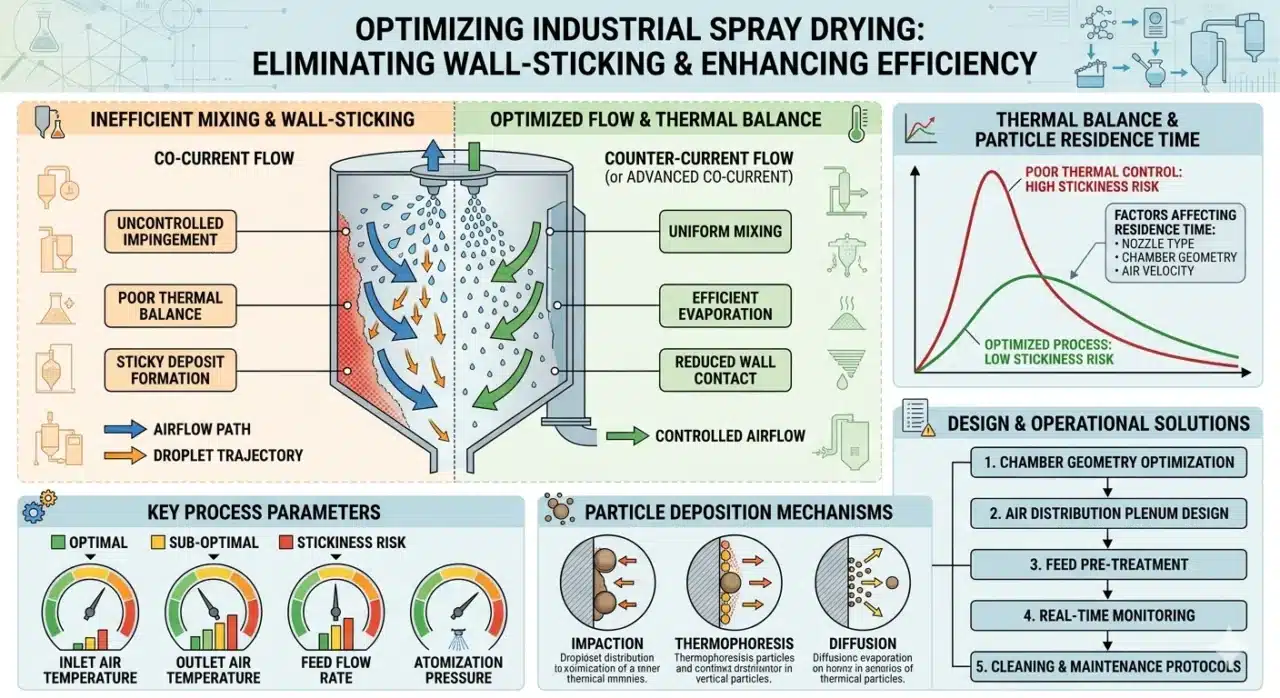
What is Tg? The Critical Threshold for Spray Drying Stability
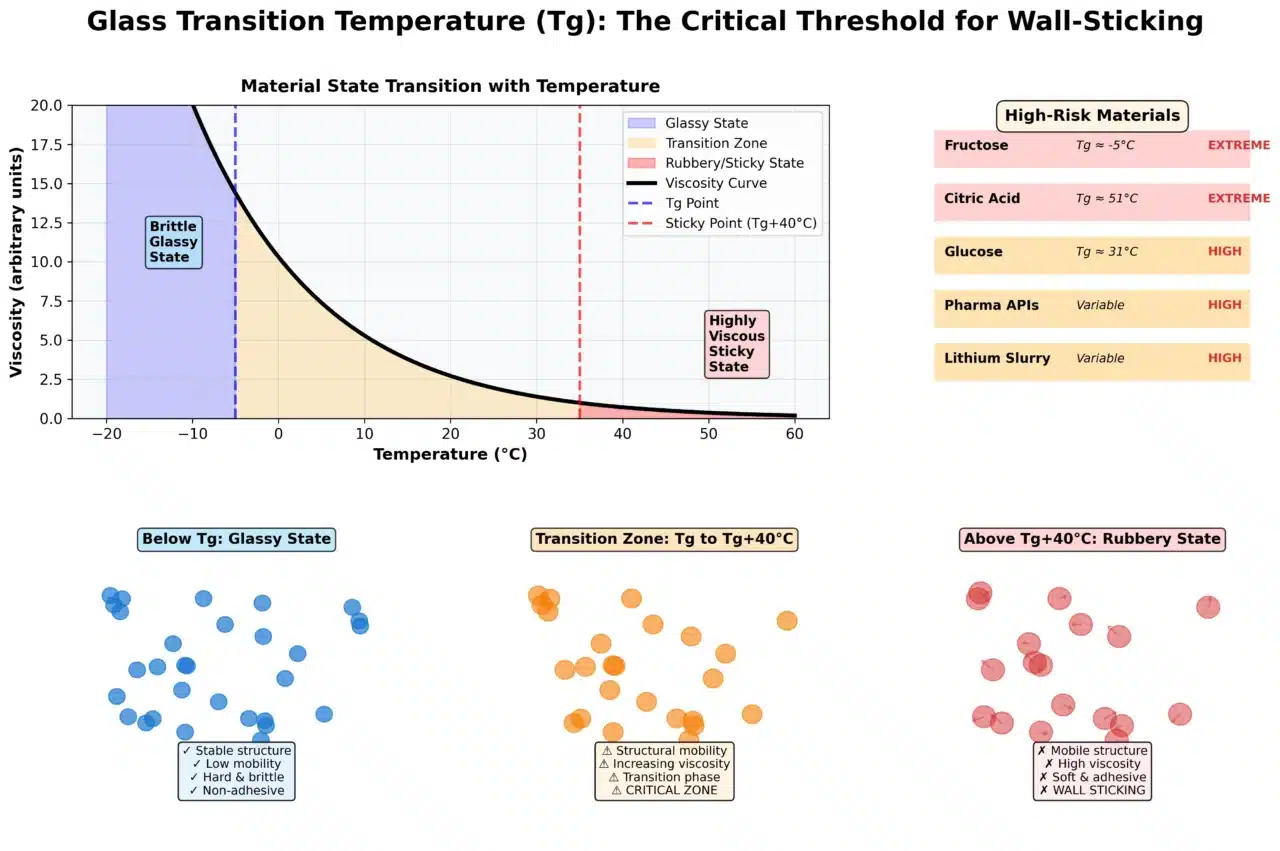
In spray drying process optimization, the transition of a droplet into a stable powder particle is governed by the rapid removal of solvent. The transition of a droplet into a stable powder particle is governed by the rapid removal of solvent, usually water or organic solvents like NMP, within a high-temperature gas stream. This process is not merely a change of state but a race against the material’s inherent stickiness. For amorphous materials, which comprise the majority of spray-dried products in the food and pharmaceutical sectors, the glass transition temperature () serves as the critical threshold for stability. When the temperature of the drying particle exceeds its , the material shifts from a brittle, glassy state to a rubbery, highly viscous state. In this rubbery phase, the particle surface becomes adhesive, causing it to stick to the chamber walls or other particles upon contact.
High-Risk Materials: Why Fructose, Glucose, and Citric Acid Stick in Spray Dryers
Research into sugar-rich foods in spray drying applications, such as fruit juices, highlights the severity of this spray drying challenge. Components like fructose and glucose have values as low as 14°C and 31°C, respectively. When these materials are processed, the operating environment must be meticulously controlled to ensure the particle surface temperature remains below the sticky point, which is typically 10°C to 20°C above the. If the thermal balance is disrupted, a catastrophic “meltdown” occurs on the tower walls, leading to a build-up that insulates the surface, further increasing localized temperatures and causing product browning or burning.
Material Component | Glass Transition Temp (Tg) | Sticky Point (Tsticky) | Risk Level |
Fructose | 14°C | 24- | Extreme |
Glucose | 31°C | 41- | High |
Citric Acid | 16°C | 26- | Extreme |
Maltodextrin (DE5) | 188°C | 198- | Low (Drying Aid) |
Pharmaceutical API | Variable (40-) | Tg+ | Moderate to High |
Engineering Solutions: Spray Drying Equipment Design Beyond Material Science
While materials science offers solutions like adding high-molecular-weight additives (e.g., maltodextrin) to raise the of the feed, engineering-level solutions focus on managing the interaction between the particles and the dryer’s internal environment. The question then becomes: how can equipment design proactively prevent this thermodynamic failure?
Structural Fixes: Tower Geometry and Atomization Trajectory in Industrial Spray Dryers
Optimizing Tower H/D Ratio for Spray Drying Equipment Performance
The physical architecture of the spray drying tower is the first line of defense against wall deposition. A mismatch between the atomizer’s spray pattern and the tower’s height-to-diameter (H/D) ratio is a frequent cause of chronic sticking. In centrifugal atomization systems, such as those featured in SINOTHERMO’s LPG-series, the liquid is propelled horizontally at high velocities. If the tower diameter is insufficient to accommodate the “mist distance”—the distance required for the droplet surface to dry and lose its initial kinetic energy—the droplets will inevitably strike the wall in a semi-wet state.Observations in high-capacity lithium slurry mixing suggest that for centrifugal atomizers, a larger tower diameter is often more beneficial than excessive height. Typical industrial dryers utilize H/D ratios between 3:1 and 5:1, but for heat-sensitive materials that are prone to sticking, “short-path” dryers with a 1:1 to 2:1 ratio are sometimes preferred to reduce the probability of wall contact. Furthermore, the cone angle at the bottom of the tower, usually set at 60°C, must be optimized to ensure that the dried powder slides effectively toward the discharge valve.
| Parameter | Impact on Wall Sticking | Recommended Strategy |
| Tower Diameter | Dictates mist distance and horizontal impact | Increase diameter for centrifugal atomization |
| Tower Height | Influences residence time and moisture removal | Match height to drying rate of slow-drying materials |
| Cone Angle | Controls gravity-assisted powder discharge | Standard 60°C; steeper for cohesive powders |
| Air Flow Pattern | Determines particle-gas contact and trajectory | Use air distributors to maintain center-flow |
Wall Surface Treatment: Polishing and PTFE Coating for Spray Dryer Towers
Beyond geometry, the metallurgy of the inner wall plays a decisive role in adhesion. A rough surface provides “anchor points” for fine particles, which can then accumulate through Van der Waals forces or electrostatic attraction. SINOTHERMO implements a rigorous polishing protocol, achieving a surface smoothness of  for pharmaceutical and food-grade towers. For particularly difficult materials, the application of non-stick coatings like Polytetrafluoroethylene (PTFE) can reduce powder adhesion by creating a low-energy surface that prevents the formation of stable bonds.
Thermal Barriers: Jacketed Cooling Systems for Spray Drying Process Optimization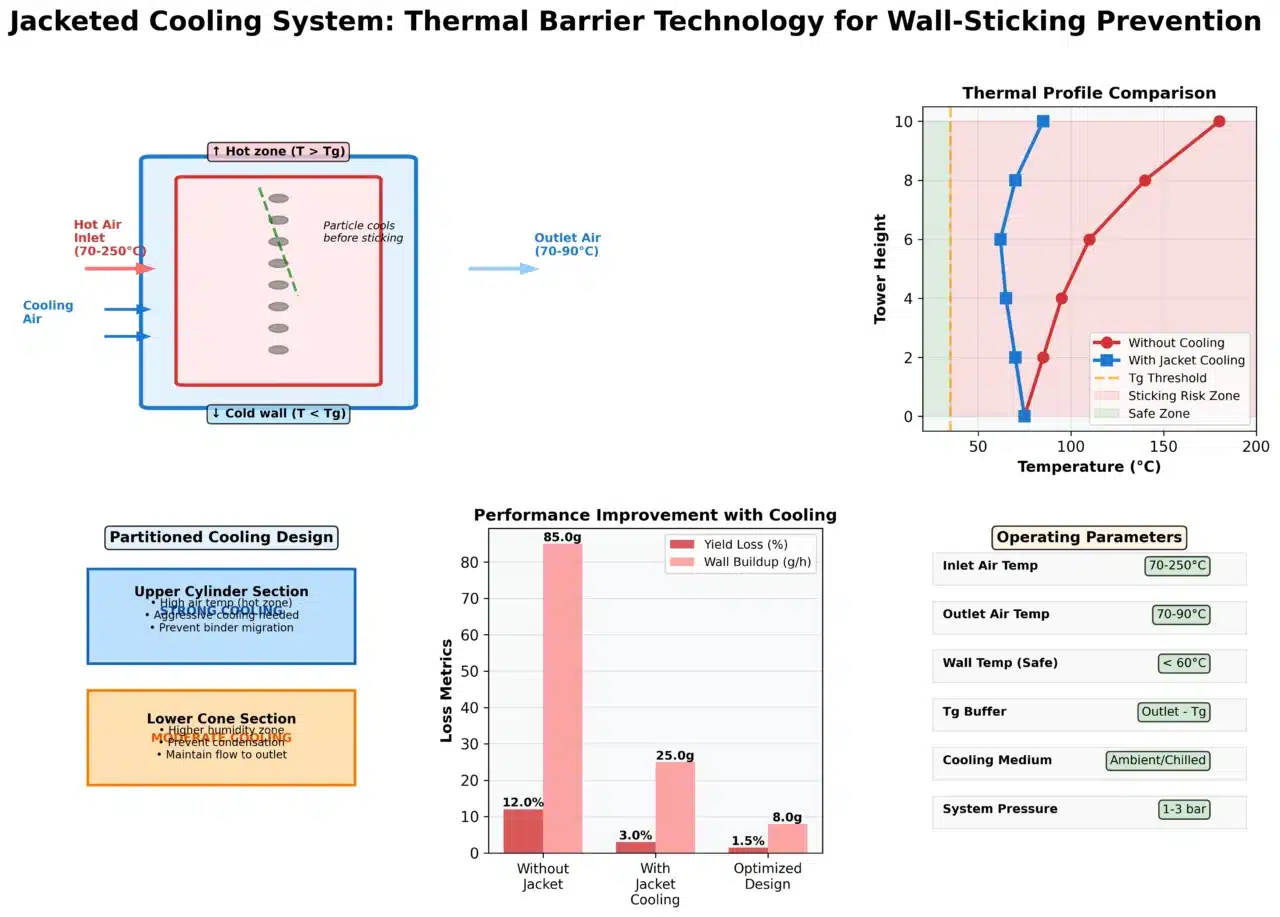
The Double-Wall Design: How Jacketed Cooling Technology Works in Spray Dryers
When dealing with thermoplastic materials—those that soften or melt at the temperatures required for drying—standard insulation is insufficient. In a conventional dryer, the tower wall temperature quickly equilibrates with the outlet air temperature, which is often 80°C to 100°C. For an extract with a of 40°C, this temperature ensures the wall is constantly in the “sticky zone”.The SINOTHERMO ZLPG-series addresses this through jacketed cooling technology. By creating a double-walled chamber and circulating ambient or chilled air within the jacket, the inner wall temperature can be maintained below 50°C. This creates a thermal barrier: any particle that deviates from the central airflow and touches the wall is immediately cooled. This localized temperature drop shifts the material from a rubbery state back to a glassy state, preventing it from adhering.
Partitioned Cooling Strategy: Managing Condensation Risks in Jacketed Equipment
Engineering a jacketed system requires a delicate balance. If the wall temperature drops below the dew point of the humid exhaust air, condensation will occur, leading to “wetting-induced” sticking. Therefore, the cooling system must be partitioned, often providing more intensive cooling in the upper cylinder where the air is hotter, and moderate cooling in the lower cone where humidity is higher.
The Air Broom and Kinetic Remediation Technology in Industrial Spray Dryers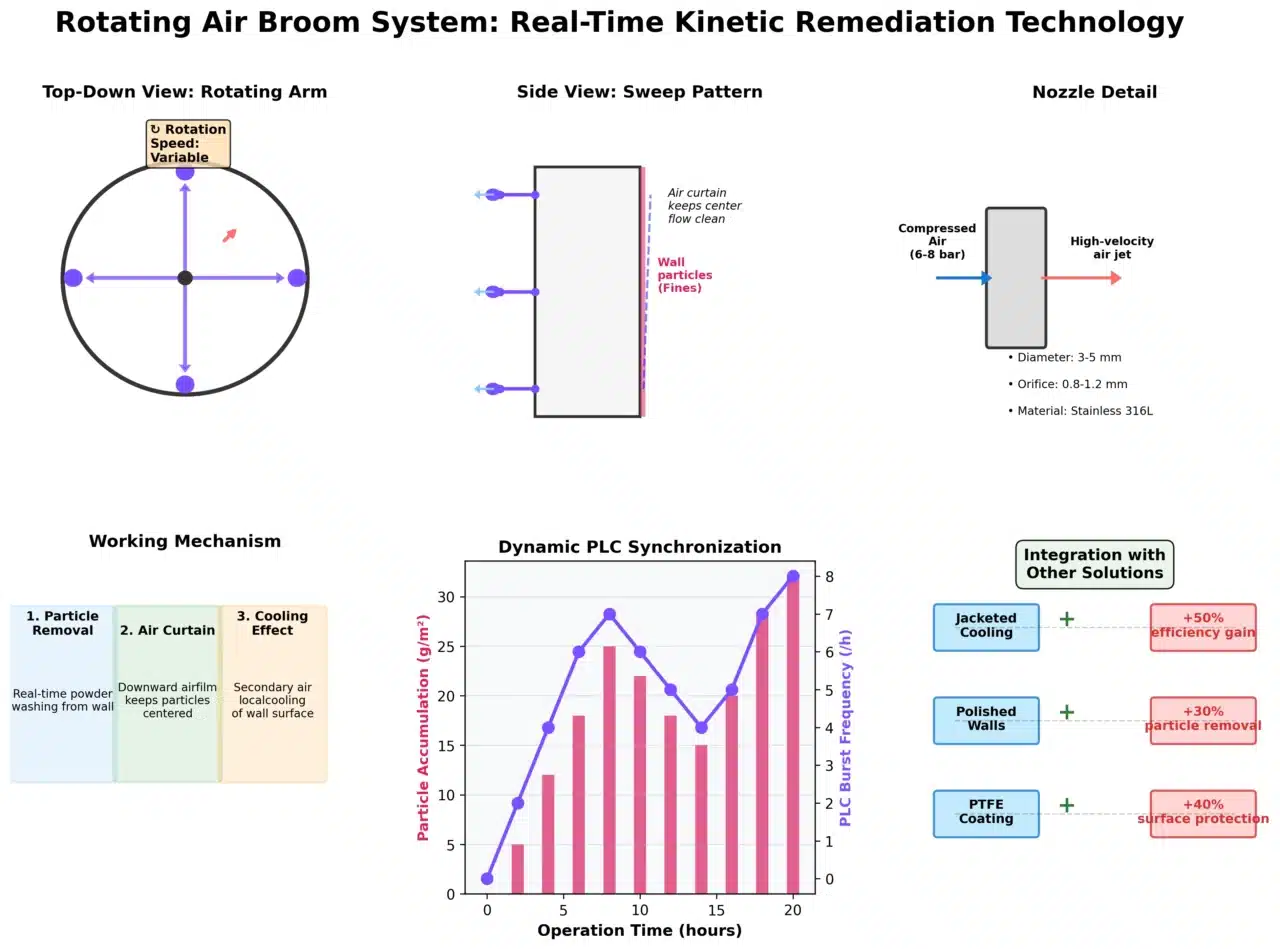
How the Rotating Air Broom Works: Mechanical Cleaning Solution
Despite optimized geometry and thermal barriers, the accumulation of “fines”—extremely small particles that are easily trapped in the slow-moving air boundary layer near the wall—remains a risk. Over time, these fines can form a thin layer that acts as an insulator, eventually leading to localized overheating and product scorching.The “Air Broom” or “Air Sweep” device is the mechanical solution to this challenge. This system consists of a rotating arm equipped with a row of high-pressure nozzles that follow the internal circumference of the tower. At SINOTHERMO, these systems use compressed air (typically 6 to 8 bar) to create a high-velocity air curtain that “sweeps” the wall surface.
Critical Advantages: Continuous Cleaning and Real-Time Performance
The air broom provides several critical advantages:
- Continuous Cleaning: It removes powder in real-time without requiring process shutdowns.
- Air Curtain Formation: The introduced secondary air creates a downward-moving film that helps keep particles toward the center of the tower.
- Heat Dissipation: The sweeping air provides a final localized cooling effect on the wall surface.
PLC Integration: Dynamic System Control Based on Material Properties
For large-scale industrial operations, the air broom must be synchronized with the dryer’s PLC to adjust burst times and rotational speed based on the material’s specific adhesion rate. This kinetic remediation ensures that the tower remains clean throughout production cycles that can last for days or weeks.
Conclusion: Engineering for Efficiency in Spray Drying Process Optimization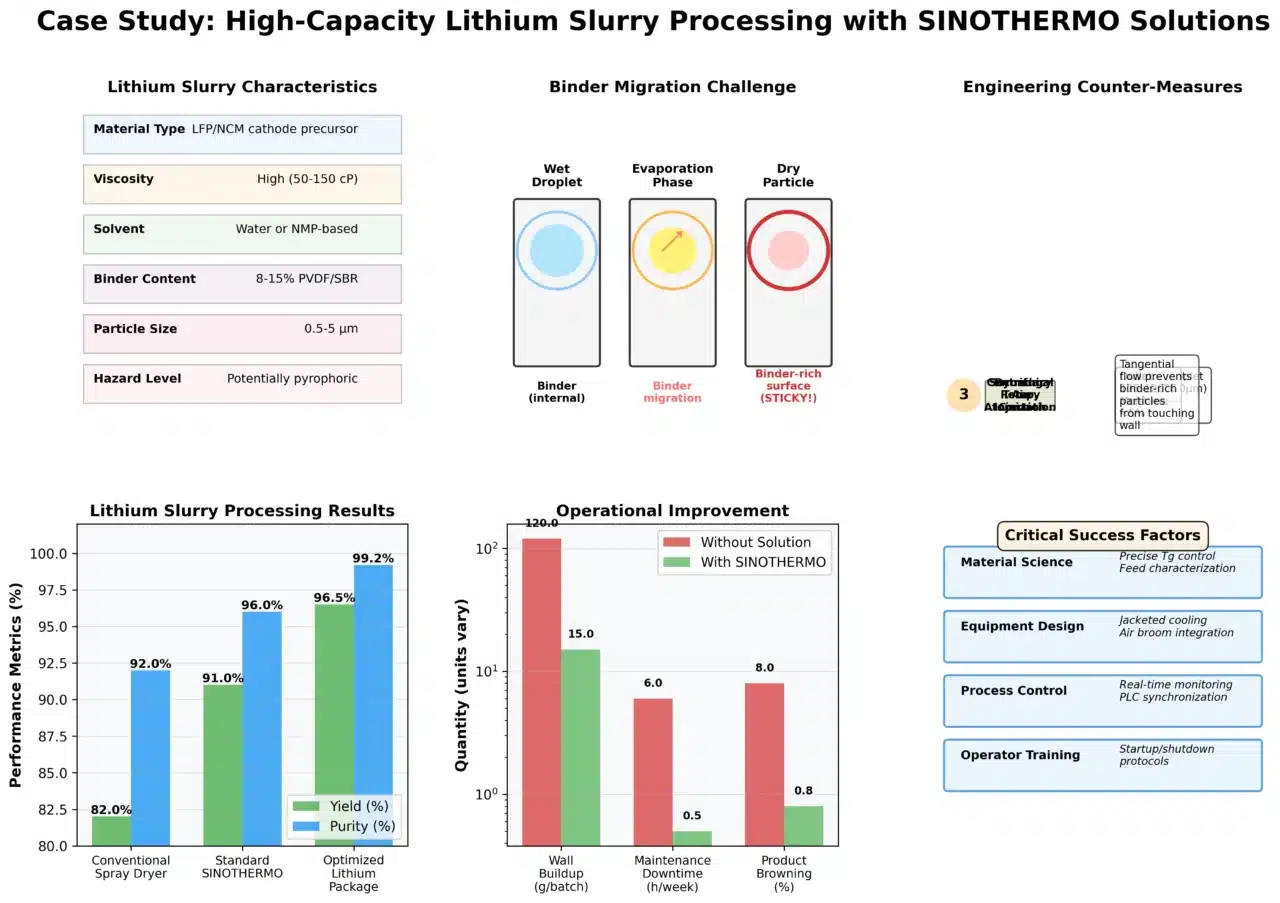
Lithium Slurry Challenges: Abrasion, Viscosity, and Binder Migration
The new energy sector, particularly the production of Lithium Iron Phosphate (LFP) and Nickel-Cobalt-Manganese (NCM) cathode materials, has become one of the most demanding applications for spray drying technology. These slurries are abrasive, highly viscous, and sensitive to binder migration during the drying process.
The Binder Migration Problem: Why Yield Loss Occurs in Consecutive Batches
Observations in high-capacity lithium slurry mixing suggest that “yield loss” in consecutive batches is often caused by the accumulation of binder-rich fines on the tower walls. As the water or solvent evaporates, the binder (such as PVDF or SBR) tends to migrate to the surface of the droplet, making it inherently stickier than the bulk material. If these binder-rich particles stick to the wall, they can degrade, changing the chemical composition of the final product and reducing the battery’s electrochemical performance.
SINOTHERMO Solutions: Rotary Atomization, Temperature Control, and Air Injection
To mitigate this, SINOTHERMO utilizes the following engineering strategies:
- Centrifugal Rotary Atomization: Using abrasion-resistant wheels (e.g., tungsten carbide) to handle the high-solid-content slurries while ensuring a uniform droplet size that minimizes wall impact.
- Dynamic Temperature Modulation: Maintaining a precise outlet temperature (often 90°C to 105°C ) that is high enough to ensure a moisture content of but low enough to prevent the binder from softening.
- Secondary Air Injection: Introducing clean air tangentially to the tower wall to prevent the binder-rich droplets from ever making contact with the surface.
Feature | Lithium Slurry Requirement | SINOTHERMO Solution |
Atomization | High abrasive resistance & high feed rate | Rotary Atomizer with reinforced wheel |
Purity | Zero metal contamination | 316L/310S Stainless Steel & Ceramic linings |
Recovery | > Yield | Multi-stage Cyclone + Bag Filter + Air Broom |
Safety | Explosion-proof (if using solvents) | GXP-series Inert Loop (Nitrogen) system |
Operational Wisdom: The Art of Dynamic Tuning
The Critical Balance: Inlet Temperature, Feed Rate, and Outlet Temperature
Engineering alone cannot solve the wall-sticking crisis; the equipment must be operated with a deep understanding of its dynamic thermal balance. The most critical operational lever is the relationship between the inlet temperature, feed rate, and outlet temperature.The inlet temperature ( ) determines the total energy available for evaporation. A higher increases the drying rate, which is generally beneficial as it shortens the time a particle spends in the “adhesive zone”. However, if the feed rate is too high, the is depleted too quickly, leading to a low outlet temperature (
 ) and high relative humidity. This is the primary cause of “semi-wet” sticking: the particles simply haven’t had enough time or energy to form a dry crust.Conversely, if the feed rate is too low, the can rise to a level where the material reaches its melting point, causing “hot-melt” sticking. The “sweet spot” for industrial operation involves maintaining a 30°C to 50°C buffer between the outlet temperature and the material’s glass transition temperature.
Startup and Shutdown Protocols: Critical Operating Procedures
Pre-Operation Heating and Shutdown Solvent Flush
Factory-floor observations indicate that many sticking incidents occur during the first or last 30 minutes of operation. Proper startup requires pre-heating the tower with clean air until the outlet temperature has stabilized. Only then should the feed be introduced. Similarly, shutdown should involve a “solvent flush” (using water or pure solvent) to clean the atomizer and the tower walls while the system is still at its operating temperature, preventing the residual powder from cooling and hardening on the surfaces.
Conclusion: Engineering for Efficiency and Zero-Waste Production
From Reactive Cleaning to Proactive Prevention
The “wall-sticking” crisis is a solvable industrial challenge when approached with the right combination of thermodynamic insight and mechanical engineering. By acknowledging the glass transition temperature as the defining limit of the process, manufacturers can transition from reactive cleaning to proactive prevention. Through the deployment of SINOTHERMO’s ZLPG-series extract dryers, featuring jacketed cooling and rotating air brooms, industries as diverse as pharmaceuticals and new energy can achieve unprecedented levels of yield and product consistency.
Customized Solutions: Tailoring Equipment to Your Material Profile
Solving the crisis means moving beyond “off-the-shelf” equipment and adopting solutions that are tailored to the material’s specific adhesive profile. Whether through superior surface polishing, optimized tower geometry, or dynamic thermal control, the goal remains the same: transforming complex liquids into high-value powders with zero waste.