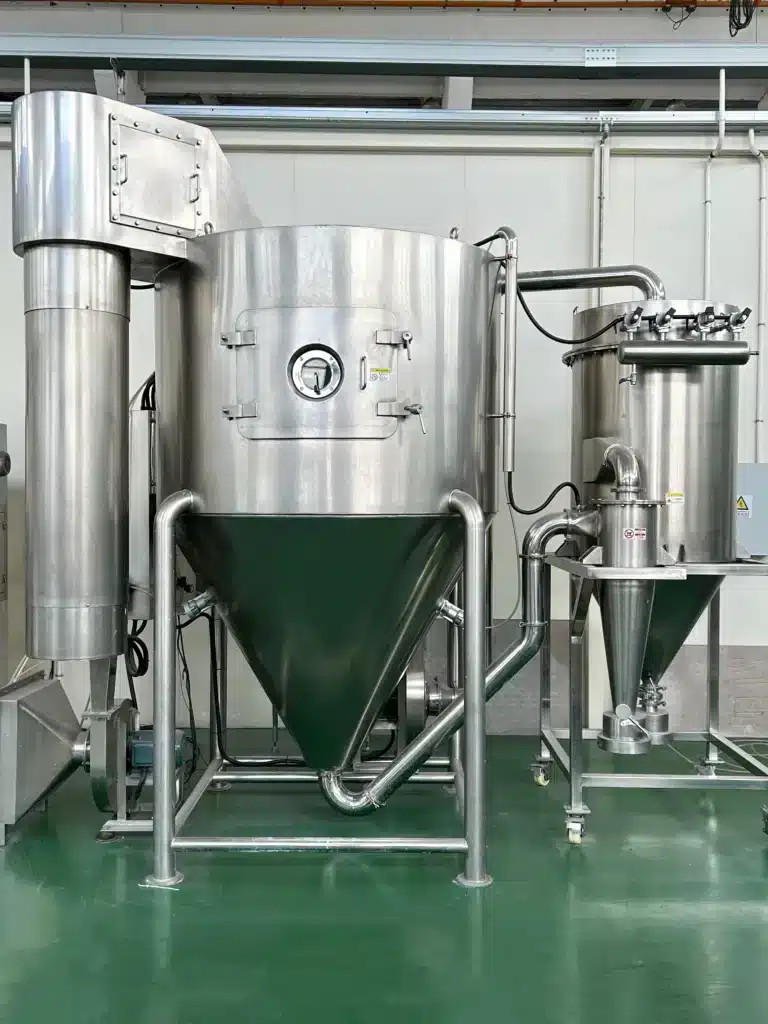
Spray drying is one of the most widely used technologies for converting liquid feeds into fine, uniform powders. Whether you are developing a new pharmaceutical formulation, scaling up a food product, or testing a novel material, a pilot spray dryer provides the critical bridge between laboratory research and industrial production.
In this guide, we will cover everything you need to know about pilot and lab spray dryers: how they work, key specifications, typical applications, and how to select the right system for your needs.
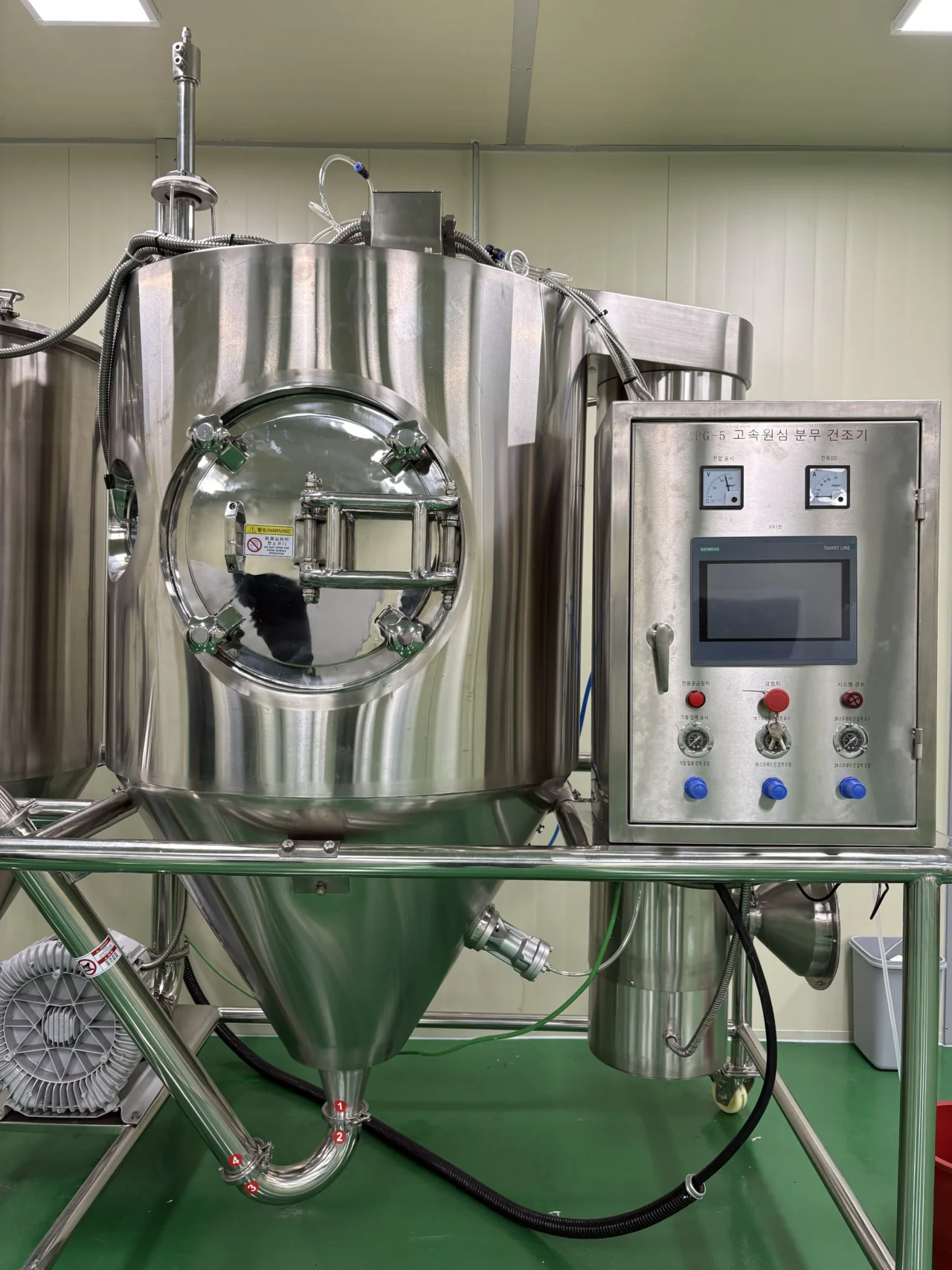
What Is a Pilot Spray Dryer?
A pilot spray dryer is a small-to-medium scale spray drying system designed for research and development, process optimization, and small-batch production. Unlike industrial spray dryers that process hundreds or thousands of liters per hour, pilot spray dryers typically handle 1-50 liters per hour, making them ideal for:
- New product formulation development and feasibility testing
- Establishing optimum drying parameters (temperature, feed rate, atomization)
- Producing sample batches for quality testing and customer evaluation
- Generating scale-up data for transitioning to industrial production
- Small-volume commercial production of high-value products
Lab Spray Dryer vs Pilot Spray Dryer — What Is the Difference?
Understanding the distinction between lab and pilot spray dryers helps you choose the right equipment for your project stage:
| Parameter | Lab Spray Dryer | Pilot Spray Dryer |
| Evaporation Rate | 0.5 – 3 L/h | 5 – 50 L/h |
| Typical Use | Feasibility, formulation screening | Scale-up validation, small production |
| Sample Required | As low as 10-50 mL per run | 1-10 L per run |
| Particle Size | 1-25 µm (some up to 80 µm) | 5-100+ µm |
| Atomization | Two-fluid nozzle | Two-fluid, centrifugal, or pressure nozzle |
| Footprint | Benchtop, < 1 m² | Floor-standing, 3-10 m² |
| Terbaik Untuk | Universities, R&D labs | Pilot plants, scale-up facilities |
How Does a Spray Dryer Work?
The spray drying process involves four fundamental stages:
- Atomization: The liquid feed is broken into fine droplets using an atomizer (two-fluid nozzle, centrifugal disc, or pressure nozzle). Droplet size directly influences the final particle size of the powder.
- Droplet-Air Contact: The atomized droplets meet hot drying air in the drying chamber. Most pilot and lab spray dryers use co-current flow (droplets and air travel in the same direction), which protects heat-sensitive materials.
- Evaporation: Moisture rapidly evaporates from the droplet surface. The entire drying process takes only 2-4 seconds, minimizing thermal degradation of active ingredients.
- Powder Collection: Dried particles are separated from the exhaust air using cyclone separators, bag filters, or electrostatic precipitators, and collected in a product vessel.
Key Applications of Pilot & Lab Spray Dryers
Pilot and lab spray dryers serve a remarkably diverse range of industries:
Pharmaceutical Industry: Producing amorphous solid dispersions to enhance drug solubility and bioavailability. Manufacturing inhalable drug powders for DPI and pMDI devices. Encapsulating active pharmaceutical ingredients for controlled release. Drying vaccines and biological products under gentle conditions.
Food & Nutraceutical Industry: Creating milk powder, coffee powder, and fruit juice powders. Encapsulating flavors, oils, and probiotics to improve shelf life. Producing nutritional supplement powders with precise particle properties.
Chemical & Materials Industry: Drying catalysts, pigments, and ceramic precursors. Producing battery cathode materials (LFP, NMC) with controlled particle morphology. Creating polymer microspheres and functional coatings.
How to Choose the Right Pilot or Lab Spray Dryer
Selecting the right spray dryer depends on several critical factors:
- Material Properties: Is your feed aqueous or organic solvent-based? What is the solid content and viscosity? Heat-sensitive materials require lower inlet temperatures or vacuum spray drying systems.
- Target Particle Size: Different atomization methods produce different size ranges. Two-fluid nozzles give finer particles (1-25 µm), while centrifugal atomizers can produce larger particles (10-100+ µm).
- Production Scale: Start with a lab spray dryer for initial R&D, then move to a pilot spray dryer for scale-up validation. Ensure your pilot system provides representative data for industrial-scale transition.
- Safety Requirements: Organic solvent drying requires nitrogen inert loop systems. Explosive or toxic materials need additional containment measures.
- Budget and Space: Lab spray dryers are more affordable and compact. Pilot spray dryers require more floor space and investment but deliver production-representative results.
Common Mistakes When Selecting a Spray Dryer
Based on our 20+ years of experience helping customers select spray drying equipment, here are the most common pitfalls to avoid:
- Underestimating feed complexity: Not all liquids spray dry equally. Sticky, high-sugar, or high-fat materials may require specialized configurations like vacuum spray drying or cold spray drying.
- Ignoring scale-up factors: Data from a lab spray dryer does not always translate directly to industrial scale. Working with a pilot spray dryer provides more reliable scale-up parameters.
- Overlooking powder recovery: A spray dryer with poor collection efficiency wastes valuable materials. Look for systems with >90% recovery rates.
- Neglecting safety compliance: Drying organic solvents in open-cycle systems is dangerous. Always use nitrogen inert loop systems for flammable solvents.
Why Choose SINOTHERMO for Your Spray Drying Needs?
SINOTHERMO brings over 20 years of thermal process engineering expertise to every spray drying project. Our advantages include:
- Complete product range from benchtop lab spray dryers to pilot-scale and industrial systems
- In-house R&D center with dedicated testing laboratory for sample trials
- ISO 9001:2015 certified manufacturing with full quality traceability
- Customized solutions tailored to your specific material and process requirements
- Global service network with installation, commissioning, and training support
Ready to find the right pilot or lab spray dryer for your project? Contact our engineering team for a free consultation and sample testing service.
Contact: Mark Gu | mark.gu@sinothermo.com | +86 180 2197 2660
Website: https://www.sinothermo.com
FAQ — Frequently Asked Questions
Q: What is the difference between a lab spray dryer and a pilot spray dryer?
A: A lab spray dryer is designed for small-scale feasibility testing with sample volumes as low as 10 mL, while a pilot spray dryer handles larger volumes (5-50 L/h) for scale-up validation and small production runs.
Q: How much does a pilot spray dryer cost?
A: Pilot spray dryer prices vary significantly based on capacity, configuration, and features. Fully configured pilot systems can range from $10,000 to $100,000+. Contact SINOTHERMO for a customized quote.
Q: Can a lab spray dryer handle organic solvents?
A: Yes, but you need a spray dryer equipped with a nitrogen inert loop system for safe handling of organic solvents. SINOTHERMO offers dedicated inert loop models for both lab and pilot scales.
Q: What particle size can a pilot spray dryer produce?
A: Depending on the atomization method and process parameters, pilot spray dryers can produce particles ranging from 1 to 100+ microns. Two-fluid nozzles typically produce 1-25 µm, while centrifugal atomizers produce 10-100+ µm.
Q: Does SINOTHERMO offer sample testing services?
A: Yes. SINOTHERMO operates a dedicated testing laboratory where you can send your material samples. Our engineers will conduct spray drying trials and provide a detailed report with optimized parameters and product samples.
Q: Can spray drying be used for heat-sensitive materials?
A: Absolutely. Co-current spray drying designs and low-temperature options (inlet as low as 60°C) ensure minimal thermal exposure. The entire drying process takes only seconds, protecting sensitive compounds like probiotics, enzymes, and vitamins.