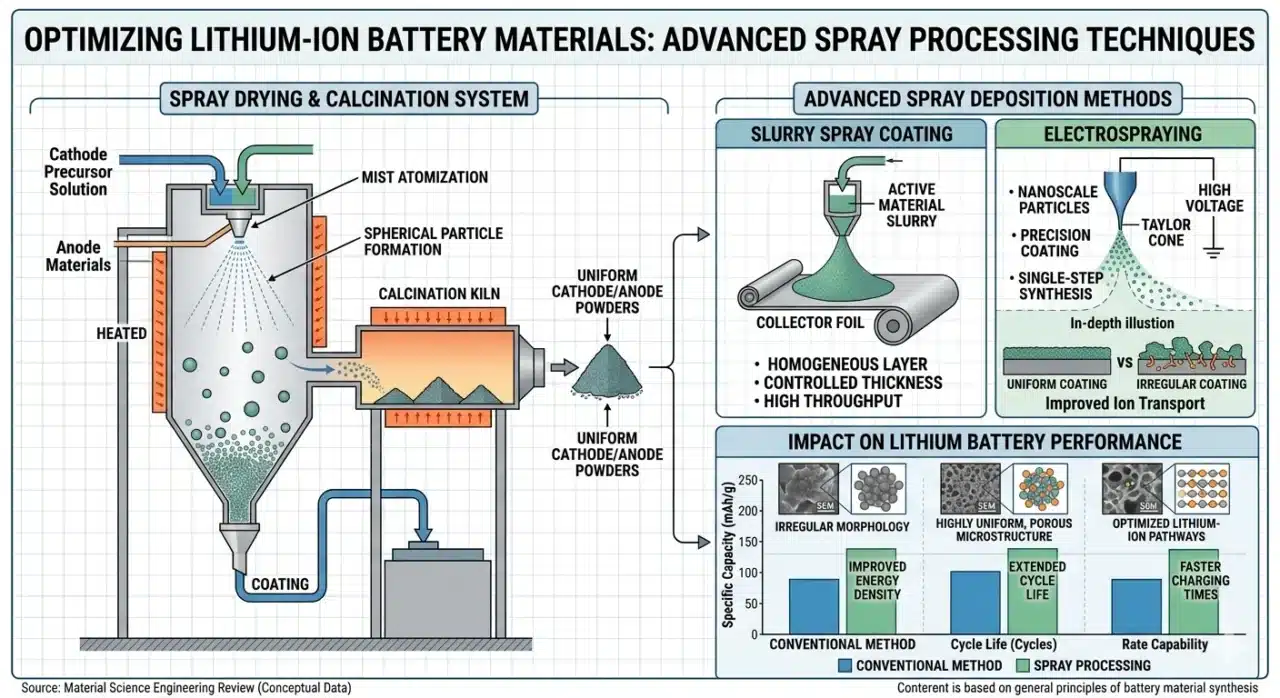
Spray processing in lithium battery materials is at the heart of the global transition to electric propulsion and renewable energy. As the EV market demands higher energy density and faster charging, the focus has shifted to the precise engineering of active materials at the precursor level. In this high-stakes environment, spray processing—including spray drying, pyrolysis, and cooling—has emerged as a decisive technology. This report provides an exhaustive analysis of its technical role and demonstrates how SINOTHERMO’s advanced engineering solutions address the industry’s most critical challenges in battery material synthesis.
The Microscopic Foundations of Battery Longevity
The performance of a lithium-ion battery is an emergent property of its microscopic architecture. While the chemical formula of a cathode or anode determines its theoretical capacity, the physical consistency of the material dictates its practical performance in a real-world electrochemical environment. The primary challenge facing the new energy sector is the requirement for extreme uniformity in particle size distribution (PSD) and morphological structure. Inconsistent materials are the primary cause of premature battery failure, safety risks, and poor manufacturing yields.
The Electrochemical Consequences of Particle Inconsistency
Within a battery electrode, lithium ions must travel through the electrolyte and intercalate into the active material particles. If the particle sizes are not tightly controlled, the kinetics of this process vary across the electrode surface. Smaller particles have higher surface areas and shorter diffusion paths, allowing them to charge and discharge faster than larger particles. This kinetic mismatch leads to uneven current distribution. During rapid charging, smaller particles may reach their voltage limits while larger particles remain undercharged, causing localized overpotential and the potential for lithium plating—a precursor to dendrite growth and internal short circuits.
Furthermore, the volumetric expansion and contraction of particles during lithiation and delithiation cycles generate mechanical stress. Non-uniform particles experience this stress differently, leading to micro-cracking and the loss of electrical contact between the active material and the conductive network. By utilizing spray drying technology, manufacturers can produce spherical secondary particles that distribute these stresses more evenly, thereby significantly extending the cycle life of the cell.
Quantitative Quality Metrics for Battery Precursors
The industrial requirements for lithium battery materials are among the most stringent in the chemical processing sector. Sinothermo’s equipment is specifically designed to meet or exceed these benchmarks, ensuring that the final powder exhibits the necessary characteristics for high-performance electrode fabrication.
| Parameter | Industry Standard Requirement | Electrochemical Impact |
| D50 Particle Size | 5 µm – 25 µm | Determines diffusion distance and electrode coating thickness. |
| D90/D10 Ratio | < 2.5 (Narrow Distribution) | Ensures uniform current density and prevents localized overcharge. |
| Residual Moisture | < 500 ppm (0.05%) | Prevents the formation of Hydrofluoric Acid (HF) and electrolyte degradation. |
| Tap Density | > 1.5 (g/cm for LFP/NCM) | Directly correlates to the volumetric energy density of the final battery. |
| Metallic Impurities | < 10 ppb (Iron, Copper, Zinc) | Eliminates self-discharge pathways and enhances thermal safety. |
| Specific Surface Area | 10 – 45 ㎡/g | Balances high power capability with interfacial chemical stability. |
Precursor Synthesis: Engineering Specific Surface Area and Porosity
The transition from solution-based chemistry to solid-state active materials is the most critical step in precursor synthesis. Spray drying technology serves as a bridge, transforming a liquid feed—whether a homogeneous solution of metal salts or a high-solid-content suspension—into dry, spherical granules in a single, continuous step. Sinothermo’s LPG and YPG series equipment leverage advanced atomization physics to provide manufacturers with granular control over the resulting powder morphology.
Mechanisms of Evaporation-Driven Self-Assembly
The core of the spray drying process is atomization. As the liquid feed is forced through a centrifugal disc or a pressure nozzle, it is broken into a fine mist of droplets. The surface-to-volume ratio increases exponentially, facilitating instantaneous heat and mass transfer. In the synthesis of Nickel-Cobalt-Manganese (NCM) precursors, such as , the drying kinetics dictate how the primary nanoparticles assemble into secondary spherical structures.
Sinothermo’s high-speed centrifugal atomizers (LPG series) operate at speeds exceeding 18,000 RPM, producing droplets with extremely narrow size distributions. This precision is critical because the final particle size ( ) is a direct function of the initial droplet size (
 ) and the solid content (
 ) of the slurry:
By manipulating the atomizer frequency and the feed rate through a sophisticated PLC interface, Sinothermo allows for the real-time adjustment of particle size to match specific electrode designs.
Optimizing Specific Surface Area (SSA) for High-Rate Discharge
Specific Surface Area (SSA) is a double-edged sword in battery science. A high SSA increases the contact area between the electrode and the electrolyte, facilitating high power output (C-rate). However, excessive SSA can lead to unwanted side reactions and thermal instability. Sinothermo’s technology enables the creation of “structured porosity.”
Recent research into rough-surfaced Lithium Iron Phosphate (RS-LFP) demonstrates that template-assisted spray drying can produce powders with an SSA of up to 41.2㎡/g , significantly higher than conventional methods. This is achieved by controlling the drying temperature profile. High inlet temperatures (e.g., 250°C) cause rapid “crusting” of the droplet surface, followed by the evaporation of internal moisture which creates a porous internal structure. This tailored microstructure reduces charge-transfer resistance and allows for rapid ion transport, which is essential for the next generation of fast-charging EVs.
Carbon Coating and In-Situ Modification
Another advantage of Sinothermo’s spray processing is the ability to perform in-situ modifications. For LFP materials, which have inherently low electronic conductivity, a carbon source (such as citric acid or glucose) can be added to the precursor slurry. As the droplet dries, the carbon source is uniformly distributed throughout the particle. During the subsequent calcination step, this forms a highly conductive carbon-cage network that interconnects the nanoparticles, imparting superior discharge rates and cycle stability.
Purity and Protection: The Role of GXP Closed-Loop Systems
As the industry moves toward high-nickel chemistries (NCM811 and beyond) and solid-state electrolytes, the sensitivity of materials to environmental factors has reached an all-time high. These materials are highly susceptible to moisture and oxidation, which can permanently damage their electrochemical properties before they even reach the assembly line. Sinothermo’s GXP series closed-loop spray dryers are engineered to provide a sanctuary for these sensitive compounds.
Anaerobic Environments and Oxygen Control
Traditional spray dryers use heated atmospheric air as the drying medium. For materials like LFP precursors or silicon-graphite composites, exposure to oxygen at high temperatures can lead to unwanted oxidation of the transition metals or the surface functional groups. The GXP series replaces air with an inert gas, typically nitrogen ( ), which is continuously recirculated in a sealed loop.
Sinothermo’s GXP systems maintain oxygen concentrations below 500 ppm through a combination of precision sealing and automatic compensation. This inert atmosphere ensures that:
- The transition metal oxidation states (e.g.,
 in LFP) remain stable during the drying phase.
 - Pyrophoric materials can be handled with absolute safety, eliminating the risk of dust explosions or fires.
- The surface chemistry of high-nickel cathodes is preserved, preventing the formation of resistive
 Und
Und  layers.
Solvent Recovery and Economic Sustainability
Many advanced battery material synthesis routes involve organic solvents such as ethanol, acetone, or hexane to achieve better dispersion of nanoparticles or to facilitate the incorporation of conductive additives.These solvents are not only flammable but also represent a significant portion of the raw material cost.
The GXP series integrates a multi-stage condensation and recovery system that captures these solvents from the nitrogen stream. Sinothermo equipment typically achieves recovery rates of over 99%, allowing manufacturers to reuse the solvents in subsequent batches.This capability transforms the economics of battery production by:
- Slashing Raw Material Costs: The ability to recover and reuse expensive solvents like NMP (which can cost $1.5–3.0 per liter) provides a massive competitive advantage.
- Environmental Compliance: By operating in a closed loop, the system eliminates Volatile Organic Compound (VOC) emissions, simplifying the permitting process and reducing the carbon footprint of the manufacturing facility.
- Enhanced Purity: The closed-loop design prevents external contaminants (such as atmospheric dust or ambient moisture) from entering the product stream, ensuring that the precursor meets the ppb-level purity standards required for long-life batteries.
Solving the Wall-Sticking Crisis: Airflow and Thermal Balance
In the high-volume production of battery materials, “yield” is the most critical metric. However, many battery slurries—particularly those with high concentrations of binders and conductive additives—suffer from “wall-sticking,” where semi-wet powder adheres to the internal surfaces of the drying tower.This not only wastes expensive materials but also leads to “coking” (degradation of the material due to prolonged heat exposure) and creates safety hazards.
The Physics of the Sticky Point
Wall-sticking occurs when the material temperature exceeds its Glass Transition Temperature ( ). Above , amorphous components in the slurry (like binders) transition from a glassy state to a rubbery, viscous state, allowing them to form strong mechanical bonds with the tower wall. For many lithium battery formulations, is depressed by the presence of residual solvents or moisture, making the “sticky window” particularly difficult to navigate.
Sinothermo’s Engineering Countermeasures
Sinothermo has developed a suite of technologies to combat wall-sticking and ensure consistent, high-yield operation:
- Integrated Air Broom Systems: Sinothermo towers can be equipped with rotating air broom nozzles that sweep the inner walls with a high-velocity stream of cold nitrogen. This continuously dislodges particles before they can bond and keeps the wall temperature below the critical .
- Tower Geometry and Airflow Modeling: Using Computational Fluid Dynamics (CFD), Sinothermo engineers optimize the cone angle and air distribution plates to ensure a uniform laminar flow. This minimizes the turbulence that typically throws droplets against the walls.
- Precision Wall Cooling: For highly heat-sensitive materials, Sinothermo offers jacketed drying towers. By circulating chilled water through the tower walls, the equipment maintains a cold boundary layer, ensuring that any particle that touches the wall is immediately cooled and “frozen” back into a non-sticky glassy state.
- Electrostatic Management: Battery materials are often prone to static buildup, which causes fine particles to cling to surfaces. Sinothermo integrates grounding systems and optional ionization devices to neutralize these charges, further enhancing powder recovery rates.
Industry Vision: Scaling for Global Demand
The transition to gigawatt-scale manufacturing requires equipment that is not only precise but also robust and scalable. Sinothermo’s product architecture is designed to support the entire lifecycle of battery material development, from laboratory R&D to massive industrial production.
From Lab to Pilot: The AGT Case Study
In 2025, Sinothermo delivered an LPG-5 Lab Centrifugal Spray Dryer to Advanced Green Technology (AGT) in South Korea, a key player in the battery recycling and high-nickel precursor market. The objective was to optimize the production of Lithium Iron Phosphate (LFP) from recycled rare earth metals.
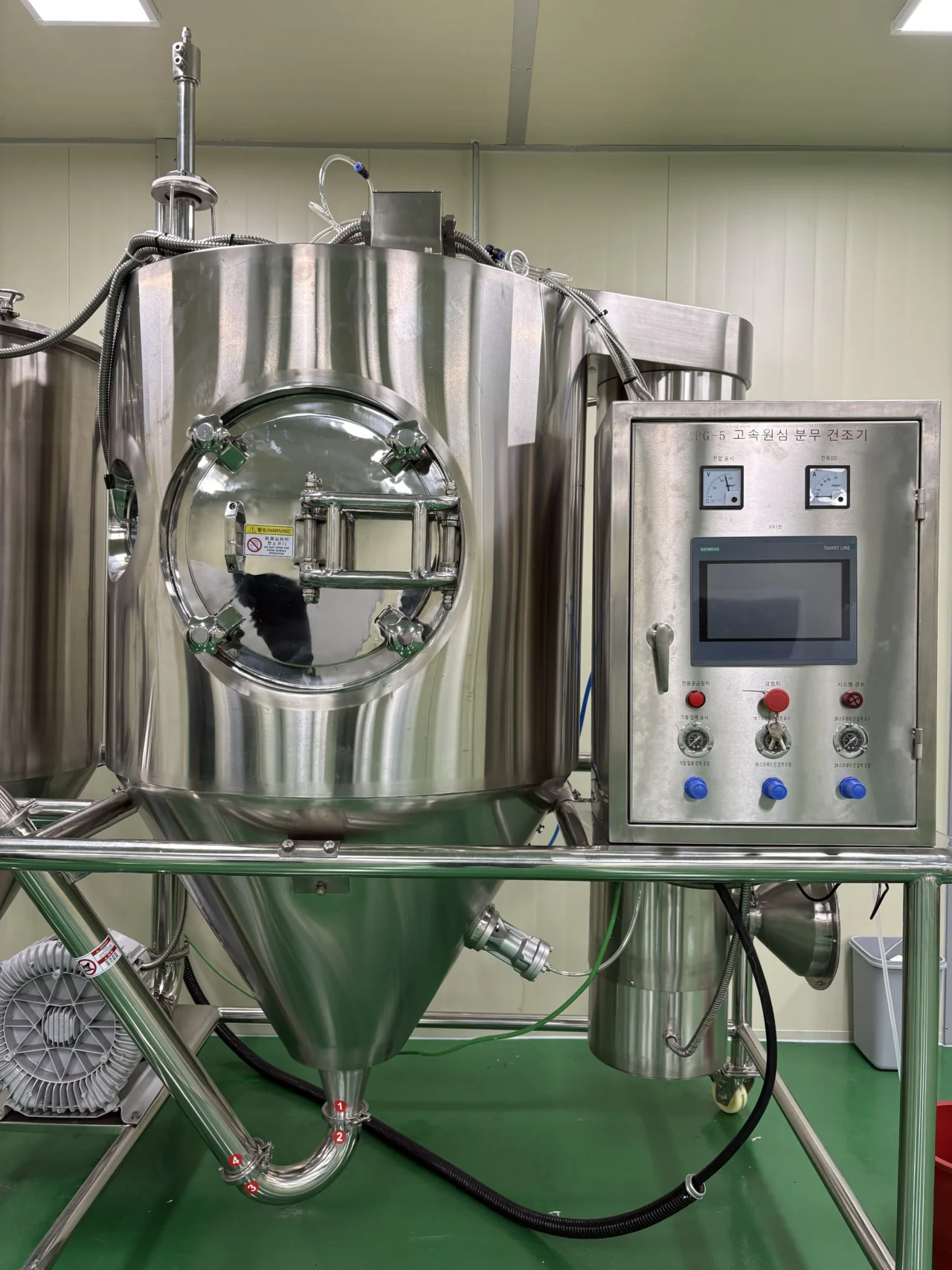
The collaboration demonstrated the versatility of Sinothermo’s platform:
- Operational Flexibility: The LPG-5 handled diverse feed types, including water-based LFP suspensions and NCM precursors with organic additives.
- Data-Driven Scale-Up: The precise control over inlet air temperatures (adjustable from 200°C to 250°C) and atomizer speeds allowed AGT to establish a “process fingerprint.” These parameters were then used to design a full-scale industrial line with the confidence that the particle morphology and moisture content would remain consistent.
- Verlässlichkeit: Constructed from high-grade SUS304, the equipment maintained zero metallic contamination over months of continuous testing, a requirement for high-purity battery grade materials.
The Strategic CAPEX Perspective: Evaluating ROI
For decision-makers at battery manufacturers, the choice of a spray processing partner is a long-term strategic commitment. Sinothermo systems are designed to offer a superior Return on Investment (ROI) by focusing on Total Cost of Ownership (TCO).
| Factor | Sinothermo Advantage | Impact on ROI |
| Material Recovery | > 95% – 99.9% | Minimizes the loss of expensive lithium and cobalt salts. |
| Energieeffizienz | Integrated heat recovery (up to 30% savings) | Reduces the carbon footprint and ongoing operational costs. |
| Maintenance | Abrasive-resistant atomizer designs and CIP systems | Extends equipment lifespan and minimizes downtime in 24/7 production. |
| Residual Value | Robust construction with 15–20 year life expectancy | High-quality machines retain 40–50% of their value for refurbishment or resale. |
Future-Proofing for Next-Generation Chemistries
The lithium battery industry is in a state of constant flux. Emerging technologies such as sodium-ion batteries, sulfur-based cathodes, and all-solid-state batteries (ASSBs) require even more sophisticated particle engineering. For instance, sulfide-based solid electrolytes must be processed in strictly moisture-free environments, often requiring specialized solvent-based spray drying in atmospheres. Sinothermo’s modular design approach allows for the integration of specialized secondary drying stages, such as vibrating fluid beds or flash dryers, to achieve the ultra-low moisture levels required for these future technologies.
Conclusion: Sinothermo as a Catalyst for the Energy Transition
The global transition to sustainable energy depends on the ability to manufacture lithium battery materials with unprecedented consistency, purity, and scale. As this report has detailed, spray processing is no longer a peripheral utility but a core technological pillar of the battery industry. It is the bridge between chemical synthesis and electrochemical performance.
Sinothermo’s advanced spray drying solutions—characterized by the inert-gas protection of the GXP series, the precision atomization of the LPG series, and the high-throughput reliability of the YPG series—provide the infrastructure necessary for this transition. By solving the challenges of wall-sticking, specific surface area optimization, and solvent recovery, Sinothermo enables manufacturers to achieve higher yields and superior battery life. In the race to power the future, Sinothermo remains a vital partner, ensuring that every particle of the energy transition is engineered to perfection.