The best industrial drying equipment supplier for you is the one that engineers a process around your material — not the one with the longest product list. Dryer selection depends entirely on your feed's physical state and behaviour, so a supplier's willingness and ability to test your material is the single strongest predictor of a successful purchase.
This article is a starting point across dryer types. If you already know your category, the deeper supplier-evaluation guides go further: spray dryer manufacturers, fluid bed dryer manufacturers, and rotary dryer manufacturers.
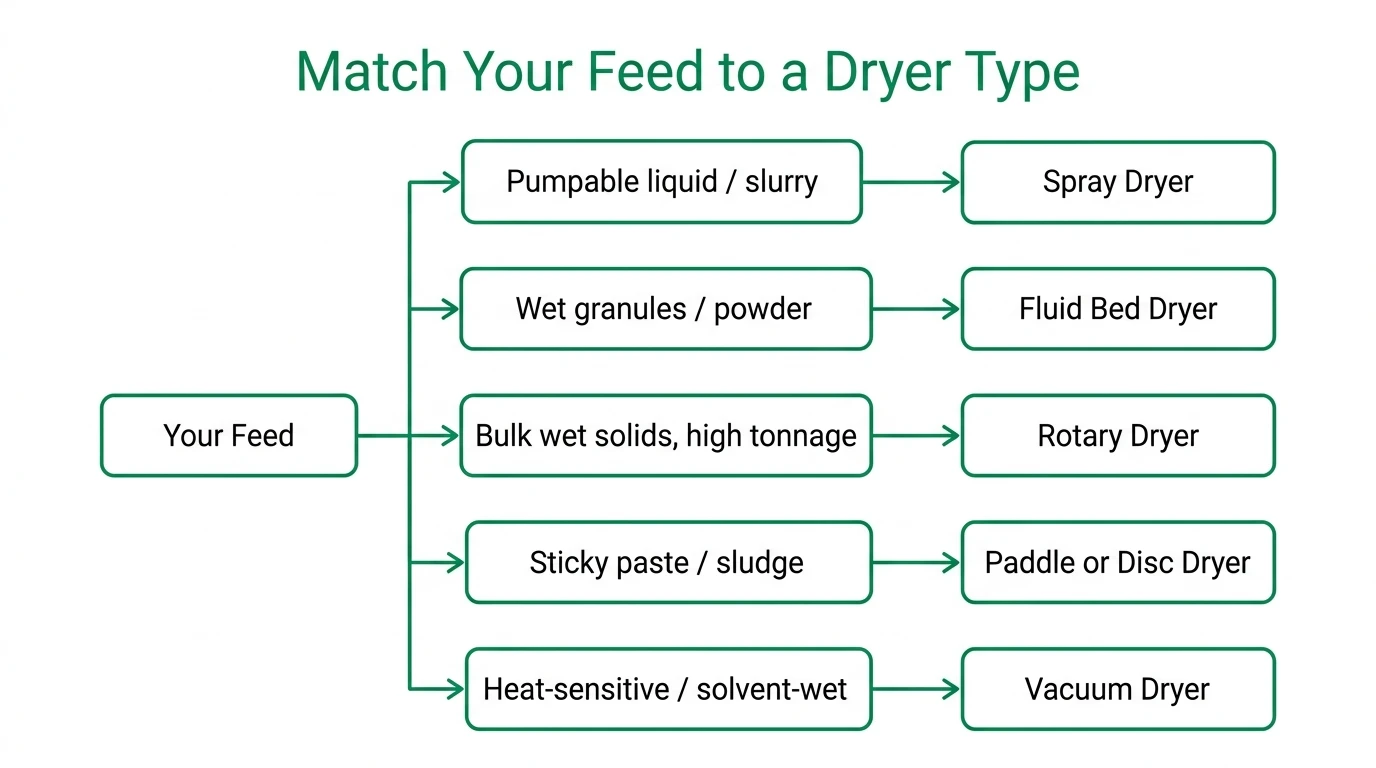
Step 1: Know which dryer type you need before shortlisting
Supplier evaluation is much easier once you know the equipment category. A quick orientation:
| Your feed | Likely dryer type | Go deeper |
|---|---|---|
| Pumpable liquid / slurry | Spray dryer | Spray dryer manufacturers |
| Wet granules / powder | Fluid bed dryer | Fluid bed dryer manufacturers |
| Bulk wet solids, high tonnage | Rotary dryer | Rotary dryer manufacturers |
| Sticky paste / sludge | Paddle or disc dryer | Paddle / disc dryer guide |
| Heat-sensitive / solvent-wet | Vacuum dryer | Industrial vacuum dryer guide |
If you are unsure which row fits, see how to choose an industrial dryer first — specifying the wrong category is a far more expensive mistake than choosing the wrong supplier within the right one.
Step 2: Evaluate supplier capability
Six dimensions separate a supplier who engineers your process from one who fabricates a box to a spec sheet. Each is worth a direct question and a specific piece of evidence — not a general impression from a glossy brochure.
Process engineering, not just fabrication
The key distinction among suppliers is whether they engineer a drying process or simply build to a specification you provide.
Ask for: what they need to know about your material before they will quote a price.
A passing answer starts with questions about your feed — moisture content, particle size, heat sensitivity, throughput target — before it starts with a number.
Slow down if the answer is only "capacity and budget." That is a fabricator, which is fine if you already have the process engineering worked out, and risky if you do not.
Testing facilities
Can they run your actual material? An in-house pilot lab is the clearest evidence of process capability, and the resulting data protects you whether or not you ultimately buy from them.
Ask for: whether the lab is on their own site or a partner facility, whether trials run on your material or a substitute, and what written deliverable you receive.
Slow down if "testing" turns out to mean a verbal assurance with no data behind it.
Relevant experience
Ask for references in your industry and with materials of similar behaviour, not just similar names — drying a heat-sensitive food extract and drying a mineral slurry are different engineering problems even at the same moisture content. A supplier who can name specific installations and what changed between them has done this before; one who offers only generic case studies may not have.
Manufacturing and QC
In-house fabrication versus subcontracting affects lead-time reliability and accountability. Ask who actually builds the machine, and where — the same due-diligence questions covered in depth in our spray dryer manufacturers guide apply here regardless of dryer type.
Compliance
GMP, CE, ATEX, food-grade — ask for documentation with a readable scope statement, and confirm whether certification is included in the quoted price or billed as an extra. A certificate with no readable scope is worth asking about twice.
After-sales
Spare parts availability, commissioning support, and — for international purchases — how support and warranty work across borders and time zones. This is frequently underweighted at purchase and deeply regretted years later, once the supplier that answered every email pre-order goes quiet post-delivery.
Supplier evaluation checklist
| Dimension | Ask for | Passes when | Watch for |
|---|---|---|---|
| Process engineering | What they need to know before quoting | Questions about your material come first | Only "capacity and budget" asked |
| Testing facilities | Own-site lab; trial on your material; written report | Defined deliverable, own facility | Partner lab; verbal results only |
| Relevant experience | References with materials of similar behaviour | Specific installations named | Generic case studies, no specifics |
| Manufacturing/QC | Who builds it, and where | In-house fabrication, transparent sourcing | Subcontracted scope not disclosed |
| Compliance | Certificates with readable scope | Documentation matches your product/market | Certification claimed, no scope shown |
| After-sales | Spare parts list; cross-border support terms | Named contact, response commitment | Support undefined once order ships |
Step 3: Compare quotes on the same basis
Quotes from different suppliers are rarely scoped identically. Normalise on:
- Guaranteed performance — throughput at a stated outlet moisture, not a bare tonnage number
- Scope of supply — what auxiliary equipment (cyclones, filters, controls, ducting) is included
- Materials of construction — grade and finish of contact parts
- Installation and commissioning — included or extra
- Compliance documentation — included or extra
- Spares package — recommended stock and cost
Only after normalising these should you compare the headline price. What legitimately drives cost differences between suppliers is covered in our spray dryer cost guide — the same cost drivers (scope, materials, compliance, after-sales) apply across dryer types, not just spray dryers.
Common buyer mistakes
- 1.Specifying a dryer type before understanding the material. Some buyers approach suppliers already fixed on a machine category because a competitor uses it, or because it was the incumbent technology at the old site. Get the category right first — see Step 1 — and let the material's behaviour decide, not precedent.
- 2.Comparing prices before normalising scope. The cheapest quote is often the least complete one, not the best value. A number that excludes air handling, controls, or commissioning will always look better than one that includes them, right up until installation.
- 3.Skipping pilot testing to save time or money. It feels like a shortcut early in a project and becomes the most expensive step to have skipped once a full-scale machine underperforms on real material. It is the cheapest insurance available on a capital purchase this size.
- 4.Underweighting after-sales. Parts availability and support responsiveness matter for years after the invoice clears, long after the sales relationship that closed the deal has moved on to the next customer.
- 5.Accepting throughput figures without a moisture target. Always ask "at what outlet moisture?" — a bare kilograms-per-hour number is not a guarantee you can hold anyone to, and two suppliers quoting the same headline figure at different moisture targets are not actually comparable.
Where SINOTHERMO fits
We would rather you applied this framework to us than took our word for it. SINOTHERMO manufactures across the full drying range — spray, fluid bed, rotary, flash, belt, paddle, rake, vacuum and conical dryers, plus rotary kilns — so the equipment recommendation is not constrained by a narrow product line, with 20+ years of experience in industrial drying behind the design work. Our in-house pilot laboratory tests your actual material — a paid engineering service — and returns documented parameters and a sizing basis you can use to evaluate any supplier's proposal, including ours. See the facility on the testing lab page.
Comparing drying equipment suppliers? Send us your material and target spec. We will run a pilot test and return a documented sizing basis, ours included.
✉️ mark.gu@sinothermo.com · 📱 WhatsApp: +86 180 2197 2660 · 🌐 www.sinothermo.com · 💬 Request a pilot test
SINOTHERMO — Process Engineering Infrastructure.
Frequently asked questions
How do I evaluate an industrial drying equipment supplier?
Assess whether they engineer a process rather than just fabricate to spec, whether they can pilot-test your actual material, their experience with materials of similar behaviour, in-house manufacturing and QC, relevant compliance documentation, and after-sales support including spare parts and cross-border warranty terms.
What should I ask an industrial dryer manufacturer before buying?
Ask what they need to know about your material before quoting, whether they will test it, what throughput they guarantee at your target outlet moisture, what is included in the scope of supply, and how commissioning, warranty, and spare parts support work.
Why do industrial dryer quotes vary so much?
Because suppliers scope them differently — auxiliary equipment, materials of construction, compliance documentation, and installation/commissioning may be included or excluded. Normalise scope line by line before comparing headline prices.
Do I need a pilot test before buying industrial drying equipment?
It is strongly advisable. Materials with identical moisture content can dry very differently depending on particle size, density and heat sensitivity, and a pilot test produces the drying data needed to size equipment correctly — protecting you from an oversized, undersized, or wrongly specified machine.
How do I know which type of industrial dryer I need?
Match your feed's physical state to the categories in the table above: pumpable liquids to spray dryers, wet granules to fluid bed dryers, bulk high-tonnage solids to rotary dryers, sticky pastes to paddle or disc dryers, and heat-sensitive or solvent-wet material to vacuum dryers. If your feed does not clearly fit one row, a pilot test on the actual material is the reliable way to confirm the category before you shortlist suppliers.

Mark Gu
Passionate about enhancing customer experiences and streamlining operations, Mark focuses on building strong relationships, fostering innovation, and leading teams to achieve exceptional service and efficiency.
Email: mark.gu@sinothermo.com
Phone: +86 18021972660