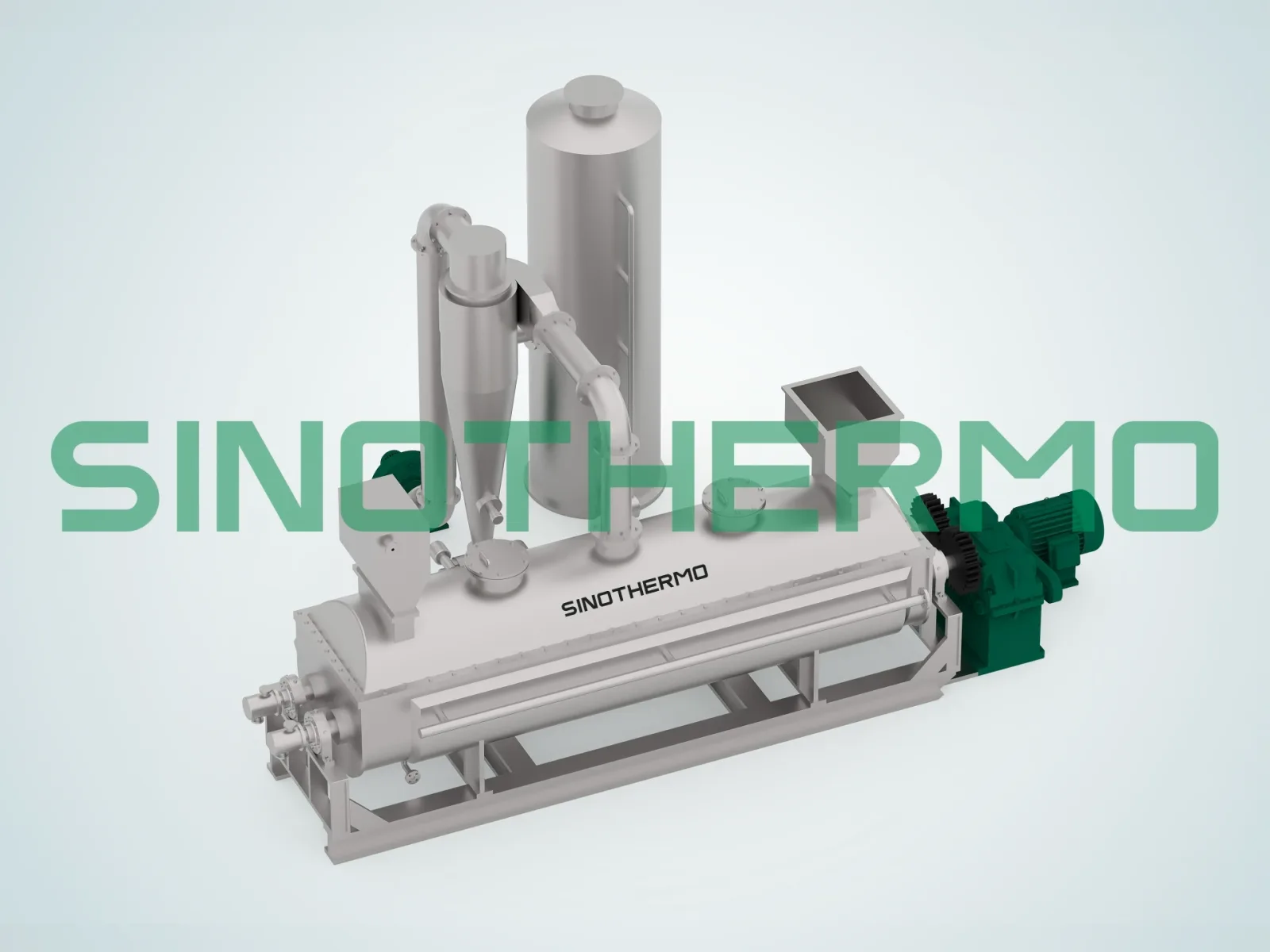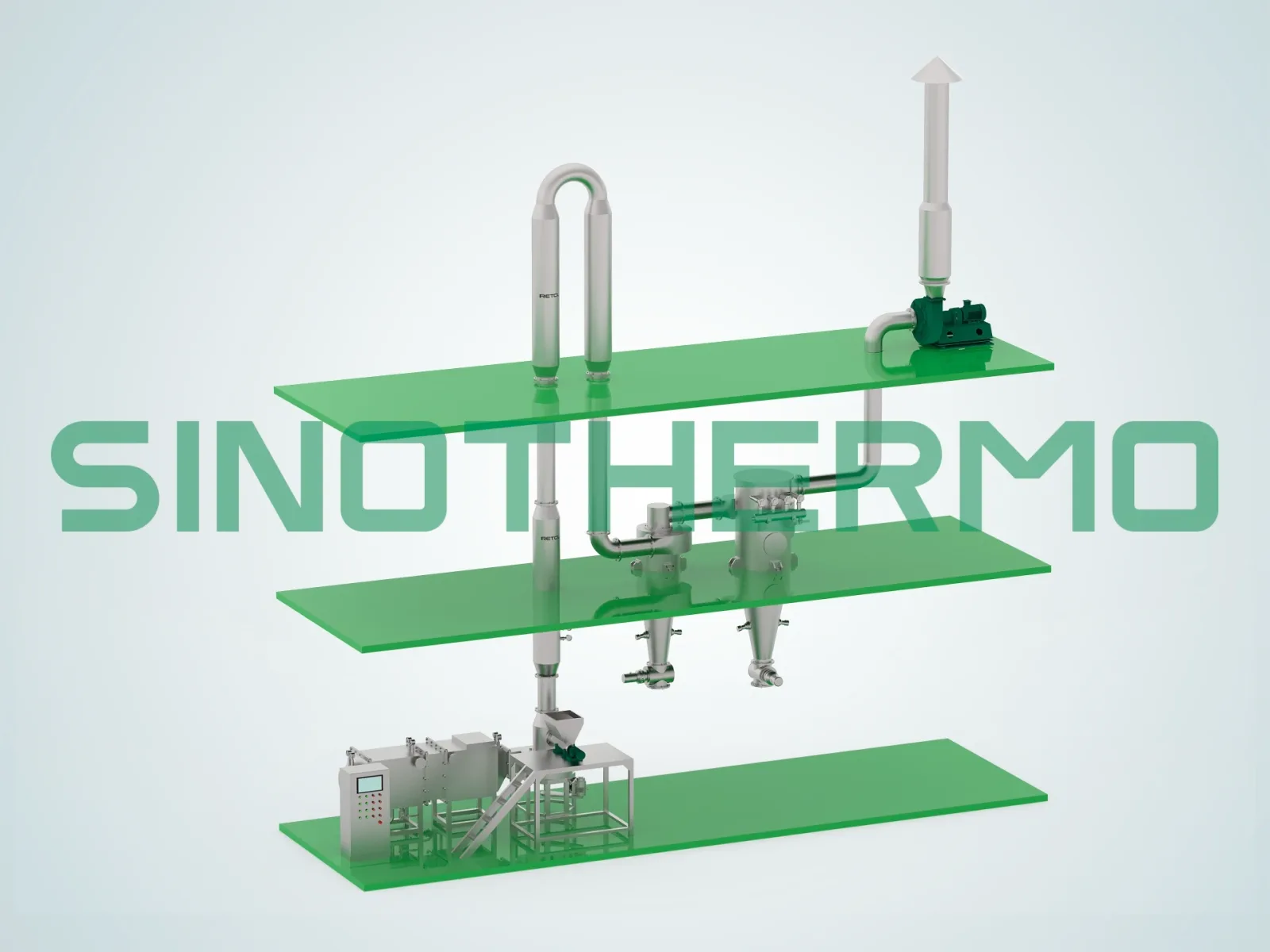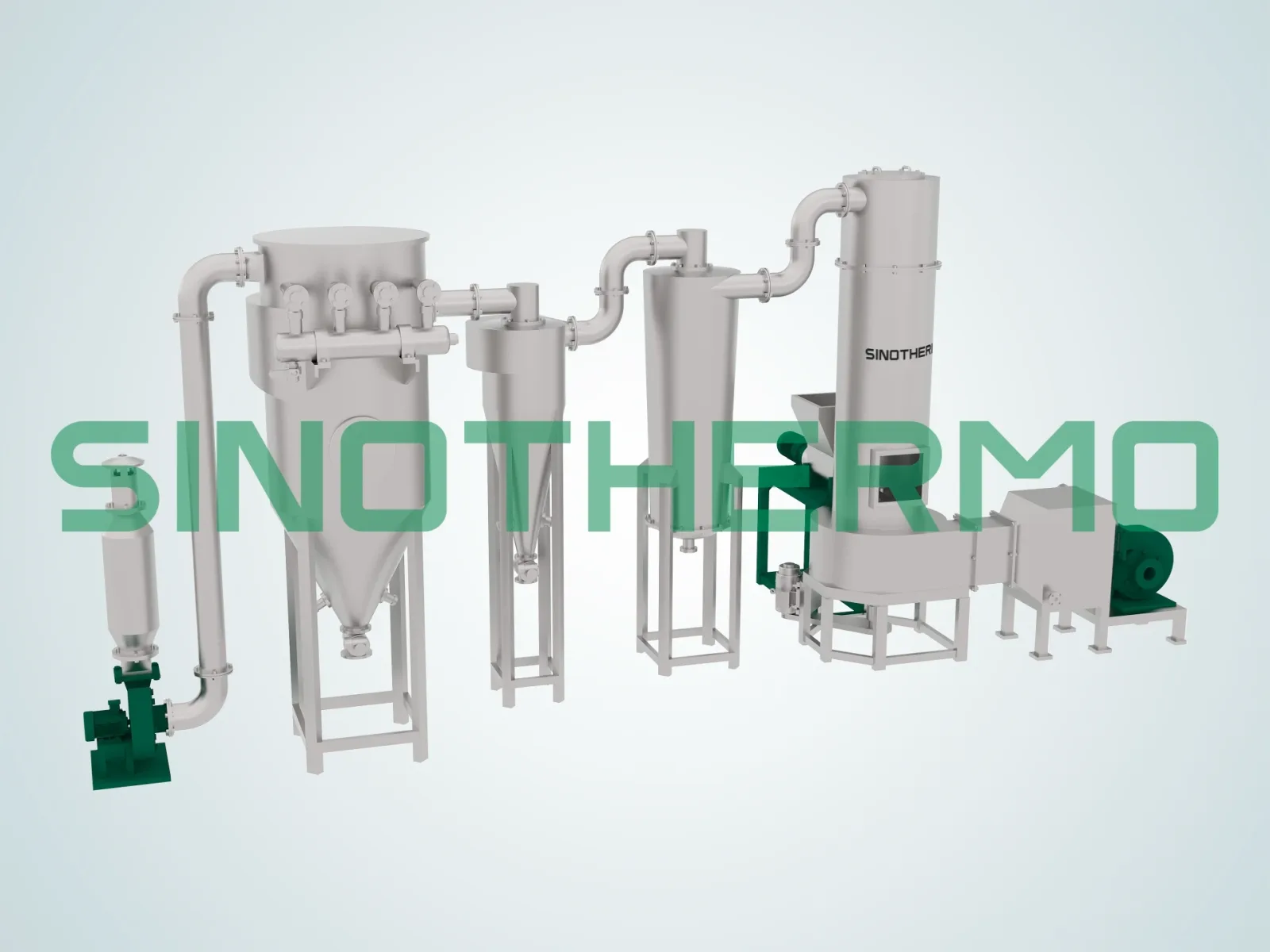
A rotary flash dryer, also called a spin flash dryer, dries wet cakes, pastes and filter-press output into powder in a single pass. Hot air enters the bottom of a vertical chamber and swirls upward while a rotor breaks up the wet material, so moisture leaves in seconds and the dried particles are carried out with the air. It combines drying, conveying and de-lumping in one unit.
If you are comparing flash dryers, the technical features that matter are the rotor and chamber design, the air temperature and volume, the feed method, the residence time and the evaporation capacity. This guide explains each, shows the SINOTHERMO XSG model range, and covers where a rotary flash dryer fits and where it does not.
Quick Context: what problem a rotary flash dryer solves
Many process streams leave a filter press, centrifuge or wash step as a wet cake: a cohesive, lumpy solid with 30 to 60 percent moisture or more. Drying a lump from the outside takes a long time, and the lumps stick together and clog conventional air dryers. A rotary flash dryer solves this by breaking the cake into fine particles at the moment it meets the hot air. The surface area exposed to the gas rises by orders of magnitude, so the surface moisture flashes off quickly and the dry powder leaves immediately, with little time for heat damage.
Working principle
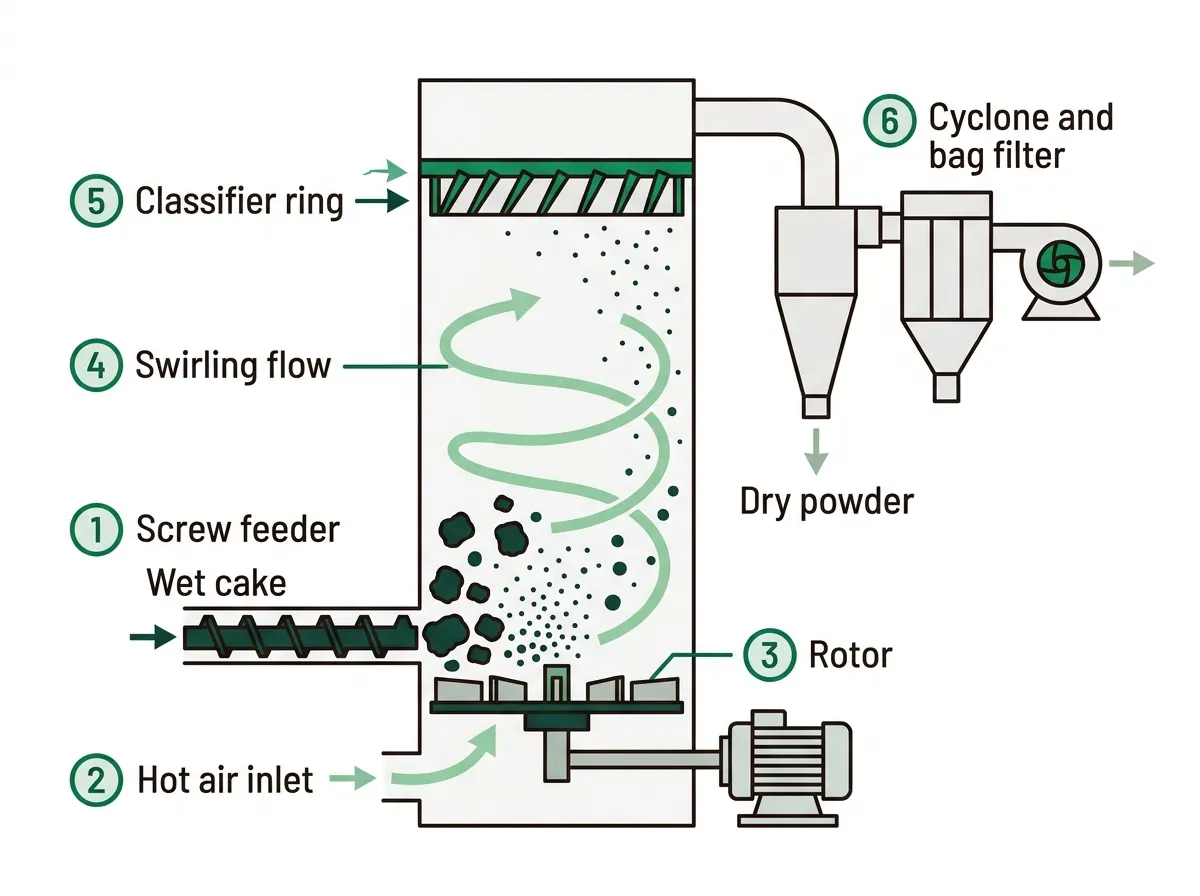
- 1.Feeding. Wet cake or paste is fed by a screw feeder into the lower part of the drying chamber. Loose or granular solids can be fed the same way.
- 2.Hot air entry. Heated air enters tangentially at the bottom, which creates a swirling, rising flow inside the chamber.
- 3.Dispersion by the rotor. A rotor at the bottom of the chamber turns at speed, shearing the cake into small particles. The swirl suspends them in the air stream.
- 4.Drying. Surface moisture evaporates quickly. Wetter, heavier particles stay in the bottom zone of the chamber and keep getting broken up and dried. Particles that are dry enough become light and rise.
- 5.Classification. In a typical spin flash design, a classifier ring at the top of the chamber holds back oversize or still-wet particles, so only particles small and dry enough pass through.
- 6.Collection. Dry powder leaves with the air and is separated in a cyclone and bag filter. The exhaust gas then passes through the fan.
The wet-bulb effect protects the product while it contains moisture, and the residence time is only a matter of seconds, which is why flash drying suits many heat-sensitive materials. For a wider introduction, see our flash dryer guide.
Technical features that matter
| Feature | What it does | Why you should ask about it |
|---|---|---|
| Rotor and agitation | Shears wet cake into fine particles and keeps the bottom zone fluidised | Determines whether cohesive, pasty feeds disperse or clog |
| Swirling hot air | Creates a rotating flow that suspends particles and lengthens their path | Affects drying uniformity and residence time |
| Classifier ring | Holds back oversize and wet particles until they are dry (typical spin flash design) | Controls final moisture and top particle size |
| Integrated grinding | Breaks lumps during drying, so no separate mill is needed for many materials | Saves a downstream step and floor space |
| Air temperature | 140 to 220 °C standard; below 140 °C for heat-sensitive materials (XSG product data) | Sets the drying rate and the product temperature |
| Residence time | Seconds | Limits heat exposure |
| Compact footprint | Vertical single unit | Saves space compared with tray or belt drying |
SINOTHERMO XSG model range
SINOTHERMO's spin flash dryer is the XSG series. Specifications from the product data:
| Model | Cylinder diameter (mm) | Main unit power (kW) | Process air volume (m³/h) | Evaporation capacity (kg/h) |
|---|---|---|---|---|
| XSG-200 | 200 | 5 to 9 | 300 to 800 | 10 to 20 |
| XSG-300 | 300 | 8 to 15 | 600 to 1,500 | 20 to 50 |
| XSG-400 | 400 | 10 to 17.5 | 1,250 to 2,500 | 25 to 70 |
| XSG-500 | 500 | 12 to 24 | 1,500 to 4,000 | 30 to 100 |
| XSG-600 | 600 | 20 to 29 | 2,500 to 5,000 | 40 to 200 |
| XSG-800 | 800 | 24 to 35 | 3,000 to 8,000 | 60 to 600 |
| XSG-1000 | 1,000 | 40 to 62 | 5,000 to 12,500 | 100 to 1,000 |
| XSG-1200 | 1,200 | 50 to 89 | 10,000 to 20,000 | 150 to 1,300 |
| XSG-1400 | 1,400 | 60 to 105 | 14,000 to 27,000 | 200 to 1,600 |
| XSG-1600 | 1,600 | 70 to 135 | 18,700 to 36,000 | 250 to 2,000 |
| XSG-1800 | 1,800 | 100 to 180 | 30,000 to 40,000 | 300 to 2,500 |
| XSG-2000 | 2,000 | 150 to 200 | 35,000 to 45,000 | 400 to 3,000 |
Evaporation capacity depends on the material, the feed moisture and the inlet and outlet temperatures. Use the table as a guide to scale, and confirm the model with a trial on your own cake.
What materials suit a rotary flash dryer?
Good fits: filter-press cakes, centrifuge cakes, pastes and thick slurries that can be fed by screw; fine chemicals and pigments; starches; mineral and ceramic raw materials; and food ingredients such as protein cakes. See our application notes on spin flash dryer feeds and drying rice protein in a flash dryer.
Poor fits:
- Liquids you can pump. Use a spray dryer. See flash dryers vs spray dryers.
- Materials with high bound moisture. Flash drying removes surface moisture quickly; materials that hold water inside the particle may need a longer residence time and another dryer type.
- Strongly thermoplastic or melting solids. They may smear on the rotor or chamber wall.
- Material that must keep its shape. The rotor breaks particles.
If you are deciding between the main dryer families, read powder dryers: types, selection and what actually decides the choice.
Rotary flash dryer vs other flash dryers
Spin flash vs pneumatic flash. A pneumatic flash dryer conveys loose, non-viscous material through a hot-air duct and dries it in a single pass. It handles loose solids well but not sticky cakes. The spin flash adds the rotor and swirl chamber, which let it handle pasty feeds. For a starch-specific comparison see flash dryer vs spin flash dryer for starch.
Spin flash vs fluid bed dryer. A fluid bed holds material in the dryer for minutes and suits granular, free-flowing solids. A flash dryer holds it for seconds and suits cakes and fine powders.
Spin flash vs rotary drum dryer. A drum dryer has a long residence time and handles large volumes of coarse material. A flash dryer is more compact and gentler for heat-sensitive fine material. See the rotary drum dryer guide.
How to size a rotary flash dryer
Sizing starts from the water you need to remove, not from the powder weight. Work out the feed rate, the feed moisture and the target product moisture, and the difference gives the evaporation load in kilograms of water per hour. Then match that load to the evaporation range of an XSG model, remembering that each model has a range rather than one figure, because the result depends on the material and the temperatures.
For example, you want 100 kg/h of finished powder at 5 percent moisture from a filter cake at 50 percent moisture (wet basis). The powder holds 95 kg of solids and 5 kg of water. The cake feed is 190 kg/h, carrying 95 kg of water, so the evaporation load is 95 − 5 = 90 kg/h. On the XSG table that points towards the XSG-500 or XSG-600 range, subject to a trial on the real cake. For the full method, including heat and airflow, see spray dryer sizing, which uses the same evaporation-based approach.
Three factors can move you up or down a model: how cohesive the cake is (sticky cakes need more rotor power and may need dry product recycled into the feed), the final moisture you need (lower targets need more air or higher temperature), and the particle size you want (finer product needs a different classifier setting).
Common mistakes to avoid
- Feeding a cake that is too wet or too sticky without testing. Very wet cake can bridge in the feeder or stick to the rotor. A trial shows what feed moisture the unit tolerates, and whether you need back-mixing of dry product.
- Choosing by evaporation capacity alone. Air volume, rotor power and the classifier setting decide whether a cohesive feed disperses well.
- Setting the air temperature too high for the product. The product stays cooler than the air while it is wet, but once it is dry it can heat up quickly. Control the outlet temperature, not just the inlet.
- Neglecting dust collection. Flash drying produces fine powder. Specify the cyclone and bag filter for your particle size, and think about explosion protection for combustible dusts.
- Skipping the trial. Cakes behave differently. A pilot test on your own filter cake shows feed behaviour, final moisture and particle size. Our testing lab runs paid trials on customer material.
Conclusion
A rotary flash dryer is the compact answer to drying wet cakes and pastes into fine powder in seconds. The features to check are the rotor and chamber design, air temperature and volume, the classifier setting and the evaporation capacity of the model. Confirm the choice with a trial on your own material.
Next step: request a pilot test with your filter cake or paste. Pilot testing is a paid service, and the report gives you final moisture, particle size and operating parameters for sizing a production unit.
FAQ
What is a rotary flash dryer?
A rotary flash dryer, also called a spin flash dryer, is a vertical dryer in which hot air swirls through a chamber while a rotor breaks wet cake into fine particles. Moisture evaporates in seconds and the dry powder is carried out with the air.
How does a flash dryer work?
Wet material is fed into a hot air stream, dispersed into small particles and dried in seconds. Heavier, wetter particles remain in the chamber for further drying, and dry particles pass a classifier and are collected in a cyclone and bag filter.
What are the main technical features of a rotary flash dryer?
A rotor for dispersing cake, swirling hot air, a classifier ring, integrated grinding, seconds-level residence time and a compact vertical footprint. SINOTHERMO's XSG series operates at 140 to 220 °C standard, and below 140 °C for heat-sensitive materials.
What is the capacity of a SINOTHERMO spin flash dryer?
The XSG series ranges from the XSG-200 at 10 to 20 kg/h evaporation to the XSG-2000 at 400 to 3,000 kg/h. Actual capacity depends on feed moisture, material and temperatures.
What materials can a rotary flash dryer dry?
Filter cakes, pastes, thick slurries and loose solids, including chemicals, pigments, starches, minerals and food ingredients. It is not suited to pumpable liquids, strongly thermoplastic solids or materials that must keep their particle shape.
Is a flash dryer suitable for heat-sensitive materials?
Often yes. Residence time is only seconds and the product stays cooler than the air while it is wet. SINOTHERMO's unit can operate below 140 °C for heat-sensitive materials, but you should confirm the result with a trial.
How do I know if my cake can be flash dried?
Test it. A pilot run on your own material shows how it feeds, what moisture you reach and what particle size you get. Pilot testing is a paid service, and you can request one through our contact page.

Mark Gu
Passionate about enhancing customer experiences and streamlining operations, Mark focuses on building strong relationships, fostering innovation, and leading teams to achieve exceptional service and efficiency.
Email: mark.gu@sinothermo.com
Phone: +86 18021972660