Sodium-ion (SIB) battery materials share the same three core drying challenges as lithium-ion — thermal sensitivity, oxidation risk, and very low residual moisture targets — but two sodium-specific material families add constraints that lithium processing simply does not have: Prussian Blue Analog (PBA) cathodes carry a firm upper temperature ceiling set by their cyanide-bearing framework, and the sodium electrolyte salt NaPF₆ hydrolyses to hydrogen fluoride in the presence of trace moisture. Everything else — layered oxides, polyanionic cathodes, hard carbon — runs on equipment families you already know, with re-validated parameters.
That last clause is where most sodium-ion scale-up projects go wrong. The equipment map looks familiar, so teams carry lithium-ion process parameters straight across and discover the mismatch during commissioning, or worse, in the finished cell. This guide sets out what genuinely transfers from lithium, what does not, and how to specify drying and calcination equipment for a chemistry that does not yet have a deep public record of standardised production parameters.
Why sodium-ion is not "lithium with a cheaper metal"
Sodium-ion has moved from research curiosity to real production planning on the strength of raw-material economics and cold-weather performance. But the processing story is not a straight substitution. The sodium ion is larger than lithium, which pushes cathode developers toward host structures that lithium never needed — open-framework hexacyanoferrates, specific layered oxide stoichiometries, and polyanionic frameworks tuned for a bigger guest ion. Those structural differences show up as process constraints long before they show up as cell performance.
At the same time, the anode changed completely. Graphite, which anchors the lithium-ion anode supply chain, does not intercalate sodium usefully. Hard carbon took its place, and hard carbon is made by high-temperature carbonisation rather than by purification and coating. That single substitution moves the anode side of the plant from a moderate-temperature drying problem to a high-temperature, inert-atmosphere thermal-processing problem.
So the honest summary is this: roughly two thirds of a sodium-ion material line looks like a lithium-ion line running different setpoints, and roughly one third is genuinely new. The engineering risk sits almost entirely in that third.
The four sodium-ion material families and what each one demands
| Material family | Drying / thermal process consideration |
|---|---|
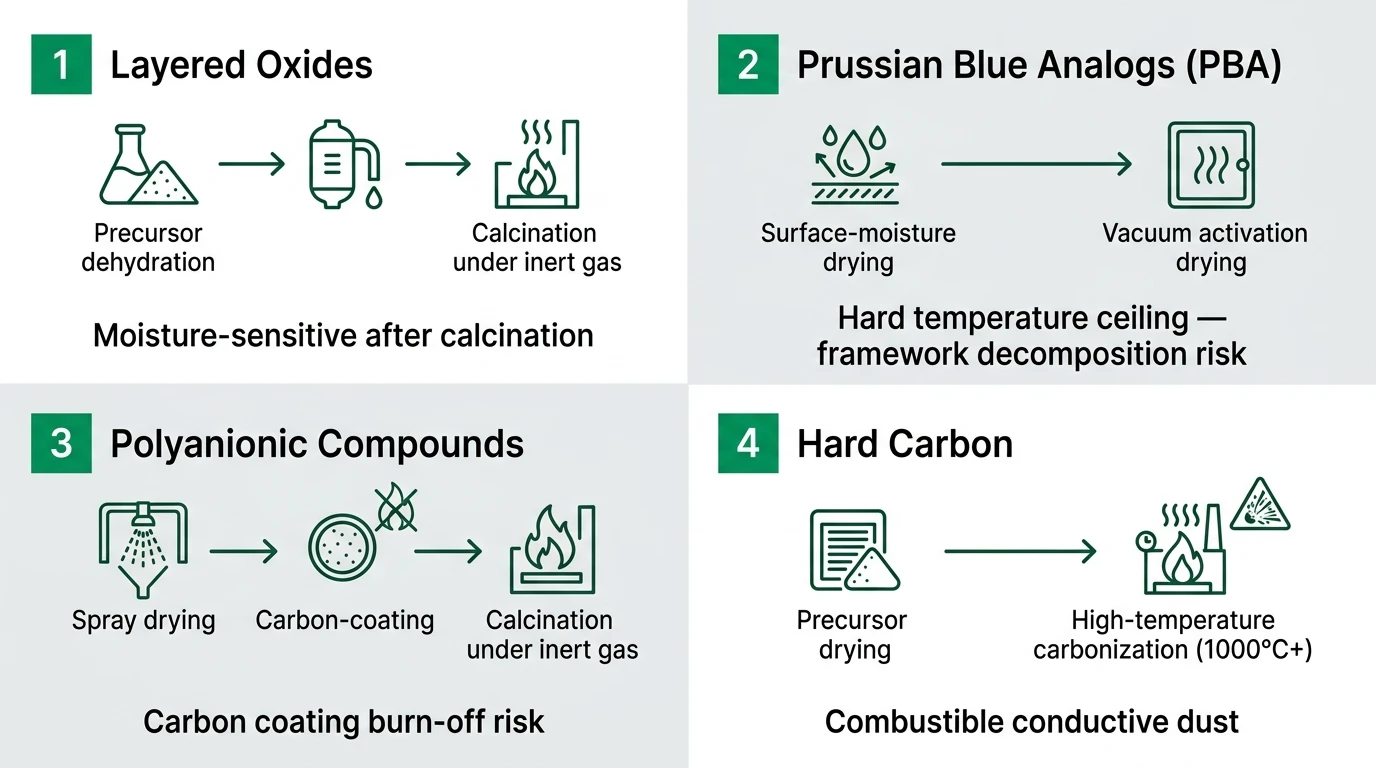
| Layered transition-metal oxides (Na-Ni-Fe-Mn oxide types and relatives) | Broadly similar to lithium layered-oxide processing — precursor dehydration followed by calcination under controlled atmosphere. Several formulations are reported to be more moisture-sensitive than their lithium analogues, so post-calcination handling and packing deserve more attention, not less. |
| Prussian Blue Analogs (PBA) | The most distinct SIB material. Water sits inside the crystal lattice and must be removed in a controlled "activation" drying step, and the cyanide-bearing framework sets a firm upper temperature limit that has no equivalent in most lithium cathode processing. |
| Polyanionic compounds (phosphates, fluorophosphates, sulfates) | Follow a spray-drying-then-calcination route broadly similar to LFP precursor processing, run under inert atmosphere. Carbon coating, where used, carries the same burn-off risk as LFP. |
| Hard carbon (the standard SIB anode) | High-temperature carbonisation — commonly cited in the 1000 °C-plus range — under inert atmosphere, similar in principle to specialty carbon processing. Precursor drying comes first, and the fine carbon product carries full combustible-dust obligations. |
6 proven rules for drying sodium-ion battery materials
1. Treat the PBA temperature ceiling as a hard process boundary, not a setpoint
PBA cathode materials — sodium transition-metal hexacyanoferrates — hold water in two distinct forms: adsorbed surface moisture, and water coordinated inside the crystal lattice. Removing the second kind is the whole point of "activation" drying, and it is also what creates the risk. Push the temperature to accelerate lattice-water removal and you approach the point where the cyanide-bearing framework begins to break down.
Practically, this means PBA activation is run under dynamic vacuum at a carefully controlled, moderate temperature, held well below the framework decomposition threshold, with off-gas monitoring as standard practice given the framework chemistry involved. The design instinct that serves you well on most cathode materials — raise the temperature to shorten the cycle — is exactly the wrong instinct here. You buy cycle time with vacuum depth and heat-transfer area, not with temperature.
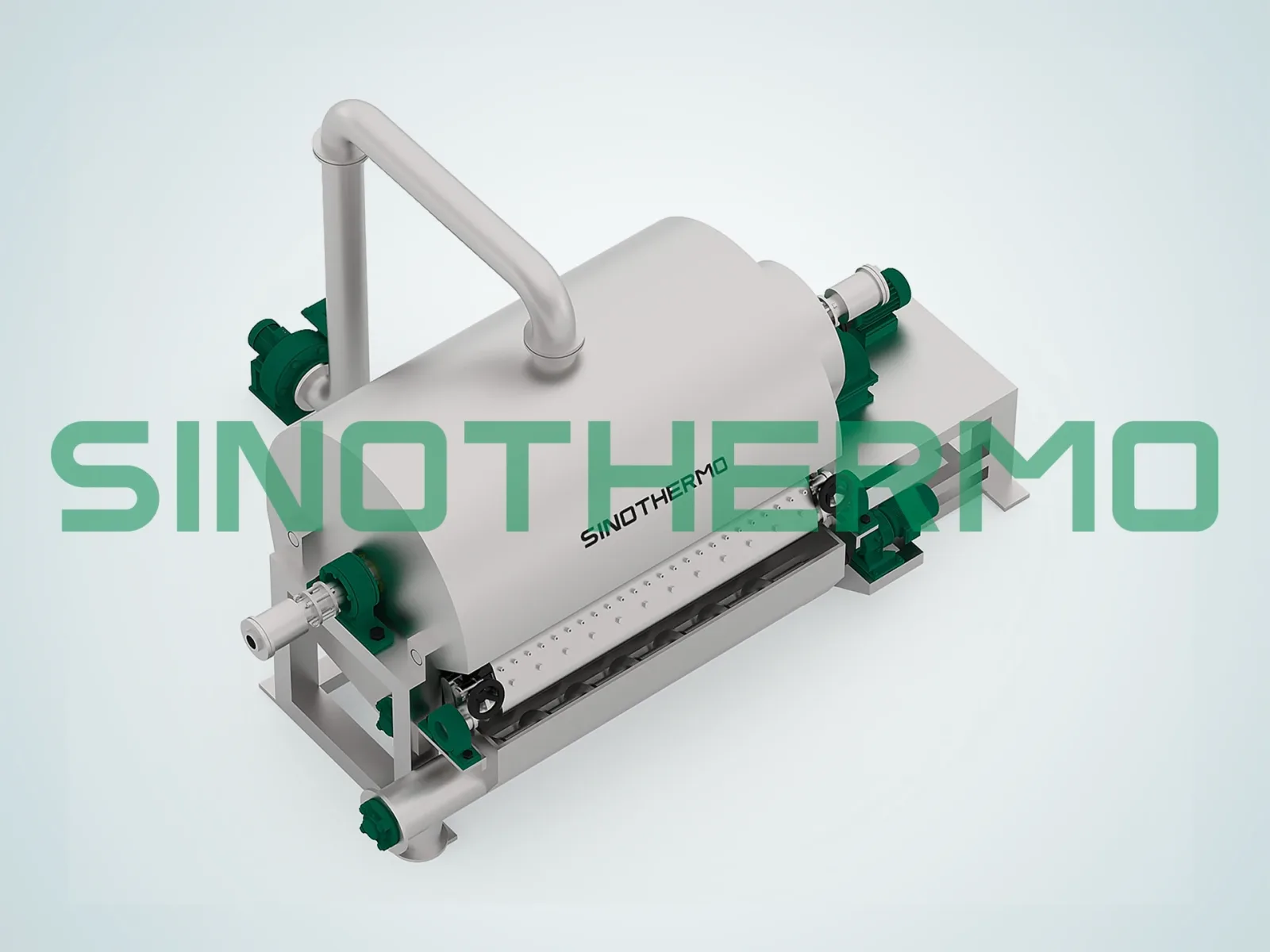
A vacuum paddle dryer or vacuum rake dryer suits this duty because both give you a large, gently agitated heat-transfer surface at low pressure without a hot gas stream. For thinner-layer, lower-shear duty, a vacuum horizontal disc dryer is worth evaluating. The general selection logic across the vacuum family is covered in our industrial vacuum dryer guide.
2. Separate surface moisture from structural water in the drying curve
Because PBA holds water in two forms, its drying curve is not a single smooth decline. Treating it as one stage produces a familiar failure: the batch hits its bulk moisture target while lattice water is still present, and the material later releases that water into the cell.
The fix is process design, not instrumentation. Run a lower-temperature stage to strip surface moisture, then a controlled activation stage under deeper vacuum for structural water — and define the endpoint on something that tracks the second stage, not on a bulk figure that has already been satisfied by the first. This is the single most useful thing a pilot trial establishes for a PBA producer, and it is material-specific enough that it cannot be inherited from a published curve.
3. Dry NaPF₆ in two stages, with corrosion-resistant wetted parts and HF-capable off-gas handling
Sodium hexafluorophosphate is chemically analogous to lithium hexafluorophosphate and shares its defining weakness: trace moisture hydrolyses the salt and generates hydrogen fluoride. The consequences are simultaneous and unforgiving — the salt degrades, the off-gas becomes corrosive, and the equipment itself starts to suffer.
Standard practice is two-stage vacuum drying with very tight moisture control, and the specification consequences follow directly:
- Wetted parts selected for HF service, not general stainless practice.
- Off-gas routed to a scrubber sized for HF, with the duct material chosen accordingly.
- Seals and gaskets specified for fluoride service.
- Moisture specified in ppm and verified by measurement, because the practical failure threshold sits far below anything a percentage-based spec will catch.
- Discharge, cooling, conveying and packing kept under a dry inert blanket, because a salt this hygroscopic will undo the drying step in ambient air.
If your project also touches the lithium salt side, the parallel constraints are set out in our guide to lithium carbonate and hydroxide drying.
4. Run oxidation-sensitive cathodes under inert gas, exactly as you would for lithium
Layered oxide and polyanionic SIB cathodes generally need the same nitrogen protection during spray drying and calcination as their lithium counterparts. Where a conductive carbon coating is used, it burns off in air at calcination temperature just as it does on LFP — the material still meets its moisture spec while the functional coating that justified the step has been partially destroyed.
The oxygen targets commonly designed to across battery-material lines — below 500 ppm in spray-drying circuits, and as low as 20–100 ppm in high-temperature calcination — apply here as well, and the equipment implications are identical: closed-loop gas circuit, leak-tight vessel and valve design, continuous oxygen monitoring with interlocks, and explosion protection retained alongside inerting. All four are covered in depth in our inert-gas drying guide.
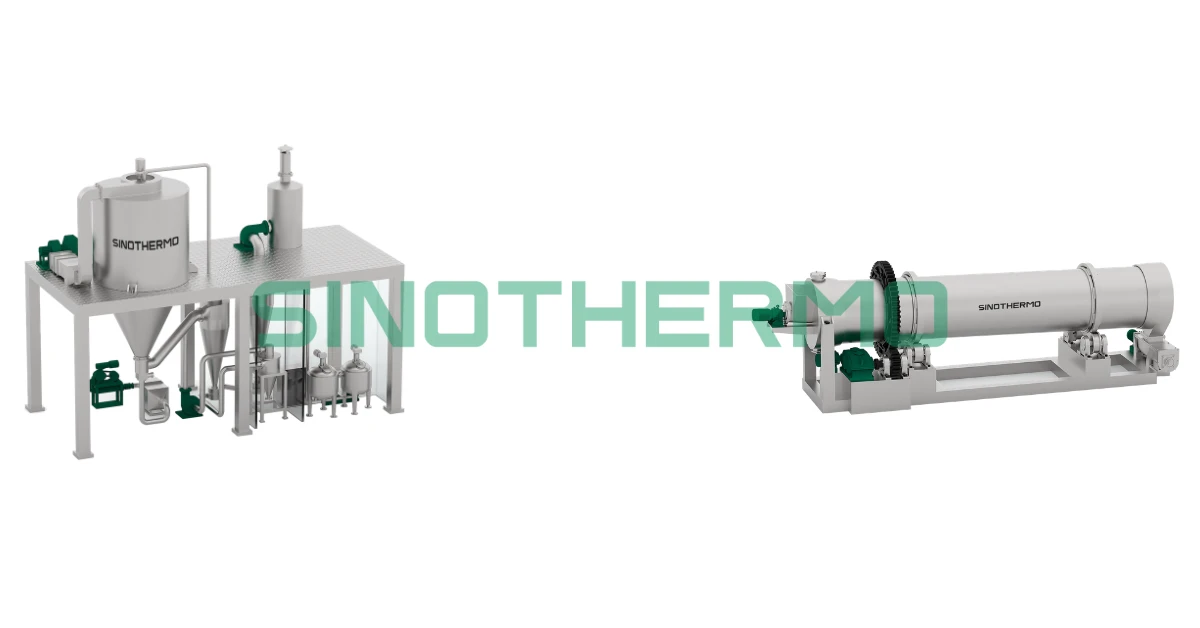
For the spray stage itself, a centrifugal spray dryer suits slurries where droplet size is controlled by wheel speed, while a pressure spray dryer suits duties where a coarser, more free-flowing granule is wanted. If spray drying is new to your team, start with how spray drying works and the applied view in spray processing in lithium battery materials — the process physics carries over to sodium chemistries unchanged.
5. Handle hard carbon as a combustible dust from the very first pilot batch
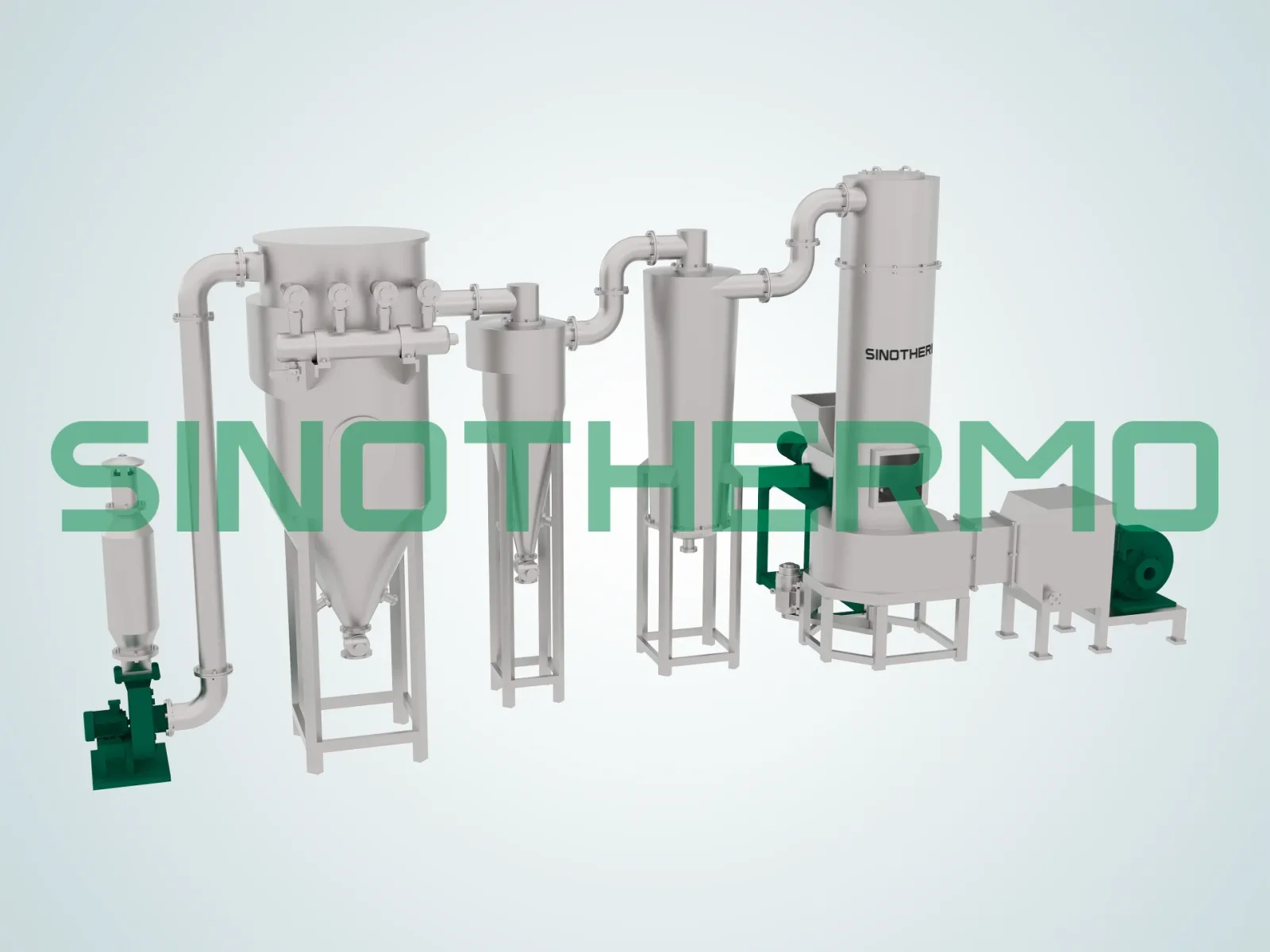
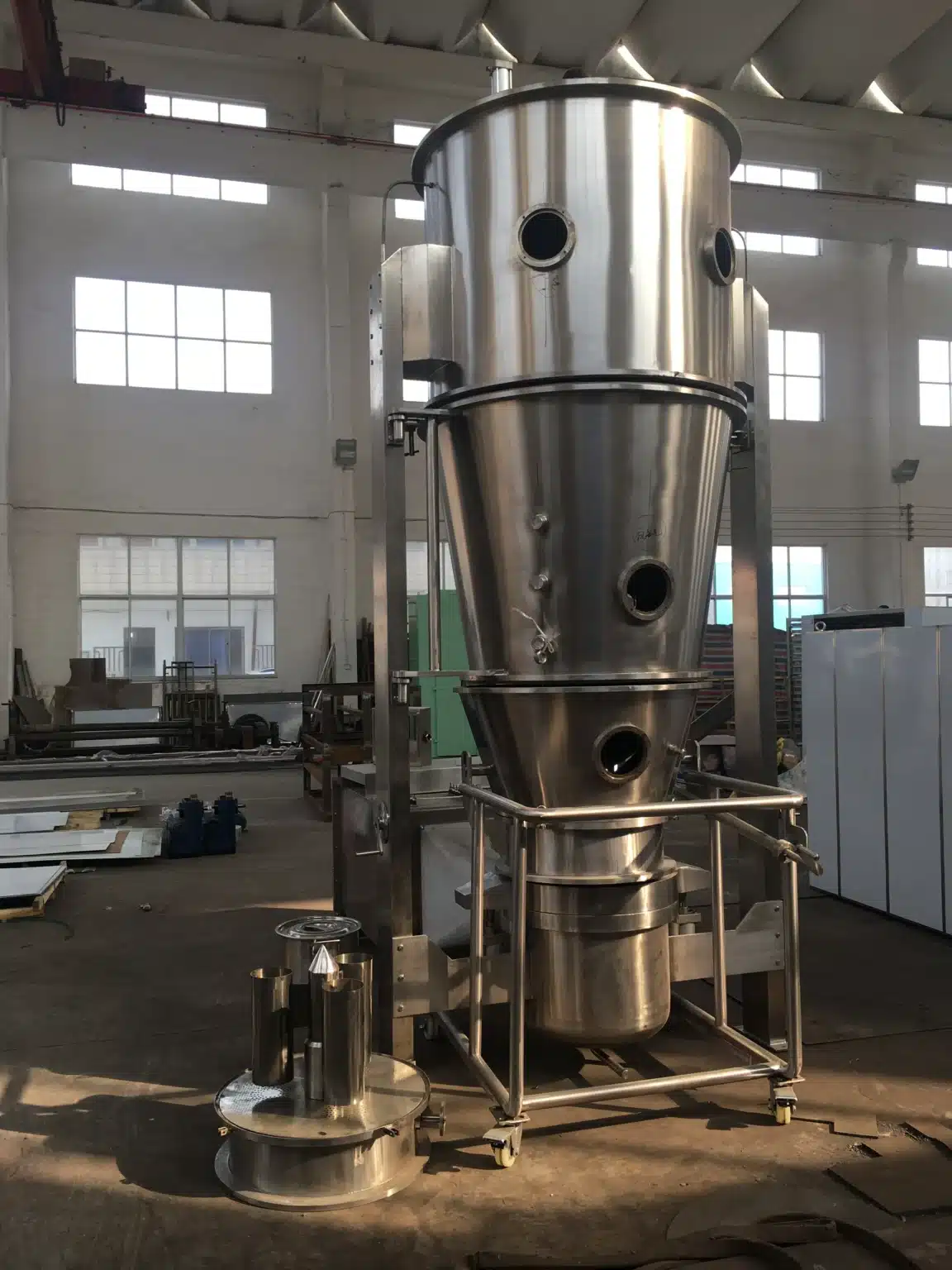
Hard carbon production has two thermal stages worth separating in your mind. The precursor — biomass-derived, resin-derived or otherwise — usually needs drying before carbonisation, and that front-end duty is a conventional drying problem suited to a pneumatic (flash) dryer or a horizontal vibrating fluidised bed dryer depending on particle behaviour. Carbonisation itself is a high-temperature, inert-atmosphere duty, typically served by a rotary kiln; the mechanical fundamentals of that equipment family are covered in our rotary drum dryer guide.
What ties both stages together is dust. Hard carbon is a fine, combustible, often conductive powder, and it deserves the same treatment graphite and silicon-carbon get on a lithium line: inert atmosphere, explosion venting or suppression, anti-static grounding throughout, and controlled discharge. The mistake we see is scale-related — teams handle laboratory quantities safely by informal means, then carry the same informality into a pilot line where the dust inventory is orders of magnitude larger.
6. Re-validate every parameter you inherited from lithium — especially the ones that "obviously" transfer
Some parameters do transfer. Spray-dryer inlet and outlet temperature relationships, cyclone and baghouse sizing logic, atomiser selection, kiln residence-time calculations — the physics is chemistry-agnostic. What does not transfer is anything anchored to the material's own stability: maximum safe temperature, oxidation sensitivity, moisture endpoint, and the shape of the drying curve.
The dangerous cases are the ones that look close enough to be assumed. A sodium layered oxide is not a lithium layered oxide with a different alkali metal in it, and a sodium polyanionic cathode is not LFP. They are near enough to make a copied recipe run without an obvious alarm, and different enough to cost you a batch.
Equipment map across a sodium-ion material line
| Process step | Typical equipment | Atmosphere / notes |
|---|---|---|
| Cathode precursor slurry → powder | Centrifugal or pressure spray dryer | Closed N₂ loop for oxidation-sensitive chemistries |
| Cathode calcination | Rotary kiln (indirect fired) | Inert atmosphere; tight temperature profile control |
| PBA activation drying | Vacuum paddle / rake / horizontal disc dryer | Dynamic vacuum, moderate temperature, off-gas monitoring |
| NaPF₆ electrolyte salt drying | Two-stage vacuum drying | HF-resistant wetted parts, scrubbed off-gas, inert blanket downstream |
| Hard carbon precursor drying | Pneumatic (flash) or vibrating fluid-bed dryer | Conventional drying duty; dust controls from the start |
| Hard carbon carbonisation | Rotary kiln | High temperature under inert atmosphere |
| Cooling, conveying, packing | Sealed transfer under N₂ | Prevents re-oxidation and moisture pickup |
Sodium-ion vs lithium-ion drying: a side-by-side
| Dimension | Lithium-ion | Sodium-ion |
|---|---|---|
| Oxidation sensitivity | High for Ni-rich cathodes and coated materials | Comparable for layered oxides and coated polyanionics |
| Residual moisture target | Very low; specified in ppm | Comparable, and tighter again for the electrolyte salt |
| Hard upper temperature ceiling | Not typical for mainstream cathodes | Yes — PBA framework decomposition |
| Anode thermal processing | Graphite purification / coating | Hard carbon carbonisation at much higher temperature |
| Electrolyte salt moisture risk | LiPF₆ → HF | NaPF₆ → HF (same mechanism) |
| Dust-explosion exposure | Graphite, silicon-carbon, black mass | Hard carbon and other fine electrode powders |
| Availability of published parameters | Deep and mature | Thin — first-hand trial data matters more |
| Core equipment families | Spray dryers, vacuum dryers, rotary kilns | The same families, re-parameterised |
Common mistakes to avoid
- Copying lithium-ion setpoints onto a sodium chemistry because the equipment is the same. The vessel is transferable; the temperature and moisture windows are properties of your material. This is the single most common and most expensive error in sodium-ion scale-up.
- Treating PBA's temperature limit as a soft target to be optimised. It is a decomposition boundary. Shorten the cycle with vacuum depth, agitation, and heat-transfer area — never by creeping the temperature upward.
- Specifying a single-stage drying step for PBA. Surface moisture and lattice water come off under different conditions. One stage will hit a bulk moisture number while leaving structural water behind.
- Specifying NaPF₆ drying equipment in standard stainless with an unscrubbed vent. Any moisture ingress produces HF. The corrosion case and the off-gas case have to be designed in, not retrofitted after the first campaign.
- Underestimating hard carbon dust at pilot scale. Laboratory habits do not scale. Inerting, venting or suppression, and grounding belong in the pilot line, not only in the eventual production plant.
- Stopping inert or dry protection at the dryer outlet. Several sodium layered oxides are reported as more moisture-sensitive than their lithium analogues, and the electrolyte salt certainly is. Cooling, conveying, and packing all stay under blanket, or the drying step is quietly undone.
Why published parameters will not save you on this chemistry
Lithium-ion processing benefits from two decades of accumulated public engineering knowledge. Sodium-ion does not, and that gap is not a temporary inconvenience — it is the defining practical characteristic of specifying equipment for this chemistry today.
Three things follow from it. First, the numbers that do circulate are often single-source, drawn from one formulation at laboratory scale, and were never intended to be design inputs for a production line. Second, sodium-ion formulations are still moving; two producers' "layered oxide" can differ enough that one set of drying parameters genuinely does not describe the other. Third, and most consequentially, the parameters that matter most — the PBA temperature ceiling for your framework composition, the moisture endpoint for your salt purity, the carbonisation profile for your precursor — are the ones least likely to be published by anyone who has determined them.
This is precisely why pilot validation matters more for sodium-ion than it does for a mature chemistry, not less. On a lithium line, a trial confirms what the literature suggests. On a sodium line, a trial often is the literature.
Prove it on your material before you specify
The two numbers that decide whether a sodium-ion drying line performs — the temperature your material actually tolerates, and the moisture endpoint it actually needs — cannot be read off a table for this chemistry. They have to be measured on your feed.
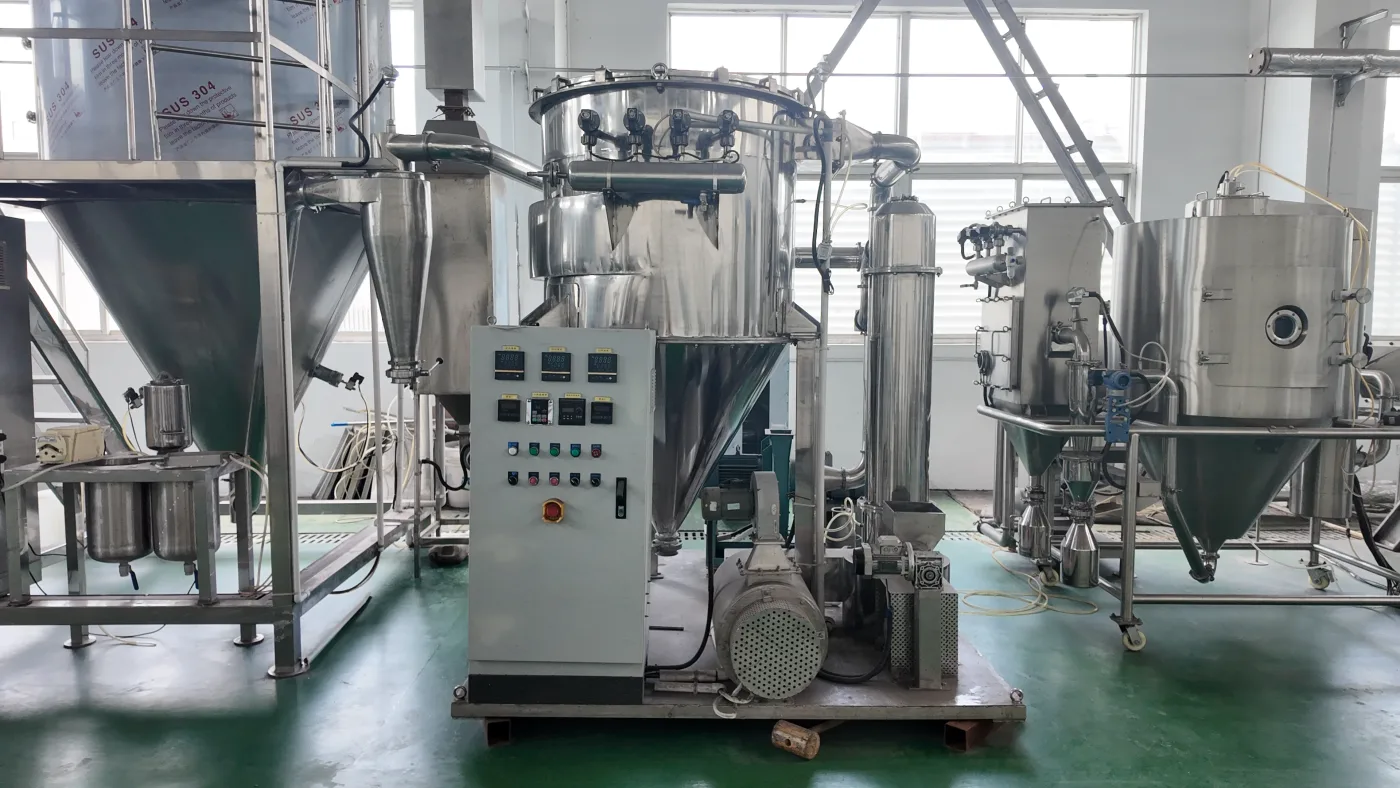
That is why SINOTHERMO runs an in-house pilot laboratory: bring your layered oxide precursor, PBA cathode, polyanionic slurry, hard carbon precursor, or electrolyte salt, and trial it before you commit to a specification. We measure the drying curve, separate surface moisture from structural water where that distinction matters, confirm the safe temperature and atmosphere window, and check how the material behaves at discharge and handling — the stages where re-oxidation and moisture pickup usually happen. Backed by 20+ years of experience and deep customisation capability, our engineers use that trial data to size the vessel, the gas loop, the seals, and the separation train correctly the first time.
Sodium-ion producers frequently arrive with a second question attached: how the same plant should handle end-of-life material later. The parallel constraints on that route are covered in our guide to black mass drying and solvent recovery. And if you are still narrowing the equipment family rather than the parameters, start with how to choose an industrial dryer, then see the full equipment map in our battery material drying solutions.
SINOTHERMO — Process Engineering Infrastructure. We solve the process problem, not just sell a machine.
Conclusion
Most of a sodium-ion material line runs on equipment families the drying industry has built for decades: spray dryers for cathode precursor slurries, rotary kilns for calcination and hard carbon carbonisation, vacuum dryers for the low-moisture polish. What changes is the envelope those machines have to operate inside — a hard framework-decomposition ceiling on PBA, an HF-generating hydrolysis risk on NaPF₆, a much higher carbonisation temperature on the anode side, and a public parameter record too thin to design against.
Get those four right, on your own material, and the equipment decisions follow naturally. Assume them from lithium-ion experience, and you will find out which assumptions were wrong at the least convenient point in the project.
Scaling a sodium-ion cathode, hard carbon anode, or electrolyte salt — and unsure what temperature and moisture window your material actually needs? Send us a sample: our pilot lab establishes the process window on your material before you specify the plant.
✉️ mark.gu@sinothermo.com · 📱 WhatsApp: +86 180 2197 2660 · 🌐 www.sinothermo.com
SINOTHERMO — Process Engineering Infrastructure.
FAQ
Is drying sodium-ion battery materials the same as drying lithium-ion materials?
Mostly similar, but not identical. Both need inert-gas protection against oxidation, very low residual moisture, and combustible-dust precautions, and both run on the same equipment families — spray dryers, vacuum dryers, and rotary kilns. The differences are material-specific: Prussian Blue Analog cathodes have a firm upper temperature limit that mainstream lithium cathodes do not, the sodium electrolyte salt NaPF₆ carries the same moisture-driven HF risk as LiPF₆, and hard carbon anode production requires much higher-temperature carbonisation than graphite processing.
Why do Prussian Blue Analog cathodes have a maximum drying temperature?
Because their crystal structure is built on a cyanide-bearing framework that can begin to decompose at elevated temperature. PBA activation drying has to remove water held inside the lattice, which normally argues for more heat, but the framework sets a ceiling instead. The standard approach is dynamic vacuum at a carefully controlled, moderate temperature, with off-gas monitoring, so structural water leaves without approaching the decomposition threshold.
Why is the sodium-ion electrolyte salt NaPF₆ difficult to dry?
NaPF₆ is chemically analogous to lithium's LiPF₆ and shares its defining weakness: trace water hydrolyses the salt and generates hydrogen fluoride. That single reaction degrades the product and attacks the equipment at the same time, so drying is typically run in two vacuum stages with very tight moisture control, corrosion-resistant wetted parts, HF-capable off-gas handling, and an inert blanket maintained through cooling, conveying, and packing.
Can lithium-ion drying equipment be used for sodium-ion materials?
The equipment families transfer well — spray dryers, vacuum paddle and rake dryers, and rotary kilns are all used on both. The process parameters do not transfer. Maximum safe temperature, oxidation sensitivity, moisture endpoint, and the shape of the drying curve are properties of the specific material and must be re-validated for sodium chemistries rather than copied from lithium experience.
How is hard carbon for sodium-ion anodes dried and processed?
Hard carbon production involves two distinct thermal steps. The precursor is dried first, which is a conventional drying duty commonly served by a flash dryer or vibrating fluidised bed dryer depending on how the particles behave. Carbonisation follows at high temperature — commonly cited in the 1000 °C-plus range — under inert atmosphere, typically in a rotary kiln. Both steps require full combustible-dust controls, since hard carbon is a fine, conductive, combustible powder.
Do sodium-ion cathode materials need inert-gas protection during drying?
Layered oxide and polyanionic sodium cathodes generally do, for the same reasons as their lithium counterparts: the metal's oxidation state has to be protected through drying and calcination, and any conductive carbon coating will burn off in air at calcination temperature. Oxygen targets commonly designed to across battery-material lines are below 500 ppm in spray-drying circuits and as low as 20–100 ppm during high-temperature calcination, with the correct figure for a specific material confirmed by trial.
Why is pilot testing more important for sodium-ion than for lithium-ion materials?
Because sodium-ion is an emerging chemistry with a thin public record of standardised production parameters, and because formulations still vary widely between producers. The figures that circulate are often single-source and drawn from laboratory scale, and the parameters that matter most — the safe temperature ceiling, the moisture endpoint, the carbonisation profile — are specific to a given formulation. On a mature chemistry a trial confirms the literature; on sodium-ion the trial frequently is the only reliable data available.

Mark Gu
Passionate about enhancing customer experiences and streamlining operations, Mark focuses on building strong relationships, fostering innovation, and leading teams to achieve exceptional service and efficiency.
Email: mark.gu@sinothermo.com
Phone: +86 18021972660