Spray dryer atomization is the part of the process that does most of the work you actually care about. It determines droplet size, droplet size distribution, and the powder morphology you end up with. Everything else in the dryer — chamber design, gas flow, recovery — supports that.
That is why “which spray dryer atomization method should we use?” usually deserves more attention than “how big should the dryer be?”. A correctly sized dryer with the wrong atomization will not produce the powder you need. The reverse is more forgiving.
This guide walks through the three main spray dryer atomization methods used in lab and pilot equipment — centrifugal (rotary), pressure nozzle, and two-fluid (twin-fluid) — what each does well, what each does poorly, and how to match the choice to your material and powder target.
What Spray Dryer Atomization Actually Does
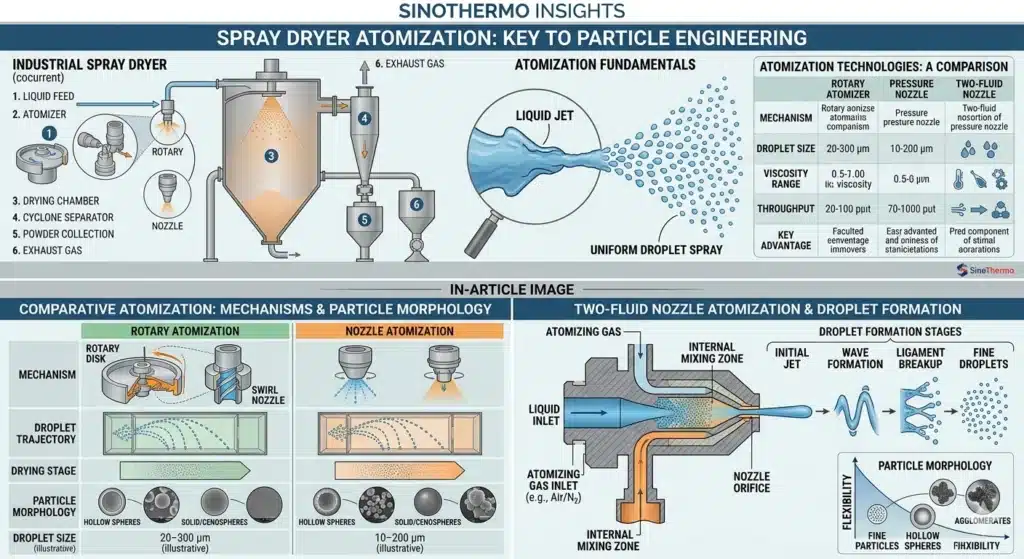
Spray dryer atomization breaks a liquid feed into droplets. The droplets dry into particles. The particle morphology, size distribution, and bulk density of the final powder are largely set at the moment of atomization.
Two practical implications follow from this:
- The spray dryer atomization choice determines what kind of powder is even physically achievable. You cannot simply “make the droplets smaller” by turning up the heat; you change the atomization method.
- A formulation that works on one spray dryer atomization mode may behave very differently on another. Atomizer selection is a process decision, not a hardware preference.
In lab and pilot spray dryers, the atomization choice also has practical consequences for cleaning, changeover, viscosity tolerance, and compatibility with solvent or sensitive systems. None of this is captured by simply comparing droplet-size charts.
Spray Dryer Atomization Method 1: Centrifugal (Rotary) Atomization
A centrifugal atomizer uses a high-speed rotating disc or wheel. Liquid is fed to the center of the disc and flung outward by centrifugal force, leaving the rim as fine droplets. This is one of the most common spray dryer atomization methods at both pilot and industrial scale.
How it behaves in practice
Centrifugal atomization typically produces a relatively narrow droplet size distribution and roughly spherical particles. The particle size depends on disc speed, disc geometry, and feed rate, but it generally sits in the moderate-fine range — useful for many food, chemical, and ceramic applications.
Strengths
- Handles a wide range of feed types: solutions, emulsions, and many suspensions
- Relatively forgiving with feeds that contain small particulates
- Easier to scale predictably between similar centrifugal designs
- Generally robust and well understood in industrial operation
Limitations
- Requires a wider chamber to give droplets enough flight distance, which can affect compact lab dryer designs
- High-speed bearings are wear items and need periodic maintenance
- Less ideal for very high viscosity feeds, where the disc cannot atomize cleanly
- Achieving very fine particle sizes (down toward the lower micron range) is harder than with two-fluid nozzles
Typical fit
Centrifugal atomization is a common default for:
- Food and dairy powders where uniform spherical particles matter
- Specialty chemicals and pigments
- Ceramic granulation feedstocks
- Battery precursor powders where consistent morphology is important
Spray Dryer Atomization Method 2: Pressure Nozzle Atomization
A pressure nozzle uses a high-pressure pump to force liquid through a precision orifice. The pressure energy is converted into droplet kinetic energy at the nozzle tip. Pressure nozzle systems are widely used as a spray dryer atomization option when feed viscosity, hollow particles, or specific morphology targets matter.
How it behaves in practice
Pressure nozzles often produce hollow or spherical particles with good dispersibility. The droplet size depends on pressure, orifice geometry, and feed properties. Pressure nozzles can handle higher-viscosity feeds than centrifugal systems in many cases, and they suit chambers that are taller than they are wide.
Strengths
- Handles higher-viscosity feeds, including paste-like systems, better than centrifugal designs in many cases
- Can be tuned to produce hollow particles that perform well in reconstitution (common in instant beverage powders)
- Lower mechanical complexity in the moving-parts sense (no high-speed disc)
- Tall, narrow chamber geometry suits certain plant layouts
Limitations
- Nozzle wear is a real maintenance item, especially with abrasive feeds; wear changes droplet size over time
- Requires a high-pressure pump, which adds capital and operating cost
- More sensitive to feed solids loading and particulates that can block the orifice
- Less flexibility once installed; nozzle geometry is matched to a target droplet size
Typical fit
Pressure nozzle atomization is common in:
- Instant beverage powders where hollow particles aid solubility
- Pharmaceutical applications that need specific particle morphology
- Higher-viscosity food and chemical feeds
- Some agglomerated products where in-flight granulation is desired
Spray Dryer Atomization Method 3: Two-Fluid (Twin-Fluid) Nozzle Atomization
A two-fluid nozzle uses a separate stream of compressed gas — typically air or nitrogen — to atomize the liquid at the nozzle tip. The gas does the work of breaking up the liquid, rather than rotational energy or hydrostatic pressure. This spray dryer atomization method is especially common at lab scale and in pharmaceutical fine-powder applications.
How it behaves in practice
Two-fluid nozzles can produce very fine droplets, including droplets considerably smaller than what most centrifugal or pressure-nozzle configurations achieve. They are especially common in lab spray dryers, where small particle sizes and very small batches are the norm.
Strengths
- Capable of producing very fine particles, useful for inhalation products, certain pharmaceutical applications, and specialty fine powders
- Low feed pressure requirement — well suited to limited or sensitive feeds
- Handles very small batch volumes efficiently
- Tolerant of higher viscosities and challenging feed rheology
Limitations
- Compressed gas consumption is a significant operating cost at larger scale
- Droplet size depends strongly on gas-to-liquid ratio, which has to be tuned carefully
- Throughput per nozzle is lower than for centrifugal designs at similar drying conditions
- Less typical at production scale, although multi-nozzle configurations exist
Typical fit
Two-fluid nozzle atomization is common in:
- Lab spray dryers for formulation screening with limited material
- Dry powder inhalation formulations
- Fine pharmaceutical powders and amorphous solid dispersions
- Specialty materials where particle size below a few tens of microns is critical
Spray Dryer Atomization Methods Side-by-Side Comparison
| Factor | Centrifugal (Rotary) | Pressure Nozzle | Two-Fluid Nozzle |
|---|---|---|---|
| Typical particle morphology | Spherical, relatively uniform | Hollow or spherical | Fine, often spherical |
| Particle size range | Moderate-fine | Moderate, can be tuned to coarser | Capable of very fine |
| Viscosity tolerance | Moderate | Higher than centrifugal | Higher than centrifugal |
| Feed solids tolerance | Moderate to high | Lower (orifice can clog) | Moderate |
| Chamber geometry suited to | Wider | Taller | Compact lab geometry |
| Maintenance items | Disc bearings, seals | Nozzle wear, high-pressure pump | Gas consumption, nozzle alignment |
| Typical lab use | Sometimes, in larger lab units | Less common at small scale | Very common in lab dryers |
| Typical pilot use | Common | Common | Common, especially for fine powders |
| Typical industrial use | Very common | Very common | Less common, mostly for specialty fine products |
The table above is qualitative on purpose. Exact numerical ranges depend heavily on chamber design, feed properties, and operating conditions. Treat the comparison as a starting point, not a substitute for a trial.The atomizer isn’t the only variable. Once you have chosen a route, granule sizing and downstream handling matter too — see our companion guides on wet vs dry granulation and the full pharmaceutical equipment sourcing guide.
How to Match Spray Dryer Atomization to Your Material
A short decision pattern that works for most projects:
- Start with the powder target. What particle size, morphology, and bulk density do you need? That eliminates one or two options before you look at hardware.
- Check feed rheology. Viscosity, solids loading, and the presence of particulates determine what is even feasible.
- Check chamber compatibility. A given atomizer has to live in a chamber sized for it. Lab dryers and pilot dryers differ in what they can accommodate.
- Check operating cost. At small scale, gas consumption for two-fluid nozzles is fine. At larger scale, it can dominate operating cost.
- Test before committing. This is the single most important step. Datasheets describe potential; trials describe reality.
For pharmaceutical fine powders or inhalation products, two-fluid spray dryer atomization is often the right starting point. For most food, chemical, and ceramic applications, centrifugal or pressure nozzles dominate. For higher-viscosity or specific morphology targets, pressure nozzles deserve serious consideration.
For a broader view of which spray dryer atomization method fits which application, see the applications guide.
What Happens When the Spray Dryer Atomization Choice Is Wrong
The consequences of the wrong spray dryer atomization choice usually show up in three patterns:
The powder is the wrong size. Either too coarse for the intended use, too fine to handle, or with too wide a size distribution. Heat tuning will not fix this — the atomizer needs to change.
The process is unstable. Wall sticking, recovery drift, and unpredictable particle morphology often trace back to atomization that is fighting the feed, not working with it.
Operating cost is higher than necessary. Two-fluid nozzles at large scale or pressure nozzles with high wear rates can quietly erode the economics of an otherwise good process.
These problems are also why testing on actual hardware before specifying equipment is so important. Atomization behavior is one of the things that does not always translate well from theory to a specific feed material.
Lab vs Pilot: How Spray Dryer Atomization Choice Changes Between Stages
The spray dryer atomization method that suits early lab screening is not always the one that suits a pilot validation run.
- A lab spray dryer often uses a two-fluid nozzle because the batches are small, the feed is precious, and very fine droplets are useful for formulation screening. The cost of compressed gas is acceptable at this scale.
- A pilot spray dryer may use the same two-fluid nozzle in some applications, but for many food, chemical, and ceramic projects it shifts to centrifugal or pressure nozzle atomization, because the process you are validating is closer to the one you will eventually run at production scale.
If your project will eventually use rotary spray dryer atomization in production, doing pilot work with a two-fluid nozzle can produce a powder that looks great on paper but does not match what you will get later. The closer the pilot atomization is to the production atomization, the more useful the pilot data tends to be.
For more on what changes between lab and pilot work, see the lab to pilot scale-up guide.
FAQ
What is the most common atomization method in industrial spray dryers?
Centrifugal (rotary) atomization and pressure nozzle atomization are both very common at industrial scale. The choice depends on feed properties, target particle morphology, and chamber design. Two-fluid nozzles are less common at industrial scale, although they are used for specific fine-powder applications.
Why are two-fluid nozzles so common in lab spray dryers?
Lab spray dryers typically run small feed volumes and need fine droplets for formulation screening. Two-fluid nozzles deliver both well, and the operating cost of compressed gas is not a constraint at small scale. As capacity grows, gas consumption becomes a larger factor and other atomization options become more attractive.
Can a single spray dryer support multiple atomization methods?
Some equipment is designed to accept interchangeable atomizer modules, although the chamber geometry usually favors one method over another. For development work, multi-atomizer capability can be useful. For routine production, dedicated atomization usually performs better.
How does atomizer choice affect particle morphology?
Significantly. Centrifugal atomization tends to produce relatively uniform spherical particles. Pressure nozzles can produce hollow particles useful for reconstitution. Two-fluid nozzles tend to produce fine, often spherical particles with a fairly tight size range. These are tendencies, not guarantees — the feed and operating conditions also matter.
Is centrifugal atomization always better for uniform powder?
For many feeds, yes — uniform droplet size is one of centrifugal atomization’s strengths. But “better” depends on the specification. A pharmaceutical inhalation powder may need particle sizes that centrifugal designs cannot easily produce; a hollow instant beverage particle is easier with a pressure nozzle. There is no universally better atomization method.
How much does atomizer choice affect operating cost?
It depends on scale. At lab scale, the differences are small. At pilot scale, they start to matter — compressed gas, high-pressure pump energy, and atomizer maintenance all add up. At production scale, atomization-related operating cost can dominate the OPEX picture.
Should I lock in atomization choice before pilot trials?
Ideally, no. The most informative pilot trials usually include at least a brief comparison of atomization options, especially when the production atomization is not yet decided. Testing lab work is a low-cost way to do this comparison before any equipment commitment.
Choosing Spray Dryer Atomization With Confidence
Spray dryer atomization is not a checkbox at the end of a spec sheet. It is one of the most consequential process decisions in a spray dryer project, and it usually deserves a focused conversation with someone who has run your kind of material before.
Want help matching atomization to your material? Sinothermo’s engineering team has supported centrifugal, pressure nozzle, and two-fluid configurations across food, pharmaceutical, chemical, battery, and botanical projects. Contact us with a description of your feed and powder target, and we will recommend an atomization approach — and a trial plan — that fits your application.